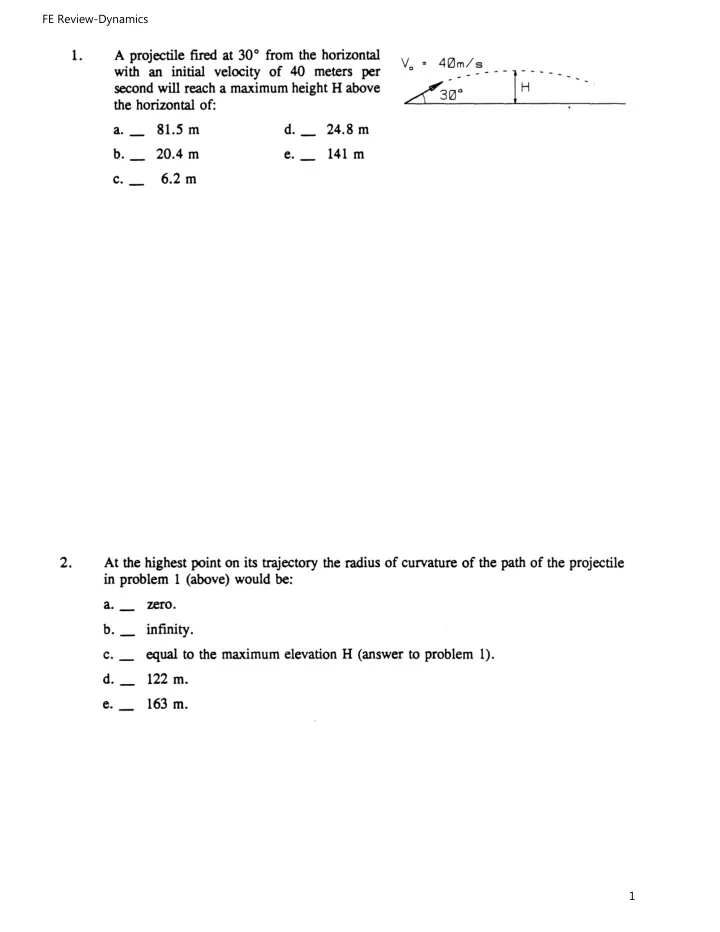
SLIDE 1 A projectile fired at 30° from the horizontal
v
40m/s
with an initial velocity of 40 meters per
°
second will reach a maximum height H above the horizontal of:
"£—1—- 3 0 °
, H a.
81.5 m
e.
141 m
c. 6.2 m
At the highest point on its trajectory the radius of curvature of the path of the projectile in problem 1 (above) would be:
a . zero.
b . infinity.
c .
equal to the maximum elevation H (answer to problem 1).
e .
163 m.
FE Review-Dynamics 1
SLIDE 2 The gear starts from rest and the angular position of line OP is given by d = 2t^ - 7t? where d is in radians and t in
- seconds. The magnitude of the total acceleration of point P
when t = 2 seconds is: x a
.
38 fps^ d. 20 fps^
b
. 10 f]ps^
e.
19 fps^
The acceleration of a particle moving along a straight line is directly proportional to its displacement: a = 2s where a is in meters per second squared and s is in meters, if the particle has a velocity of +2 m/s as it passes through the origin, its velocity at s = 4 m will be: a
.
18 m/s d.
4.5 m/s
b
.
4.0 m/s
e. 6 m/s c. 3.5 m/s
FE Review-Dynamics 2
SLIDE 3 Member OA has a constant angular velocity of 3 radians per seconds
- clockwise. For the position shown B is
moving to the right with a velocity of: a . 12 ips. b
.
9 ips. c
.
16 ips. d . 15 ips.
e
.
zero (it is instantaneously at rest).
FE Review-Dynamics 3
SLIDE 4
Wheel OA is rotating counterclockwise with a constant angular velocity of 6 radians per second. At the instant shown the angular velocity of member AB is zero, and the angular acceleration of AB is: a. b.
c. d. e.
zero.
9 rad/s^ counterclockwise. 9 rad/s^ clockwise. 6 rad/s^ counterclockwise. 8.3 rad/s^ clockwise.
60n
'6rad/s
240n * 100mm-
FE Review-Dynamics 4
SLIDE 5 7. The 10 pound ball is supported by a cord and is swinging
in the vertical plane. At the instant shown the velocity of the ball is 3 fps, and the tension in the cord is:
a. 28.0 lb.
c. 6.0 lb.
e. 8.6 lb.
1 0 l b
8.
The two bodies shown move on frictionless planes and are connected by a flexible cord. The tensile load in the cord is: a. b.
c.
d. 201b. 50 lb. 60 lb. 80 lb.
5 0 l b
7777777777777777777
e.
110 lb.
FE Review-Dynamics 5
SLIDE 6 9.
The homogeneous 1000 newton crate moves on small frictionless rollers of negligible mass. The combined normal reaction on the front rollers at B is:
- a. _ 400 N
- b. _ 500 N
- c. _ 700 N
- d. _ 1100 N
e
. 1000 N (i.e. it is tipping).
. 5
B V
/7777777777777T77
FE Review-Dynamics 6
SLIDE 7 10. The 32.2 pound homogeneous cylinder is released from rest on the inclined plane. The angular acceleration of the cylinder after it is released will be: a. 13.4 rad/s2
c. 3.2 rad/s2
d.
5.9 rad/s2 e. 8.3 rad/s2
2 F t d i n FE Review-Dynamics 7
SLIDE 8 11.
A slender rod 2 meters long and having a mass of 10
2m
ff
kilograms is released from rest in the horizontal position.
*
'« o
It swings counterclockwise in the vertical plane while
, ^-10^9
pivoted about point '0\ Its angular velocity as it reaches
\
the vertical position is:
v ^
a .
1.2 rad/s
d.
9.8 rad/s
s N
N
b .
7.7 rad/s e. 3.8 rad/s
" -
c. 19.6 rad/s
12. Two identical cylinders R and S are released simultaneously from rest at the top of two inclined planes having the same length and slope. Cylinder R rolls without slipping while cylinder S moves down a perfectly smooth plane. The two cylinders reach the bottom of their respective planes: a . at the same instant.
f
1
* - b
.
with the same angular velocity.
1
* 1
v
c
. with the same linear velocity of the mass centers. d . with the same kinetic energy.
e.
with none of the above.
FE Review-Dynamics 8
SLIDE 9 Carts A and B have weights and initial
velocities as shown. The velocity of cart B immediately after impact is observed to be 4 ft/sec to the right. The velocity of cart A immediately after impact is:
_
1 fps2
d.
5.6 fps2
_ 2 fps2
e.
10 fps2
VA ° ? F
ps
V H =2 F
ps
20 lb 3 0 l b
The carts in problem No. 13 rebound with a coefficient of restitution of:
- a. _ 0.67
- d. _ 1.2
- b. _ 0.22
- e. _ 2.0
c. 0.40
FE Review-Dynamics 9
SLIDE 10 DYNAMICS- 1
How many degrees of freedom does a coin rolling on the ground have? (A) one (B) two (C) three (D) five DYNAMICS—2 What is the definition of instantaneous velocity? (A) v = dx dt (B) v = f x dt dx At (C) v = — (D) v = lim —— dt
At—>o Ax
FE Review-Dynamics 10
SLIDE 11
DYNAMICS-3
A car travels 100 km to city A in 2 h, then travels 200 km to city B in 3 h. What is the average speed of the car for the trip? (A) 45 kru/h (B) 58 km/h (C) 60 km/h (D) 66 km/h DYNAMICS—4 The position of a particle moving along the ar-axis is given by x(t) = t 2 — t
+ 8,
where x is in units of meters, and t is in seconds. Find the velocity of the particle when t — 5 s, (A) 9.0 m/s (B) 10 m/s (C) 11 m/s (D) 12 m/s FE Review-Dynamics 11
SLIDE 12
BYNAMICS-5
If a particle's position is given by the expression x(t) = 3 At 3 — 5.4t m, what is most nearly the acceleration of the particle at t = 5 s? (A) 1,0 m/s2 (B) 3.4 m/s2 (C) 18 m/s2 (D) 100 m/s2 DYNAMICS—6 A car starts from rest and moves with a constant acceleration of 6 m/s2. What is the speed of the car after 4 s? (A) 18 m/s (B) 24 m/s (C) 35 m/s (D) 55 m/s FE Review-Dynamics 12
SLIDE 13
DYNAMICS-7
A car starts from rest and has a constant acceleration of 3 m/s2. What is the average velocity during the first 10 s of motion? (A) 12 m/s (B) 13 m/s (C) 14 m/s
(B) 15 m/s DYNAMICS-8
A truck increases its speed uniformly from 13 km/h to 50 km/h in 25 s. What is most nearly the acceleration of the truck? (A) 0.22 m/s2 (B) 0.41 m/s2 (C) 0.62 m/s2 (D) 0.92 m/s2 FE Review-Dynamics 13
SLIDE 14 DYNAMICS—9
A bicycle moves with a constant; deceleration of —2 m/s2, If the initial velocity
- f the bike is 4,0 m/s, how far does it travel in 3 s?
(A) 2.0 m (B) 2.5 m (C) 3,0 m (D) 4.0 m DYNAMXCS-10 A ball is dropped from a height of 60 m above ground. How long does it take to hit the ground? (A) 1.3 s (B) 2.1 s (C) 3.5 s (D) 5.5 s FE Review-Dynamics 14
SLIDE 15 DYN AMICS-11
A man driving a car at 65 km/h suddenly sees an object in the road 20 m
- ahead. Assuming an instantaneous reaction on the driver's part, what constant
deceleration is required to stop the car in this distance? (A) 7.1 m/s2 (B) 7.5 m/s2 (C) 8.0 m/s2 (D) 8-1 m/s2
DYN AMICS-12
A ball is thrown vertically upward with an initial speed of 24 m/s. Most nearly how long will it take for the ball to return to the thrower? (A) 2.3 s (B) 2.6 s (C) 4.1 s (D) 4.9 s FE Review-Dynamics 15
SLIDE 16 DYNAMICS—13
A projectile is launched upward from level ground at an angle of 60° from the
- horizontal. It has an initial velocity of 45 m/s. How long will it take before the
projectile hits the ground? (A) 4.1 s (B) 5.8 s (C) 7.9 s (D) 9.5 s DYNAMICS 14 A man standing at a 5 m tall window watches a falling ball pass by the window in 0.3 s. From approximately how high above the top of the window was the ball released from a stationary position? (A) 8.2 m (B) 9.6 m (C) 12 m (D) 21 m FE Review-Dynamics 16
SLIDE 17 DYNAMICS-15
A block with a spring attached to one end slides along a rough surface with an
initial velocity of 7 m/s. After it slides 4 m, it impacts a wall for 0.1 s, and then slides 10 m in the opposite direction before coming to a stop. If the block's deceleration is assumed constant and the contraction of the spring is negligible, what is the average acceleration of the block during impact with the wall?
block
T spring
Km
(A) —120 m/s2 (B) —100 m/s2 (C) —99 m/s2 (D) —49 m/s2 FE Review-Dynamics 17
SLIDE 18
DYNAMICS-IT
A train with a top speed of 75 km/h cannot accelerate or decelerate faster than 1.2 m/s2. What is the minimum distance between two train stops in order for
the train to be able to reach its top speed? (A) 300 m (B) 350 m (C) 360 m
(D) 365 m FE Review-Dynamics 18
SLIDE 19 DYN AMICS-18
A block with a mass of 150 kg slides down a frictionless wedge with a slope of 40°. The wedge is moving horizontally in the opposite direction at a constant velocity of 4.9 m/s. What is most nearly the absolute speed of the block 2 s
after it is released from rest?
<*>
cr
wedge 40 = 4.9 m/s
(A) 8-9 m/s (B) 9.4 m/s (C) 9.5 m/s (B) 9.8 m/s FE Review-Dynamics 19
SLIDE 20 DYNAMICS-19
A stream flows at v., = 4.5 km/h. At what angle, 6, upstream should a boat traveling at v& = 12 km/h be launched in order to reach the shore directly
- pposite the launch point?
vs = 12 km/h
v, = 4.5 km/h
(A) 22° (B) 24° (C) 26° (D) 28°
DYN AMICS-20
An object is launched at 45° to the horizontal on level ground as shown. What is
the range of the projectile if its initial velocity is 55 m/s? Neglect air resistance.
45° N\
(A) 309 m (B) 617 m (C) 624 m (D) 680 m FE Review-Dynamics 20
SLIDE 21
D YN AMICS-21
A projectile is fired with a velocity, v, perpendicular to a surface that is inclined at an angle, 6, with the horizontal. Determine the
expression for the distance R
to the point of impact-
point of impact
(A) R
= 2v2 sin 0
gcos2 6 (C) R
=
(B) R 2v cos 9
g sin0
2v2 sin 9
gc.osO
(D) R
= 2v sin
6
g cos 0
FE Review-Dynamics 21
SLIDE 22 DYNAMICS-22
A cyclist on a circular track of radius r = 240 m is traveling at 8 m/s. His speed
in the tangential direction (i.e., the direction of his travel) increases at the rate
- f 1 m/s2. What is most nearly the cyclist's total acceleration?
(A) -0.9 m/s2 (B) 0.7 m/s2 (C) 0.9 m/s2 (D) 1.0 m/s2 DYNAMICS—23 A motorcycle moves at a constant speed ofv=12m/s around a curved road of radius r = 100 m. What is most nearly the magnitude and general direction of
the motorcycle's acceleration?
v = 12 m/s 100
(A)
(B)
(C) (D) 1.1 m/s2 away from the center of curvature 1.1 m/s2 toward the center of curvature 1.4 m/s2 away from the center of curvature 1.4 m/s2 toward the center of curvature FE Review-Dynamics 22
SLIDE 23 DYNAMICS-24
A pendulum of mass m and length L rotates about the vertical axis. If the angular velocity is u>, determine the expression for the height h. (A) h
= g cost
(B) h = JL
uj«
(C) h
tj2 cos 9 (D) h_S±^!l
UJ-
FE Review-Dynamics 23
SLIDE 24 DYNAMICS-25
A 3 kg block is moving at a speed of 5 m/s. The force required to bring the block to a stop in 8 x 10~4 seconds is most nearly (A) 10 kN (B) 13 kN (C) 15 kN (D) 19 kN DYNAMICS—26 A rope is used to tow an 800 kg car with free-rolling wheels over a smooth, level
- road. The rope will break if the tension exceeds 2000 N. What is the greatest
acceleration that the car can reach without breaking the rope? (A) 1.2 m/s2 (B) 2.5 in/s2 (C) 3.8 m/s2 (D) 4.5 m/s2 FE Review-Dynamics 24
SLIDE 25
DYNAMICS-27
A force of 15 N acts on a 16 kg body for 2 s. If the body is initially at rest, how far is it displaced by the force? (A) 1.1m (B) 1.5 m (C) 1.9 m (D) 2.1 m
DYNAMICS-28
A car of mass m = 150 kg accelerates in 10 s from rest at a constant rate
to a speed of v = 6 m/s. What is the resultant force on the car due to this
acceleration? (A) 75 N (B) 90 N
(0) 95 N
(D) 98 N FE Review-Dynamics 25
SLIDE 26 DYNAMICS—29
A man weighs himself twice in an elevator. When the elevator is at rest, he weighs 824 N; when the elevator starts moving upward, he weighs 932 N. Most
nearly how fast is the elevator accelerating, assuming constant acceleration? (A) 0.64 m/s2 (B) 1.1 in/s2 (C) 1.3 m/s2 (D) 9.8 m/s2
DYN AMICS-30
A truck weighing 1.4 kN moves up a slope of 15°. What is the force generated by
the engine if the truck is accelerating at a rate of 3 m/s2? Assume the coefficient
F
t
(A) 876 N (B) 926 N (C) 930 N (D) 958 N FE Review-Dynamics 26
SLIDE 27 DYNAMICS-32
A simplified model of a carousel is illustrated. The 8 m long arms AB and AC
attach the seats B and C, each with a mass of 200 kg, to a vertical rotating shaft. What is the maximum angle of tilt, 6, for the seats, if the carousel operates at 12 rpm?
(B) 40° (C) 45° (D) 51° FE Review-Dynamics 27
SLIDE 28
DYNAMIC5-34
Three masses are attached by a weightless cord as shown. If mass 7712 is exactly halfway between the other masses and is located at the center of the flat sur face when the masses are released, what is most nearly its initial acceleration? Assume there is no friction in the system and that the pulleys have no mass.
frictionless pulley m, = 16 kg 4 kg
W
frictionless surface 12 kg
W / / / / / / / / / / / / / / / / / . W////M/////M.
(A) 1.0 m/s2 (B) 1.2 m/s2 (C) 9.8 m/s2 (D) 12 m/s2 FE Review-Dynamics 28
SLIDE 29 DYN AMICS-35 The maximum capacity (occupant load) of an elevator is 1000 N. The elevator starts from rest, and its velocity varies with time as shown in the graph. What
is most nearly the maximum additional tension in the elevator cable due to the
- ccupants at full capacity? Neglect the mass of the elevator.
v (m/s)
2 4
6 time (s)
(A) 960 N (B) 1000 N (C) 1200 N (D) 1400 N FE Review-Dynamics 29
SLIDE 30
DYNAMICS—37
A lead hammer weighs 45 N. In one swing of the hammer, a nail is driven 1.5 cm into a wood block. The velocity of the hammer's head at impact is 4.5 m/s.
What is most nearly the average resistance of the wood block?
hammer 45 N
(A) 3090 N (B) 3100 N (C) 3920 N (D) 4090 N FE Review-Dynamics 30
SLIDE 31 DYNAMICS-39
A 580 N man is standing on the top of a building 40 rn above the ground. What is his potential energy relative to the ground? (A) 10 kJ (B) 12 kJ (C) 20 kj (D) 23 kj
DYNAMICS-41
A 0.05 kg mass attached to a spring (spring constant, k — 0.5 N/m) is accelerated
to a velocity of 0.4 m/s. What is the total energy for the body in the following diagram? Neglect the spring mass.
static equilibrium position
\
spring
\ m = 0,05 kg
v = 0.4 m/s
k = 0.5 N/m 0.1 m
(A) 0.0025 J (B) 0.0040 J (C) 0.0065 J (D) 0.0092 J FE Review-Dynamics 31
SLIDE 32
DYN
AMICS—42
A 1000 kg car is traveling down a 25° slope. At the instant that the speed is
13 m/s, the driver applies the brakes. What constant force parallel to the road must be generated by the brakes if the car is to stop in 90 m?
X
1
(A) 1290 N (B) 2900 N (C) 5080 N (D) 8630 N FE Review-Dynamics 32
SLIDE 33 DYNAMICS—44
A simple pendulum consists of a 100 g mass attached to a weightless cord. If
the mass is moved laterally such that h = 5 cm and then released, what is the
maximum tension in the cord, T?
pivot
/ = 0.50 m
mg
J
h = 5 cm
(A) 1.08 N (B) 1.12 N (C) 1.18 N (B) 1.25 N FE Review-Dynamics 33
SLIDE 34 DYN
AMICS—45 A stationary passenger car of a train is set into motion by the impact of a moving
- locomotive. What is the impulse delivered to the car if it has a velocity of 11
m/s immediately after the collision? The weight of the car is 56.8 kN.
(A) 45.5 kN-s (B) 5T.5 kN-s (C) 63.7 kN-s (D) 64.1 kN-s FE Review-Dynamics 34
SLIDE 35
DYNAMICS-47
Two identical balls hit head-on in a perfectly elastic collision. Given that the initial velocity of one ball is 0.85 m/s and the initial velocity of the other is
—0.53 m/s, what is the relative velocity of each bail after the collision?
(A) 0.85 m/s and —0.53 m/s (B) 1.2 m/s and —0.72 m/s (C) 1.2 m/s and —5.1 m/s (D) 1.8 m/s and —0.98 m/s FE Review-Dynamics 35
SLIDE 36
DYNAMICS 48
A steel ball weighing 490 N strikes a stationary wooden ball weighing 490 N. If
the steel ball has a velocity of 5.1 m/s at impact, what is its velocity immediately after impact? Assume the collision is central and perfectly clastic.
(A) —5 m/s (B) —2 m/s (C) 0 m/s (D) 5 m/s FE Review-Dynamics 36
SLIDE 37
DYNAMICS—49 Two masses collide in a perfectly inelastic collision. Given the data in the il lustration, find the velocity and direction of motion of the resulting combined mass.
my v, - 10 m/s v2 - -20 m/s
m2
my
m2
m-[ = 4/T)2
(A) The mass is stationary. (B) 4 m/s to the right (C) 5 m/s to the left (D) 10 m/s to the right FE Review-Dynamics 37
SLIDE 38 DYNAMICS-50
A ball is dropped onto a solid floor from an initial height, Hq, If the coefficient
- f restitution, e, is 0.90, how high will the ball rebound?
r-Q
initial position hi
I
,-Tn '
I ) rebound position
'-I-'.
I
I
(A) 0.45bi (B) 0.81/ti (C) 0-85hi (D) 0.90fci FE Review-Dynamics 38
SLIDE 39 DYNAMICS-51
A mass suspended in space explodes into three pieces whose masses, initial ve locities, and directions are given in the illustration. All motion is within a single
- plane. Find the velocity of m3.
fT7i = 1
v, = 20 m/s
60
"'3
m 2 m 2
v2 = 40 m/s
(A) 20 m/s (B) 23 m/s (C) 35 m/s (D) 40 m/s FE Review-Dynamics 39
SLIDE 40
DYNAMICS—53
A uniform beam of weight W is supported by a pin joint and a wire. What will be the angular acceleration, a, at the instant that the wire is cut? FE Review-Dynamics 40
SLIDE 41
DYNAMICS—54
A thin circular disk of mass 25 kg and radius 1,5 m is spinning about its axis
with an angular velocity of w = 1800 rpm. It takes 2.5 min to stop the motion by applying a constant force, F, to the edge of the disk. The force required is most nearly (A) 7,2 N (B) 16 N (C) 24 N (D) 32 N
FE Review-Dynamics 41
SLIDE 42
DYN
AMICS—55 A mass, m, of 0.025 kg is hanging from a spring whose spring constant, k, is 0.44 N/m. If the mass is pulled down and released, what is the period of oscillation? (A) 0.50 s (B) 1.2 s (C) 1.5 s (D) 2.1 s DYNAMICS—56 A body hangs from an ideal spring. What is the frequency of oscillation of the body if its mass, m, is 0.015 kg, and k is 0.5 N/m? (A) 0.51 Hz (B) 0.66 Hz (C) 0.78 Hz (D) 0.92 Hz DYN AMICS—57 What is the natural frequency, uj, of an oscillating body whose period of oscilla tion is 1.8 s? (A) 1.8 rad/s (B) 2.7 rad/s (C) 3,5 rad/s (D) 4.2 rad/s FE Review-Dynamics 42
SLIDE 43 DYNAMICS—58
A one-story frame is subjected to a sinusoidal forcing function q(t) = Q sino>t at
the transom. What is most nearly the frequency of q{t), in hertz, if the frame is in resonance with the force?
q{t) = Qsinwf
m •- 135 kg
lateral stiffness
k = 5 kN/cm
(A) 2.6 Hz,
MzmmmMmmmmmmm
(B) 2.9 Hz (C) 3.6 Hz (B) 9.7 Hz DYNAMICS—59 In the mass-spring system shown, the mass, m, is displaced 0.09 m to the right
- f the equilibrium position and then released. Find the maximum velocity of m.
<r-|
17 kN/m
— m
k2= 17 kN/m
—m— i
frictionless surface
(A) 0.3 m/s (B) 5 m/s (C) 8 m/s (D) 14 m/s FE Review-Dynamics 43
SLIDE 44 DYNAMICS-fiO
A cantilever beam with an end mass, m = 7000 kg, deflects 5 cm when a force
- f 5 kN is applied at the end. The beam is subsequently mounted on a spring
- f stiffness, ka = 1.5 kN/cm, What is most nearly the natural frequency of the
mass-beam-spring system?
5 kN
I
I
m
i
8 • 6 cm
(A) 1.5 rad/s (B) 3.1 rad/s (C) 6.0 rad/s (D) 6,3 rad/s FE Review-Dynamics 44
SLIDE 45 1 - A particle's curvilinear motion is represented by the
equation s(t) = 20t+ 4£2 — 3t3. What is most nearly the particle's initial velocity? (A) 20 m/s (B) 25 m/s (C) 30 m/s (D) 32 m/s
- 2. A vehicle is traveling at 62 km/h when the driver
sees a traffic light in an intersection 530 m ahead turn
- red. The light's red cycle duration is 25 s. The driver
wants to enter the intersection without stopping the vehicle, just as the light turns green. If the vehicle decelerates at a constant rate of 0.35 m/s2, what will be its approximate speed when the light turns green? (A) 31 km/h (B) 43 km/h (C) 59 km/h (D) 63 km/h FE Review-Dynamics 45
SLIDE 46 4- A particle's position is defined by s(t) =
2 sin ti + 4 cos tj
[t in radians]
What is most nearly the magnitude of the particle's velocity when t = 4 rad?
5> A roller coaster train climbs a hill with a constant
- gradient. During a 10 s period, the acceleration is con
stant at 0.4 m/s , and the average velocity of the train is
40 km/h. What is most nearly the velocity of the train after 10 s?
- 6. Choose the equation that best represents a rigid body
- r particle under constant acceleration.
(A) 2.6 (B) 2.7 (C) 3.3 (D) 4.1 (A) 9.1 m/s (B) 11 m/s (C) 13 m/s (D) 15 m/s (A) a — 9.81 m/s2 + vo/^ (B) v = ao(t- t 0) + v0 (D) a
=
v 2 t/r FE Review-Dynamics 46
SLIDE 47 7- A particle's curvilinear motion is represented by the equation s(t) = 40£ + 5£2 — 8t3. What is most nearly the initial acceleration of the particle? (A) 2 m/s2 (B) 3 m/s2 (C) 8 m/s2 (D) 10 m/s2
- 8. The rotor of a steam turbine is rotating at 7200 rpm
when the steam supply is suddenly cut off. The rotor decelerates at a constant rate and comes to rest after 5 min. What is most nearly the angular deceleration of
the rotor?
(A) 0.40 rad/s2 (B) 2.5 rad/s2 (C) 5.8 rad/s2 (D) 16 rad/s2
- 9. The angular position of a car traveling around a
curve is described by the following function of time (in seconds).
0(t) = t 3 -2t 2 -4*+
10 What is most nearly the angular acceleration of the car at a time of 5 s? (A) 4.0 rad/s2 (B) 6.0 rad/s2 (C) 26 rad/s2 (D) 30 rad/s2 FE Review-Dynamics 47
SLIDE 48 10- A vehicle is traveling at 70 km/h when the driver
sees a traffic light in the next intersection turn red. The intersection is 250 m away, and the light's red cycle duration is 15 s. What is most nearly the uniform decel eration that will put the vehicle in the intersection the moment the light turns green? (A) 0.18 m/s2 (B) 0.25 m/s2 (C) 0.37 m/s2 (D) 1.3 m/s2
11- A projectile has an initial velocity of 85 m/s and a launch angle of 60° from the horizontal. The surround
ing terrain is level, and air friction is to be disregarded. What is most nearly the horizontal distance traveled by the projectile? (A) 80 m (B) 400 m (C) 640 m (D) 1200 m
12- A particle's position is defined by
s(t) = 15 sin ti + 8.5 cos tj
[t in radians]
What is most nearly the magnitude of the particle's
acceleration when t
=
n?
(A) 6.5 (B) 8.5 (C) 15 (D) 17 FE Review-Dynamics 48
SLIDE 49
13- A particle's curvilinear motion is represented by the equation s(t) — 301 — St2 + 6£3. What is most nearly the maximum speed reached by the particle?
(A) 26 m/s (B) 30 m/s (C) 35 m/s (D) 48 m/s
14- A projectile has an initial velocity of 80 m/s and a launch angle of 42° from the horizontal. The surround
ing terrain is level, and air friction is to be disregarded. What is most nearly the maximum elevation achieved by the projectile? (A) 72 m (B) 150 m (C) 350 m (D) 620 m FE Review-Dynamics 49
SLIDE 50
- 1. The 52 kg block shown starts from rest at position A
and slides down the inclined plane to position B. The coefficient of friction between the block and the plane is fi = 0.15. What is most nearly the velocity of the block at position B? (A) 2.4 m/s (B) 4.1 m/s (C) 7.0 m/s (D) 9.8 m/s
- 2. A 5 kg block begins from rest and slides down an
inclined plane. After 4 s, the block has a Velocity of 6 m/s. If the angle of inclination of the plane is 45°, approximately how far has the block traveled after 4 s? (A) 1.5 m (B) 3.0 m (C) 6.0 m (D) 12 m FE Review-Dynamics 50
SLIDE 51
3- The elevator in a 20-story apartment building has a mass of 1800 kg. Its maximum velocity and maximum acceleration are 2.5 m/s and 1.4 m/s2, respectively. A passenger weighing 67 kg stands on a scale in the eleva tor as the elevator ascends at its maximum acceleration. When the elevator reaches its maximum acceleration, the scale most nearly reads (A) 67 N (B) 560 N (C) 660 N (D) 750 N 4- A rope is used to tow an 800 kg car with free-rolling wheels over a smooth, level road. The rope will break if the tension exceeds 2000 N. What is most nearly the greatest acceleration that the car can reach without breaking the rope? (A) 1.2 m/s2 (B) 2.5 m/s2 (C) 3.8 m/s2 (D) 4.5 m/s2 FE Review-Dynamics 51
SLIDE 52 5- An 8 kg block begins from rest and slides down an inclined plane. After 10 s, the block has a velocity of 15 m/s. The plane's angle of inclination is 30°. What is most nearly the coefficient of friction between the plane and the block?
- 6. If the sum of the forces on a particle is not equal to
zero, the particle is (A) moving with constant velocity in the direction of
the resultant force
(B) accelerating in a direction opposite to the resul
tant force
(C) accelerating in the same direction as the resul
tant force
(D) moving with a constant velocity opposite to the direction of the resultant force
7> A 383 N horizontal force is applied to the 65 kg block
- shown. Beginning at position A, the block moves down
the slope at a velocity of 12.5 m/s and comes to a complete stop at position B. The coefficient of friction between the block and the plane is
= 0.22.
What is most nearly the distance between positions A and B? (A) 6.1 m (B) 9.1 m
(C) 15 m (D) 19 m (A) 0.15 (B) 0.22 (C) 0.40 (D) 0.85 FE Review-Dynamics 52
SLIDE 53 1- A 1530 kg car is towing a 300 kg trailer. The coeffi cient of friction between all tires and the road is 0.80. The car and trailer are traveling at 100 km/h around a banked curve of radius 200 m. What is most nearly the necessary banking angle such that tire friction will NOT be necessary to prevent skidding? (A)
00
(C) 36° (D) 78°
- 2. Why does a spinning ice skater's angular velocity
increase as she brings her arms in toward her body? (A) Her mass moment of inertia is reduced. (B) Her angular momentum is constant. (C) Her radius of gyration is reduced. (D) all of the above 3- A 1 m long uniform rod has a mass of 10 kg. It is pinned at one end to a frictionless pivot. What is most nearly the mass moment of inertia of the rod taken about the pivot point? (A) 0.83 kg-m2 (B) 2.5 kg-m2 (C) 3.3 kg-m2 (D) 10 kg-m2 FE Review-Dynamics 53
SLIDE 54
- 4. In the linkage mechanism shown, link AB rotates
with an instantaneous counterclockwise angular velocity What is most nearly the instantaneous angular velocity
- f link BC when link AB is horizontal and link CD is
vertical? (A) 2.3 rad/s (clockwise) (B) 3.3 rad/s (counterclockwise) (C) 5.5 rad/s (clockwise) (D) 13 rad/s (clockwise) 5- Two 2 kg blocks are linked as shown. Assuming that the surfaces are frictionless, what is most nearly the velocity of block B if block A is moving at a speed of 3 m/s? (A) 0 m/s (B) 1.3 m/s (C) 1.7 m/s (D) 5.2 m/s
wAB = 10 rad/s (counterclockwise) 5 m V////////////Z,
FE Review-Dynamics 54
SLIDE 55
- 6. A car travels on a perfectly horizontal, unbanked
circular track of radius r. The coefficient of friction between the tires and the track is 0.3. If the car's veloc ity is 10 m/s, what is most nearly the smallest radius the car can travel without skidding? (A) 10 m (B) 34 m (C) 50 m (D) 68 m
- 7. A uniform rod (AB) of length L and weight W is
pinned at point C. The rod starts from rest and accel
erates with an angular acceleration of 12g/7L.
What is the instantaneous reaction at point C at the moment rotation begins? W 4 W 3 4W 7
(A) (B) (C) (D) m
v ; 12
FE Review-Dynamics 55
SLIDE 56
- 8. A wheel with a 0.75 m radius has a mass of 200 kg.
The wheel is pinned at its center and has a radius of gyration of 0.25 m. A rope is wrapped around the wheel and supports a hanging 100 kg block. When the wheel is released, the rope begins to unwind. What is most nearly the angular acceleration of the wheel as the block descends? (A) 5.9 rad/s2
(B) 6.5 rad/s2 (C) 11 rad/s2 (D) 14 rad/s2 9- A car travels around an unbanked 50 m radius curve without skidding. The coefficient of friction between the tires and road is 0.3. What is most nearly the car's maximum velocity? (A) 14 km/h (B) 25 km/h (C) 44 km/h (D) 54 km/h FE Review-Dynamics 56
SLIDE 57 10B A uniform rod (AB) of length L and weight W is pinned at point C and restrained by cable OA. The cable is suddenly cut. The rod starts to rotate about point C, with point A moving down and point B moving up. Jo
A
B
IJ
C I - L
4
L
The instantaneous linear acceleration of point B is <a> if
(B) f
(C) f (D) M FE Review-Dynamics 57
SLIDE 58 1- The 40 kg mass, ra, in the illustration shown is
guided by a frictionless rail. The spring constant, k, is 3000 N/m. The spring is compressed sufficiently and released, such that the mass barely reaches point B.
1 m
6 m
compressed position
m
= 40 kg
k= 3000 N/m
What is most nearly the initial spring compression? (A) 0.96 m
(B) 1.3 m (C) 1.4 m (D) 1.8 m
- 2. TWO balls, both of mass 2 kg, collide head on. The
velocity of each ball at the time of the collision is 2 m/s. The coefficient of restitution is 0.5. Most nearly, what are the final velocities of the balls? (A) 1 m/s and —1 m/s (B) 2 m/s and —2 m/s (C) 3 m/s and —3 m/s (D) 4 m/s and —4 m/s FE Review-Dynamics 58
SLIDE 59 3- A 1500 kg car traveling at 100 km/h is towing a 250 kg trailer. The coefficient of friction between the tires and the road is 0.8 for both the car and trailer. Approximately what energy is dissipated by the brakes
if the car and trailer are braked to a complete stop?
(A) 96 kJ (B) 390 kJ (C) 580 kJ (D) 680 kJ 4- A 3500 kg car traveling at 65 km/h skids and hits a wall 3 s later. The coefficient of friction between the tires and the road is 0.60. What is most nearly the speed
- f the car when it hits the wall?
(A) 0.14 m/s (B) 0.40 m/s (C) 5.1 m/s (D) 6.2 m/s FE Review-Dynamics 59
SLIDE 60
5- In the illustration shown, the 170 kg mass, m, is guided by a frictionless rail. The spring is compressed sufficiently and released, such that the mass barely reaches point B.
1 m t- B
A' 6 m
compressed position m = 170 kg
What is most nearly the kinetic energy of the mass at point A? (A) 20 J (B) 220 J
(C) 390 J (D) 1700 J 6- A pickup truck is traveling forward at 25 m/s. The bed is loaded with boxes whose coefficient of friction with the bed is 0.40. What is most nearly the shortest time that the truck can be brought to a stop such that
the boxes do not shift? (A) 2.3 s
(B) 4.7 s (C) 5.9 s (D) 6.4 s FE Review-Dynamics 60
SLIDE 61 7- Two balls both have a mass of 8 kg and collide head
- n. The velocity of each ball at the time of collision is
18 m/s. The velocity of each ball decreases to 10 m/s in
- pposite directions after the collision. Approximately
how much energy is lost in the collision? (A) 0.57 kJ (B) 0.91 kJ (C) 1.8 kJ (D) 2.3 kJ
- 8. The impulse-momentum principle is mostly useful for
solving problems involving (A) force, velocity, and time (B) force, acceleration, and time (C) velocity, acceleration, and time (D) force, velocity, and acceleration FE Review-Dynamics 61
SLIDE 62 9- A 12 kg aluminum box is dropped from rest onto a large wooden beam. The box travels 0.2 m before con tacting the beam. After impact, the box bounces 0.05 m above the beam's surface. Approximately what impulse does the beam impart on the box? (A) 8.6 N-s (B) 12 N-s (C) 36 N-s (D) 42 N-s
- 10. The 85 kg mass, m, shown is guided by a frictionless
- rail. The spring is compressed sufficiently and released,
such that the mass barely reaches point B. The spring constant, k, is 1500 N/m.
1 m B
4-A'
6 m compressed position m = 85 kg
k = 1500 N/m
What is most nearly the velocity of the mass at point A? (A) 3.1 m/s (B) 4.4 m/s (C) 9.8 m/s (D) 20 m/s
FE Review-Dynamics 62
SLIDE 63
- 1. The element is subjected to the plane stress condition
shown.
(jx — -140 MPa
cTy = 205 MPa A°V
Txv — 100 MPa
What is the maximum shear stress?
(A) 100 MPa (B) 160 MPa (C) 200 MPa (D) 210 MPa
°V
|°V
txy
I
Toy
- 2. A plane element in a body is subjected to a normal
tensile stress in the ^-direction of 84 MPa, as well as shear stresses of 28 MPa, as shown.
28 MPa 84 MPa 28 MPa 84 MPa
Most nearly, what are the principal stresses? (A) 70 MPa; 14 MPa (B) 84 MPa; 28 MPa (C) 92 MPa; -8.5 MPa (D) 112 MPa; -28 MPa FE Review-Dynamics 63
SLIDE 64
- 3. What is most nearly the lateral strain, ey, of the steel
specimen shown if ^=3000 kN, £=193 GPa, and u
=
0.29?
> c
A = 0.04 m2
x (A) -4.0 x 10~4 (B) -1.1 x 10"4 (C) 1.0 xlO"4 (D) 4.0 xlO"4
4, The elements are subjected to the plane stress con dition shown. The maximum shear stress is 109.2 MPa.
(jx = —75 MPa
aK= 110 MPa
txy = 58 MPa
What are the orientations of the stress planes (relative to the x-axis)? (A) -74°; 15° (B) -58°; 32° (C) -32°; 58° (D) -16°; 74°
FE Review-Dynamics 64