
SLIDE 1
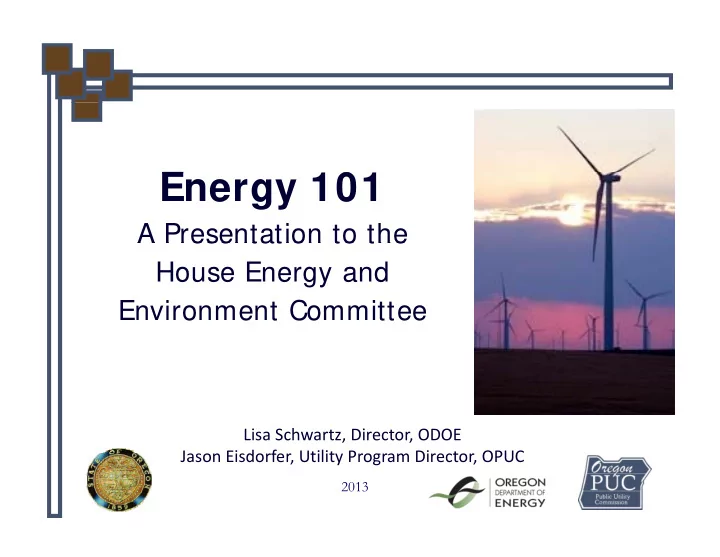
E 101 Energy 101
A Presentation to the A Presentation to the House Energy and Environment Committee Environment Committee
Lisa Schwartz, Director, ODOE J Ei d f Utilit P Di t OPUC
2013
Jason Eisdorfer, Utility Program Director, OPUC
E Energy 101 101 A Presentation to the A Presentation to the - - PowerPoint PPT Presentation
E Energy 101 101 A Presentation to the A Presentation to the House Energy and Environment Committee Environment Committee Lisa Schwartz, Director, ODOE J Jason Eisdorfer, Utility Program Director, OPUC Ei d f Utilit P Di t OPUC 2013
Lisa Schwartz, Director, ODOE J Ei d f Utilit P Di t OPUC
2013
Jason Eisdorfer, Utility Program Director, OPUC
2
3
4
Source: ODOE
73.8% of electric customers
19 Cooperatives 10.5% of customers
p y
5
buy electricity from alternative providers.
6
The Bonneville Power Administration is a Power Marketing Administration, an arm of the U.S. Department of Energy.
equal to about one-quarter of the region’s firm energy, and the Columbia Generating Station nuclear plant.
transmission system.
Columbia River Power System's impacts on fish and wildlife.
utility customers utility customers.
7
regional preference in its marketing of power. BPA sets its rates as low as possible consistent with sound business rates as low as possible consistent with sound business principles and the full recovery of all of its costs, including timely repayment of the federal investment in the system.
from BPA. Investor owned utilities participate in a Residential Exchange
Program created to provide residential and small farm customers of Pacific Northwest utilities a form of access to lo cost Fede al po e low-cost Federal power.
8
9
10
6,000 RPS Hydro 4,000 5,000 y (MW a) RPS Solar RPS 3,000 ed Energy Geothermal RPS Biomass RPS Wi d 1,000 2,000 Dispatch RPS Wind Conservation 1,000 07 09 1 3 5 7 9 21 23 25 Committed Wind
11
2007 2009 2011 2013 2015 2017 2019 2021 2023 2025
12
13
Electricity Oregon U.S Average Timeframe Residential 10.04 cents/kWh 12.03 cents/kWh
Commercial 8.43 cents/kWh 10.11 cents/kWh
Industrial 5.79 cents/kWh 6.65 cents/kWh
14
PacifiCorp 2010 Electricity Resource Mix Portland General Electric 2010 Electricity Resource Mix
Hydroelectric 10% Renewable (Beyond Hydro) 8% Hydroelectric 31% Renewable (Beyond Hydro) 7% Nuclear Other 1% Natural Gas 16% Natural Gas 27% 0.15% Other 0.25% Coal 65% Coal 35% Nuclear 0.32%
15
Source: ODOE
Renewable
EWEB 2010 Electricity Resource Mix
N t l G R bl
Consumer Owned Utilities 2010 Electricity Resource Mix
Nuclear 3% Other 5% Natural Gas 3% Renewable (Beyond Hydro) 4% Nuclear Other 1% Natural Gas 3% Renewable (Beyond Hydro) 0.22% Coal 4% Coal 7% Nuclear 12% Hydroelectric 81% Hydroelectric 77%
16
Source: ODOE
12.00
2011 Residential Revenue per kWh
8.00 10.00
20 Largest Electric Utilities
4.00 6.00 Cents per kWh 0 00 2.00 0.00
17
18
12.00 8 00 10.00 6.00 8.00 s per kWh 2.00 4.00 Cents 0.00 1997 1998 1999 2000 2001 2002 2003 2004 2005 2006 2007 2008 2009 2010 2011 Portland General Electric PacifiCorp Idaho Power Company
19
Portland General Electric PacifiCorp Idaho Power Company
20
1.
Evaluate resources on a consistent and comparable basis;
2.
Consider risk and uncertainty;
3.
Make the primary goal of the process the selection of a portfolio of resources with the best combination of expected costs and associated risks and uncertainties for the utility and its customers; y ; and
4.
Create an action plan that is consistent with the long-run public interest as expressed in Oregon and federal energy policies interest as expressed in Oregon and federal energy policies
21
4,000
Example: PGE Needs
3,000 3,500
MW a _ Annual Average Retail Load
2,000 2,500
age Availability M
Long-term Contracts
873 MWa 1,393 MWa
1,000 1,500
Annual Avera
Natural Gas - Port Westward, Coyote, Beaver (as an i t di t ) Hydro - PGE owned, MID-C contracts Wind - Biglow 1-3, Klondike II, Vansycle 500 2010 2012 2014 2016 2018 2020 2022 2024 2026 2028 2030 Coal - Boardman intermediate resource) Coal - Colstrip
22
An average megawatt (MWa) is 8,760 megawatt-hours – the continual output of a resource with 1 megawatt of capacity over a full year.
300
Resource Curve and Cost Uncertainty
200 250 Coal Conservation
Whiskers indicate High and Low cost range
150 200 2006$/MWh Gas Renewables Nuclear 50 100 2 50
23
2 , 4 , 6 , 8 , 1 , 1 2 , 1 4 , 1 6 , MWa
Plants entering service in 2017 Average Total System Cost per kWh Notes
H d 8 9 t A l t Hydropower 8.9 cents Assumes seasonal storage Woody Residues 11 cents Depends on fuel supply Natural Gas 6.6 cents Combined cycle Solar 15 cents Utility scale, grid connected Wind 9 6 cents No fuel cost Wind 9.6 cents No fuel cost Coal (conventional) 9.8 cents NW Council’s 6th Power Plan estimate for IGCC is 14 cents
24
Source: US EIA– July 2012 Energy Outlook
Geothermal 9.8 cents 91% capacity factor
Generation Type Carbon Dioxide lb/ MWh Sulfur Dioxide lb/ MWh Nitrogen Oxides lb/ MWh lb/ MWh lb/ MWh lb/ MWh
Coal-fired 2,167 5.26 3.45 Natural gas-fired 1,091 0.14 3.43
Source: EPA G id 2012
Natural gas fired 1,091 0.14 3.43 Oil-fired 1,008 5.00 12.4 Other fossil 749 0 05 2 33
eGrid 2012, data year 2009
Other fossil 749 0.05 2.33 Biomass-fired* 341 1.84 1.92 Wind and solar Hydro
25
* Emissions from the combustion of biomass or biogas are considered to be part of the natural carbon cycle because these materials would otherwise release CO2 (or other greenhouse gases) through natural decomposition.
Cheaper to save energy than to buy or produce it.
kilowatt-hour to build or buy from power plants.
electric and natural gas utilities in Oregon. Energy Trust “buys” energy efficiency by paying incentives
to customers for projected savings.
26
p y g
27
g g
Fi i l t t t dit
28
60
Energy Trust of Oregon Annual Electric Efficiency Savings
50 60
(aMW)
30 40
MW
10 20
a
2002 2003 2004 2005 2006 2007 2008 2009 2010 2011 2012* Total i t l 26.21 21.53 27.43 36.87 27.01 30.23 31.09 28.44 45.80 46.96 52.86 10 29 incremental 26.21 21.53 27.43 36.87 27.01 30.23 31.09 28.44 45.80 46.96 52.86
Total cumulative savings is 374 aMW.
30
31
32
7,000
Energy Trust of Oregon Annual Natural Gas Efficiency Savings
5,000 6,000 ,
(000s therms)
3,000 4,000 ,
ms (000s)
1,000 2,000 ,
Annual Therm
2003 2004 2005 2006 2007 2008 2009 2010 2011 2012* Total I ncremental 613 996 1,392 2,343 2,432 2,502 2,879 4,623 5,407 5,916 , 33
Oregon homes for a year.
34
that administers the statewide "One Call" system.
Oregon One Call Law and has supported the OUNC ever since, by holding a position on the Board of Directors.
administers that process.
In the last six years, damages to underground natural gas facilities have been reduced from over 2,040 to 847 per year through the aggressive educational programs of the OUNC/PUC.
35
Low impact hydro is eligible up to statutory limits.
36
An interconnected system of information + communications An interconnected system of information + communications technologies that works with the electric system to:
37
g g , in Klamath Falls.
Th i d i f CNG fl t hi l t i d
environmental compliance.
domestic natural gas will lead to stable, low prices in the foreseeable future.
p g p p remain favorable to natural gas. On average, CNG costs 47 percent less than gasoline.
CNG has lower emissions than gasoline.
38
39
40
41
42
43
Continued growth in demand for nonrenewable energy forms poses a serious … problem. It is essential that future generations not be left a legacy of vanished or depleted resources, resulting in massive environmental, social and financial impact.
resources and to develop permanently sustainable energy resources. The need exists for comprehensive state leadership in energy production distribution and utilization (ORS 469 010) production, distribution and utilization. (ORS 469.010)
Protecting Oregon from the radioactive material at Hanford
44
45
O b f l
46
state buildings through 2011 (adjusted for measure life) E dit f 1 630 h l lti i $6 3 illi i l
savings from measures implemented to date
saving up to $100,000 on energy bills each year
$ y pp 272 energy projects in Oregon saving $8 million annually
energy-saving and renewable energy projects totaling $3.1 billion of
47
energy saving and renewable energy projects totaling $3.1 billion of investment and cumulative savings/generation equal to the annual energy use of more than 1 million households
J Ei d f Utilit Di t Jason Eisdorfer, Utility Director 503-378-6137; jason.eisdorfer@state.or.us Michael Dougherty, Chief Operating Officer 503-373-1303; michael.dougherty@state.or.us
Lisa Schwartz, Director 503-378-5489; lisa.c.schwartz@state.or.us Robin Freeman, Government Relations Coordinator 503-373-2293; robin.freeman@odoe.state.or.us
48