E D C C M M or A A K K 1) Move the coins out of E make it - - PowerPoint PPT Presentation

e d
SMART_READER_LITE
LIVE PREVIEW

E D C C M M or A A K K 1) Move the coins out of E make it - - PowerPoint PPT Presentation

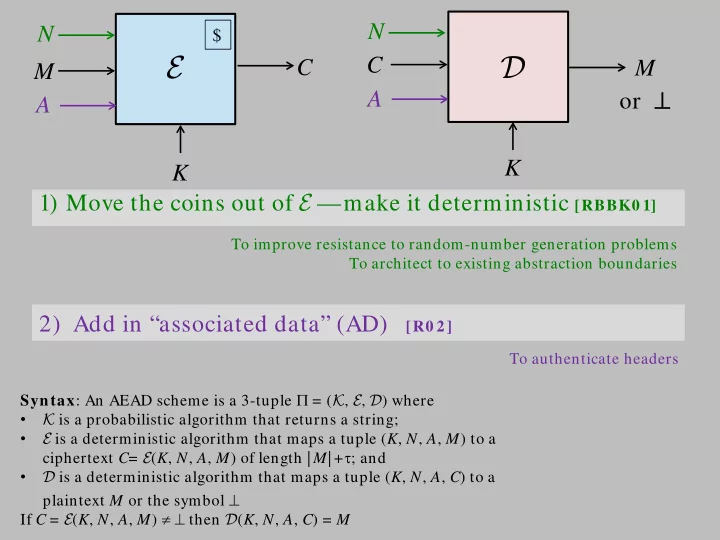
N N $ E D C C M M or A A K K 1) Move the coins out of E make it deterministic [RBBK0 1] To improve resistance to random-number generation problems To architect to existing abstraction boundaries 2) Add in associated data


slide-1
SLIDE 1

1

$

M C K C M K

  • r ⊥

N 2) Add in “associated data” (AD) [R0 2] 1) Move the coins out of E —make it deterministic [RBBK0 1] N A A

E D

To improve resistance to random-number generation problems To architect to existing abstraction boundaries To authenticate headers Syntax: An AEAD scheme is a 3-tuple Π = (K, E, D) where

  • K is a probabilistic algorithm that returns a string;
  • E is a deterministic algorithm that maps a tuple (K, N, A, M) to a

ciphertext C= E (K, N, A, M) of length | M| +τ; and

  • D is a deterministic algorithm that maps a tuple (K, N, A, C) to a

plaintext M or the symbol ⊥ If C = E (K, N, A, M) ≠ ⊥ then D(K, N, A, C) = M X

slide-2
SLIDE 2

2

C Adv (A) = Pr[A  1] − Pr[A  1] I N, A, M

  • Repeat an N in an enc query
  • Ask a dec query (N, A, C) after C is returned by an (N, A, ⋅) enc query

N, A, C M ⊥

K (⋅,⋅,⋅) K (⋅,⋅,⋅)

$ (⋅,⋅,⋅ ) ⊥ (⋅,⋅,⋅ )

C

aead

E

E D

EK, DK A may not:

A

$, ⊥

slide-3
SLIDE 3

3

C Adv (A) = Pr[A  1] − Pr[A  1] I N, A, M

  • Ask a dec query (N, A, C) after C is returned by an (N, A, ⋅) enc query

K (⋅,⋅,⋅)

$ (⋅,⋅,⋅ )

C

priv

E

E

EK A may not:

A

$

slide-4
SLIDE 4

4

C Adv (A) = Pr[A forges] I N, A, M

K (⋅,⋅,⋅)

N*, A*, C*

auth

E

E

EK

A

It outputs an (N*, A*, C*) where D(K, N*, A*, C*) ≠⊥ and no prior oracle query of (N*, A*, M) returned C*

slide-5
SLIDE 5

5

All-in-one definition Advaead(A) = Pr[AE(K, ...), D(K, ...) ⇒ 1] − Pr[A$(...), ⊥(...) ⇒ 1] Π Two-part definition Advpriv(A) = Pr[AE(K, ...) ⇒ 1] − Pr[A$(...) ⇒ 1] Π Advauth(A) = Pr[AE(K, ...) forges] Π

It outputs an (N, A, C) where D(K, N, A, C) ≠⊥ and no prior oracle query of (N, A, M) returned C A may not repeat any N query. A may not repeat any N query to its Enc oracle. It may not ask Dec(N, A, C) after an Enc(N, A, M) returned C.

slide-6
SLIDE 6

6

M C T

Encrypt-then-MAC MAC-then-Encrypt

M C

FL

T

Encrypt-and-MAC

M C

[Bellare, Nam prem pre 20 0 0 ]

Generic com position

EK

FL FL

$ $ $

EK EK

slide-7
SLIDE 7

7

SIV m ode

[Rogaway, Shrimpton 2006] ivE encryption scheme (eg, CTR), secure PRF operating on a vector of strings

M C IV EK2 fK1 A N

slide-8
SLIDE 8

8

AES-GCM-SIV

[Gueron, Langley, Lindell 2017] [Bose, Hoang, Tessaro 2018]

K N DeriveKey K2 A M a m POLYVAL Hash K1 S AES 1R127(T) 0 R127(S) N T ⊕ 1R127(T)+1 1R127(T)+2 1R127(T)+3 AES AES AES AES Pad ⊕ C K2 Additions: no carry

  • ut of last 32 bits

a m R64 (AESK(N 0)) R64 (AESK(N 1)) R64 (AESK(N 2)) R64 (AESK(N 3)) Close to GHASH but adjusted to better match AES-NI: Σ αi Mi K1i

slide-9
SLIDE 9

9

CCM

[Whiting, Housley, Ferguson 2002]

NIST SP 800-38C RFC 3610, 4309, 5084

Thm [Jonsson 2002] CCM is provably secure if E is a good PRP.

slide-10
SLIDE 10

10

GCM

[McGrew, Viega 2004]

(Follows CWC

[Kohno, Viega, Whiting 2004]) NIST SP 800-38D:2007 RFC 4106, 5084, 5116, 5288, 5647 ISO 19772:2009

Thm [Iwata , Ohashi , and Minematsu 2012] (correcting [McGrew, Viega 2004]) GCM is provably secure (not great bounds) if E is a good PRP.

slide-11
SLIDE 11

11

OCB (v3)

[Krovetz Rogaway 2011] , following

[RBBK01,LRW02,R04] RFC 7253

Thm [Krovetz, Rogaway 2011] OCB is provably secure (OK bounds) if E is a strong PRP.

slide-12
SLIDE 12

12

Y=EK (X)

EK π

Adv (A) = Pr [AEK ⇒1] – Pr [Aπ ⇒ 1]

E

1 or 0

[Liskov, Rivest, Wagner 2002]

A T-indexed family of random permutations

  • n n bits

prp

E: K × T × {0,1}n

→ {0,1}n Tweakable Blockcipher (TBC)

each EK (⋅) = E(K, T, ⋅) a perm utation

A

T

~

~ ~ ~ ~

~

~ T

slide-13
SLIDE 13

13

This is the official public announcement of the portfolio, bringing the CAESAR competition to a close. … [H]ere is the final portfolio: Use case 1: Ascon first choice, ACORN second choice. Use case 2: AEGIS-128 and OCB, without a preference. Use case 3: Deoxys-II first choice, COLM second choice. 57 round-1

(Mar 2014)

29 round-2

(Mar 2014)

16 round-3

(Aug 2016)

7 finalists

(Mar 2018)

6 winners

(Feb 209)

slide-14
SLIDE 14

14

A1 A2 A3 M1 ET⊕1

K T

〈N 〉

C1 E1#

K

E2#

K

M2 ⊕

〈N 〉

C2 M3 ⊕

〈N 〉

C3 E3#

K

E4#

K

M4 ⊕

〈N 〉

C4 E 1$

K

E 2$

K

E3$

K

⊕ ⊕ ⊕ ⊕ E N&

K

ET⊕2

K

ET⊕3

K

ET⊕4

K

Deoxys-II

Jean, Nikolić, Peyrin, Seurin Thm : Provably secure, with excellent bounds, if E is a TBC.

slide-15
SLIDE 15

15

AEGIS

AEGIS-128 [Wu, Preneel 20 13] 12 11 10 9 7 8 6 5 4 P1 P2 P3 P4 P5 P6 P0 C0 C1 C2 C3 C4 C5 C6 P7 P8 C7 C8 A B C D E A B C D E

B ⊕ CD ⊕ E

The fastest

CAESAR finalist

  • n recent Intel processors

0 .4 3 cpb (Skylake) (0 .25 cpb for AEGIS-128 L

  • n 16K messages)

K, N, A dependent initialization | A| , | P| dependent

tag computation

T