Dystopian Worlds Presentation 1. Create a Google Slides presentation - - PDF document

dystopian worlds presentation
SMART_READER_LITE
LIVE PREVIEW

Dystopian Worlds Presentation 1. Create a Google Slides presentation - - PDF document

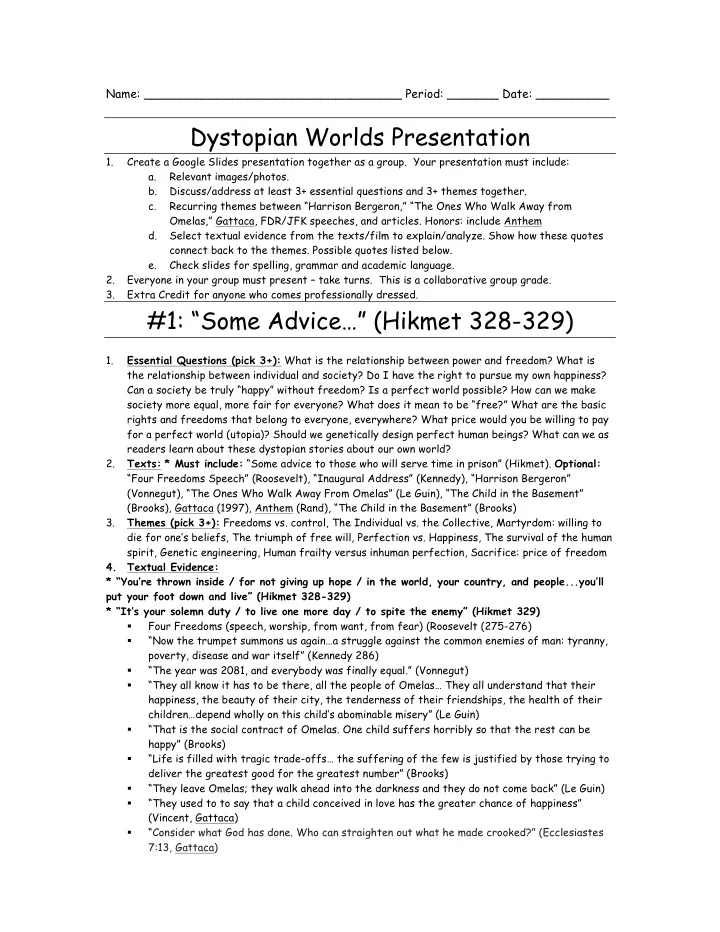
Name: ___________________________________ Period: _______ Date: __________ Dystopian Worlds Presentation 1. Create a Google Slides presentation together as a group. Your presentation must include: a. Relevant images/photos. b. Discuss/address


slide-1
SLIDE 1

Name: ___________________________________ Period: _______ Date: __________

Dystopian Worlds Presentation

1. Create a Google Slides presentation together as a group. Your presentation must include: a. Relevant images/photos. b. Discuss/address at least 3+ essential questions and 3+ themes together. c. Recurring themes between “Harrison Bergeron,” “The Ones Who Walk Away from Omelas,” Gattaca, FDR/JFK speeches, and articles. Honors: include Anthem d. Select textual evidence from the texts/film to explain/analyze. Show how these quotes connect back to the themes. Possible quotes listed below. e. Check slides for spelling, grammar and academic language. 2. Everyone in your group must present – take turns. This is a collaborative group grade. 3. Extra Credit for anyone who comes professionally dressed.

#1: “Some Advice…” (Hikmet 328-329)

1. Essential Questions (pick 3+): What is the relationship between power and freedom? What is the relationship between individual and society? Do I have the right to pursue my own happiness? Can a society be truly “happy” without freedom? Is a perfect world possible? How can we make society more equal, more fair for everyone? What does it mean to be “free?” What are the basic rights and freedoms that belong to everyone, everywhere? What price would you be willing to pay for a perfect world (utopia)? Should we genetically design perfect human beings? What can we as readers learn about these dystopian stories about our own world? 2. Texts: * Must include: “Some advice to those who will serve time in prison” (Hikmet). Optional: “Four Freedoms Speech” (Roosevelt), “Inaugural Address” (Kennedy), “Harrison Bergeron” (Vonnegut), “The Ones Who Walk Away From Omelas” (Le Guin), “The Child in the Basement” (Brooks), Gattaca (1997), Anthem (Rand), “The Child in the Basement” (Brooks) 3. Themes (pick 3+): Freedoms vs. control, The Individual vs. the Collective, Martyrdom: willing to die for one’s beliefs, The triumph of free will, Perfection vs. Happiness, The survival of the human spirit, Genetic engineering, Human frailty versus inhuman perfection, Sacrifice: price of freedom

  • 4. Textual Evidence:

* “You’re thrown inside / for not giving up hope / in the world, your country, and people...you’ll put your foot down and live” (Hikmet 328-329) * “It’s your solemn duty / to live one more day / to spite the enemy” (Hikmet 329) § Four Freedoms (speech, worship, from want, from fear) (Roosevelt (275-276) § “Now the trumpet summons us again…a struggle against the common enemies of man: tyranny, poverty, disease and war itself” (Kennedy 286) § “The year was 2081, and everybody was finally equal.” (Vonnegut) § “They all know it has to be there, all the people of Omelas… They all understand that their happiness, the beauty of their city, the tenderness of their friendships, the health of their children…depend wholly on this child’s abominable misery” (Le Guin) § “That is the social contract of Omelas. One child suffers horribly so that the rest can be happy” (Brooks) § “Life is filled with tragic trade-offs… the suffering of the few is justified by those trying to deliver the greatest good for the greatest number” (Brooks) § “They leave Omelas; they walk ahead into the darkness and they do not come back” (Le Guin) § “They used to to say that a child conceived in love has the greater chance of happiness” (Vincent, Gattaca) § “Consider what God has done. Who can straighten out what he made crooked?” (Ecclesiastes 7:13, Gattaca)

slide-2
SLIDE 2

Name: ___________________________________ Period: _______ Date: __________

Dystopian Worlds Presentation

1. Create a Google Slides presentation together as a group. Your presentation should include the following: a. Relevant images/photos. b. Discuss/address at least 3+ essential questions and 3+ themes together. c. Recurring themes between “Harrison Bergeron,” “The Ones Who Walk Away from Omelas,” Gattaca, FDR/JFK speeches, and articles. Honors: include Anthem d. Select textual evidence from the texts/film to explain/analyze. Show how these quotes connect back to the themes. e. Check slides for spelling, grammar and academic language. 2. Everyone in your group must present – take turns. This is a collaborative group grade. 3. Extra Credit for anyone who comes professionally dressed.

#2: “Caged Bird” (Angelou 326-327)

1. Essential Questions (pick 3+): What is the relationship between power and freedom? What is the relationship between individual and society? Do I have the right to pursue my own happiness? Can a society be truly “happy” without freedom? Is a perfect world possible? How can we make society more equal, more fair for everyone? What does it mean to be “free?” What are the basic rights and freedoms that belong to everyone, everywhere? What price would you be willing to pay for a perfect world (utopia)? Should we genetically design perfect human beings? What can we as readers learn about these dystopian stories about our own world? 2. Texts: * Must include: “Caged Bird” (Angelou). Optional: “Four Freedoms Speech” (Roosevelt), “Inaugural Address” (Kennedy), “Harrison Bergeron” (Vonnegut), “The Ones Who Walk Away From Omelas” (Le Guin), “The Child in the Basement” (Brooks), Gattaca (1997), Anthem (Rand), “The Child in the Basement” (Brooks) 3. Themes (pick 3+): Freedoms vs. control, The Individual vs. the Collective, Martyrdom: willing to die for one’s beliefs, The triumph of free will, Perfection vs. Happiness, The survival of the human spirit, Genetic engineering, Human frailty versus inhuman perfection, Sacrifice: price of freedom

  • 4. Textual Evidence:

* “A free bird leaps / on the back of the wind / and floats downstream / til the current ends” (Angelou 327) * “The caged bird sings / with a fearful trill of things unknown / but longed for still… for the caged bird / sings of freedom” (Angelou 327) § Four Freedoms (speech, worship, from want, from fear) (Roosevelt (275-276) § “Now the trumpet summons us again…a struggle against the common enemies of man: tyranny, poverty, disease and war itself” (Kennedy 286) § “The year was 2081, and everybody was finally equal.” (Vonnegut) § “They all know it has to be there, all the people of Omelas… They all understand that their happiness, the beauty of their city, the tenderness of their friendships, the health of their children…depend wholly on this child’s abominable misery” (Le Guin) § “That is the social contract of Omelas. One child suffers horribly so that the rest can be happy” (Brooks) § “Life is filled with tragic trade-offs… the suffering of the few is justified by those trying to deliver the greatest good for the greatest number” (Brooks) § “They leave Omelas; they walk ahead into the darkness and they do not come back” (Le Guin) § “They used to to say that a child conceived in love has the greater chance of happiness” (Vincent, Gattaca) § “Consider what God has done. Who can straighten out what he made crooked?” (Ecclesiastes 7:13, Gattaca)

slide-3
SLIDE 3

Name: ___________________________________ Period: _______ Date: __________

Dystopian Worlds Presentation

1. Create a Google Slides presentation together as a group. Your presentation should include the following: a. Relevant images/photos. b. Discuss/address at least 3+ essential questions and 3+ themes together. c. Recurring themes between “Harrison Bergeron,” “The Ones Who Walk Away from Omelas,” Gattaca, FDR/JFK speeches, and articles. Honors: include Anthem d. Select textual evidence from the texts/film to explain/analyze. Show how these quotes connect back to the themes. e. Check slides for spelling, grammar and academic language. 2. Everyone in your group must present – take turns. This is a collaborative group grade. 3. Extra Credit for anyone who comes professionally dressed.

#3: “Speech at the United Nations” (Yousafzai 309-313)

1. Essential Questions (pick 3+): What is the relationship between power and freedom? What is the relationship between individual and society? Do I have the right to pursue my own happiness? Can a society be truly “happy” without freedom? Is a perfect world possible? How can we make society more equal, more fair for everyone? What does it mean to be “free?” What are the basic rights and freedoms that belong to everyone, everywhere? What price would you be willing to pay for a perfect world (utopia)? Should we genetically design perfect human beings? What can we as readers learn about these dystopian stories about our own world? 2. Texts: * Must include: “Speech at the United Nations” (Yousafzai). Optional: “Four Freedoms Speech” (Roosevelt), “Inaugural Address” (Kennedy), “Harrison Bergeron” (Vonnegut), “The Ones Who Walk Away From Omelas” (Le Guin), “The Child in the Basement” (Brooks), Gattaca (1997), Anthem (Rand), “The Child in the Basement” (Brooks) 3. Themes (pick 3+): Freedoms vs. control, The Individual vs. the Collective, Martyrdom: willing to die for one’s beliefs, The triumph of free will, Perfection vs. Happiness, The survival of the human spirit, Genetic engineering, Human frailty versus inhuman perfection, Sacrifice: price of freedom

  • 4. Textual Evidence:

* “We call upon our sisters around the world to be brave; to embrace the strength within themselves and realize their full potential” (Yousafzai 313) * “Let us pick up our books and pens. They are our most powerful weapons. One child, one teacher, one book, and one pen can change the world. Education is the only solution.” (Yousafzai (313) § Four Freedoms (speech, worship, from want, from fear) (Roosevelt (275-276) § “Now the trumpet summons us again…a struggle against the common enemies of man: tyranny, poverty, disease and war itself” (Kennedy 286) § “The year was 2081, and everybody was finally equal.” (Vonnegut) § “They all know it has to be there, all the people of Omelas… They all understand that their happiness, the beauty of their city, the tenderness of their friendships, the health of their children…depend wholly on this child’s abominable misery” (Le Guin) § “That is the social contract of Omelas. One child suffers horribly so that the rest can be happy” (Brooks) § “Life is filled with tragic trade-offs… the suffering of the few is justified by those trying to deliver the greatest good for the greatest number” (Brooks) § “They leave Omelas; they walk ahead into the darkness and they do not come back” (Le Guin) § “They used to to say that a child conceived in love has the greater chance of happiness” (Vincent, Gattaca) § “Consider what God has done. Who can straighten out what he made crooked?” (Ecclesiastes 7:13, Gattaca)

slide-4
SLIDE 4

Name: ___________________________________ Period: _______ Date: __________

Dystopian Worlds Presentation

1. Create a Google Slides presentation together as a group. Your presentation should include the following: a. Relevant images/photos. b. Discuss/address at least 3+ essential questions and 3+ themes together. c. Recurring themes between “Harrison Bergeron,” “The Ones Who Walk Away from Omelas,” Gattaca, FDR/JFK speeches, and articles. Honors: include Anthem d. Select textual evidence from the texts/film to explain/analyze. Show how these quotes connect back to the themes. e. Check slides for spelling, grammar and academic language. 2. Everyone in your group must present – take turns. This is a collaborative group grade. 3. Extra Credit for anyone who comes professionally dressed.

#4: “The Censors” (Valenzuela 337-339)

1. Essential Questions (pick 3+): What is the relationship between power and freedom? What is the relationship between individual and society? Do I have the right to pursue my own happiness? Can a society be truly “happy” without freedom? Is a perfect world possible? How can we make society more equal, more fair for everyone? What does it mean to be “free?” What are the basic rights and freedoms that belong to everyone, everywhere? What price would you be willing to pay for a perfect world (utopia)? Should we genetically design perfect human beings? What can we as readers learn about these dystopian stories about our own world? 2. Texts: * Must include: “The Censors” (Valenzuela). Optional: “Four Freedoms Speech” (Roosevelt), “Inaugural Address” (Kennedy), “Harrison Bergeron” (Vonnegut), “The Ones Who Walk Away From Omelas” (Le Guin), “The Child in the Basement” (Brooks), Gattaca (1997), Anthem (Rand), “The Child in the Basement” (Brooks) 3. Themes (pick 3+): Freedoms vs. control, The Individual vs. the Collective, Martyrdom: willing to die for one’s beliefs, The triumph of free will, Perfection vs. Happiness, The survival of the human spirit, Genetic engineering, Human frailty versus inhuman perfection, Sacrifice: price of freedom

  • 4. Textual Evidence:

* “Soon his work became so absorbing that his noble mission blurred in his mind. Day after day he crossed out whole paragraphs in red ink, pitilessly chucking many letters into the censored basket” (Valenzuela 338) * “Naturally, he censored it without regret. And just as naturally, he couldn’t stop them from executing him the following morning, another victim of his devotion to his work” (Valenzuela 339) § Four Freedoms (speech, worship, from want, from fear) (Roosevelt (275-276) § “Now the trumpet summons us again…a struggle against the common enemies of man: tyranny, poverty, disease and war itself” (Kennedy 286) § “The year was 2081, and everybody was finally equal.” (Vonnegut) § “They all know it has to be there, all the people of Omelas… They all understand that their happiness, the beauty of their city, the tenderness of their friendships, the health of their children…depend wholly on this child’s abominable misery” (Le Guin) § “That is the social contract of Omelas. One child suffers horribly so that the rest can be happy” and “Life is filled with tragic trade-offs… the suffering of the few is justified by those trying to deliver the greatest good for the greatest number” (Brooks) § “They leave Omelas; they walk ahead into the darkness and they do not come back” (Le Guin) § “They used to to say that a child conceived in love has the greater chance of happiness” (Vincent, Gattaca) and “Consider what God has done. Who can straighten out what he made crooked?” (Ecclesiastes 7:13, Gattaca)

slide-5
SLIDE 5

Name: ___________________________________ Period: _______ Date: __________

Dystopian Worlds Presentation

1. Create a Google Slides presentation together as a group. Your presentation should include the following: a. Relevant images/photos. b. Discuss/address at least 3+ essential questions and 3+ themes together. c. Recurring themes between “Harrison Bergeron,” “The Ones Who Walk Away from Omelas,” Gattaca, FDR/JFK speeches, and articles. Honors: include Anthem d. Select textual evidence from the texts/film to explain/analyze. Show how these quotes connect back to the themes. e. Check slides for spelling, grammar and academic language. 2. Everyone in your group must present – take turns. This is a collaborative group grade. 3. Extra Credit for anyone who comes professionally dressed.

#5: “Misrule of Law” (Aung San Suu Kyi)

1. Essential Questions (pick 3+): What is the relationship between power and freedom? What is the relationship between individual and society? Do I have the right to pursue my own happiness? Can a society be truly “happy” without freedom? Is a perfect world possible? How can we make society more equal, more fair for everyone? What does it mean to be “free?” What are the basic rights and freedoms that belong to everyone, everywhere? What price would you be willing to pay for a perfect world (utopia)? Should we genetically design perfect human beings? What can we as readers learn about these dystopian stories about our own world? 2. Texts: * Must include: “Misrule of Law” (Aung San Suu Kyi). Optional: “Four Freedoms Speech” (Roosevelt), “Inaugural Address” (Kennedy), “Harrison Bergeron” (Vonnegut), “The Ones Who Walk Away From Omelas” (Le Guin), “The Child in the Basement” (Brooks), Gattaca (1997), Anthem (Rand), “The Child in the Basement” (Brooks) 3. Themes (pick 3+): Freedoms vs. control, The Individual vs. the Collective, Martyrdom: willing to die for one’s beliefs, The triumph of free will, Perfection vs. Happiness, The survival of the human spirit, Genetic engineering, Human frailty versus inhuman perfection, Sacrifice: price of freedom

  • 4. Textual Evidence:

* “So much for the idea of the law that says a person is innocent until proven guilty.” (Aung San Suu Kyi) * “The sight of the process of law leaping away from accepted standards of justice is very ugly at all times” (Aung San Suu Kyi) § Four Freedoms (speech, worship, from want, from fear) (Roosevelt (275-276) § “Now the trumpet summons us again…a struggle against the common enemies of man: tyranny, poverty, disease and war itself” (Kennedy 286) § “The year was 2081, and everybody was finally equal.” (Vonnegut) § “They all know it has to be there, all the people of Omelas… They all understand that their happiness, the beauty of their city, the tenderness of their friendships, the health of their children…depend wholly on this child’s abominable misery” (Le Guin) § “That is the social contract of Omelas. One child suffers horribly so that the rest can be happy” and “Life is filled with tragic trade-offs… the suffering of the few is justified by those trying to deliver the greatest good for the greatest number” (Brooks) § “They leave Omelas; they walk ahead into the darkness and they do not come back” (Le Guin) § “They used to to say that a child conceived in love has the greater chance of happiness” (Vincent, Gattaca) § “Consider what God has done. Who can straighten out what he made crooked?” (Ecclesiastes 7:13, Gattaca)

slide-6
SLIDE 6

Name: ___________________________________ Period: _______ Date: __________

Dystopian Worlds Presentation

1. Create a Google Slides presentation together as a group. Your presentation should include the following: a. Relevant images/photos. b. Discuss/address at least 3+ essential questions and 3+ themes together. c. Recurring themes between “Harrison Bergeron,” “The Ones Who Walk Away from Omelas,” Gattaca, FDR/JFK speeches, and articles. Honors: include Anthem d. Select textual evidence from the texts/film to explain/analyze. Show how these quotes connect back to the themes. e. Check slides for spelling, grammar and academic language. 2. Everyone in your group must present – take turns. This is a collaborative group grade. 3. Extra Credit for anyone who comes professionally dressed.

#6: “Credo: What I Believe” (Gaiman)

1. Essential Questions (pick 3+): What is the relationship between power and freedom? What is the relationship between individual and society? Do I have the right to pursue my own happiness? Can a society be truly “happy” without freedom? Is a perfect world possible? How can we make society more equal, more fair for everyone? What does it mean to be “free?” What are the basic rights and freedoms that belong to everyone, everywhere? What price would you be willing to pay for a perfect world (utopia)? Should we genetically design perfect human beings? What can we as readers learn about these dystopian stories about our own world? 2. Texts: * Must include: “Credo: What I Believe” (Gaiman). Optional: “Four Freedoms Speech” (Roosevelt), “Inaugural Address” (Kennedy), “Harrison Bergeron” (Vonnegut), “The Ones Who Walk Away From Omelas” (Le Guin), “The Child in the Basement” (Brooks), Gattaca (1997), Anthem (Rand), “The Child in the Basement” (Brooks) 3. Themes (pick 3+): Freedoms vs. control, The Individual vs. the Collective, Martyrdom: willing to die for one’s beliefs, The triumph of free will, Perfection vs. Happiness, The survival of the human spirit, Genetic engineering, Human frailty versus inhuman perfection, Sacrifice: price of freedom

  • 4. Textual Evidence:

* “I believe that it is difficult to kill an idea. Ideas are invisible and contagious, and they move fast” (Gaiman) * “I believe that in the battle betwee guns and ideas, ideas will, eventually win” (Gaiman) § Four Freedoms (speech, worship, from want, from fear) (Roosevelt (275-276) § “Now the trumpet summons us again…a struggle against the common enemies of man: tyranny, poverty, disease and war itself” (Kennedy 286) § “The year was 2081, and everybody was finally equal.” (Vonnegut) § “They all know it has to be there, all the people of Omelas… They all understand that their happiness, the beauty of their city, the tenderness of their friendships, the health of their children…depend wholly on this child’s abominable misery” (Le Guin) § “That is the social contract of Omelas. One child suffers horribly so that the rest can be happy” (Brooks) § “Life is filled with tragic trade-offs… the suffering of the few is justified by those trying to deliver the greatest good for the greatest number” (Brooks) § “They leave Omelas; they walk ahead into the darkness and they do not come back” (Le Guin) § “They used to to say that a child conceived in love has the greater chance of happiness” (Vincent, Gattaca) § “Consider what God has done. Who can straighten out what he made crooked?” (Ecclesiastes 7:13, Gattaca)