Dynamic HTML 5 using jQuery for Perl Devs Pete Krawczyk June 14, - - PowerPoint PPT Presentation

dynamic html 5 using jquery for perl devs
SMART_READER_LITE
LIVE PREVIEW

Dynamic HTML 5 using jQuery for Perl Devs Pete Krawczyk June 14, - - PowerPoint PPT Presentation

Get it early: http://bit.ly/htmljspp Dynamic HTML 5 using jQuery for Perl Devs Pete Krawczyk June 14, 2012 1 Get it early: http://bit.ly/htmljspp Intro My name: Pete Krawczyk My job: Developer for book wholesaler You know: Perl,


slide-1
SLIDE 1

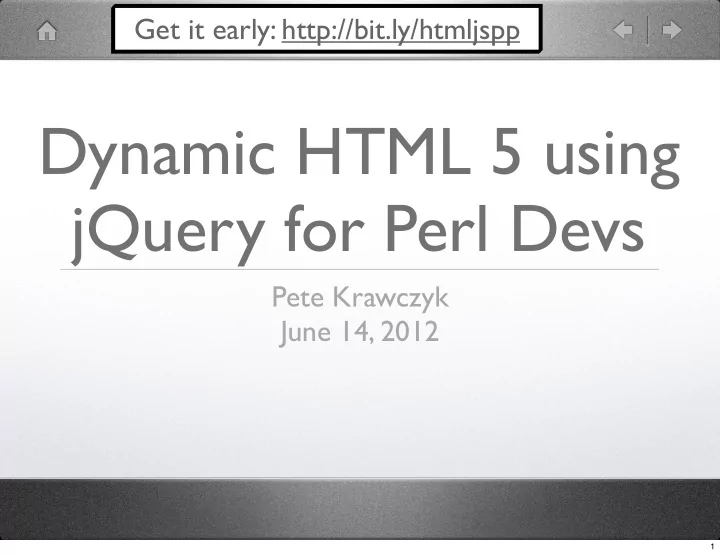
Dynamic HTML 5 using jQuery for Perl Devs

Pete Krawczyk June 14, 2012 Get it early: http://bit.ly/htmljspp

1
slide-2
SLIDE 2

Intro

  • My name: Pete Krawczyk
  • My job: Developer for book wholesaler
  • You know: Perl, some HTML and CSS
  • You might also know basic JavaScript, but

you haven’t done Serious Programming with it Get it early: http://bit.ly/htmljspp

2

slide-3
SLIDE 3

Our Roadmap

  • Perl-based To-Do list app
  • Changes to HTML for HTML 5
  • Introduce JavaScript and jQuery
  • Create JSON backend for data transfer

Get it early: http://bit.ly/htmljspp

3

slide-4
SLIDE 4

Get it early: http://bit.ly/htmljspp

4

slide-5
SLIDE 5

Go get it!

http://bit.ly/htmljspp http://petekrawczyk.com/slides/jspp.tgz (These links are the same) I also have a thumb drive, if necessary Get it now: http://bit.ly/htmljspp

5

slide-6
SLIDE 6

Notes on the code

  • Standard demo app caveats
  • Prerequisite check for executing code:
  • perl prereq/check_prerequisites.pl
  • You may also need to adjust your httpd.conf

Get it now: http://bit.ly/htmljspp

6

slide-7
SLIDE 7

App Demo

http://localhost/orig/index.cgi Get it now: http://bit.ly/htmljspp

7

slide-8
SLIDE 8

Let’s talk HTML

  • HTML5 simplifies HTML4 and XHTML
  • Valid HTML more important than ever
  • Browsers act differently with invalid HTML
  • Especially don’t duplicate: id="xyz"
  • Not everything is available to everyone
  • http://caniuse.com

8

slide-9
SLIDE 9

Document Type

  • <!DOCTYPE HTML PUBLIC "-//W3C//DTD HTML 4.01//EN"
  • "http://www.w3.org/TR/html4/strict.dtd">
  • <!DOCTYPE html PUBLIC "-//W3C//DTD XHTML 1.0 Transitional//EN"
  • "http://www.w3.org/TR/xhtml1/DTD/xhtml1-transitional.dtd">

+<!DOCTYPE html>

9

slide-10
SLIDE 10

Document header

  • <html>
  • <html xmlns="http://www.w3.org/1999/xhtml">

+<html lang="en">

10

slide-11
SLIDE 11

META content tag

  • <meta http-equiv="Content-Type" content="text/html;

charset=iso-8859-1"> +<meta charset="iso-8859-1">

  • This declaration must be in the first 1K of the page
  • If your webserver can do this, even better

11

slide-12
SLIDE 12

Including CSS and JS

  • <style type="text/css">

+<style>

  • <script type="text/javascript">

+<script>

12

slide-13
SLIDE 13

Presentational Markup

  • HTML moving to separation of structure and presentation
  • CSS now used instead of <font> <i> border=""...
  • Tables, etc now styled through CSS as well
  • No more frames! (but that doesn’t stop you from using them)
  • Browsers mostly support mixed versions, can do in steps

13

slide-14
SLIDE 14

Styling content

  • <b>

+<strong> <!-- style="font-weight: bold;" -->

  • <i>

+<em> <!-- style="font-style: italic;" -->

  • <font ...>

+<span style="font: ..."> <!-- CSS -->

  • <table border="1" cellpadding="1" ...>

+<style>table { border-collapse: collapse; } + th,td { border: 1px solid black; padding: 1px } +</style>

14

slide-15
SLIDE 15

Eliminate self-close tags

  • <img src="..." />

+<img src="...">

  • <input type="..." />

+<input type="...">

  • <meta ... />

+<meta ...>

15

slide-16
SLIDE 16

CSS for presentation

  • Use style sheets - separate from structure
  • Be as specific and as general as you can
  • “cascading” is the key word here
  • Degrade gracefully
  • Don’t get cute
  • CSS needs to be validated, too!

16

slide-17
SLIDE 17

App Demo

http://localhost/html5/index.cgi

  • Removed presentational HTML attributes
  • Added CSS classes and a stylesheet
  • Simplified tags like the DOCTYPE

17

slide-18
SLIDE 18

Let’s talk JavaScript

  • Time to think event-driven programming
  • Declared variables; no sigils; no interpolation
  • Everything is an object!
  • Scope is by function, not by block
  • Learn by doing: get a good JavaScript console
  • Your browser may include one

18

slide-19
SLIDE 19

References

  • https://developer.mozilla.org/en/JavaScript/Reference
  • http://msdn.microsoft.com/en-us/library/d1et7k7c(v=vs.

94).aspx

  • http://interglacial.com/hoj/hoj.html

19

slide-20
SLIDE 20

Events

  • Most JavaScript will be triggered by events
  • onClick, onFocus, onChange, onSubmit...
  • Return values are important
  • This requires you to think asynchronously
  • You can’t assume state or exclusivity
  • Avoiding spaghetti is difficult but important

20

slide-21
SLIDE 21

4 ways to include JS

  • <script src="javascript.js"></script>
  • <script>alert('foo');</script>
  • <button onClick="alert('foo');">
  • <a href="javascript:alert('foo')">

21

slide-22
SLIDE 22

Inline or Include?

  • Module vs. Script
  • Page size vs. Browser Cache
  • May be helpful to version your filename
  • My rules of thumb
  • Functions go in an include file, or in the head
  • Actions go where they’re needed
  • Shift-reload as a habit

22

slide-23
SLIDE 23

The document object

  • Your page is represented with a DOM

(document object model)

  • Think of document as a dispatcher
  • Object manipulation, not text
  • Avoid the temptation of direct reference

23

slide-24
SLIDE 24

Browser objects

  • Your browser has objects, too
  • window
  • screen
  • history

24

slide-25
SLIDE 25

Return, Control, Fail

  • Your function can only return one thing
  • return true / false as control
  • JavaScript’s default failure mode: stop
  • Knowing how to debug is a must

25

slide-26
SLIDE 26

Declaring things

  • ur $document = Document->new;

sub adjust_priority { my ($e) = @_; my $new_value = $e->{value}; my $old_value = 1; my @all_selects = $document->getElementsByTagName('select'); my $num_selects = scalar @all_selects; function adjust_priority(e) { var new_value = e.value; var old_value = 1; var all_selects = document.getElementsByTagName('select'); var num_selects = all_selects.length;

26

slide-27
SLIDE 27

Control Loops

while (1) { for (my $i = 0; $i < $num_selects; $i++) { if ($all_selects[$i]->{value} == $old_value) { $old_value++; next; } } last; while (1) { for (var i = 0; i < num_selects; i++) { if (all_selects[i].value == old_value) {

  • ld_value++;

continue; } } break;

27

slide-28
SLIDE 28

Loops/Comparisons

foreach my $select (@{$all_selects}) { if ($select->{id} != $e->{id} ) { if ($select->{value} >= $from && $select->{value} <= $to) { if ($dir eq 'i') { # increasing values $select->{value}++; } else { ... for (select_index in all_selects) { var select = all_selects[select_index]; if (select.id != e.id) { if (select.value >= from && select.value <= to) { if (dir == 'i') { // increasing values select.value++; } else { ...

28

slide-29
SLIDE 29

Concept Perl JavaScript Function

sub foo { my ($bar) = @_; } function foo( bar ) {}

Conditionals

if / elsif / else for(;;) / foreach $a (@b) if / else if / else for(;;) / for (idx in b)

Loop Controls next

last continue break

Arrays

my @a = ($b, $c); var a = new Array (b, c); var a = [ b, c ];

Hashes*

my %a = ('b' => $c); print $a{‘b’}; var a = { 'b': c }; print(a['b']);

Equality*

$a == $b (integer) $a eq $b (string) a == b (weak typing) a === b (strong typing)

Increment

$a++ $a += 2 a++ a += 2

Comments

# foo! =pod / =end // foo! /* foo! */

29

slide-30
SLIDE 30

Concept Perl JavaScript Concatenation* $a . $b

a + b a.toString() + b.toString()

Print

print() document.write() // NOT print()

Warn

warn() alert() console.warn() (log, error)

Regex Match

if ($a =~ /^b+c*$/) var re = /^b+c*$/; if (re.test(a))

Regex Extract

($a) = $b =~ /^(c+)$/; var re = /^(c+)$/; var a = re.exec(b)[1];

eval BLOCK

my $rc = eval { 1; } if (!$rc) {...} try { 1; } catch(err) {...}

Escape eval

die "foo" throw "foo"

Object being called

my $self = shift; $self->foo(); this.foo();

30

slide-31
SLIDE 31

App Demo

http://localhost/firstjs/index.cgi

  • Added a function to adjust priorities
  • Added an event: “onchange”

31

slide-32
SLIDE 32

Let’s talk jQuery

  • Simplify common DHTML operations
  • Handles cross-browser compatibility
  • Easy to write set operations
  • Extensions can be easily added dynamically
  • (Really, all the frameworks give you these)
  • Prototype, GWT,

YUI, others

32

slide-33
SLIDE 33

Let’s talk jQuery

  • Everything revolves around an object: $
  • Think set operations, like SQL
  • Think callbacks and anonymous functions
  • http://jquery.com/ is an awesome reference

33

slide-34
SLIDE 34

Are you ready?

  • You can’t work on a page until it’s rendered
  • To this end, jQuery provides a helper:

$(document).ready()

  • Replaces <body onload="...">
  • Can be called multiple times

34

slide-35
SLIDE 35

jQuery ♥ CSS

  • jQuery uses CSS selectors as targets
  • $("body").append("<p>Foo!</p>");
  • $("div.notes").hide();
  • $("table#taskrows th").addClass(...);
  • This is why CSS validation is important

35

slide-36
SLIDE 36

Do things on a click

<input type="submit" id="add_new" name="add_new" value="+"> <input type="checkbox" id="n1_c" name="n1_c" value="done"> <input type="text" id="n1_s" name="n1_s" value="" size="30"> <textarea id="n1_d" name="n1_d" rows="3" cols="50"></textarea> $(document).ready( function() { var added_tasks = 1; $("#add_new").click( function(event) { event.preventDefault(); added_tasks++;

36

slide-37
SLIDE 37

Mid-action: prepare row data

// This stores the new task values and resets the "add" fields var new_complete = $("#n1_c").is(':checked'); if (new_complete) { $("#n1_c").toggle(); } var new_summary = $("#n1_s").val(); $("#n1_s").val(''); var new_description = $("#n1_d").val(); $("#n1_d").val(''); // This adds a new priority to each existing one var all_selects = document.getElementsByTagName('select'); var num_selects = all_selects.length; var new_pri = num_selects + 1; $("select.sel_pri").append('<option value="' + new_pri + '">' + new_pri + '</option>');

37

slide-38
SLIDE 38

Copy task into new row

// This duplicates an existing row and then modifies it var new_task_row = $("tr.task_row :last").closest('tr').clone(); var pre = 'n' + added_tasks; new_task_row.find('select').attr('id',pre+'_p').attr( 'name',pre+'_p').val(new_pri); new_task_row.find('.complete input').attr('id',pre+'_c').attr( 'name',pre+'_c').prop('checked',new_complete); new_task_row.find('.summary input').attr('id',pre+'_s').attr( 'name',pre+'_s').val(new_summary); new_task_row.find('.description textarea').attr('id',pre+'_d').attr( 'name',pre+'_d').val(new_description); new_task_row.change(function(){ return adjust_priority(this); }); $("tbody").append(new_task_row);

38

slide-39
SLIDE 39

App Demo

http://localhost/addjq/index.cgi

  • Adjusted Perl to support multiple new rows
  • Added a class for jQuery selector
  • Added a click handler for our “new task”

39

slide-40
SLIDE 40

Let’s talk data exchange

  • JavaScript allows external data fetches
  • This is what’s known as “AJAX” -

Asynchronous Javascript and XML

  • Doesn’t have to be XML
  • JSON: “JavaScript Object Notation”
  • If you’ve seen JSON, you’ve seen

YAML (mostly)

40

slide-41
SLIDE 41

AJAX calls

  • In the old days: XMLHttpRequest
  • Catch your own errors, maintain state
  • Tracking asynchronous calls a pain
  • These days: $.ajax() / $.getJSON()
  • Let your framework handle the details
  • Give a callback function when work completes

41

slide-42
SLIDE 42

AJAX caveats

  • Be prepared to offer a fallback
  • Your data service might be unavailable
  • Your request might not complete
  • Be compatible with older browsers
  • Not just IE7: phones have old ones too
  • JSON: one additional include...

42

slide-43
SLIDE 43

Make an AJAX service

use JSON; $out = { status => 'OK', taskid => 1, }; my $out_json = encode_json($out); print <<"JSON"; Content-type: application/json $out_json JSON exit(0);

43

slide-44
SLIDE 44

Make an AJAX call

$.getJSON('new_task.cgi', { summary: new_summary, description: new_description, }, function(json){ if (json.status && json.status == 'OK') { add_new_task_row( json.taskid,new_complete,new_summary,new_description ); } else { alert("Error! Your new task may not have been saved."); } } ).error(function() { alert("Error! Asynchronous request could not be sent"); });

44

slide-45
SLIDE 45

App Demo

http://localhost/ajax/index.cgi

  • Added more Perl to handle incoming AJAX
  • Added the extra JSON include for fallback
  • Function to add task rows to our task table
  • AJAX request/callback function for tasks
  • Add a “template row” to copy

45

slide-46
SLIDE 46

App Demo

http://localhost/ajax-nojs/index.cgi

  • Removed script tags

46

slide-47
SLIDE 47

Now what?

  • Offer instant change sync support
  • Add more data points?
  • Support push of new tasks?
  • See completed tasks?
  • The rest is up to you...

47

slide-48
SLIDE 48

Thank you!

48