SLIDE 1
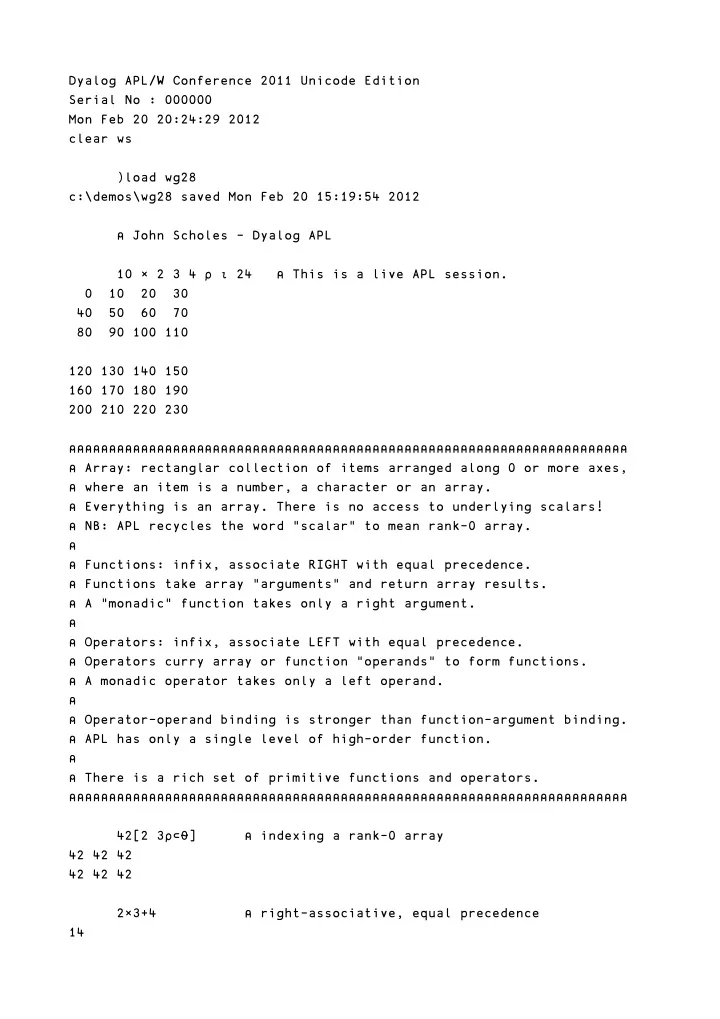
Dyalog APL/W Conference 2011 Unicode Edition Serial No : 000000 Mon Feb 20 20:24:29 2012 clear ws )load wg28 c:\demos\wg28 saved Mon Feb 20 15:19:54 2012 ⍝ John Scholes - Dyalog APL 10 × 2 3 4 ⍴ ⍳ 24 ⍝ This is a live APL session. 0 10 20 30 40 50 60 70 80 90 100 110 120 130 140 150 160 170 180 190 200 210 220 230 ⍝⍝⍝⍝⍝⍝⍝⍝⍝⍝⍝⍝⍝⍝⍝⍝⍝⍝⍝⍝⍝⍝⍝⍝⍝⍝⍝⍝⍝⍝⍝⍝⍝⍝⍝⍝⍝⍝⍝⍝⍝⍝⍝⍝⍝⍝⍝⍝⍝⍝⍝⍝⍝⍝⍝⍝⍝⍝⍝⍝⍝⍝⍝⍝⍝⍝⍝⍝⍝⍝ ⍝ Array: rectanglar collection of items arranged along 0 or more axes, ⍝ where an item is a number, a character or an array. ⍝ Everything is an array. There is no access to underlying scalars! ⍝ NB: APL recycles the word "scalar" to mean rank-0 array. ⍝ ⍝ Functions: infix, associate RIGHT with equal precedence. ⍝ Functions take array "arguments" and return array results. ⍝ A "monadic" function takes only a right argument. ⍝ ⍝ Operators: infix, associate LEFT with equal precedence. ⍝ Operators curry array or function "operands" to form functions. ⍝ A monadic operator takes only a left operand. ⍝ ⍝ Operator-operand binding is stronger than function-argument binding. ⍝ APL has only a single level of high-order function. ⍝ ⍝ There is a rich set of primitive functions and operators. ⍝⍝⍝⍝⍝⍝⍝⍝⍝⍝⍝⍝⍝⍝⍝⍝⍝⍝⍝⍝⍝⍝⍝⍝⍝⍝⍝⍝⍝⍝⍝⍝⍝⍝⍝⍝⍝⍝⍝⍝⍝⍝⍝⍝⍝⍝⍝⍝⍝⍝⍝⍝⍝⍝⍝⍝⍝⍝⍝⍝⍝⍝⍝⍝⍝⍝⍝⍝⍝⍝ 42[2 3⍴⊂⍬] ⍝ indexing a rank-0 array 42 42 42 42 42 42 2×3+4 ⍝ right-associative, equal precedence 14
SLIDE 2
2+÷-4 ⍝ "monadic" use of functions 1.75 ⍝ Function definition: {⍺ ∇ ⍵} {⌊⍵+0.5} 3.4 ¯5.6 ⍝ round to nearest 3 ¯6 3 {⍵*÷⍺} 64 125 ⍝ ⍺th root 4 5 30 {⍵=0:|⍺ ⋄ ⍵ ∇ ⍵|⍺} 105 ⍝ GCD (Euclid) 15 ⍝ Operator definition: {⍺ (⍺⍺ ∇∇ ⍵⍵) ⍵} ⍝ └────∇───┘ ÷{⍺⍺ ⍺⍺ ⍵} 4 ⍝ twice (monadic) 4 0∘≠{⍺⍺ ⍵:⍵⍵ ⍵ ⋄ 0}÷ 4 ⍝ sequential test (cf C's &&) 0.25 ⍝ We name things using ← (right-pointing finger :-) vec ← 1 2 3 ⍝ naming an array vec = 3 2 1 ⍝ cf: item-wise comparison 0 1 0 sum ← +/ ⍝ naming a "derived" (curried) function. avg ← {(+/⍵)÷⍴⍵} ⍝ naming a "defined" function ("D-fn"). sum avg¨ vec(4 5) ⍝ sum of avg mapped over a 2-vector. 6.5 ⍝ A number is a number is a number ... ⍳ 5 ⍝ first five nats 0 1 2 3 4 ⍳ 6+*○¯1*÷2 ⍝ ditto - (c) Euler 0 1 2 3 4 1=49×÷49 ⍝ tolerant comparison 1 ⍝ Many functions are shape-invariant: )copy dfns.dws easter c:\Home\dfns saved Thu Jan 26 09:52:17 2012
SLIDE 3
⎕cr'easter' ⍝ display source of easter function: easter←{ ⍝ Easter Sunday in year ⍵. G←1+19|⍵ ⍝ year golden number in 19-year Metonic cycle. C←1+⌊⍵÷100 ⍝ Century: for example 1984 → 20th century. X←¯12+⌊C×3÷4 ⍝ number of years in which leap yr omitted. Z←¯5+⌊(5+8×C)÷25 ⍝ synchronises Easter with moon's orbit. S←(⌊(5×⍵)÷4)-X+10 ⍝ find Sunday. E←30|(11×G)+20+Z-X ⍝ Epact. F←E+(E=24)∨(E=25)∧G>11 ⍝ (when full moon occurs). N←(30×F>23)+44-F ⍝ find full moon. N←N+7-7|S+N ⍝ advance to Sunday. M←3+N>31 ⍝ month: March or April. D←N-31×N>31 ⍝ day within month. ↑10000 100 1+.×⍵ M D ⍝ yyyymmdd. } easter 2012 ⍝ Easter this year April 8th 20120408 ⎕ ← vec ← ⊂[1 2]2000+2 2 3⍴⍳12 ⍝ vector of matrices 2000 2001 2002 2006 2007 2008 2003 2004 2005 2009 2010 2011 easter vec ⍝ vector of easter matrices 20000423 20010415 20020331 20060416 20070408 20080323 20030420 20040411 20050327 20090412 20100404 20110424 ⍝ Some more examples: pow ← {(⍺⍺⍣⍺)⍵} ⍝ Primitive operator ⍣ is power 0 1 ⌽pow¨ 'hello' 'world' ⍝ conditional application hello dlrow f ← (32∘+)∘(×∘1.8) ⍝ Operator ∘ is compose / curry f ¯273.15 ¯40 0 100 ⍝ Fahrenheit from Celsius ¯459.67 ¯40 32 212 c ← f⍣¯1 ⍝ ⍣¯1 is inverse c ¯459.67 ¯40 32 212 ⍝ Celsius from Fahrenheit ¯273.15 ¯40 0 100
SLIDE 4 1 +∘÷⍣≡ 1 ⍝ ⍣≡ is fixpoint 1.618033989 )copy dfns dft c:\Home\dfns saved Thu Jan 26 09:52:17 2012 +∘÷⍣≡ dft 3 ⍝ display function tree ⍣ ┌─┴─┐ ∘ ≡ ┌─┴─┐ + ÷ ⍝ NB:This section experimental - won't work in TryAPL.org ⍝ Iverson struggled for years to express calculus: f+g ⍝ And then, waking from a nap, he realised: ⍝ "Forms f+g and f×g were not used in APL ⍝ and could be introduced without conflict" ⍝ ⍝ (f g h)⍵ → ( f ⍵)g( h ⍵) ⍝ monadic "fork" ⍝ ⍺(f g h)⍵ → (⍺ f ⍵)g(⍺ h ⍵) ⍝ dyadic "fork" mean ← +/ ÷ ⍴ ⍝ mean as fork mean 1 2 3 4 2.5 mean dft 1 ⍝ display of function train ┌─┼─┐ / ÷ ⍴ ┌┘ + (+,-,×,÷)dft 1 ⍝ display of train (forks of forks) ┌─┼───┐ + , ┌─┼───┐
× , ÷ 6(+,-,×,÷)2 ⍝ vector of fns! (comma not special) 8 4 12 3 ⍝ Forks (cf S) together with primitive functions: 2⊢3 ⍝ "right" (cf I) 3 2⊣3 ⍝ "left" (cf K) 2 ⍝ and the primitive composition operator f∘g, ⍝ provide a combinator base for function/array expressions.
SLIDE 5
⍝ This means APL {...} "lambda" functions may be converted ⍝ mechanically into tacit "combinator" form. Cool or what! ⍝ Implementation ⍝ APL is usually implemented as an interpreter. ⍝ Interpretative overhead amortized over items of large array. A←0.1× 1e6?1e6 ⍝ million-item 64-bit float vector. B←0.1×1⌈1e6?1e6 )copy dfns cmpx c:\Home\dfns saved Thu Jan 26 09:52:17 2012 cmpx'A÷B' ⍝ timing in seconds (may use multiple cores). 3.4E¯2 ⍝ Dyalog "compiler" project. ⍝ Pre-evaulation of (small) constant expressions. ⍝ Elimination of local names. ⍝ Byte code. ⍝ General parse-tree topiary. ⍝ ... ⍝ Semantics: Arrays are passed by value. ⍝ Implementation: (no they're not) ⍝ APLers like to mutate their arrays: A[100?1000]←0 ⍝ replace items of A with zeros ⍝ Uses ref-counting to defer copy until/if mutation. ⍝ More modern array-languages (J) have removed this mutation ⍝ syntax in favour of a pure "merge" operator: ⍝ new ← old (selection merge) vals ⍝ but the performance considerations remain. ⍝ Traditionally, APL has (over-) indulged its users ⍝ by allowing them to: ⍝ - interrupt the evaluation of an expression, ⍝ - save the heap ("workspace") to a binary file, ⍝ - update the interpreter executable, ⍝ - reload the saved workspace, ⍝ - resume execution.
SLIDE 6
(8↑''),⊂display demo.links ⍝ What's next? ┌→────────────────────────────────────────────────────────┐ │http://TryAPL.org:8080 ⍝ Play APL + more links. │ │http://dfns.dyalog.com ⍝ Lots of sample code. │ │ │ │www.jsoftware.com ⍝ J: Iverson's successor to APL │ │www.kx.com ⍝ K: Arthur Whitney's .. .. │ │www.nars2000.org ⍝ open-source APL (Bob Smith) │ │www.smartarrays.com ⍝ commercial API for APL-style arrays│ │ │ │Dyalog conference Helsingør.DK, Oct 2012 │ │Minnowbrook.NY Array-language conference, autumn 2013? │ │ │ │At a future WG2.8 meeting, please consider inviting: │ │ │ │ Roger Hui (J) Arthur Whitney (K) │ └─────────────────────────────────────────────────────────┘ ⍝ That's all folks! Questions?