DTTF/NB479: Dszquphsbqiz Day 12 Announcements: Homework 2 returned - - PowerPoint PPT Presentation

dttf nb479 dszquphsbqiz day 12
SMART_READER_LITE
LIVE PREVIEW

DTTF/NB479: Dszquphsbqiz Day 12 Announcements: Homework 2 returned - - PowerPoint PPT Presentation

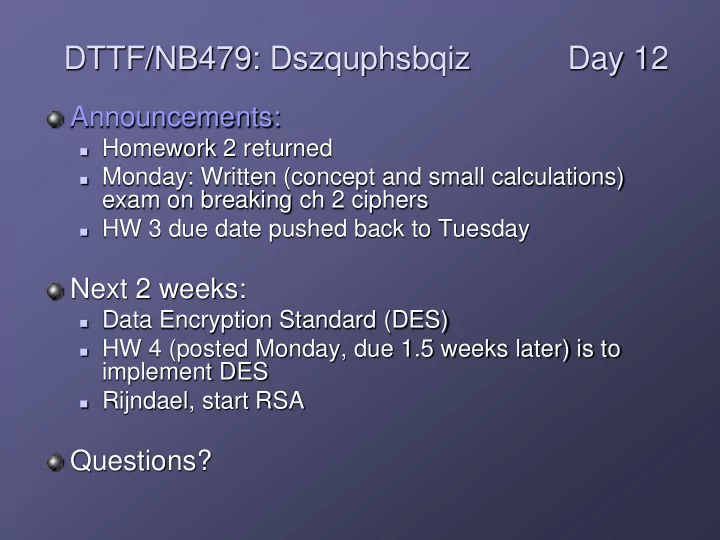
DTTF/NB479: Dszquphsbqiz Day 12 Announcements: Homework 2 returned Monday: Written (concept and small calculations) exam on breaking ch 2 ciphers HW 3 due date pushed back to Tuesday Next 2 weeks: Data Encryption Standard (DES)


slide-1
SLIDE 1

Announcements:

 Homework 2 returned  Monday: Written (concept and small calculations)

exam on breaking ch 2 ciphers

 HW 3 due date pushed back to Tuesday

Next 2 weeks:

 Data Encryption Standard (DES)  HW 4 (posted Monday, due 1.5 weeks later) is to

implement DES

 Rijndael, start RSA

Questions?

DTTF/NB479: Dszquphsbqiz Day 12

slide-2
SLIDE 2

The Chapter 2 Written Exam is next class Content:

 Written problems  Concepts of the algorithms we discussed, how they

work, how you can break them using various attacks

 Inverses of integers and matrices (mod n)  Working out some examples by hand, like 5-1 mod (7)  Anything else from ch 1-2, but nothing that will require

a computer.

Rules:

 Closed book and computer  You may bring a sheet with lettersnumbers, and

inverses mod 26.

 A scientific calculator is allowed

slide-3
SLIDE 3

DES is a block cipher

History? Full-scale version operates on 64-bit blocks

Text ASCII bit vector Block1 (64 bits) DES Encoded1 (64 bits) Encoded bit vector Block2 (64 bits) DES Encoded2 (64 bits) …

slide-4
SLIDE 4

EDEN is a toy version of DES that operates on 12-bit blocks

EDEN is a term I coined:

Easy Data Encryption Non-standard

slide-5
SLIDE 5

EDEN

Input (12 bits) L0 (6) R0 (6) f L1 (6) R1 (6)

K1(8)

f L2 (6) R2 (6)

K2(8)

Round 1 Round 2 Repeat for 8 rounds … The key, Ki for round i is derived from a 9-bit key K.

  • 1. Write L1, R1
  • 2. We can decrypt by

switching L and R and using the same procedure! (We need

  • nly to reverse the key

sequence.) Example. This is a Feistel system.

slide-6
SLIDE 6

1.

Expanders

2.

XOR with key

3.

S-boxes

Read p. 116 to help with Q1-4. Could you implement this?

EDEN’s encryption function f has the same three types of components as DES’ f

1-4

slide-7
SLIDE 7

DES has the same structure as EDEN except it uses initial permutations (IP)

Trappe &Washington, p. 125

slide-8
SLIDE 8

The initial permutation table tells at which position in the input to find the output bit

58 50 42 34 26 18 10 2 60 52 44 36 28 20 12 4 62 54 46 38 30 22 14 6 64 56 48 40 32 24 16 8 57 49 41 33 25 17 9 1 59 51 43 35 27 19 11 3 61 53 45 37 29 21 13 5 63 55 47 39 31 23 15 7

Reading permutation tables Say y = IP(x) Then y[1] = x[58], y[2] = x[50], … If y = IP-1(x), y[58] = x[1], y[50] = x[2], …

slide-9
SLIDE 9

Differences between DES & EDEN

EDEN DES 12-bit blocks 64-bit blocks Extra initial permutation IP (for efficiency in 1970’s?) 8 rounds 16 rounds E: 68 bits E: 3248 bits 9 bit key: use 8/round 64-bit key: use 56/round Also contains extra permutations, a left-shift each round, and a reduction to 48 bits each round 2 S-boxes: 43 bits each 8 S-boxes: 64 bits each f ends by permuting the 32 bits

slide-10
SLIDE 10

T&W, p. 126

5

slide-11
SLIDE 11

DES round keys involve two permutations and a left shift

K = Grab 56 permuted bits:[57, 49, 41, 33 …] Get 1100… In round 1, LS(1), so: 100 …1 Then grab 48 permuted bits: [14, 17, 11, 24, 1, 5, 3, …] Get … 1 0 …

T&W, p. 127

0 1 1 1 1 1 1 0 0 1 0 0 1 0 0 0 1 1 0 0 0 0 1 0 1 0 0 0 0 0 1 0 0 0 0 1 1 1 0 0 0 0 0 0 1 1 1 0 1 1 1 1 0 1 0 0 1 1 1 0 1 0 0 0