DTTF/NB479: Dszquphsbqiz Day 5 Announcements: Please pass in - - PowerPoint PPT Presentation

dttf nb479 dszquphsbqiz day 5
SMART_READER_LITE
LIVE PREVIEW

DTTF/NB479: Dszquphsbqiz Day 5 Announcements: Please pass in - - PowerPoint PPT Presentation

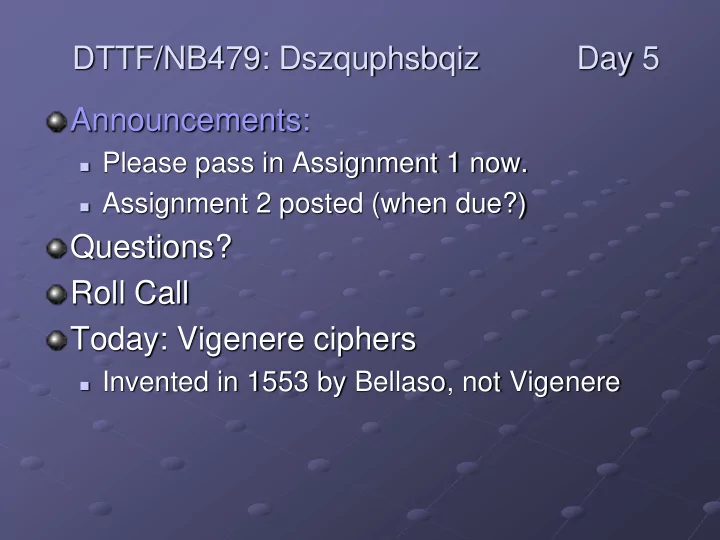
DTTF/NB479: Dszquphsbqiz Day 5 Announcements: Please pass in Assignment 1 now. Assignment 2 posted (when due?) Questions? Roll Call Today: Vigenere ciphers Invented in 1553 by Bellaso, not Vigenere Q1-2 Vigenere Ciphers Idea: the

slide-1
SLIDE 1

Announcements:

 Please pass in Assignment 1 now.  Assignment 2 posted (when due?)

Questions? Roll Call Today: Vigenere ciphers

 Invented in 1553 by Bellaso, not Vigenere

DTTF/NB479: Dszquphsbqiz Day 5

slide-2
SLIDE 2

Idea: the key is a vector of shifts

 The key and its length are unknown to Eve

Encryption:

 Repeat the vector as many times as needed to get

the same length as the plaintext

 Add this repeated vector to the plaintext.

Example:

 Key = hidden (7 8 3 3 4 13).

The recent development of various methods of

7 8 3 3 413 7 8 3 3 413 7 8 3 3 413 7 8 3 3 413 7 8 3 3 4 13 7 8 3 3 413 7 8 015 7 20 815112122 6 8 811191718161720 1 17 8 25132416172322 2511 11017 7 5 2113

aph uiplvw giiltrsqrub ri znyqrxw zlbkrhf vn

 Demo

Vigenere Ciphers

Q1-2

Key

slide-3
SLIDE 3

The shift vector isn’t known (of course)

  • 1. It’s length isn’t even known!
  • 2. With shift ciphers, the most frequent cipher

letter is probably e.

 But here, e maps to H, I, L, … (spread out!)

Consider 4 attacks:

 Known plaintext?  Chosen plaintext?  Chosen ciphertext?  Ciphertext only?

Security

Q3

slide-4
SLIDE 4

English letter frequencies

A 0.082 B 0.015 C 0.028 D 0.043 E 0.127 F 0.022 G 0.020 H 0.061 I 0.070 J 0.002 K 0.008 L 0.040 M 0.024 N 0.067 O 0.075 P 0.019 Q 0.001 R 0.060 S 0.063 T 0.091 U 0.028 V 0.010 W 0.023 X 0.001 Y 0.020 Z 0.001 Graph:

5 10 15 20 25 30 0.02 0.04 0.06 0.08 0.1 0.12 0.14

slide-5
SLIDE 5

Ciphertext-only attack

Assume you know the key length, L. Make any other assumptions you need. Take 3-4 min with a partner and devise a method to break Vigenere.

Q4

slide-6
SLIDE 6

Perhaps yours looks something like this?

Assume we know the key length, L, …

 We’ll see how to find it shortly

Method 1:

 Parse out the characters at positions p = i (mod L)

These have all been shifted the same amount Do a frequency analysis to find shift

 The most frequent letter should be e, given enough text. Can

verify to see how shift affects other letters.

 This gives the first letter of the key  Repeat for positions p = 2, p = 3, … p = L  Problem: involves some trial and error.  For brute force to work, would need to brute force all

letters of key simultaneously: _____ possibilities

slide-7
SLIDE 7

Dot products

Consider A = (0.082 0.015 0.028 0.043 0.127 0.022 0.020 0.061 0.070 0.002

0.008 0.040 0.024 0.067 0.075 0.019 0.001 0.060 0.063 0.091 . 0.028 0.010 0.023 0.001 0.020 0.001);

Ai = A displaced i positions to the right A0 = (0.082 0.015 0.028 …

0.001 0.020 0.001)

A1 = (0.001 0.082 0.015 0.028 …

0.023 0.001 0.020)

A2 = (0.020 0.001 0.082 0.015 0.028 … 0.023 0.001) A0 .* A1 = 0.039 A0 .* A0 = 0.066 Ai .* Aj depends on _____ only. Max occurs when _____. 3 reasons why:

5 10 15 20 25 30 0.02 0.04 0.06 0.08 0.1 0.12 0.14 5 10 15 20 25 30 0.02 0.04 0.06 0.08 0.1 0.12 0.14

  

i i iB

A B A B A * . Q5-6

slide-8
SLIDE 8

Towards another method

Method 1

 Parse out the characters at positions p = 1

(mod L)

These have all been shifted the same amount Do a frequency analysis to find shift

 The most frequent letter should be e, given enough text.

Can verify to see how shift affects other letters.

 This gives the first letter of the key  Repeat for positions p = 2, p = 3, … p = L

slide-9
SLIDE 9

Another method

Method 2

 Parse out the characters at positions p = 1

(mod L)

These have all been shifted the same amount Get the whole freq. distribution W = (0.05, 0.002, …)

 W approximates A. Calculate  Max occurs when we got the shift correct.

 This gives the first letter of the key  Repeat for positions p = 2, p = 3, … p = L  Demo

25    i for A W

i

slide-10
SLIDE 10

Method 2 is more robust since it uses the whole letter distribution

Find dot product of Ai: and W:

5 10 15 20 25 30 0.02 0.04 0.06 0.08 0.1 0.12 0.14 5 10 15 20 25 30 0.02 0.04 0.06 0.08 0.1 0.12 0.14 5 10 15 20 25 30 0.02 0.04 0.06 0.08 0.1 0.12 0.14 5 10 15 20 25 30 0.02 0.04 0.06 0.08 0.1 0.12 0.14 5 10 15 20 25 30 0.02 0.04 0.06 0.08 0.1 0.12 0.14

Q7-8

More robust than just using 1 letter (‘e’)… …but harder to compute by hand.

slide-11
SLIDE 11

Finding the key length

What if the frequency of letters in the plaintext approximates A? Then for each k, the frequency of each group of letters in position p = k (mod L) in the ciphertext approximates A. Then loop, displacing the ciphertext by i, and counting the number of matches.

 Get max when displace by correct key length  So just look for the max number of matches!

displacement APHUIPLVWGIILTRSQRUBRIZNYQRXWZLBKRHFVN (0) NAPHUIPLVWGIILTRSQRUBRIZNYQRXWZLBKRHFV (1) 1 match VNAPHUIPLVWGIILTRSQRUBRIZNYQRXWZLBKRHF (2) 0 matches … KRHFVNAPHUIPLVWGIILTRSQRUBRIZNYQRXWZLB (6) 5 matches

slide-12
SLIDE 12

Key length: an example

Take any random pair in the ciphertext: The letter in the top row is shifted by i (say 0) The letter in the bottom row is shifted by j (say 2)

Prob(both ‘A’) = P(‘a’)*P(‘y’) = 0.082 * 0.020 Prob(both ‘B’) = P(‘b’)*P(‘z’) = 0.015 * 0.001 Prob both same (any letter) is ___ or generally ___ Recall, this is maximum when ______ When are each letter in the top and bottom rows shifted by same amount?

A0 = (0.082 0.015 0.028 …

0.001 0.020 0.001)

A2 = (0.020 0.001 0.082 0.015 0.028 … 0.023 0.001)

slide-13
SLIDE 13

Still a bit fuzzy?

Nothing like implementation to aid understanding!

 Homework 2: Program it  Third week programming quiz: use your

program to decrypt a message