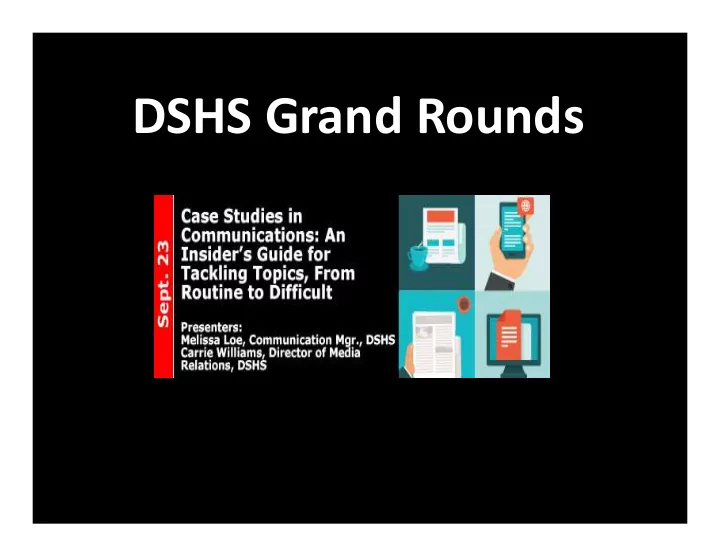
DSHS Grand Rounds . Logistics Registration for free continuing - - PowerPoint PPT Presentation

dshs grand rounds
SMART_READER_LITE
LIVE PREVIEW

DSHS Grand Rounds . Logistics Registration for free continuing - - PowerPoint PPT Presentation

DSHS Grand Rounds . Logistics Registration for free continuing education (CE) hours or certificate of attendance through TRAIN at: https://tx.train.org Streamlined registration for individuals not requesting CE hours or a certificate of attendance


slide-1
SLIDE 1

.

DSHS Grand Rounds

slide-2
SLIDE 2

Logistics

2

Registration for free continuing education (CE) hours or certificate of attendance through TRAIN at: https://tx.train.org Streamlined registration for individuals not requesting CE hours

  • r a certificate of attendance
  • 1. webinar: http://www.dshs.state.tx.us/grandrounds/webinar‐no‐CE.shtm
  • 2. live audience: sign in at the door

For registration questions, please contact Laura Wells, MPH at CE.Service@dshs.state.tx.us

slide-3
SLIDE 3

Logistics (cont.)

3

Slides and recorded webinar available at: http://www.dshs.state.tx.us/grandrounds Questions? There will be a question and answer period at the end of the presentation. Remote sites can send in questions throughout the presentation by using the GoToWebinar chat box or email GrandRounds@dshs.state.tx.us. For those in the auditorium, please come to the microphone to ask your question. For technical difficulties, please contact: GoToWebinar 1‐800‐263‐6317(toll free) or 1‐805‐617‐7000

slide-4
SLIDE 4

Disclosure to the Learner

4

Requirement of Learner Participants requesting continuing education contact hours or a certificate of attendance must register in TRAIN, attend the entire session, and complete the online evaluation within two weeks of the presentation. Commercial Support This educational activity received no commercial support. Disclosure of Financial Conflict of Interest The speakers and planning committee have no relevant financial relationships to disclose. Off Label Use There will be no discussion of off‐label use during this presentation. Non‐Endorsement Statement Accredited status does not imply endorsement by Department of State Health Services ‐ Continuing Education Services, Texas Medical Association, or American Nurses Credentialing Center of any commercial products displayed in conjunction with an activity.

slide-5
SLIDE 5

5

Additional Readings

For full text articles, please e-mail the DSHS Medical and Research Library (Library@dshs.state.tx.us)

  • 1. Bartlett C, Wurtz R. Twitter and public health. J Public Health Manag Pract. 2015;21(4):375‐83.

doi: 10.1097/PHH.0000000000000041.

  • 2. Del Vento A, Bavelas J, Healing S, MacLean G, Kirk P. An experimental investigation of the

dilemma of delivering bad news. Patient Education & Counseling. 2009;77(3):443‐449. doi:10.1016/j.pec.2009.09.014.

  • 3. Edworthy J, Hellier E, Newbold L, Titchener K. Passing crisis and emergency risk

communications: the effects of communication channel, information type, and repetition. Applied Ergonomics. 2015;48:252‐262. doi:10.1016/j.apergo.2014.12.009.

  • 4. Graham M, Avery E, Park S. The role of social media in local government crisis
  • communications. Public Relations Review. 2015;41(3):386‐394.

doi:10.1016/j.pubrev.2015.02.001.

  • 5. Remington, P. Communicating public health information effectively: a guide for practitioners.

Washington, DC: American Public Health Association; 2002

slide-6
SLIDE 6

Introductions

6

Kirk Cole DSHS Interim Commissioner is pleased to introduce our DSHS Grand Rounds speaker

slide-7
SLIDE 7

7

Carrie Williams Director of Media Relations, DSHS

Case Studies in Communications: An Insider’s Guide for Tackling Topics, From Routine to Difficult

Melissa Loe Communications Manager, DSHS

slide-8
SLIDE 8

8

Participants should be able to:

1. Identify and apply many of the key communications lessons to their

  • wn planning and response efforts for any crisis, routine event or

sensitive topic. 2. Consider various communication methods to deliver clear, concise information to a variety of audiences. 3. Identify communications pitfalls and factors that influence message effectiveness, including plain language, accuracy and timing.

Learning Objectives

slide-9
SLIDE 9

Case Studies in Communications

An Insider’s Guide For Tackling Tough Topics, From Routine to Difficult

slide-10
SLIDE 10

Melissa Loe

Communications Manager

Carrie Williams

Media Relations Director Texas Department of State Health Services Grand Rounds Sept. 23, 2015

@TexasDSHS

slide-11
SLIDE 11
  • Drives how people see you
  • Saves lives

Why Good Communication?

slide-12
SLIDE 12
  • Helps avoid error, frustration,

misuderstanding

Why Good Communication?

slide-13
SLIDE 13
  • Key to success in life and relationships
  • Key to doing a good job

Why Good Communication?

slide-14
SLIDE 14
  • Why good communication matters
  • Evolution of communication platforms
  • Elements of good communication
  • Case studies:

–WIC –Blue Bell –Speak Your Mind Texas –Texas Ebola

What We’re Going to Cover

slide-15
SLIDE 15
  • Crisis communications tips
  • TV tips
  • What you can do now

What We’re Going to Cover

slide-16
SLIDE 16

Social media is here to stay

Communication Platforms

slide-17
SLIDE 17

Facebook

Communication Platforms

slide-18
SLIDE 18

Twitter

Communication Platforms

slide-19
SLIDE 19

News Media

  • Daily newspapers
  • 24/7 news cycle
  • Tweeting/blogging reporters
  • Reaches the masses
  • How you respond may become the news

Communication Platforms

slide-20
SLIDE 20

“Dear government agency: Ignoring me is not going to make me go away. It's going to make me annoy you even more. Choose your path wisely.”

Tweet from Dallas Morning News Reporter

Communication Platforms

slide-21
SLIDE 21

“Health department officials did not immediately return calls seeking comment.”

Associated Press

“Note to Texas agencies: Quit releasing records at 5 p.m. on Friday. I don't mind staying late and writing what the records show.”

Tweet from Houston Chronicle Reporter

Communication Platforms

slide-22
SLIDE 22
  • Identify a need and goal
  • Craft your message
  • Channel: go to your audience
  • Evaluate

Elements of Good Communication

slide-23
SLIDE 23

Craft your message

  • Clear
  • Concise

Elements of Good Communication

slide-24
SLIDE 24
  • Fast
  • Helpful
  • Credible
  • Complete
  • Context
  • Available, responsive

Elements of Good Communication

slide-25
SLIDE 25
  • Trust and human error
  • Relationships
  • Honesty

Elements of Good Communication

slide-26
SLIDE 26

Case Study: WIC

slide-27
SLIDE 27

Key Challenges

  • Participation rates declining
  • Lack of awareness, understanding

Key Messages

  • WIC is mom’s partner
  • WIC helps you raise amazing kids

WIC

slide-28
SLIDE 28

Initial Messages

  • Not empowering
  • Not respectful

WIC

slide-29
SLIDE 29

Initial Messages

  • Not clear

WIC

slide-30
SLIDE 30

Final Messages

  • “Real” is relatable to moms and their lives
  • Positive connection

WIC

slide-31
SLIDE 31

Key Takeaways

  • Listen to your audience
  • Adjust your message as needed

WIC

slide-32
SLIDE 32

On April 20, Blue Bell recalled all of its ice cream.

Case Study: Blue Bell

slide-33
SLIDE 33

Key Challenges

  • Iconic Texas company
  • Loyal following
  • Multiple states
  • Incremental
  • Low-risk food

Blue Bell Recall

slide-34
SLIDE 34

What We Knew

  • Outbreak included deaths
  • People wanted Blue Bell
  • The story had legs
  • Inspections had issues
  • Needed appropriate action
  • Needed balanced message

Blue Bell Recall

slide-35
SLIDE 35

Key Messages

  • Discard or return product
  • We have a firm plan
  • Blue Bell is cooperative
  • We can ensure compliance
  • But, one thing we couldn’t answer

Blue Bell Recall

slide-36
SLIDE 36

Key Takeaways

  • Take action and explain it
  • Do the right thing
  • Be transparent
  • Acknowledge public concern/allegiance
  • Be OK with tangental questions (but focus on

core messages)

Blue Bell Recall

slide-37
SLIDE 37

Case Study: Speak Your Mind

slide-38
SLIDE 38

Audience

  • Youth age 12-25 years
  • Youth support systems

Key Messages

  • Teen mental health and substance use are

prevalent public health issues

  • Help is available
  • Recovery is possible

Speak Your Mind Texas

slide-39
SLIDE 39

Key Challenges

  • “Typical teen behavior”
  • Sensitive subject

Speak Your Mind Texas

slide-40
SLIDE 40

Speak Your Mind Texas

Video Clip

Video Clip

slide-41
SLIDE 41

Speak Your Mind Texas

slide-42
SLIDE 42

Results

  • Increased awareness: social media engaged

more than 168,000 users and got more than 24,000 “likes”’

  • Shared resources: website received more

than 188,000 visits

  • People received help: calls to hotline related

to mental health and substance use increased by 68 percent

Speak Your Mind Texas

slide-43
SLIDE 43

On Sept. 30, Texas confirmed the first case of Ebola diagnosed in the United States.

Case Study: Texas Ebola

slide-44
SLIDE 44

What We Knew

  • Public health emergency
  • Our single case could impact entire country
  • Our mission: prevent community spread

Texas Ebola

slide-45
SLIDE 45

Key Challenges

  • And then it was here
  • Scary disease, wrong info
  • Multiple jurisdictions

Texas Ebola

slide-46
SLIDE 46

Key Challenges

  • Rumors
  • Story control

Texas Ebola

slide-47
SLIDE 47

Key Challenges

  • Difficult messages
  • Cognitive dissonance
  • How safe is safe enough?

Texas Ebola

slide-48
SLIDE 48

Key Strategies

  • Absolute candor
  • Err on the spectrum of doing more
  • Remember core mission

Texas Ebola

slide-49
SLIDE 49

Key Takeaways

  • Quickly recognize crisis
  • Find the data
  • Reach big audiences
  • Not business as usual
  • Promote milestones

Texas Ebola

slide-50
SLIDE 50

Key Takeaways

  • Don’t underestimate the power of good news
  • Public health worked

Texas Ebola

slide-51
SLIDE 51

10 Tips For Any Crisis

  • 1. Be fast, say something
  • 2. Be OK with overreaction, uncertainty
  • 3. Remember your core mission
  • 4. Funnel what’s new, what’s needed
  • 5. Own your own errors
slide-52
SLIDE 52

10 Tips For Any Crisis

  • 6. Prepare to be second-guessed
  • 7. Do the right thing; actions speak
  • 8. Numbers and data make you accountable
  • 9. Maintain calm demeanor
  • 10. Deliver good news, too
slide-53
SLIDE 53

5 Things You Can Do Now to Get Ready for a Crisis

  • 1. Envision the worst crisis
  • 2. Identify big team
  • 3. Plan, drill
  • 4. Make a case now for being at the table
  • 5. Use what’s out there
slide-54
SLIDE 54

TV Spokesperson Training in 3 Minutes or Less

  • Act natural, be yourself
  • Embody the agency
  • Look at the reporter
  • Know your audience

(it’s not the reporter)

slide-55
SLIDE 55
  • What do you need to say, and why?
  • You are not your target audience
  • Plain language, plain language, plain language
  • Listen
  • Adjust

Key Takeaways

slide-56
SLIDE 56
  • If you only remember three things:
  • Be confident: you are the subject matter expert
  • Keep it simple
  • Be open to feedback
  • Questions

In Closing

slide-57
SLIDE 57

Questions and Answers

Remote sites can send in questions by typing in the GoToWebinar chat box or email GrandRounds@dshs.state.tx.us. For those in the auditorium, please come to the microphone to ask your question.

57

Ricky Garcia, Director Center for Policy and External Affairs, DSHS

slide-58
SLIDE 58