SLIDE 1
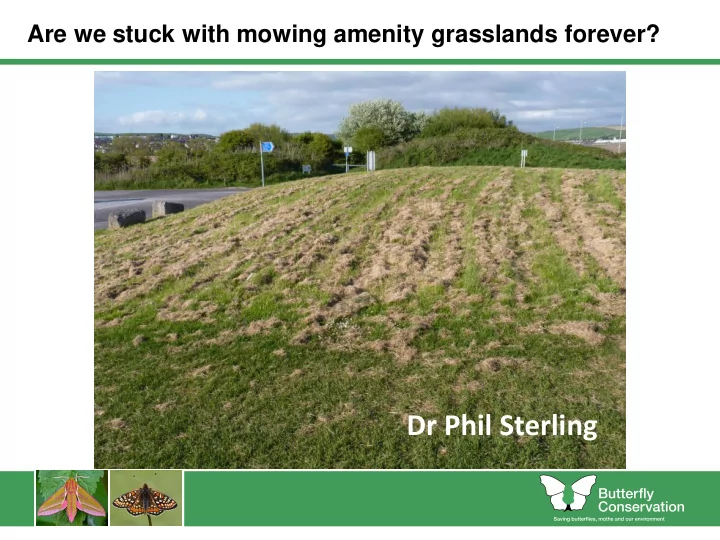
Are we stuck with mowing amenity grasslands forever?
Dr Phil Sterling
SLIDE 2 An ecological approach to amenity grass management
- If we can control the amount grass grows in the first place,
we will have less to cut
- If we have less to cut, mowing should cost us less, and we
can spend more time on other jobs, and
- There will be more biodiversity because more species thrive
in poorer soils
- Response to austerity; ‘Climate Emergency’; C-reduction
targets; topsoil conservation; response to public awareness
SLIDE 3 Can we control the factors that make grass grow?
Rainfall – no control Sunshine – no control Temperature – no control Soil fertility – we can control
SLIDE 4
What does soil fertility do to grassland? Thick topsoil – coarse grasses dominate – high fertility – few gaps for germination Thin topsoil / no topsoil – fine grasses & herbs – low fertility – plenty gaps for germination
SLIDE 5 Happy coincidence
Our best grasslands for wildflowers, bees and butterflies develop on the poorest soils Lots of plants are able to compete for what nutrients are available Coarse grasses can’t dominate
SLIDE 6
Construction: Weymouth Relief Road, Dorset 2009 – 2011
SLIDE 7
Low fertility verges designed in 15mm topsoil or no topsoil Wildflower seed hand sown
SLIDE 8
2013
SLIDE 9
2019
SLIDE 10
Grassland management - 2 systems
Mow & leave arisings – lots of coarse grasses, few wildflowers Cut & collect – fine grasses, lots of wildflowers
SLIDE 11
The Grillo: ideal for cut-and-collect in urban areas Grillo FD2200 (Hydrostatic Out-front Mower)
SLIDE 12
3 x cut & collect in 2017 reduces coarse grasses and favours fine grasses - this is mid-May in 2018
Establishing wildflowers in amenity grass - reduce fertility first
SLIDE 13
Disposal on site
SLIDE 14
Disposal out of town on highway land, hidden in the bramble thickets
SLIDE 15 People now see common wildflowers on urban grasslands
work or the shops. These wildflowers support insects such as common butterflies and bumblebees. Previously this verge was mown 5 times a year and supported almost no wildlife at all
SLIDE 16
Once regularly mown amenity grass, cut-and-collect started 2017, seeded in autumn 2017, now wildflower meadow in 2019
SLIDE 17
Typical urban verge in Blandford after 2 years cut/collect
SLIDE 18
A354 Blandford Bypass verges County Wildlife Site after 5 years cut-and-collect
SLIDE 19
Let your community know what’s happening
SLIDE 20
North Dorset verges cut by DCC staff – just 2x in 2018
SLIDE 21 The annual budget for highway verge management at Dorset Council is reducing year-on-year based on adoption of an ecological approach
SLIDE 22 Taking an ecological approach - conclusions
- If we reduce the amount grass grows in the first place
there’s less to cut, and
- We mirror natural conditions for flower-rich grasslands
- Low fertility can be achieved by design & management
- Saves money / staff can be redeployed more usefully
- The ecological approach will deliver a buzz in our towns &
cities on any amenity grassland at any scale