Dr Dr. . Gus Gustavo Arcin iniegas GEO|Design+BIM, 1-2 November, - - PowerPoint PPT Presentation

dr dr gus gustavo arcin iniegas
SMART_READER_LITE
LIVE PREVIEW

Dr Dr. . Gus Gustavo Arcin iniegas GEO|Design+BIM, 1-2 November, - - PowerPoint PPT Presentation

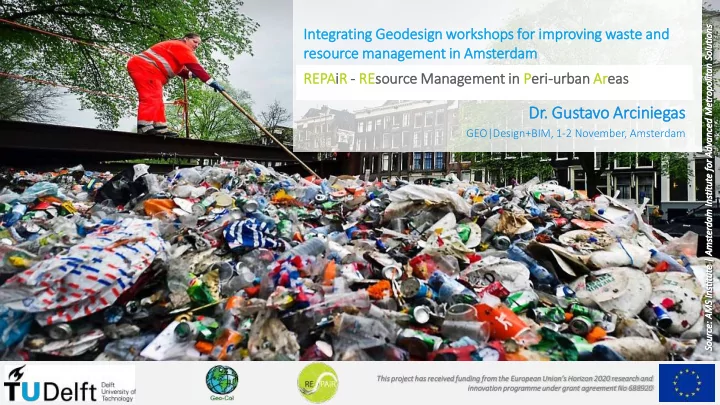
Integratin ing g Geod Geodesig ign wor orkshop ops for or imp mprovin ing g was aste and and reso esource ma management in n Ams Amsterdam REP REPAiR R - RE REsource Man Management in n Per eri-urban Ar Areas eas Dr Dr.


slide-1
SLIDE 1

Integratin ing g Geod Geodesig ign wor

  • rkshop
  • ps for
  • r imp

mprovin ing g was aste and and reso esource ma management in n Ams Amsterdam REP REPAiR R - RE REsource Man Management in n Per eri-urban Ar Areas eas

Dr Dr. . Gus Gustavo Arcin iniegas

GEO|Design+BIM, 1-2 November, Amsterdam

This project has received funding from the European Union’s Horizon 2020 research and inno nnova vati tion

  • n pr

prog

  • gramme unde

under gr grant ant agr agreement t No

  • 68892

688920

slide-2
SLIDE 2

Content

  • Geodesign in short
  • The Circularity Gap
  • The REPAiR Project approach
  • The Amsterdam Metropolitan Area

Peri-Urban Living Lab

slide-3
SLIDE 3

Geodesign in short

slide-4
SLIDE 4

Geodesign in short: addressing six questions

1. How should the area be described? Representation models 2. How does the study area operate? Process Mod

  • dels

ls 3. Is the current study area working well? Evaluati tion Mod

  • dels

4. How might the study area be altered? Ch Change e Mod

  • del

els 5. What differences might the changes cause? Im Impact Mod

  • dels

ls 6. How should the study area be changed? De Decision Mod

  • dels

ls

Source: Steinitz, C. A Framework for Geodesign. 2012. Redlands, Esri press.

slide-5
SLIDE 5

The Circularity Gap: From a Linear to a Circular Economy

slide-6
SLIDE 6

From a Linear to a Circular Economy

A linear economy converts natural resources into waste via production. In a circular economy, there will be no loss of value and the net effect on the environment will be zero.

source: https://www.ellenmacarthurfoundation.org

slide-7
SLIDE 7

Circular Economy

The Ellen MacArthur Foundation’s

diagram: looking beyond the tak

ake- ma make-dis ispos

  • se extractive industrial

model

The principles: Design out waste and pollution Keep resources in use Regenerate natural systems

source: https://www.ellenmacarthurfoundation.org

slide-8
SLIDE 8

REPAiR project

slide-9
SLIDE 9

REPAiR - REsource Management in Peri-urban Areas: Going Beyond Urban Metabolism

+ =

slide-10
SLIDE 10

This project has received funding from the European Union’s Horizon 2020 research and innovation programme under grant agreement No 688920

RE REPAiR R - RE REsource Man anagement in in Peri-urban Ar Areas: Go Goin ing Beyond Urb rban Metaboli lism

Horizon 2020 SO SOCI CIETAL CHA CHALLENGES topic Waste-6b-2015 Eco-innovative Strategies Principal Investigator: Prof. Dr. Arjan van Timmeren Scientific Coordinator: DI Alexander Wandl, MSc

slide-11
SLIDE 11

Participant (Acronym) Country Delft University of Technology (TUD) NL Ghent University (UG) BE DiARC UNINA - University of Naples Federico II (UNINA) I HafenCity Universität Hamburg (HCU) D Institute for Regional Studies, CERS of HAS, MTA KRTK (RKI) H Institute of Geography and Spatial Organization Polish Academy of Sciences (IGiPZ) PL Joint Research Centre (JRC) I Geo-Col GIS and Collaborative Planning (Geo-Col) NL Delta Development Group (DELTA) NL BIOKOM Nonprofit Ltd (BIOKOM) H Gertz Gutsche Rümenapp Stadtentwicklung und Mobilität GbR (GGR) D OVAM - Public Waste Agency of Flanders (OVAM) BE Municipality of Haarlemmermeer (GHM) NL Campania Regional Authority (CRA) I Pheno horizon (PHH) PL Bauer Umwelt GmbH (BMU) D/I IVAGO (IVAGO) BE Stadtreinigung Hamburg (SRH) D

RE REPAiR R | | RE REsource Mana anagement in in Peri eri-urban Ar Areas as: : Goi

  • ing Be

Beyond Urban Metabolism

This project has received funding from the European Union’s Horizon 2020 research and innovation programme under grant agreement No 688920

slide-12
SLIDE 12

Goal of REPAiR

To develop, test and implement a geodesign decision support environment (GDSE) for the development of integrative spatial development strategies that understand waste and related treatment processes as a resource.

This project has received funding from the European Union’s Horizon 2020 research and innovation programme under grant agreement No 688920

slide-13
SLIDE 13

RE REPAiR R | | RE REsource Mana anagement in in Peri eri-urban Ar Areas as: : Goi

  • ing Be

Beyond Urban Metabolism

This project has received funding from the European Union’s Horizon 2020 research and innovation programme under grant agreement No 688920

Framework of Geodesign (Steinitz 2012)

REPAiR Approach

REP REPAiR integrates life cycle thinking and geodesign to operationalise urban metabolism

slide-14
SLIDE 14

How?

Through the implementation of living labs in peri-urban areas across Europe in order to develop, test, implement and assess place-specific eco-innovative solutions for resource management to improve environmental and spatial quality and quality of life.

This project has received funding from the European Union’s Horizon 2020 research and innovation programme under grant agreement No 688920

slide-15
SLIDE 15

What are Urban Living Labs?

Living labs are “user-centered, open innovation ecosystems based on a systematic user co-creation approach in public– private–people partnerships, integrating research and innovation processes in real-life communities and settings”

slide-16
SLIDE 16

Eco-Innovative Strategies

Alternative courses of action aimed at addressing both specific

  • bjectives and challenges identified within a PULL towards the

development of innovation towards circularity in peri-urban areas.

The Strategy can be composed of a systemic integration of two or more elementary actions, namely Eco-Innovati tive Solu

  • luti

tions (EIS).

This project has received funding from the European Union’s Horizon 2020 research and innovation programme under grant agreement No 688920

slide-17
SLIDE 17

Eco-Innovative Solutions

are creative and smart ideas aimed to innovate and improve a specific and fixed process in relation of the management of waste as a resource.

This project has received funding from the European Union’s Horizon 2020 research and innovation programme under grant agreement No 688920

slide-18
SLIDE 18

A sim simple Eco-innovative Solut

  • lution

From

  • m br

bread was aste e to

  • Beer

eer

Grant Agreement No.: 688920 REP

REPAiR - RE REso source Management t in Peri-urban AR AReas

Courtesy the Glad Café and Brewdog

slide-19
SLIDE 19

Spa patia ial Develo elopment Str trategy Including Eco-innovative e Solut

  • lution

Grant Agreement No.: 688920 REP

REPAiR - RE REso source Management t in Peri-urban AR AReas

Courtesy: W. ter Hijden, W. Zonghao. D. Hegyi, B.Bathena TU Delft Students.

slide-20
SLIDE 20

The Amsterdam Metropolitan Area Peri-Urban Living Lab

slide-21
SLIDE 21

The Amsterdam Metropolitan Area

The Netherlands

slide-22
SLIDE 22

Peri-Urban Living Labs (PULLs)

Consist of meetings, each structured differently in terms of type and participants

  • Each PULL involves a series of workshops with stakeholders from the field of

waste and resource management who participate in a co-design process for solutions and strategies

  • Providing these stakeholders with a common platform of information and

solution design options is the core task of a computerized interactive communication tool: Geodesign Decision Support Environment (GDSE)

  • The GDSE support the tasks in each PULL workshop
slide-23
SLIDE 23

How are Eco-Innovative Solutions developed?

  • CE Challenges are identified for key flows in the AMA
  • Initial EIS are brainstormed in the first PULL workshops
  • Selected EIS to respond to the challenges are collected:
  • REPAiR research team, partners and advisory board
  • Literature and practice: State of the art
  • MSc Students: industrial ecology, architecture, urbanism
  • Stakeholders at PULL workshops
  • Final EIS are assessed and eventually modified using the GDSE

This project has received funding from the European Union’s Horizon 2020 research and innovation programme under grant agreement No 688920

slide-24
SLIDE 24

Peri-Urban Living Lab (PULL)

Five phases of PULL workshops:

  • 1. Co-exploration
  • 2. Co-design
  • 3. Co-production
  • 4. Co-Decision
  • 5. Co-Governance
slide-25
SLIDE 25

Peri-Urban Living Lab (PULL)

Five phases of PULL workshops:

  • 1. Co-exploration
  • 2. Co-design
  • 3. Co-production
  • 4. Co-decision
  • 5. Co-governance
slide-26
SLIDE 26

Geodesign framework

1. How should the area be described? Represe sentation mod

  • dels

ls 2. How does the study area operate? Proce

  • cess Mod
  • dels

3. Is the current study area working well? Eval aluation Mod

  • dels

4. How might the study area be altered? Cha hange Mod

  • dels

5. What differences might the changes cause? Im Impact Mod

  • dels

ls 6. How should the study area be changed? Decis ecisio ion Mod

  • dels

ls

slide-27
SLIDE 27

Geodesign in a PULL

slide-28
SLIDE 28

Phase 1. Co-Exploration

Geodesign questions Geodesign phases Topics

How should the study area be described?

Representation Model

Definition and mapping of Region - Focus, and Sample Areas Definition and mapping of Wastescapes Definition of stakeholders and experts How does the study area

  • perate?

Process s Model

Selection of key resource flows Definition and mapping of material flows and waste management system

GD GDSE Appli lication Poin

  • int 1

Common understanding of the territory developed Categorized + defined main challenges / problems and objectives established

slide-29
SLIDE 29

Geodesign in a PULL

GDSE Application Point #1

slide-30
SLIDE 30
slide-31
SLIDE 31
slide-32
SLIDE 32
slide-33
SLIDE 33
slide-34
SLIDE 34

Workshop 1: Co-Exploration

Place image credits here

De Defin inin ing key ch chall llenges

  • Verify challenges already identified
  • Add new challenges
  • Develop main challenges to detailed level
  • Suggest solution paths
slide-35
SLIDE 35

Materials: Challenge Trees - before and after

Place credits here Place credits here

Challenge tree

Challenge tree with feedback

slide-36
SLIDE 36

Results: CE challenges and solution paths

Chal alleng enge Solut ution

  • n Path

Lack of data

Guidelines for information sharing

Mistrust between municipalities

More balanced governance / voice to smaller municipalities

Taxation: lack of incentives

Taxing waste production

Building regulations

Reform to allow use of circular materials

Spatial planning regulations

Make CE a goal in SP

Circular tendering: no criteria and experience

Agreement on alignment of municipal tenderiing rules to promote CE

Plastic Bottles

Reusing strategies / bioplastic

CDW: focus on refurbishment

Reduce waste and negative impacts

Organic/ FW: collection from actors and with different compositions

Separate collection of FW flows for better reuse

Wastescapes: buffer zones: Schiphol and Harbor of Amsterdam

Innovative ideas for wastescapes, mitigating risks for human health

slide-37
SLIDE 37

Phase 2. Co-Design

Geodesign questions Geodesign phases Topics

Is the current study area working well?

Evaluatio ion Model Sustainability assessment of the status quo

Assessment of the status quo resource flow circularity How might the study area be modified?

Ch Change Model

Definition and common understanding of what constitutes an EIS Characteristics and effect of EIS on the process model

GDS DSE Appli lication Poin

  • int 2

Identified, mapped and visualized key activities and actors in the value chains that should be included into the discussion and development of EIS

Identified specific challenges and problems Identified and mapped actor network for individual EIS

slide-38
SLIDE 38

GDSE Application Point #2

slide-39
SLIDE 39
slide-40
SLIDE 40
slide-41
SLIDE 41
slide-42
SLIDE 42
slide-43
SLIDE 43

Sustainability framework to assess EIS

Final set of impact categories selected

slide-44
SLIDE 44
slide-45
SLIDE 45

Workshop 2: Co-Design

Place image credits here

De Developin ing fir first so solu lution id ideas as

  • Develop first set of solutions based on

defined objectives

  • Confirm / Rank objectives in the AMA
slide-46
SLIDE 46

Materials: Eco-Innovation Sheet - before

SYSTEM DI DIAGRAM OF ACTIVITIES AND FLOWS EXIS ISTING SIT ITUATION CE CE DIA DIAGRAM SOLUTION CA CARD

slide-47
SLIDE 47

Materials: Eco-Innovation Sheet - after

slide-48
SLIDE 48

Results: EIS developed and discussed

Eco-Innovative Solu Solution

Reuse areas within noise and safety contour from airport, port, railways and roads, increase the quality and quantity of natural green areas (biodiversity) Concentrating green houses, reuse other green houses Alternatives to the predetermined (big) portions at supermarkets Smart biorefinery Separation of plant-based and animal-based OW Rethinking the chain - start with the requirements for the end-product CE Business models Circular tendering: Public-private (urban area) development Open and secure material exchange Cross sectoral material and process platform

slide-49
SLIDE 49

Phase 3. Co-Production

Geodesign questions Geodesign phases Topics

How might the study area be modified?

Cha Change Model EIS and Eco-Innovative strategies

Expert meetings on EIS

How should the study area be changed?

Dec Decisio ion Model

Relating EIS to objectives Ranking of objectives Pairwise comparison of the relative importance of sustainability indicators Defining the targets

GDS GDSE App pplicatio ion Poin

  • int 3

Ranked objectives Weights of the sustainability indicators Set and assessment of flow targets Selected EIS and defined Eco-Innovative Strategies

slide-50
SLIDE 50

GDSE Application Point #3

slide-51
SLIDE 51
slide-52
SLIDE 52
slide-53
SLIDE 53
slide-54
SLIDE 54
slide-55
SLIDE 55
slide-56
SLIDE 56
slide-57
SLIDE 57
slide-58
SLIDE 58
slide-59
SLIDE 59
slide-60
SLIDE 60
slide-61
SLIDE 61

Workshop 3: Co-Production

Place image credits here

slide-62
SLIDE 62

Workshop 3: Co-Production

Co-develop EIS

  • Develop EIS that follow a GDSE-

friendly template, based on EIS initial set

  • Match EIS with CE objectives
  • Transfer EIS from Naples to AMA
slide-63
SLIDE 63

Materials: GDSE

GDSE running on three computers EIS sheets, partially completed

slide-64
SLIDE 64

Results: Eco-Innovative Solution Sheet - after

slide-65
SLIDE 65

Phase 4. Co-Decision

Geodesign questions Geodesign phases Topics

What differences might the change cause?

Im Impact Model

Sustainability and flow assessment of Eco-Innovative Strategies Aggregation of sustainability indicators according to given weights into impact categories How should the study area be changed?

Dec Decisio ion Model

Designing decision rules of system Establishing and documenting the agr agreements and con

  • nflicts between different

interests and groups of decision makers Triggering future local development and supporting decision-making processes

GDS DSE Appli lication Poin

  • int 4
slide-66
SLIDE 66

GDSE Application Point #4

slide-67
SLIDE 67

Key messages of this lecture

  • Geodesign can be used to structure the collaborative and iterative

process of developing spatially-explicit place-specific EIS that promote CE in peri-urban areas

  • REPAiR offers a GDSE (software + hardware + processware) to

structure a PULL process that integrates geodesign, life cycle thinking, sustainability into a living lab

  • With the GDSE, stakeholders work together on new EIS and get

feedback on the sustainability effects of their proposed strategies

slide-68
SLIDE 68

Thank you!

@tavo_arci

nl.linkedin.com/in/geocolplanning geocolconsultant@gmail.com g.a.arciniegaslopez@tudelft.nl