Dr Bruce Williams presentation notes:- Population Symposium 12-6-19 - - PDF document

dr bruce williams presentation notes population symposium
SMART_READER_LITE
LIVE PREVIEW

Dr Bruce Williams presentation notes:- Population Symposium 12-6-19 - - PDF document

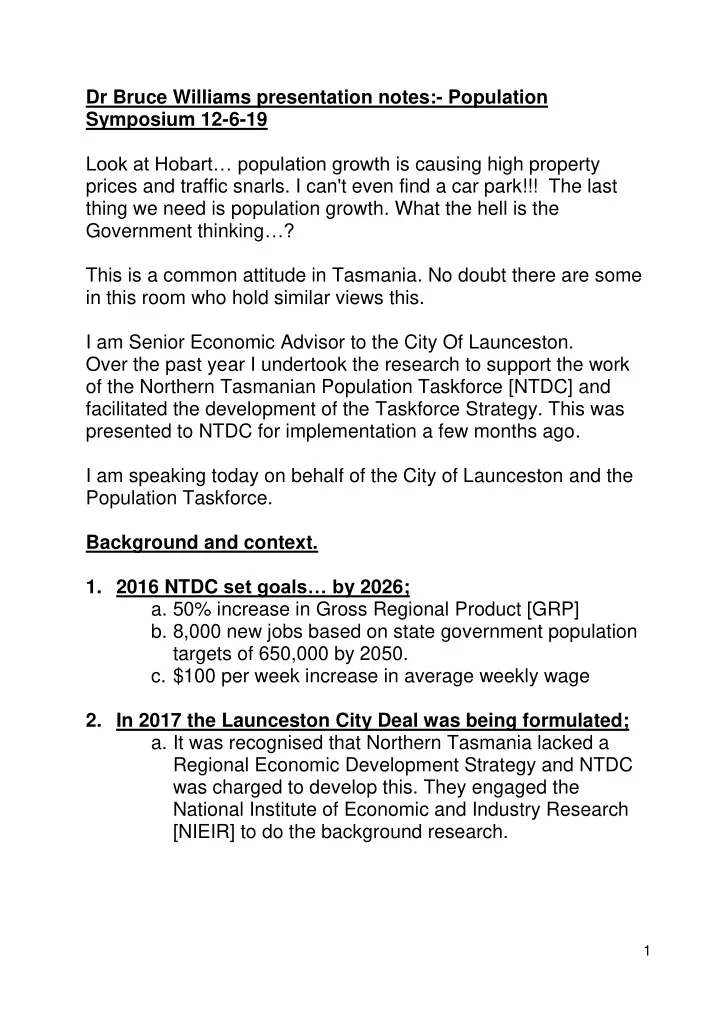
Dr Bruce Williams presentation notes:- Population Symposium 12-6-19 L ook at Hobart population growth is causing high property prices and traffic snarls. I can't even find a car park!!! The last thing we need is population growth. What the


slide-1
SLIDE 1

1

Dr Bruce Williams presentation notes:- Population Symposium 12-6-19 Look at Hobart… population growth is causing high property prices and traffic snarls. I can't even find a car park!!! The last thing we need is population growth. What the hell is the Government thinking…? This is a common attitude in Tasmania. No doubt there are some in this room who hold similar views this. I am Senior Economic Advisor to the City Of Launceston. Over the past year I undertook the research to support the work

  • f the Northern Tasmanian Population Taskforce [NTDC] and

facilitated the development of the Taskforce Strategy. This was presented to NTDC for implementation a few months ago. I am speaking today on behalf of the City of Launceston and the Population Taskforce. Background and context.

  • 1. 2016 NTDC set goals… by 2026;
  • a. 50% increase in Gross Regional Product [GRP]
  • b. 8,000 new jobs based on state government population

targets of 650,000 by 2050.

  • c. $100 per week increase in average weekly wage
  • 2. In 2017 the Launceston City Deal was being formulated;
  • a. It was recognised that Northern Tasmania lacked a

Regional Economic Development Strategy and NTDC was charged to develop this. They engaged the National Institute of Economic and Industry Research [NIEIR] to do the background research.

slide-2
SLIDE 2

2

  • 3. NIEIR's Key directions report received mid 2018, it

showed …

  • b. Population will possibly grow by 3,000 over next

decade BUT working age population will decline by 5,000… BUT by 2036 the working age population will decline by 12,000. Ageing population is the cause.

  • c. The City of Launceston is about 60% of region

[population and GRP]… the city and the region's future are intertwined. Alone, neither is a functional economy, simply not big enough. So a regional response is required.

  • d. A balance of trade deficit has progressively developed
  • ver the past 20 years. It is now -1 $billion per annum.
  • e. A decline in real wages of $3 per hour has occurred
  • ver the past decade.
  • f. That we have to grow the export sector and job
  • pportunities.
  • g. That we need investment of 0.5 $ billion per annum

above business as usual for next decade in region.

  • a. To put this is context for the City of Launceston,

this = $300 million per year, OR one UTAS redevelopment per year OR x10 silos developments per year for every year for next decade.

  • h. The task is huge and business as usual will not address

these opportunities.

  • 4. In mid-2018, NTDC convened a Population taskforce

headed by Michael Stretton General Manager of City of Launceston The Taskforce:-

  • a. Reviewed literature on population drivers.
  • b. Reviewed approaches in Australia and internationally to

grow population.

  • c. Data analysis of population demographics and trends.
  • d. Prepared population strategy.
  • e. Handed the strategy to NTDC for implementation a few

months ago.

slide-3
SLIDE 3

3

  • 5. What The Taskforce Found …

We found that we have very low population growth  Most recent data shows that of the 50 largest cities in Australia, Launceston has the 5th lowest and Hobart has the 13th lowest population growth rates. Bendigo had a smaller population than Launceston a decade ago and now has 10,000 more residents.  In Launceston population increased by 27 from 2011 to

  • 2017. This means that if you and the 4 families living either

side of you had moved to Melbourne there would have been zero population growth over this 6 year period.  Last year The City of Launceston population increased by around 600, [0.8% ] and most of this has been humanitarian migrants and students. To date there is not a lot of evidence that the recent population growth is driven by employment. We found major demographic changes in the City and the Region For example in the City of Launceston:-  Increases in aged demographic … 1,976 people +50 years in past census period.  Significant net loss of 1,063 people of working age with young families [last Census period].  increase in number of people needing assistance with core activities [about 1000 since 2005].  Influx of 1,429 humanitarian migrant over past decade.  This means that the community that is older, sicker, less educated and less skilled which makes us less competitive. We found there is no silver bullet or recipe to population growth We are not Robinson Crusoe here. Lots of other regions in Australia and globally have similar challenges. But we are a canary in the Australian demographic coal mine.

slide-4
SLIDE 4

4

In the literature there are many examples of failure and no uniform recipes to success. Where population growth strategy has been success it has always related to a positive answer to:-  Is there meaningful long term work?  Is there a welcoming community?  Can a migrant settle and make a home? We found people move around  38% shift in the City and region each census period [similar across Australia 40%]. About 6,000 people move in and out

  • f City of Launceston each Census period.

 Population flows from northwest through Launceston to Hobart and from Launceston north to Melbourne, Brisbane Sunshine coast etc.  Growing regional Cites experience a "spill over effect". People migrate outwards from major cities to regional

  • centres. We don't have a spill over option… but our

potential spill over target is Melbourne. Before I get to the targets…

  • 6. In April 2019 the State Government released population

projections  The predications are more sobering than those of the NIEIR's report. Predicting lower growth and a large shift in population to southern Tasmania.  Northern Tasmania Region population growth is forecast to be +3,168 persons over next 25 years = 0.1% growth rate. This is amongst the lowest population growth in Australia.  Hobart and the Southern Tasmania is forecast to grow by +49,014 persons over 25 years = 0.7% growth rate.  This means that by and large the State Government focus is already on planning and managing the impact of population growth on Southern Tasmania.

slide-5
SLIDE 5

5

  • 7. The Northern Tasmanian Population Taskforce Regional

Targets  We are targeting regional growth rate of around 1.2% per annum = 16,000 over 10 years. Similar growth rate to Bendigo over the last decade and Hobart last year [1.5%].  Our regional population target is 160,000 by 2031 and 200,000 by 2050. These targets also reflect and support the State Government targets.  BUT to a range of investors our population is currently 6,000 people below the threshold for attractiveness as identified by the Coordinator General. Right now the minimum threshold is around 150,000 people. A stretch target has been set at 200,000 by 2040 [about 60,000 more people than now or a 40% increase].

  • 8. What to do now …

 We have a developed a strategy with 14 initiatives.  I'm not going to articulate the strategies today BUT they centre around job creation, export growth, welcoming people, making a home and promoting the opportunity to relocate to Northern Tasmania.  Let's fight hard for action on the ground and to embrace population growth.  NTDC have appointed Edward Obi to drive the Population Strategy forward and they will launch the Strategy and articulate an implementation process in due course.  We are seeking funding assistance from Local, State and Federal Governments to support strategy implementation.  What I haven't touched on today are the impacts of population growth on infrastructure. This needs to be very carefully considered, integrated and planned for and become part of the conversation going forward.

slide-6
SLIDE 6

6

  • 9. To Summarise

Business as usual is an option here. But let's be crystal clear… all of the evidence… suggests that a business as usual approach to population growth will have a very poor long term outcome for our people and our community. And remember:- It is not just population growth that is an issue… it is the demographic changes swimming underneath it. It’s the demographic issues that will cause us grief. So this is what you might to do to help right now…  Support the work of NTDC and the implementation of the Northern Tasmanian Population Taskforce Strategy.  Commit to act regionally and fight hard for change. And …  When someone says … Look at Hobart… population growth is causing high property prices and traffic snarls. I can't even find a car park!!! The last thing we need is population

  • growth. What the hell is the Government thinking…?

Please take your opportunity to challenge them… Thank you. Some further information on the next page

slide-7
SLIDE 7

7

  • 10. Some of the Population Strategy priority actions if there

is time to raise them

  • a. Support the University of Tasmania and develop the

growth in the international student population.

  • b. Pilot a program to retain international students.
  • c. Pilot a program to retain skilled migrants.
  • d. Welcome humanitarian migrants and identify

meaningful pathways to work for them.

  • e. Develop pathways to real jobs… community / health

sector will need a lot of workers. There has already been an increase of about 900 FTE's in past two years in the City of Launceston. A direct pathway for humanitarian migrants could be developed for these jobs.

  • f. Pilot a lifestylepreneur program aimed at targeting and

to attracting people to bring their small business to Northern Tasmania.

  • g. Pilot a program to attract and retain young families.
  • h. Work with the State Government population programs
  • i. Participate in federal Government regionalisation

initiatives.

  • j. Seek funding to implement the strategy.

Data sources used in this presentation

  • 1. Australian Bureau of Statistics
  • 2. Economy .id regional Northern Tasmania data.

https://economy.id.com.au/northern-tasmania

  • 3. The Key Directions Report, NIEIR

http://ntdc.org.au/2018/11/13/key-directions-report-for- northern-tasmania-nieir/

slide-8
SLIDE 8

8

  • 4. 2019 Population ProjectionsTasmania and Local

Government Areas April 2019 https://www.treasury.tas.gov.au/Documents/2019%20Popul ation%20Projections%20- %20Tasmania%20and%20Local%20Government%20Areas .pdf

  • 5. Northern Tasmanian Population Taskforce research papers,

2018.

  • a. Migration Data City of Launceston and Region.
  • b. Population Data and Metrics that drive Population

Growth

  • c. Approaches to address population decline and

increase migration