Dr Andrew Howie Dr Kiri Prentice Consultant Psychiatrist - - PowerPoint PPT Presentation

dr andrew howie dr kiri prentice
SMART_READER_LITE
LIVE PREVIEW

Dr Andrew Howie Dr Kiri Prentice Consultant Psychiatrist - - PowerPoint PPT Presentation

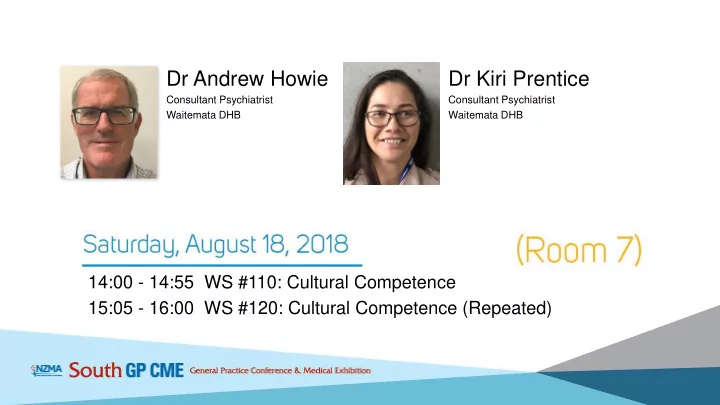
Dr Andrew Howie Dr Kiri Prentice Consultant Psychiatrist Consultant Psychiatrist Waitemata DHB Waitemata DHB 14:00 - 14:55 WS #110: Cultural Competence 15:05 - 16:00 WS #120: Cultural Competence (Repeated) Cultural Competence GPCME August


slide-1
SLIDE 1

Dr Kiri Prentice

Consultant Psychiatrist Waitemata DHB

14:00 - 14:55 WS #110: Cultural Competence 15:05 - 16:00 WS #120: Cultural Competence (Repeated)

Dr Andrew Howie

Consultant Psychiatrist Waitemata DHB
slide-2
SLIDE 2

Cultural Competence

GPCME August 2018 Andrew Howie and Kiri Prentice

slide-3
SLIDE 3
  • By the end of the session participants will be able to :
  • Define cultural competence and cultural humility
  • Incorporate a generic approach to patients and family from a

different culture into their practice

  • Be familiar with the RNZCGP requirements of cultural

competence

  • Be familiar with the application of some cultural skills when

working with Maori (mihi mihi, whanaungatanga, karakia)

Aims

slide-4
SLIDE 4
slide-5
SLIDE 5
slide-6
SLIDE 6
slide-7
SLIDE 7

Te Manawa o Te Ika a Maui

slide-8
SLIDE 8

Te Rewarewa Marae

slide-9
SLIDE 9

Cultural Competence

A Recipe for Working with Maori

slide-10
SLIDE 10
  • Ko te kai o te rangatira he korero
  • (The chief’s sustenance is discussion)
  • Whakatauki
  • (Proverb)
slide-11
SLIDE 11

Menu

  • Appetite – Why
  • Recipes – How
  • Entrée – Approach
  • Main – Whakawhanaunga (connecting)
  • Dessert – Manaakitanga (respecting)
  • Doggy bag – Take home messages
slide-12
SLIDE 12

Appetite

  • Am I hungry for this?
  • Why be culturally competent?
slide-13
SLIDE 13

Definition

  • Cultural competence can be defined as
  • a set of academic, experiential and interpersonal skills that
  • allow individuals and systems
  • to increase their understanding and appreciation of
  • cultural differences and similarities within, among and between groups

Counties Manukau DHB 2001; Jansen and Sorrensen 2002

  • (In Tiatia J. 2008. Pacific Cultural Competencies: A literature review. Wellington: Ministry of Health p3)

https://www.mcnz.org.nz/assets/News-and-Publications/Statements/Statement-on-cultural-competence.pdf

slide-14
SLIDE 14

Q: Why should we be culturally competent?

  • Better outcomes
  • Right (moral) obligation
  • Legal duty
  • Professional duty
slide-15
SLIDE 15

Q: Why should we be culturally competent?

A: There is a clear connection between cultural competence, quality improvement, and the elimination of racial / ethnic disparities etc. . (e.g Aitato 2011 etc.)

But also:

  • Shows respect for persons and their differences
  • Therefore has an ethical basis
slide-16
SLIDE 16

A Precondition: Cultural Humility

The virtue necessary for cultural competence Cultural Humility is a prerequisite in this process of addressing cultural differences, where the [practitioner]

  • relinquishes the role of expert to the patient,
  • becoming the student of the patient with a conviction and explicit expression of the

client’s potential to be capable and full partner in the therapeutic alliance.

  • (Tervalon and Murray-Garcia 1998 p 121)
slide-17
SLIDE 17

Cultural Humility - 2

  • An attitude, rather than facts about other cultures, or a set of cultural skills
  • a necessary condition of
  • gaining knowledge of other cultures
  • developing skills to apply knowledge in clinical situations
  • applying this knowledge in real-life situations
  • monitoring the outcomes in terms of patient and client satisfaction (Howie 2011

p 519)

slide-18
SLIDE 18

Cultural Humility - 3

  • The client can expect
  • to have her values respected
  • to experience receptiveness to her questions
  • to receive questions asking for further information about cultural values,

roles and expectations (Howie 2011 p 520).

  • There is permission “not to know” (Maller and Langsome 2013 p 12)
slide-19
SLIDE 19
slide-20
SLIDE 20

Focus on equal health outcomes Foster a relationship with the community Ensure all general practice staff are culturally competent Create a physical environment of cultural competence at the general practice Collect and maintain accurate ethnicity data Pronounce your patients’ names correctly Consider involving the family

slide-21
SLIDE 21

Teach and learn The LEARN model for cross-cultural health care Listen to your patient Explain your reasons Acknowledge their concerns Recommend a course of action Negotiate a plan that gives consideration to your patient’s cultural norms and personal lifestyle. Be flexible in your approach to sharing information

slide-22
SLIDE 22

Be flexible in your approach to sharing information Be aware of indirect information and how to interpret it Your delivery should not be the same for every patient Try to find some common ground with your patient Try that we are all individuals within our cultural groupings Members of society hold you as a representative of the medical culture

slide-23
SLIDE 23
slide-24
SLIDE 24

National Cultural Competency Toolkit

slide-25
SLIDE 25

Toolkit

  • Interpreter, support worker
  • Telephone interpreter
  • Printed information
  • Community organisation
  • Complementary health provider / key individual
  • Culturally validated assessment tool
slide-26
SLIDE 26

The New Zealand context

slide-27
SLIDE 27

Context in Aotearoa: Te Tiriti o Waitangi

slide-28
SLIDE 28

Context in Aotearoa: Te Tiriti o Waitangi

Article One

  • The Chiefs of the Confederation, and all these chiefs who have not joined in that Confederation give up to the Queen of

England for ever all the Governorship (Kawanatanga) of their lands. Article Two

  • The Queen of England agrees and consents (to Give) to the Chiefs, hapus, and all the people of New Zealand, the full

chieftainship (rangatiratanga) of their lands, their villages and all their possessions (taonga: everything that is held precious) but the Chiefs give to the Queen the purchasing of those pieces of land which the owner is willing to sell, subject to the arranging of payment which will be agreed to by them and the purchaser who will be appointed by the Queen for the purpose of buying for her. Article Three

  • This is the arrangement for the consent to the governorship of the Queen. The Queen will protect all the Māori people of

New Zealand, and give them all the same rights as those of the people of England. http://www.govt.nz/aboutnz/treaty.php3 (accessed 21 May 2016)

slide-29
SLIDE 29

Legal and professional duty

  • Legal duty
  • Te Tiriti o Waitangi - Section 4 Public Health And Disability Act 2000
  • http://www.legislation.govt.nz/act/public/2000/0091/latest/DLM80051.html
  • Regulatory Compliance Health Practitioners Competence Assurance Act 2003 (HPCAA), Clause

118 (i)

  • “health professionals are to set standards of clinical competence, cultural competence and ethical

conduct to be observed by health practitioners of the profession”.

  • http://www.health.govt.nz/our-work/regulation-health-and-disability-system/health-practitioners-competence-assurance-act
  • Professional duty
  • The Medical Council of NZ
  • https://www.mcnz.org.nz/assets/News-and-Publications/Statements/Statement-on-cultural-competence.pdf
  • https://www.mcnz.org.nz/news-and-publications/media-releases/cultural-competence-partnership-and-health-equity-

professional-obligations-towards-maori-health-improvement/

  • The Royal NZ College of GPs
  • https://www.ranzcp.org/Publications/Indigenous-mental-health/Maori-Mental-Health.aspx
slide-30
SLIDE 30

Recipes – the how to

slide-31
SLIDE 31
slide-32
SLIDE 32

Te Whare Tapa Wha

from Mason DurieAn Introduction to TeAoMaori

slide-33
SLIDE 33
slide-34
SLIDE 34

Entrée - Approach

  • Tikanga = a process of engagement
  • Tika = right, tikanga = the right way
  • Beginning, middle and end
  • With time add more ingredients & tweak recipe
  • Powhiri
  • Whakawhanaunga & Manaakitanga
slide-35
SLIDE 35

Entrée – Approach

Beginning

  • Greetings - kia ora, tena koe
  • Hariru - hand shake, hongi, hug only if you’re comfortable
  • Correct pronunciation (ask, just do your best)
  • Karakia – offer to open with karakia (prayer)
  • Mihimihi – formal acknowledgements
  • Whakawhanaunga ……the Main course
slide-36
SLIDE 36

KARAKIA - The means by which spiritual pathways are cleared

  • Effective engagement in a therapeutic milieu so that the process of transition –

making ‘space’ for tangata whaiora, whánau and kaimahi can occur.

  • Understanding there are different types, forms and approaches to Karakia: it’s not

about religion.

  • To promote the role of Karakia as fundamental in the care for ‘self and others’.
  • Note: It is as much about the how it is spoken and the ‘spirit’ in which it is given. “Kia

whakatau i te mauri”

slide-37
SLIDE 37

Karakia Timatanga To open a meeting

He hōnore, he korōria ki te Atua He maungārongo ki te whenua He whakaaro pai ki ngā tāngata katoa Hangā e te Atua he ngākau hou Ki roto, ki tēnā, ki tēnā o mātou Whakatōngia to wairua tapu Hei awhina, hei tohutohu i a mātou Hei ako hoki i ngā mahi mō tēnei rā Amine Whakataka te hau ki te uru Whakataka te hau ki te tonga Kia mākinakina ki uta Kia mātaratara ki tai E hī ake ana te atakura He tio, he huka, he hau hū Tīhei mauri ora!

Honour and glory to God Peace on Earth Goodwill to all people Lord, develop a new heart Inside all of us Instil in us your sacred spirit Help us, guide us In all the things we need to learn today Amen

http://maori.otago.ac.nz/reo-tikanga-treaty/te-reo/karakia

Cease the winds from the west Cease the winds from the south Let the breeze blow over the land Let the breeze blow over the ocean Let the red-tipped dawn come with a sharpened air. A touch of frost, a promise of a glorious day.

slide-38
SLIDE 38

MIHIMIHI - Structured Communication

  • A process of introduction and communication which establishes the unique Máori

recognition and intimacy required to communicate effectively and appropriately.

  • A requirement is established to uphold tikanga during communication.
  • In this context, Mihimihi can be used to establish an understanding of roles.
  • Important to assist in the transition from hui to other experiences.
slide-39
SLIDE 39

Entrée – Approach

Middle

  • Season with kupu Maori
  • Ae, kia ora, whanau, wairua, tinana e.t.c
  • Ask questions if you don’t understand
  • Use metaphors and visual aids
  • For more advanced tauira (students)
  • Korero purakau (ancient stories)
  • Whakatauki (proverbs)
slide-40
SLIDE 40

Metaphor & Visual Aids

Waka

  • Whanau & team
  • Roles and responsibilities
  • Paddling in same direction
  • Direction & navigation
  • Ancestors migration
slide-41
SLIDE 41

Metaphor & Visual Aids

Harakeke = Flax Whanau protects rito Ancestors nourish roots Absent whanau…

slide-42
SLIDE 42

Korero Purakau – (Ancient Story)

Kete matauranga – (basket of knowledge)

slide-43
SLIDE 43

Entrée – Approach

Ending

  • Mihimihi – acknowledgements
  • Acknowledge participants
  • Validate and encourage
  • Offer karakia to conclude
slide-44
SLIDE 44

Karakia Whakamutunga To close a meeting

Christian Karakia (2 Corinthians, 13:14) Kia tau ki a tātou katoa Te atawhai o tō tātou Ariki, a Ihu Karaiti Me te aroha o te Atua Me te whiwhingatahitanga Ki te wairua tapu Ake, ake, ake Amine Traditional Karakia Unuhia, unuhia Unuhia ki te uru tapu nui Kia wātea, kia māmā, te ngākau, te tinana, te wairua i te ara takatā Koia rā e Rongo, whakairia ake ki runga Kia tina! TINA! Hui e! TĀIKI E!

May the grace of the Lord Jesus Christ, and the love of God, and the fellowship of the Holy Spirit be with you all Forever and ever Amen Draw on, draw on, Draw on the supreme sacredness To clear, to free the heart, the body and the spirit

  • f mankind

Rongo, suspended high above us (i.e. in ‘heaven’) Draw together! Affirm!

slide-45
SLIDE 45

The Main Course-Whakawhanaungatanga

Multiple system dynamics

  • Recognition of the interconnectedness and relationships, particularly between

whánau, hapú and iwi. Identity of self is through others.

  • Whakawhanaunga concerns itself with the process of establishing and maintaining

links and relationships with others (including but not limited to whánau toto).

  • Promotion of inter-sectorial working and a multi system approach to working with

whánau to achieve oranga.

slide-46
SLIDE 46

Main – Whakawhanaungatanga

Connecting

  • “Where are you from?”
  • Whakapapa
  • Genealogy
  • “the process of laying one thing upon another”
  • Relationships
  • Tuakana – teina (older & younger siblings)
  • Mentor & student
  • Mokopuna – koroua/kuia
  • Matua – tamariki
  • Tipuna
slide-47
SLIDE 47

Dessert - Manaakitanga

  • Mana is:
  • Prestige, authority, control, power, influence, status,

spiritual power, charisma, mandate, freedom,

  • Aki is:
  • Urge, induce, replace, encourage
  • So manaaki is….
slide-48
SLIDE 48

Dessert - Manaakitanga

  • Trample mana – “takahi mana”
  • Give away your mana
  • It can be diminished but not lost
  • Hope of restoration
slide-49
SLIDE 49

Dessert - Manaakitanga

  • Respect
  • Give of your own mana = hospitality
  • Measure of a chief – manaakitanga
  • Cup of tea
  • Little acts of kindness
  • Make people feel welcome
  • With humility
slide-50
SLIDE 50

Doggy bag – Take home messages

1. Approach = beginning, middle & end

1. Greetings, karakia, whakawhanaunga, 2. Kupu Maori, metaphor & visual aids 3. Mihimihi, karakia

  • 2. Whakawhanaungatanga = connecting

1. Self, whanau, whenua, clinicians, ancestors

  • 3. Manaaki = enhancing their mana

1. Respect, hospitality, simple acts of kindness, humility

slide-51
SLIDE 51
slide-52
SLIDE 52
slide-53
SLIDE 53

Barriers to care for Pacific service users

Lack of Pacific Islanders in healthcare’s leadership and workforce Systems of care poorly designed to meet the needs of Pacific Islanders Poor communication between providers and Pacific Islanders Health care providers must

  • Be made aware of the impact of social and cultural factors on health beliefs and behaviours
  • Be equipped with the tools and skills to manage these factors appropriately through training and

education

  • Empower their patients to be more of an active partner in the medical encounter

Organisations can do this through

  • Cross –cultural training
  • Quality improvement efforts that include process and outcome measures that reflect the needs of

multicultural and minority populations

  • Programmes to educate patients on how to navigate the health care system and become an active

participant in their care.

slide-54
SLIDE 54
slide-55
SLIDE 55
slide-56
SLIDE 56
slide-57
SLIDE 57
slide-58
SLIDE 58

Conclusions

  • The main cultural need is the awareness that cultural differences might be significant
  • For Maori, acknowledgement of a different world view (Te Whare Tapa Wha), and

the use of important practices (mihimihi, karakia, whanaungatanga etc) goes a long way.

  • Some questions are very useful:
  • Is an interpreter (who may also have cultural knowledge) needed?
  • Is printed information in their preferred language needed?
  • Are there relevant community organisations?
  • Might a traditional healer be needed?
  • Are there useful cultural assessment tools?
slide-59
SLIDE 59

References

Howie, A.J. (2011) Cultural Humility. In S Loue & M Satatovic (Eds.), Encyclopedia of immigrant health (pp 519- 520). New York, NY: Springer. Liew T, Working with Asian Patients: Cultivating cultural competence, https://www.fmhs.auckland.ac.nz/assets/fmhs/soph/goodfellow/symposiumarchive/2008/docs/asian_patients_part_1.pdf

(accessed 30 May 2016)

Maller, D, Langsam, K, The Praeger Handbook of Community Mental Health, Oxford: Praeger 2013 Matuaraki, Takarangi Competency Framework, http://www.matuaraki.org.nz/resources/takarangi-competency-framework- essence-statements-poster/388 (accessed 30 May 2016) Multicultural Mental Health Australia, National Cultural Competency Toolkit (NCCT) for Mental Health Services www.mhima.org.au/_literature_73821/NCCT (accessed 30 May 2016) Tiatia J. 2008. Pacific Cultural Competencies: A literature review. Wellington: Ministry of Health https://www.health.govt.nz/system/files/documents/publications/pacific-cultural-competencies- may08-2.pdf (accessed 30 May 2016)

slide-60
SLIDE 60

Nga Patai (questions) Korerorero (discussion)