Downtown Morgantown Retail Feasibility Presented By: Patrick M. - - PowerPoint PPT Presentation
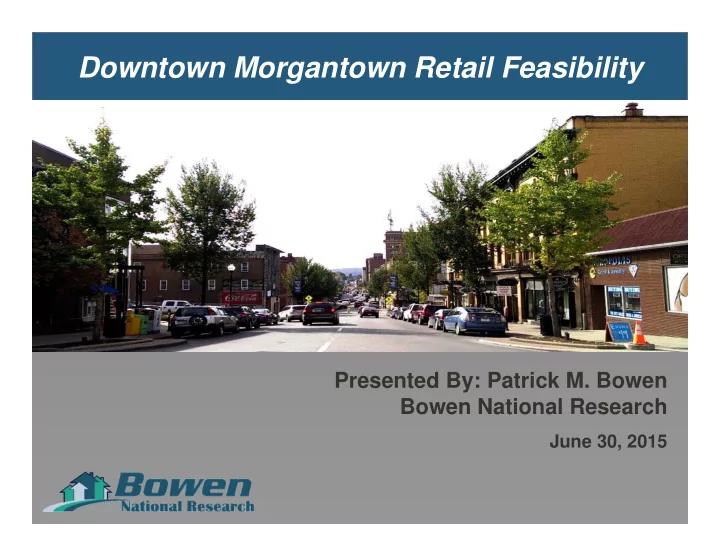
Downtown Morgantown Retail Feasibility Presented By: Patrick M. Bowen Bowen National Research June 30, 2015 Purpose of Analysis Assess the downtowns current retail market and conditions, and evaluate the demographic characteristics and
Purpose of Analysis
- Assess the downtown’s current retail market and conditions, and evaluate
the demographic characteristics and trends that affect retail space needs
- Identify retail categories within downtown that are currently over/under
served
- Provide recommendations and strategies to maximize downtown retail
- pportunities
Scope of Work
- Established
Market Areas – Determined a Primary Trade Area (Downtown) and a Competitive Trade Area (Balance of Morgantown)
- Evaluated Demographics – Conducted analysis of area demographic
characteristics and trend: household income and disposable income
- Surveyed Retail Space - Personally identified and surveyed downtown
retail space; obtained data regarding retail square footage, rent-per- square foot, occupancy levels, quality, etc. Analyzed shopping centers located outside downtown that are currently capturing retail expenditures.
- Conducted a Retail Gap Analysis – Compare Morgantown consumer
expenditures with downtown’s success in capturing such expenditures
- Conducted Stakeholder Interviews - Obtained local input on retail
market conditions and ideas on strengths and weaknesses of the market
- Provided Recommendations - Recommend specific types of retail
- pportunities to meet the needs of those retail categories that are under
served and recommend strategies or approaches that might be taken to satisfy the identified retail needs.
Primary Trade Area (PTA)
Competitive Trade Area (CTA)
Competitive Shopping Centers
Population & Household Trends
PTA CTA West Virginia U.S. Pop. H.H. Pop. H.H. Pop. H.H. Pop. H.H. 2014 Estimated 1,249 727 98,356 41,315 1,875,906 775,600 313,129,017 118,208,713 2019 Projected 1,357 800 106,982 45,331 1,902,231 788,581 323,986,227 122,665,498 Change 2014-2019 108 73 8,626 4,016 26,325 12,981 10,857,210 4,456,785 Percent Change 2014-2019 8.6% 10.0% 8.8% 9.7% 1.4% 1.7% 3.5% 3.8%
Source: ESRI; Urban Decision Group; Bowen National Research
- Pop. - Population
H.H. - Households
Population Growth Rate (2014-2019)
8.6% 8.8% 1.4% 3.5%
0.0% 1.0% 2.0% 3.0% 4.0% 5.0% 6.0% 7.0% 8.0% 9.0% 10.0% PTA CTA West Virginia U.S.
Location Percent Growth
Household Growth Rate (2014-2019)
3.8% 1.7% 9.7% 10.0%
0.0% 1.0% 2.0% 3.0% 4.0% 5.0% 6.0% 7.0% 8.0% 9.0% 10.0% PTA CTA West Virginia U.S.
Location Percent Growth
Households by Income PTA CTA Household Income 2014 2019 2014 2019 # % # % # % #
%
<$15,000 408 56.1% 435 54.4% 9,839 23.8% 10,037
22.1%
$15,000-$24,999 107 14.7% 103 12.9% 4,992 12.1% 4,593
10.1%
$25,000-$34,999 53 7.3% 59 7.4% 3,652 8.8% 3,881
8.6%
$35,000-$49,999 46 6.3% 48 6.0% 4,480 10.8% 4,244
9.4%
$50,000-$74,999 39 5.4% 48 6.0% 6,443 15.6% 6,874
15.2%
$75,000-$99,999 29 4.0% 42 5.3% 4,646 11.2% 6,237
13.8%
$100,000-$149,999 29 4.0% 40 5.0% 4,263 10.3% 5,328
11.8%
$150,000-$199,999 7 1.0% 10 1.3% 1,580 3.8% 2,193
4.8%
$200,000+ 10 1.4% 16 2.0% 1,416 3.4% 1,940
4.3%
Total 728 100.0% 801 100.0% 41,311 100.0% 45,327
100.0%
Median HH Income $13,382 $13,810 $41,208 $49,583
Household Income Trends
Households by Income (2014)
0.0% 5.0% 10.0% 15.0% 20.0% 25.0% 30.0% 35.0% 40.0% 45.0% 50.0% 55.0% 60.0% <$15,000 $15K - $24,999 $25K - $34,999 $35K - $49,999 $50K - $74,999 $75K - $99,999 $100K - $149,999 $150K - $199,999 $200,000+
Household Income % of Households PTA CTA
Households by Disposable Income
Households by DISPOSABLE Income (2014) PTA CTA Disposable Household Income # % # % <$15,000 419 57.6% 10,603 25.7% $15,000-$24,999 114 15.7% 5,748 13.9% $25,000-$34,999 53 7.3% 4,058 9.8% $35,000-$49,999 40 5.5% 5,349 12.9% $50,000-$74,999 46 6.3% 7,440 18.0% $75,000-$99,999 26 3.6% 3,597 8.7% $100,000-$149,999 17 2.3% 3,257 7.9% $150,000-$199,999 7 1.0% 701 1.7% $200,000+ 4 0.6% 558 1.4% Total 727 100.0% 41,311 100.0% Median Disposable Income $12,995 $35,505
Households by Disposable Income (2014)
0.0% 5.0% 10.0% 15.0% 20.0% 25.0% 30.0% 35.0% 40.0% 45.0% 50.0% 55.0% 60.0% <$15,000 $15K - $24,999 $25K - $34,999 $35K - $49,999 $50K - $74,999 $75K - $99,999 $100K - $149,999 $150K - $199,999 $200,000+
Disposable Household Income % of Households PTA CTA
Median Disposable Income by Age
Median Disposable Income by Age of Householder (2014) <25 25-34 35-44 45-54 55-64 65-74 75+ PTA Total Households 425 104 28 21 52 46 49 Median Disposable Income $11,330 $27,465 $23,279 $19,141 $15,578 $16,281 $12,250 CTA Total Households 8,693 8,177 5,395 5,727 6,216 3,955 3,148 Median Disposable Income $14,220 $38,821 $51,517 $52,847 $50,249 $37,032 $22,704
Median Disposable Income by Age (2014)
$0 $5,000 $10,000 $15,000 $20,000 $25,000 $30,000 $35,000 $40,000 $45,000 $50,000 $55,000 <25 25 - 34 35 - 44 45 - 54 55 - 64 65 - 74 75+
Age Household Income PTA CTA
Demographic Findings
The demographic picture
- f
the Primary Trade Area (downtown) is uniquely different from the CTA. When compared to the CTA, the PTA is experiencing the following: Similar population & household growth. Much higher population density. Lower median age. Much higher share of renters. Much lower share of family households. Significantly lower median incomes. Median disposable income 1/3 of CTA.
Factors Impacting Retail Trade in Downtown
- The population base is 1,249.
- Daytime employment is over 3,100
workers.
- 12 bus lines and the Personal Rapid
Transit service the downtown
- WVU downtown campus has 12
residence halls and apartment complexes located adjacent to the downtown.
- 2013 traffic counts on highways in downtown average 18,931 per
day.
- Hundreds of retailers and restaurants located within a 0.16 square
mile.
- Over 500 performances, festivals and annual events.
- Over one mile of riverfront and creek side real estate, including
Caperton and Deckers Creek Rails-Trails.
Downtown & City Retail Supply - Vacancies
Market Total Spaces Total Leasable Area* Total Vacant Spaces Total Vacant Area* Vacancy Rate PTA (Downtown) 180 374,586 20 32,680 8.7% CTA 328 2,938,655 41 351,462 12.0%
*Square Feet estimates based on 89 spaces for which information was available
- The PTA (Downtown) has an overall retail vacancy rate of 8.7%, which is lower
than the CTA vacancy rate of 12.0% (Morgantown area that excluded downtown)
- The Midwest and South Atlantic
regions report vacancy rates of 11.3% on average.
- The national retail vacancy
rate is approximately 10.0%.
Retail Space Vacancy Rates
8.7% 12.0% 11.3% 11.3% 10.0%
0.0% 1.0% 2.0% 3.0% 4.0% 5.0% 6.0% 7.0% 8.0% 9.0% 10.0% 11.0% 12.0% PTA CTA Midwest Region South Atlantic Region U.S.
Location Percent Vacant
Existing Retail in Downtown
Market Reported Annual Rent / Square Foot Range Average Median PTA (Downtown) $4.68 - $28.00 $12.67 $11.82 CTA $5.00-$26.00 $19.00 $20.00
Downtown & City Retail Supply – Lease Rates
- Median rent per square foot in the PTA (Downtown) is $11.82
- Median rent per square foot in the CTA is $20.00
- The Midwest and South Atlantic regions report a slightly lower rent per
square foot of $16.00 to $18.00
Retail Space Median Rent per Square Foot
$11.82 $20.00 $16.00 $18.00
$0.00 $2.00 $4.00 $6.00 $8.00 $10.00 $12.00 $14.00 $16.00 $18.00 $20.00 PTA CTA Midwest Region South Atlantic Region
Location Rent per Sq. Ft.
Quality of Downtown Retail
Quality Rating/ Class Number of Properties Total Square Footage Percentage
- f Total
Space Available Square Footages Vacancy Rate Average Lease Rate A 15 30,174 8.1% 8,478 28.1% * B 129 274,490 73.3% 9,950 3.6% $12.48 C or Lower 36 69,922 18.6% 14,252 20.4% $10.41 Total 180 374,586 100.0% 32,680 8.7% $12.67
Quality Rating: A = excellent / B = good / C = fair to poor *insufficient sample
Retail Space by Quality Rating
73.3% 18.6% 8.1%
0.0% 10.0% 20.0% 30.0% 40.0% 50.0% 60.0% 70.0% 80.0% A B C or Lower
Quality Rating Share of Space
Retail Space Vacancy Rates by Quality Rating
28.1% 20.4% 3.6%
0.0% 5.0% 10.0% 15.0% 20.0% 25.0% 30.0% A B C or Lower
Quality Rating Percent Vacant
Consumer Expenditure Trends
Consumer Expenditures
Geographical Area Aggregate 2014 Projected Aggregate 2019 % Increase In Aggregate Spending 2014-2019 Average Spending Per Household 2014 Average Spending Per Household 2019 Average Annual Growth 2014-2019 2014 Market Index To USA Total PTA $7,343,466 $8,377,979 14.09% $10,060 $10,420 0.72% 41.5 Total CTA $864,571,503 $1,146,299,956 32.59% $20,926 $25,287 4.17% 86.2
Note: The CTA includes the PTA.
The above table suggests the following consumer spending trends from 2014 to 2019 for the selected areas:
- Aggregate spending in the CTA is expected to increase by 32.59%, while aggregate spending in the PTA will increase by
14.09%.
- Households residing within the PTA will increase spending by just 0.72%, compared with a 4.17% increase within the CTA.
- The 2014 Market Index for the CTA, the area from which most of the retail support will originate, is 86.2, which is slightly
below the national index of 100. This indicates area consumers are spending slightly less money on goods and services than the national average.
Retail Gap Analysis – Demand Potential
Potential Retail Support Estimates Increase In Spending 2014-2019 /$350 Sales Per S.F. = Total Potential Support (S.F.) Multiplied by PTA Capture Rate Potential Square Footage of Space Potential Annual Square Footage $281,728,453 /350 X 3.6% 28,978 5,796
- It is estimated that the downtown can support approximately 5,800
square feet of additional retail space each year
- Most lease space likely sought will be “B” Class product
- Generally lease prices will continue to hover around $12.00 per sq. ft.
Retail Gap Analysis - Overview
Retail Gap Analysis – Compares retails sales of an area with consumer expenditures to determine if there is: Leakage – When demand for a particular retail industry is exceeding the retail supply in the market; This is an indication that additional retail in a specific retail industry could be supported in the market. Surplus – When the existing retail supply in the market exceeds the local demand for products and services of such industry; indication that local retail supply is either relying on external market support OR that the supply cannot find enough demand and has a higher likelihood to fail.
Retail Gap Analysis – Best Opportunities
Retail Industry Groups with Best Opportunities in Downtown
- Other General Merchandise Stores (e.g. dollar stores)
- Specialty Building Material & Supply Stores (e.g. hardware stores)
- Furniture Stores
- Shoe Stores
- Specialty Home & Garden Supply Stores
- Grocery Stores, including Convenience Stores
- Office Supplies, Stationary & Gift Stores
Stakeholder Surveys - Overview
- 20 downtown Stakeholder Interviews/Surveys were
conducted with local business owners and operators (retailers, bars, restaurants, personal services, and professional services)
- Stakeholders were asked to provide input on the
following:
- Their current downtown business space
- Typical business patrons
- Factors that influenced selection of business location
- Perceptions of downtown (strengths and weaknesses)
Stakeholder Surveys - Responses
Patrons – Approximately 25% to 50% of business originate from students and downtown employees; some rely heavily on tourism Why Downtown – Most respondents indicated that it was the “central location” and proximity to services and WVU that led them to choose downtown for their business Lease Terms – Leases ranged in length of 1 to 3 years, with a lease term of two years being the norm. Most leases require tenants to pay rent, janitorial services, repair/maintenance costs, building insurance & taxes.
Potential Enhancements to Downtown – Parking – Lighting – Reduce loitering and panhandling – Improved traffic flow – Better store signage Types of Businesses Needed – Clothing, shoes – Hardware – Drugstore/pharmacy – Bookstore – Eateries, bakeries, & Restaurants
Downto town's N Natu tural S Strength ths 0.00 0.50 1.00 1.50 2.00 2.50 3.00 3.50 4.00 4.50
Economic Stability Proximity to WVU Historic Character Special Events & Unique Attractions (festivals, museums, etc.) Availability of Public Transportation Concentration of Other Businesses High Pedestrian Traffic High Vehicular Traffic Civic Pride (locally owned, history, farmer's market, etc.) Natural Features (rivers, creeks, trails, etc.) Other
Aver erage R age Rating
Stakeholder Surveys - Responses
Downtown Strengths
Percei eived We d Weak aknesses 0.00 0.50 1.00 1.50 2.00 2.50 3.00 3.50 4.00 4.50 5.00
Lack of Cleanliness Presence of "Undesirable Characters" Confusing Traffic Patterns Not Bike or Pedestrian Friendly Availability of Parking Proximity to Parking Poor Quality or Deferred Maintenance of Some Buildings Lack of Cohesiveness (building designs, streetscapes, gateways) Non-retail uses partitioning or segmenting downtown retailers Proximity to Public Transportation Stops Limited Availability and Variety of Downtown Housing Options Other
Aver erage age R Rating
Limitations of Downtown
Stakeholder Surveys - Responses
Strengths:
- Demographic Trends are Projected to be Positive
- Household Disposable Incomes….
- Central location in the Greater Morgantown Area
- Waterfront development opportunities
- Demand for Additional Retail Space will Grow as Morgantown
Grows – Downtown can capture a portion of this growth
- You can’t duplicate downtown retail corridor, it is unique
Weaknesses:
- Perception of crime and lack of parking linger
- Limited Class A space available in downtown limits downtown’s
ability to retain or attract Class A space users
Study Conclusions - Summary of Findings
Conclusion/Recommendations
- Pursue policies and practices that encourage the development of new
housing
- Collaborate with the local Continuum of Care in an effort to identify the
needs of the homeless population and their service providers
- Continue and consider expanding financial incentive programs to increase
the aesthetic appeal of the downtown
- Support efforts to diminish the perception of crime in downtown along with
efforts to clean & maintain downtown
- Ensure efforts to promote good traffic flow
- Monitor public parking usage and promote downtown parking
Retail Recruitment Strategy
Continue to develop the downtown based on the goals and vision detailed in the 2010 Downtown Plan. Develop attractive marketing materials to convey that the downtown is unique and offers a competitive advantage over other locations. Identify prospective tenants that could benefit from downtown location. Detailed knowledge of the retail market should be readily available in
- rder to assist and persuade business owners to select a downtown