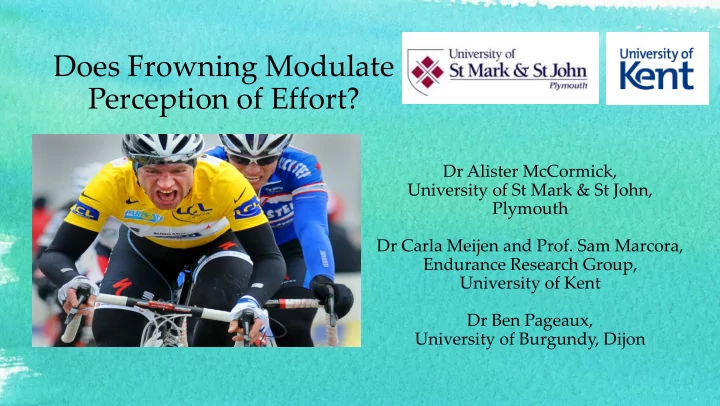
Does Frowning Modulate Perception of Effort? Dr Alister McCormick, - - PowerPoint PPT Presentation

does frowning modulate perception of effort
SMART_READER_LITE
LIVE PREVIEW

Does Frowning Modulate Perception of Effort? Dr Alister McCormick, - - PowerPoint PPT Presentation

Does Frowning Modulate Perception of Effort? Dr Alister McCormick, University of St Mark & St John, Plymouth Dr Carla Meijen and Prof. Sam Marcora, Endurance Research Group, University of Kent Dr Ben Pageaux, University of Burgundy,


slide-1
SLIDE 1

Does Frowning Modulate Perception of Effort?

Dr Alister McCormick, University of St Mark & St John, Plymouth Dr Carla Meijen and Prof. Sam Marcora, Endurance Research Group, University of Kent Dr Ben Pageaux, University of Burgundy, Dijon

slide-2
SLIDE 2

Introduction

  • People frown when they

experience high effort.

  • Could frowning be a

determinant of perceived effort?

slide-3
SLIDE 3

Introduction

  • Research on the facial

feedback hypothesis shows that facial expressions can amplify or soften elicited feeling states.

  • If frowning influences

perception of effort, then interventions that target frowning could be used to improve endurance performance.

slide-4
SLIDE 4

Study Aims

  • The facial feedback hypothesis and the psychobiological

model of endurance performance were applied.

  • We examined whether intentionally frowning during a

cycling time-to-exhaustion test increased perception of effort and, consequently, reduced time to exhaustion.

  • Does frowning amplify perceived effort?
  • We also examined the effects of frowning on affective

states experienced while cycling and after exhaustion.

slide-5
SLIDE 5

Methods

  • Ten endurance athletes performed time-to-

exhaustion tests in three conditions.

  • In one condition, participants frowned

throughout the time-to-exhaustion test. There were two control conditions.

  • Electromyography biofeedback was used to

deliver interventions.

  • Perception of effort (RPE) and exercise-

related affect (Feeling Scale) were measured throughout the time-to-exhaustion test.

slide-6
SLIDE 6

Manipulation Checks

slide-7
SLIDE 7

Effects During Performance

slide-8
SLIDE 8

Results Summary

  • Time to exhaustion was similar in the frowning

(609 ± 243s) and no-intervention conditions (603 ± 175s), and it was shorter in the thumb-press condition (558 ± 159s) (p = .58).

  • Intentionally frowning did not affect perception of

effort, affective states experienced while cycling or after exhaustion, or time to exhaustion.

slide-9
SLIDE 9

Discussion

  • The findings suggest that frowning may not

modulate perception of effort during endurance performance.

  • The results are not promising for frowning-based

performance-enhancing interventions informed by the facial feedback hypothesis.

  • Future research that examines the effects of

inhibiting frowning could offer greater clarity.

slide-10
SLIDE 10

Any Questions?

Dr Alister McCormick, University of St Mark & St John, Plymouth Dr Carla Meijen and Prof. Sam Marcora, Endurance Research Group, University of Kent Dr Ben Pageaux, University of Burgundy, Dijon