Divorce: When a Spouse Files Bankruptcy Dischargeability of Domestic - - PowerPoint PPT Presentation

divorce when a spouse files bankruptcy
SMART_READER_LITE
LIVE PREVIEW

Divorce: When a Spouse Files Bankruptcy Dischargeability of Domestic - - PowerPoint PPT Presentation

Presenting a live 90-minute webinar with interactive Q&A Divorce: When a Spouse Files Bankruptcy Dischargeability of Domestic Support Obligations and Property Settlements WEDNES DAY, FEBRUARY 15, 2012 1pm East ern | 12pm Cent ral |


slide-1
SLIDE 1

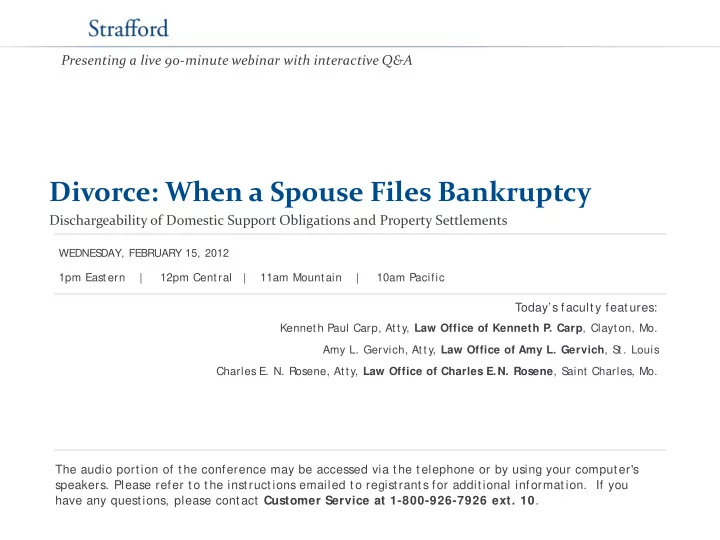
Divorce: When a Spouse Files Bankruptcy

Dischargeability of Domestic Support Obligations and Property Settlements

Today’s faculty features:

1pm East ern | 12pm Cent ral | 11am Mount ain | 10am Pacific

The audio portion of the conference may be accessed via the telephone or by using your computer's

  • speakers. Please refer to the instructions emailed to registrants for additional information. If you

have any questions, please contact Customer Service at 1-800-926-7926 ext. 10.

WEDNES DAY, FEBRUARY 15, 2012

Presenting a live 90-minute webinar with interactive Q&A

Kenneth Paul Carp, At t y, Law Office of Kenneth P . Carp, Clayt on, Mo. Amy L. Gervich, At t y, Law Office of Amy L. Gervich, S t . Louis Charles E. N. Rosene, At t y, Law Office of Charles E.N. Rosene, S aint Charles, Mo.

slide-2
SLIDE 2

Conference Materials

If you have not printed the conference materials for this program, please complete the following steps:

  • Click on the + sign next to “ Conference Materials” in the middle of the left-

hand column on your screen.

  • Click on the tab labeled “ Handouts” that appears, and there you will see a

PDF of the slides for today's program.

  • Double click on the PDF and a separate page will open.
  • Print the slides by clicking on the printer icon.
slide-3
SLIDE 3

Continuing Education Credits

For CLE purposes, please let us know how many people are listening at your location by completing each of the following steps:

  • Close the notification box
  • In the chat box, type (1) your company name and (2) the number of

attendees at your location

  • Click the S

END button beside the box

FOR LIVE EVENT ONLY

slide-4
SLIDE 4

Tips for Optimal Quality

S

  • und Qualit y

If you are listening via your computer speakers, please note that the quality of your sound will vary depending on the speed and quality of your internet connection. If the sound quality is not satisfactory and you are listening via your computer speakers, you may listen via the phone: dial 1-866-961-9091 and enter your PIN -when prompted. Otherwise, please send us a chat or e-mail sound@ straffordpub.com immediately so we can address the problem. If you dialed in and have any difficulties during the call, press *0 for assistance. Viewing Qualit y To maximize your screen, press the F11 key on your keyboard. To exit full screen, press the F11 key again.

slide-5
SLIDE 5

BANKRUPTCY AND DIVORCE

Kenneth P. Carp Amy L. Gervich Charles E. N. Rosene

5

slide-6
SLIDE 6

OVERVIEW

  • Bankruptcy Basics

– Chapter 7 vs. Chapter 13

  • Who files and When
  • Bankruptcy Estate and Limitation
  • Qualified Domestic Support Obligations

– Exception: 11 U.S.C. § 523(a)(5) – Property Settlement Debt Exception: 11 U.S.C. § 523(a)(15) – Automatic Stay – Preferential Treatment of Creditors

  • Separation Agreements

– Factors Courts look at – Intent of the parties – Protect your fee – Protect your client from “spousal revenge”

  • Foreclosure
  • Practical Tips/Possible Pitfalls

6

slide-7
SLIDE 7

Divorce vs. Bankruptcy

Either the last thing together or the first thing separate

  • Divorce

– Can provide:

  • fresh start
  • separation of assets
  • visitation of children
  • Just a divorce can help you start over and

rebuild life, bankruptcy can help you rebuild your financial affairs by getting rid

  • f old debts and allow you to rebuild your

financial future

7

slide-8
SLIDE 8

CHAPTER 7

  • Purpose

– Fresh Start – To have the debts discharged while keeping exempt property

  • Debt is Discharged

– Section 523(a) of the bankruptcy code sets forth all non- dischargeable debts

  • Means test is qualifying criteria

– Looks at income from all sources in last 6 months – If the mean income exceeds income threshold, then there are deductions to see whether they qualify – Deductions including:

  • Non cmi income
  • Taxes
  • Secured debt repayment
  • Court ordered DSO

– If they don’t qualify for a 7 (too much income or failed means test), then Chapter 13

8

slide-9
SLIDE 9

CHAPTER 13

  • Repayment of debt over 3 or 5 years

– Allows debtor to keep your property – Some unsecured debt can get discharged – Some junior mortgages can be discharged

  • Characterization of DSO

– Unsecured DSO has priority over other debts – No discharge unless all DSO obligations are met

  • Including pre-petition arrearages
  • Non-Filing Spouse and Chapter 13

– Ex-spouse can:

  • review plan and object to confirmation of Chapter 13 plan
  • file a claim
  • appear at the meeting of creditors

– If debtor is not current in post-petition domestic support, the ex-spouse may consider filing a motion to dismiss

  • Is that in his/her best interest?
  • Assessing value of assets

– Bankruptcy = liquidation value – Divorce = market value – Be sensitive to the interplay between valuing assets in bankruptcy and divorce

9

slide-10
SLIDE 10

CHAPTER 7 CHAPTER 13

  • Discharge of Debts
  • Means Test to Qualify
  • Keep exempt

Property

  • Over in 3 or 5 months
  • Reaffirm mortgages
  • Easy to complete
  • Pay Debts
  • Plan to Qualify
  • Keep all Property
  • Over in 3 or 5 years
  • Renegotiate

mortgages

  • Very difficult to

complete

10

slide-11
SLIDE 11

Chapter 7/Chapter 13 Income Qualifiers

  • Chapter 7

– Means Test/Threshold (Missouri only)

  • Single <$39,332
  • 2 People <$51,120
  • 3 People <$58,610
  • 4 People <$69,832
  • 5 People <$77,332
  • 6 People <$84,832

– Household Size – Secured Debt Payments

  • Chapter 13

– Every dollar is accounted for – Can’t have over $336,900 unsecured debt OR – Over $1,010,650 secured debts

11

slide-12
SLIDE 12

Chapter 7/ Chapter 13 Prior Bankruptcy Filings

  • 8 years since last

Chapter 7 filed

  • Must not have

received:

– Chapter 7 discharge within 4 years prior OR – Chapter 13 within 2 years prior

12

slide-13
SLIDE 13

BANKRUPTCY ESTATE

  • 11 U.S.C. 541

– All assets owned by debtor comprise bankruptcy estate – RSMO 513.430, RSMO 513.440, RSMO 513.475:

  • Property can be exempted

13

slide-14
SLIDE 14

AUTOMATIC STAY

  • 11 U.S.C. 362

– Divorce court loses jurisdiction to divide property.

  • Crowley v. Crowley, 715 S.W.2d 934 (Mo.App. 1986).
  • Automatic Stay does not prevent:

– Establishment of Paternity – Establishment of Modification – Child Custody or Visitation – All other dissolution issues other than property » Trial can be bifurcated

– Stay against all creditors – Only applies to filing party (not to non-filing spouse) – Relief from stay can be obtained from bankruptcy court

14

slide-15
SLIDE 15

Who Files and When

  • Garnishments
  • Foreclosures
  • Median income level
  • Household size
  • Court ordered support payments

15

slide-16
SLIDE 16

Statement of Affairs vs. Bankruptcy Petition

  • Assessing value of assets

– Bankruptcy = liquidation value – Divorce = market value – Be sensitive to the interplay between valuing assets in bankruptcy and divorce

  • Bankruptcy trustee has the ability to look at

Statement of Affairs just like the divorce attorney can look at the bankruptcy petition

16

slide-17
SLIDE 17

Discharge Exclusions

  • Excluded from discharge:

– 11 U.S.C. § 523(a)(5): DSO

  • All marital and domestic relations debts incurred in

connection with a separation, divorce or related action.

– 11 U.S.C. § 523(a)(15): Property Settlement Debts

  • Any obligations coming from a dissolution judgment or

separation agreement are not dischargeable in bankruptcy.

  • Applies not only to property settlement obligations in

dissolution judgments, but also to obligations to pay for debts contained in dissolution judgments.

17

slide-18
SLIDE 18

DSO

Domestic Support Obligation is defined in Section 101(14A) of the Bankruptcy Code. Section 101(14A) provides that a DSO is: [A]debt that accrues before, on, or after the date of the order of relief in a case under this title, including interest that accrues on that debt as provided under applicable nonbankrtuptcy law notwithstanding any other provision of this title, that is (A) owed to or recoverable by – (i) a spouse, former spouse, or child of the debtor or such child’s parent, legal guardian, or responsible relative; or (ii) a governmental unit (B) in the nature of alimony, maintenance, or support (including assistance provided by a governmental unit) of such spouse, former spouse, or child of the debtor or such child’s parent, without regard to whether such debt is expressly so designated; (C) established or subject to establishment before, on, or after the date of the order for relief in a case under this title, by reason of applicable provisions of – (i) a separation agreement, divorce decree, or property settlement agreement; (ii) an order of a court of record; or (iii) a determination made in accordance with applicable nonbankruptcy law by a governmental unit; and (D) not assigned to a nongovernmental entity, unless that obligation is assigned voluntarily by the spouse, former spouse, child of the debtor, or such child’s parent, legal guardian, or responsible relative for the purpose of collecting the debt. 11 U.S.C. § 101(14A). 18

slide-19
SLIDE 19

Domestic Support Obligations

  • A debt owed to a spouse which is in the nature of

alimony, maintenance, or support and established by agreement or Court order.

  • Obligation must be owed to, or recoverable by, a

spouse, former spouse, or child of debtor, or child’s parent/guardian/relative, or government unit.

– The definition broadens the scope of who qualifies as a bankruptcy creditor

  • This language provides protection for a direct award of

attorney’s fees to an attorney representing a custody litigant

  • Designation of a DSO is not binding on the bankruptcy

court

– Court can look behind language to determine nature of debt

19

slide-20
SLIDE 20

Factors to Determine DSO/Property Settlement Exception

1) Intent of the parties or the family court at the time the obligations were created 2) Respective financial situation at the time

  • f the obligation

3) Actual substance and language of the agreement/order 4) Function served by the obligation at the time of the agreement

20

slide-21
SLIDE 21

Negotiating and Drafting

  • Has Bankruptcy been filed – Yes or No

– If not, what’s the likelihood of a bankruptcy being filed

  • Divide marital assets and debts
  • If you want an obligation to survive

bankruptcy, make sure it’s worded as a DSO

  • Are Attorney Fees in the DSO?

21

slide-22
SLIDE 22

SEPARATION AGREEMENTS

  • Drafting Separation Agreements that work

– Properly dividing debts between spouses

  • Document intent to create a support obligation
  • Include as many factors as possible that the

court considers

  • Include the intent of an Attorney Fee provision
  • Consider Domestic vs. Bankruptcy Law in value
  • f assets

22

slide-23
SLIDE 23

Best Practice Strategies

  • Enforcement of Judgment for Attorney Fees
  • Effects of Wage withholdings prior to Bankruptcy
  • Non-Exempt assets worth fighting over? Marital exception and equity in the

house.

  • Executing a Judgment and the Auto-Stay.
  • Attorney Fees as preferential transfer or contemporaneous exchange.
  • Tax refund, and Dependants.
  • Conflict of Interests between BK Atty and DIVx Atty
  • Credit Card payments from a client prior to Bankruptcy
  • Inside transactions to family members for debts prior to filing BKY
  • 522 Analysis, Where did the debtor live prior to filing BKY determines what

states exemptions to use.

  • Timing: tax refunds, foreclosure, Judgments, DSO, Debt on Date of filing,

Assets on date of filing.

  • Motion for relief to PDL?

23

slide-24
SLIDE 24

FORECLOSURE

  • Foreclosure affects everyone

– All economic brackets

  • Factors contributing to foreclosure

– Irresponsibility – Unemployment – Loan Modification process – Divorce

  • Bankruptcy and Automatic Stay
  • Cash For Keys, Short Sale, Deed in Lieu

24

slide-25
SLIDE 25

FORECLOSURE

  • During automatic stay

– Keep House or Not – Chapter 7

  • Reaffirm Debt
  • Renegotiate
  • Back payments

– Chapter 13

  • Back Debt
  • Loan Modification
  • Junior Mortgages
  • Timing

– Chapter 7 – Chapter 13

25

slide-26
SLIDE 26

PREFERENTIAL TREATMENT

  • Must disclose payments to individual creditors
  • f $600 within 90 days prior to filing
  • Only applies to Chapter 7
  • Retainers in Trust
  • Earned Fees

26

slide-27
SLIDE 27

TIDBITS AND TIPS

  • Ethics

– Bankruptcy or Divorce First – Fee

  • Separation Agreement

– Tighter after bankruptcy

  • Domestic Support Obligations

– Non-Dischargeable

  • Foreclosure

27

slide-28
SLIDE 28

TIDBITS AND TIPS

– Joint/Individual Bankruptcy – Financial/Property Statements

  • Conflicting Statements = Perjury

– Valuation in divorce vs. bankruptcy

– Why NOT to be a bankruptcy attorney (intentionally or otherwise)

  • All attorneys have to certify the accuracy of their

clients bankruptcy schedules and list of assets, as well as the ability to make payments, or face sanctions.

28

slide-29
SLIDE 29

CONCLUSION

  • Ethics/Risk Avoidance

– Ethical obligation to discuss timing – Ethical obligation to discuss joint vs. individual – Can you represent a couple/individual in bankruptcy and divorce

  • Economic Survival after Divorce

– Separation Agreements

  • Tighter after bankruptcy
  • Division of Debt to protect your client

– Prevent spousal revenge – The relief in divorce isn’t the same relief as in bankruptcy

  • Contempt vs. Sanctions

– Setting the spouses free from each other

29

slide-30
SLIDE 30

REAFFIRMATION AGREEMENTS

  • Written agreement between debtor and creditor to reaffirm the debt
  • Generally terms are the same as the original loan plus a substantial

payment of arrearages.

  • Generally, reaffirmation agreements are a bad idea because the

same results can be achieved simply by the debtor staying current in the payments. Binding only when:

  • Agreement is enforceable under applicable non-bankruptcy law;
  • Agreement was filed before the discharge; and
  • Approved forms are used

30

slide-31
SLIDE 31

Kenneth Paul Carp 314-685-8928 kennethcarp@kcarplaw.com Amy L. Gervich 314-725-7901 amy@amygervichlaw.com Charles E. N. Rosene 314-398-5260 CRosene@gmail.com

31