SLIDE 1
1
Distributed Document-Based Systems
COP 6611 Advanced Operating System
Chi Zhang czhang@cs.fiu.edu
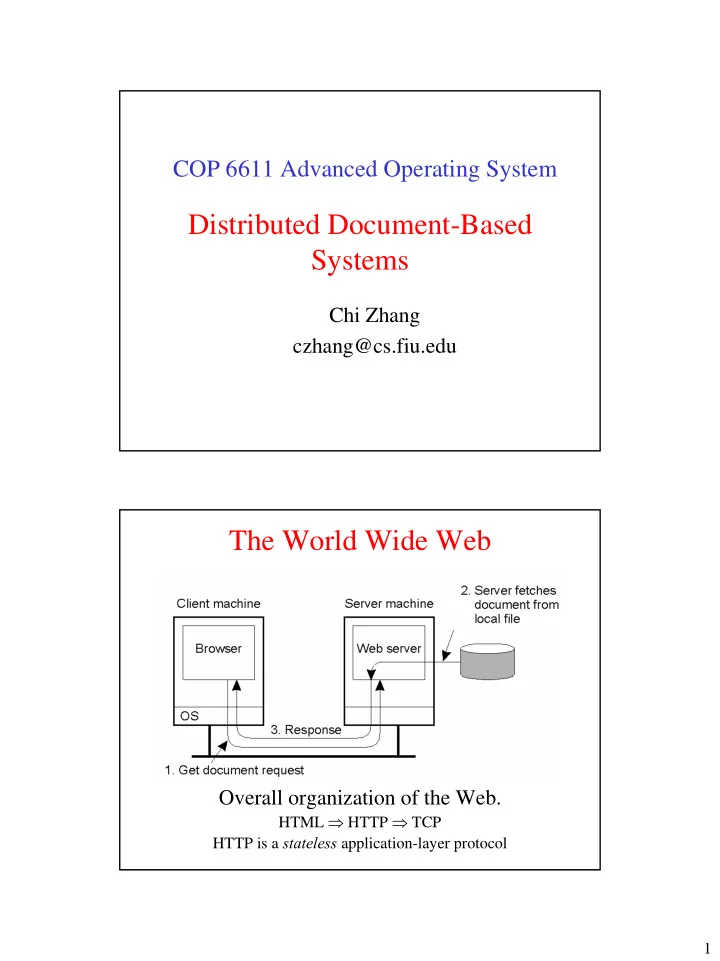
The World Wide Web
Overall organization of the Web.
HTML ⇒ HTTP ⇒ TCP HTTP is a stateless application-layer protocol
SLIDE 2 2
Document Types
Six top-level MIME types and some common subtypes. e.g. text/HTML, application/PDF
Type Subtype Description Plain Unformatted text HTML Text including HTML markup commands Text XML Text including XML markup commands GIF Still image in GIF format Image Audio Video Pointer Representation of a pointer device for presentations Multipart JPEG Still image in JPEG format Basic Audio, 8-bit PCM sampled at 8000 Hz Tone A specific audible tone MPEG Movie in MPEG format Octet-stream An uninterrupted byte sequence Postscript A printable document in Postscript PDF A printable document in PDF Mixed Independent parts in the specified order Parallel Parts must be viewed simultaneously Application
Architectural Overview (1)
The principle of using server-side CGI programs.
SLIDE 3 3
Architectural Overview (2)
Architectural details of a client and server in the Web.
Client-side script
A simple Web page embedding a script written in JavaScript. Also, client-side program: Java Applet.
< HTML> < !- Start of HTML document --> < BODY> < !- Start of the main body --> < H1> Hello World/H1> < !- Basic text to be displayed --> < P> < !- Start of a new paragraph --> < SCRI PT type = "text/ javascript"> < !- identify scripting language --> document.writeln ("< H1> Hello World< / H1> ; // Write a line of text < / SCRI PT> < !- End of scripting section
< /P> < !- End of paragraph section --> < /BODY> < !- End of main body
< /HTML> < !- End of HTML section
SLIDE 4 4
Server-side script
An HTML document containing a JavaScript to be executed by the server Also, server-side application: servlet (servlets run as threads of the server, while CGI scripts run in separate processes)
(1) <HTML> (2) <BODY> (3) <P>The current content of <pre>/data/file.txt</PRE>is:</P> (4) <P> (5) <SERVER type = "text/javascript"); (6) clientFile = new File("/data/file.txt"); (7) if(clientFile.open("r")){ (8) while (!clientFile.eof()) (9) document.writeln(clientFile.readln()); (10) clientFile.close(); (11) } (12) </SERVER> (13) </P> (14) <P>Thank you for visiting this site.</P> (15) </BODY> (16) </HTML>
HTTP Connections
a) Using nonpersistent connections. b) Using persistent connections (HTTP 1.1 or later)
SLIDE 5 5
HTTP Methods
Request Operations supported by HTTP.
Operation Description Head Request to return the header of a document Get Request to return a document to the client Put Request to store a document at a certain location Post Provide data that is to be put to a document (e.g. CGI script) Delete Request to delete a document
HTTP Messages (1)
HTTP request message Reference: URL
SLIDE 6 6
HTTP Messages (2)
HTTP response message. Status Code: the operation status. Phrase: explain the status code.
HTTP Messages (3)
A request or response message may contain additional headers, indicating content type, length, encoding, time etc.
Header Source Contents Accept-Language Client The natural language the client can handle Expires Server The time how long the response remains valid Host Client The TCP address of the document's server Last-Modified Server The time the returned document was last modified Location Server A document reference to which the client should redirect its request Referer Client Refers to client's most recently requested document Upgrade Both The application protocol the sender wants to switch to (maybe more secure SHTTP)
SLIDE 7
7
Clients (1)
Using a plug-in in a Web browser. A plug-in is a small program that can be dynamically loaded into a browser for handling a specific document (MIME) type. The interfaces are standardized.
Clients (2)
Using a Web proxy when the browser does not speak FTP. A Web proxy can be shared by a number of browsers.
SLIDE 8 8
Servers
General organization of the Apache Web server. Apache servers are highly configurable: modules can be
- incorporated. Each module can provide one or more
handlers that can assist in processing an incoming HTTP request.
Server Clusters (1)
A transport-layer switch passes the data of a TCP connection to one
- f the servers, depending on some measurement of the server’s
load. With content-aware distribution, the front end also distributes the HTTP request based also its content.
SLIDE 9
9
Server Clusters (2)
(a) The principle of TCP handoff. The server’s response is sent directly to the client, without the intervention of the front end.
Server Clusters (3)
(b) A scalable content-aware cluster of Web servers. Switch + Distributor + Dispatcher = Front End
SLIDE 10
10
Caching and Proxy
A proxy send a conditional HTTP request (with header If-Modified-Since) to a server. To improve performance at the cost of weak consistency, Squid Web Proxy assigns Texpire = α (Tcached – Tlast-modified) + Tcached Push-based mechanism and Leases Active cache: In some cases, it is possible to shift generation of the document from the server to the proxy.
Cooperative Caching
The principle of cooperative caching
SLIDE 11
11
Akamai CDN (1)
A main HTML may contain several other documents such as images, video, and audio.
Embedded documents are large Embedded documents rarely change Cache the embedded documents
In the main HTML, URLs to the embedded documents actually refer to the pages cached in CDN. The CDN DNS returns the IP address of the CDN server closest to the client, or with less load.
Alternative: assign the same IP address to several servers, and let the network layer direct the request to the nearest server.
Akamai CDN (2)
The principle working of the Akami CDN.