
SLIDE 1
1
CS 5633 Analysis of Algorithms 1 3/25/08
CS 5633 -- Spring 2008
Union-Find Data Structures
Carola Wenk Slides courtesy of Charles Leiserson with small changes by Carola Wenk
CS 5633 Analysis of Algorithms 2 3/25/08
Disjoint-set data structure (Union-Find)
Problem:
- Maintain a dynamic collection of pairwise-disjoint
sets S = {S1, S2, …, Sr}.
- Each set Si has one element distinguished as the
representative element, rep[Si].
- Must support 3 operations:
- MAKE-SET(x): adds new set {x} to S
with rep[{x}] = x (for any x ∉ Si for all i )
- UNION(x, y): replaces sets Sx, Sy with Sx ∪ Sy in S
(for any x, y in distinct sets Sx, Sy )
- FIND-SET(x): returns representative rep[Sx]
- f set Sx containing element x
CS 5633 Analysis of Algorithms 3 3/25/08
Union-Find Example
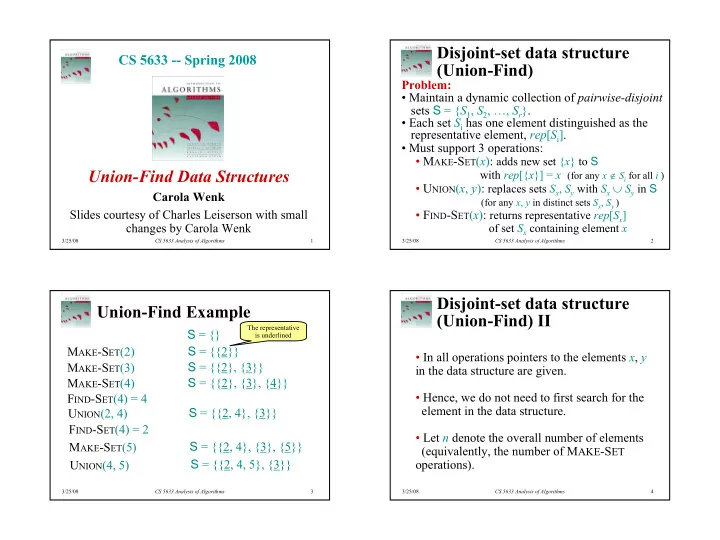
MAKE-SET(2) UNION(2, 4) FIND-SET(4) = 4 S = {} S = {{2}} MAKE-SET(3) S = {{2}, {3}} MAKE-SET(4) S = {{2}, {3}, {4}} S = {{2, 4}, {3}} FIND-SET(4) = 2 MAKE-SET(5) S = {{2, 4}, {3}, {5}} UNION(4, 5) S = {{2, 4, 5}, {3}}
The representative is underlined
CS 5633 Analysis of Algorithms 4 3/25/08
Disjoint-set data structure (Union-Find) II
- In all operations pointers to the elements x, y
in the data structure are given.
- Hence, we do not need to first search for the
element in the data structure.
- Let n denote the overall number of elements
(equivalently, the number of MAKE-SET
- perations).