Disease class of phosphate binders. 4. Select an appropriate - - PDF document

disease
SMART_READER_LITE
LIVE PREVIEW

Disease class of phosphate binders. 4. Select an appropriate - - PDF document

10/4/2014 Learning Objectives Pharmacist 1. Describe the role of phosphate binders in chronic kidney disease related mineral and bone disorder. The Attraction of Phosphate 2. Compare and contrast the different classes of Binders in


slide-1
SLIDE 1

10/4/2014 1

The “Attraction” of Phosphate Binders in Chronic Kidney Disease

Mary Vilay, Pharm.D. NMSHP Fall 2014

Learning Objectives

  • Pharmacist

1. Describe the role of phosphate binders in chronic kidney disease related mineral and bone disorder. 2. Compare and contrast the different classes of phosphate binders. 3. Discuss major safety issues associated with each class of phosphate binders. 4. Select an appropriate phosphate binder(s) for patients with chronic kidney disease.

  • Pharmacy Technician

1. Explain the indication for phosphate binders. 2. Identify agents used for phosphate binding. 3. Specify available phosphate binder dosage forms.

2

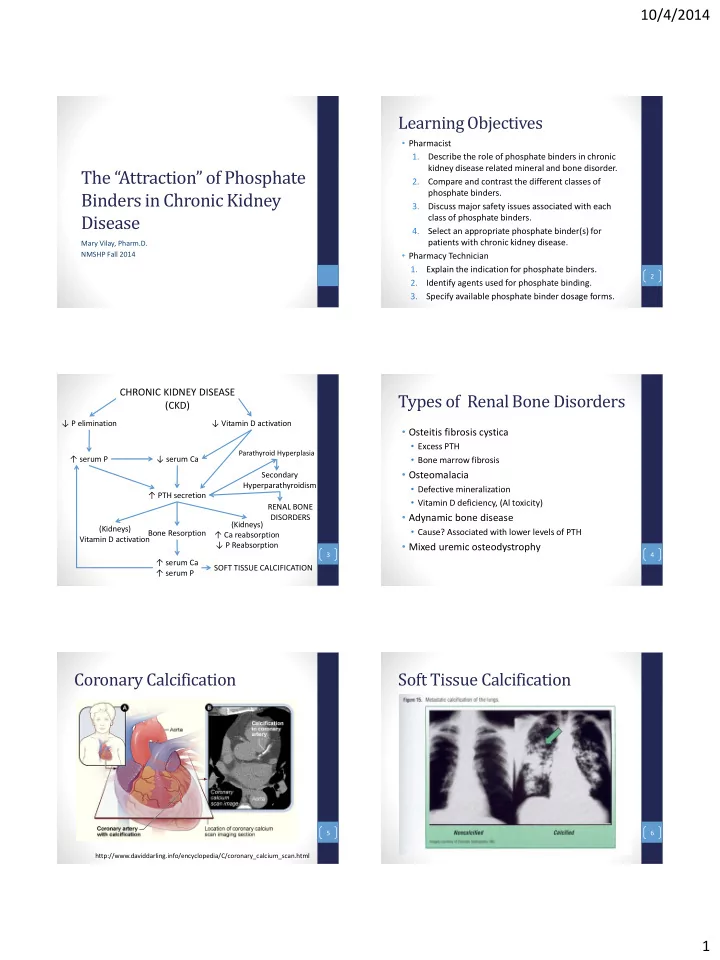
CHRONIC KIDNEY DISEASE (CKD)

↓ P elimination ↓ Vitamin D activation ↑ serum P ↓ serum Ca

Parathyroid Hyperplasia

↑ PTH secretion (Kidneys) Vitamin D activation Bone Resorption (Kidneys) ↑ Ca reabsorption ↓ P Reabsorption ↑ serum Ca ↑ serum P Secondary Hyperparathyroidism RENAL BONE DISORDERS SOFT TISSUE CALCIFICATION

3

Types of Renal Bone Disorders

  • Osteitis fibrosis cystica
  • Excess PTH
  • Bone marrow fibrosis
  • Osteomalacia
  • Defective mineralization
  • Vitamin D deficiency, (Al toxicity)
  • Adynamic bone disease
  • Cause? Associated with lower levels of PTH
  • Mixed uremic osteodystrophy

4

Coronary Calcification

http://www.daviddarling.info/encyclopedia/C/coronary_calcium_scan.html 5

Soft Tissue Calcification

6

slide-2
SLIDE 2

10/4/2014 2

Soft Tissue Calcification

7

Soft Tissue Calcification

8

Calciphylaxis

http://www.primehealthchannel.com/calciphylaxis.html 9

Case 1 – T. S. 61 y.o. female

  • PMH
  • DM Type 2
  • HTN
  • CKD
  • Meds
  • Ramipril 5 mg PO daily
  • Ferrous fumarate 300

mg PO TID

  • Lantus 24 U SC daily
  • Humalog TIDcc
  • PE
  • 1+ bilateral edema
  • Labs
  • SCr 1.5 mg/dL
  • eGFR 33

mL/min/1.73m2

  • Ca 9.2 mg/dL (8.4-

10.4)

  • P 6.7 mg/dL (2.3-5.6)
  • iPTH 314 pg/mL (11-

80)

10

CKD Mineral and Bone Disorder Guidelines

  • KDIGO (Kidney Disease Improving Global Outcomes)
  • http://kdigo.org/home/mineral-bone-disorder/
  • Kidney International 2009; 76 (Suppl 113): S1-

S130.

  • KDOQI (Kidney Disease Outcomes Quality Initiative)
  • http://www.kidney.org/professionals/KDOQI/guid

elines_bone/index.htm

  • American Journal of Kidney Diseases 2003; 42(4)

Suppl 3: S1-S201.

11

CHRONIC KIDNEY DISEASE (CKD)

↓ P elimination ↓ Vitamin D activation ↑ serum P ↓ serum Ca

Parathyroid Hyperplasia

↑ PTH secretion (Kidneys) Vitamin D activation Bone Resorption (Kidneys) ↑ Ca reabsorption ↓ P Reabsorption ↑ serum Ca ↑ serum P Secondary Hyperparathyroidism RENAL BONE DISORDERS SOFT TISSUE CALCIFICATION

12

Phosphate Binders Vitamin D Analogs Calcimimetic

slide-3
SLIDE 3

10/4/2014 3

Guideline Recommendations

Phosphorus KDIGO KDOQI Stage 3 (GFR 30-59) Normal serum P 2.7-4.6 mg/dL Stage 4 (GFR 15-29) Normal serum P 2.7-4.6 mg/dL Stage 5ND (GFR <15) Normal serum P 3.5-5.5 mg/dL Stage 5D (PD/HD) Lower towards normal serum P range 3.5-5.5 mg/dL

13

Guideline Recommendations

Calcium KDIGO KDOQI Stage 3 (GFR 30-59) Normal serum Ca Normal serum Ca Stage 4 (GFR 15-29) Normal serum Ca Normal serum Ca Stage 5ND (GFR <15) Normal serum Ca Normal serum Ca range, preferably lower end (8.4-9.5 mg/dL) Stage 5D (PD/HD) Normal serum Ca Normal serum Ca range, preferably lower end (8.4-9.5 mg/dL)

14

Dietary Phosphorus Restriction

  • Beverages:
  • Ale
  • Beer
  • Cocoa
  • Dark colas
  • Dairy products:
  • Cheese
  • Ice cream
  • Milk
  • Cream soups
  • Yogurt
  • Protein:
  • Carp
  • Fish roe
  • Organ meets
  • Oysters
  • Sardines
  • Dried beans & peas
  • Others:
  • Bran cereals
  • Whole grain products
  • Nuts

15 www.kidney.org

Phosphate Binders

Rx Formulations Place in Therapy Aluminum hydroxide No Liquid, tablet, capsule Alternate Calcium-based Preferred Ca acetate Yes/no Capsule, tablet Ca carbonate No Liquid, tablet, chewable, capsule Lanthanum carbonate Yes Chewable tablet Alternate Sevelamer Preferred Sevelamer HCl (Renagel) Yes Tablet Sevelamer carbonate (Renvela) Yes Tablet, powder

16

Biochemical Endpoints

Treat to Goal

(Prevalent HD)

RIND

(Incident HD)

SVR (n=99) Ca (n=101) P-value P 5.1±1.2 5.1±1.4 NS Ca 9.5±0.6 9.7±0.7 <0.05 ↑Ca 5% 16% <0.05 iPTH 224 138 NS ↓iPTH 30% 57% <0.05 TC 141±28 182±49 <0.05 LDL 65±21 103±43 <0.05 HDL 43±10 45±12 NS Trig 137 150 NS SVR (n=54) Ca (n=55) P-value P 5.2±0.9 5.1±0.8 NS Ca 9.1±0.5 9.6±0.5 <0.05 iPTH 298±152 243±16 <0.05 TC 134±52 160±32 <0.05 LDL 60±34 81±26 <0.05 Trig 171±108 191±106 NS

  • Chertow. Kidney Int 2002;62:245.
  • Block. Kidney Int 2005;68:1815.

17

Bone Histology Summary

  • No major difference between calcium

carbonate with lanthanum carbonate or sevelamer

  • Changes in bone turnover were

heterogenous

  • Some patients improved while others

worsened

  • Results influenced by baseline turnover

rates

  • KDIGO. Kidney International 2009; 76 (Suppl 113): S1-S130.

18

slide-4
SLIDE 4

10/4/2014 4

Treat to Goal

Coronary Artery Calcification

5 10 15 20 25 30 Wk 26 Wk 52 Median % Change

Aortic Calcification

5 10 15 20 25 30 Wk 26 Wk 52 Median % Change

*

Sevelamer vs Calcium

  • Chertow. Kidney Int 2002;62:245-252.

19

* * * * P<0.05 Ca vs Sevelamer * P<0.05 Ca vs Baseline

Treat to Goal

Coronary Artery

100 200 300 400 500 600 700 800 Median Change

Aorta

200 400 600 800 1000 1200 1400 Median Change

Sevelamer vs Calcium

  • Chertow. Kidney Int 2002;62:245-252.

20

RIND

  • Block. Kidney Int 2005;68:1815-1824.

21

RIND

  • CAC = 0 at baseline, none progressed to CAC >30

by study end

  • CAC >30 at baseline, progressive CAC increase (in

sevelamer and Ca arm)

  • Ca arm: more rapid and severe increase in CAC

Baseline CAC = (n=37) Baseline CAC >0 (n=72) Mean age 45 ± 12 y 64 ± 11 y P<0.0001

  • Block. Kidney Int 2005;68:1815-1824.

22

RIND

  • During parent study, subjects remained on

their assigned phosphate binder (sevelamer vs calcium)

  • After final scan, subjects given phosphate

binders at discretion of primary nephrologist

  • Median follow up = 44 months
  • Block. Kidney Int 2005;68:1815-1824.
  • Block. Kidney Int 2007;71:438-441.

23

RIND Follow up

Adjusted (age, race, gender, diabetes)

  • Block. Kidney Int 2007;71:438-441.

24

P=0.002

slide-5
SLIDE 5

10/4/2014 5

RIND Follow up

Adjusted (age, race, gender, DM, history artherosclerotic cardiovascular disease, CRP, albumin, Kt/V, baseline CAC)

  • Block. Kidney Int 2007;71:438-441.

25

P=0.016

DCOR

  • Prospective, multi-center, randomized,
  • pen-labeled, parallel design
  • Adult HD (>3 mo)
  • Required phosphate binder
  • Medicare = primary insurance
  • Powered to detect all-cause mortality
  • Suki. Kidney Int 2007;72:1130-7.

26

DCOR

Sevelamer (n=99) Calcium (n=101) P-value P 5.8±1.3 5.7±1.3 <0.01 Ca 9.2±0.7 9.5±0.7 <0.0001 iPTH, median 278 (200,476) 226 (142,387) <0.0001 TC 146±34 161±35 <0.0001 LDL 69±26 85±31 <0.0001 HDL 45±15 44±16 NS

  • Suki. Kidney Int 2007;72:1130-7.

27

DCOR

  • Suki. Kidney Int 2007;72:1130-7.

All-cause Mortality P=0.40 Cardiovascular Mortality P=0.53

28

Calcium = black line Sevelamer = green line

DCOR

  • Suki. Kidney Int 2007;72:1130-7.

P=0.02 P=0.21 P=0.10 P=0.37

29

All-cause Mortality Cardiovascular Mortality

≥65 y ≥65 y <65 y <65 y

DCOR Patient disposition

Randomized (N=2103) Sevelamer (N=1053) D/C (N=502) A/E (N=81) Completed (N=551) Calcium (N=1050) D/C (N=533) A/E (N=50) Completed (N=517)

  • Suki. Kidney Int 2007;72:1130-7.

30

slide-6
SLIDE 6

10/4/2014 6

DCOR Secondary Analysis CMS Data

Randomized N=2103 Mortality N=2101 Sevelamer N=1051 Completed N=938 Calcium N=1050 Completed N=938 Morbidity/Hospitalization N=1947 Sevelamer N=979 Completed N=735 Calcium N=968 Completed N=735 Linked to CMS database N=2101

  • St. Peter. Am J Kidney Dis 2008;51:445-54.

31

DCOR Secondary Analysis

  • All-cause mortality
  • Cardiovascular mortality = NS
  • St. Peter. Am J Kidney Dis 2008;51:445-54.

32

DCOR Secondary Analysis

Sevelamer (N=979) Calcium (N=968) 95% CI P First Hospitalization Unadjusted RR 0.98 Reference 0.89-1.08 0.7 Adjusted RR 0.99 Reference 0.90-1.09 0.9 Multiple hospitalizations Unadjusted RR 0.90 Reference 0.82-0.99 0.03 Adjusted RR 0.89 Reference 0.82-0.98 0.02 Hospital days Unadjusted RR 0.88 Reference 0.78-1.00 0.05 Adjusted RR 0.88 Reference 0.78-0.99 0.03

Adjusted (age, race, sex, dialysis vintage, DM, comorbid cardiovascular conditions)

  • St. Peter. Am J Kidney Dis 2008;51:445-54.

33

CARE-2

  • Multicenter, randomized, controlled, open-label, non-

inferiority trial

  • Assess calcification progression in HD patients treated

with calcium-containing vs calcium-free phosphate binders when LDL-C was decreased to <70 mg/dL.

  • P >5.5 mg/dL
  • LDL >80 mg/dL
  • CAC scores 30 to 7000 Units at baseline
  • Ca acetate n=103; sevelamer n=100
  • P goal 3.5 to 5.5
  • Atorvastatin added to achieve LDL <70 mg/dL in both

groups

  • Qunibi. Am J Kidney Dis 2008;51:952-65.

34

CARE-2

Sevelamer (n=70) Calcium (n=59) P-value P 5.4±1.8 5.0±1.6 NSD Ca 9.0±0.7 9.4±0.7 <0.05 iPTH 434±359 316±212 <0.05 TC 126±30.6 134±32.3 <0.05 LDL 62.4±23.0 68.8±22.3 NS HDL 38.8±11.3 36.4±8.7 NS Trig 149±69.8 157±124 NS

  • Qunibi. Am J Kidney Dis 2008;51:952-65.

35

CARE-2 CAC Scores

Sevelamer Calcium Acetate P-value Baseline CAC 969±1,386 1,098±1,440 NS 6 mo CAC 996±1,419 1,197±1,413 NS 6 mo absolute increase 97±211 (p<0.0001) 109±374 (p<0.0001) NS 6 mo % increase 24±39 71±365 NS 12 mo CAC 1,116±1,569 1,297±1,487 NS 12 mo absolute increase 227±485 (p<0.0001) 228±355 (p<0.0001) NS 12 mo % increase 57±86 52±92 NS

  • Qunibi. Am J Kidney Dis 2008;51:952-65.

36

slide-7
SLIDE 7

10/4/2014 7

Lanthanum Carbonate

  • Effectively lowers serum phosphorous and

iPTH

  • Does not increase serum Ca
  • Adverse effect rates comparable to other

phosphate binders

  • Accumulation in blood and bone below

toxic levels

  • Studies were short in duration, most ≤ 1y
  • Zhang. BMC Nephrology 2013;14:226.

37

Aluminum Hydroxide

  • Al adverse effects:
  • Central nervous system toxicity (Dialysis Dementia)
  • Osteomalacia
  • Microcytic anemia
  • Citrate increases intestinal Al absorption
  • KDIGO Guidelines: Avoid long-term use
  • KDOQI: May be used as short-term therapy (4

wk) in patients with serum P >7 mg/dL

  • Safe quantity of Al phosphate binder unknown

38

Phosphate Binders

Rx Cost Comments Aluminum hydroxide No $10/500 mL Al content varies 100 to >200 mg (per tablet) Calcium-based KDOQI recommends not to exceed 2000 mg/day elemental Ca Ca acetate Yes/no $100/100 tablets Medicaid formulary 25% elemental Ca Ca carbonate No $10/100 tablets 40% elemental Ca Lanthanum carbonate Yes $990/100 tablets Sevelamer Sevelamer HCl (Renagel) Yes $530/100 tablets Medicaid formulary ↓ Ciprofloxacin absorption ~50% Sevelamer carbonate (Renvela) Yes $430/100 tablets $14/powder packet 39

Pipeline – Resin

  • Colestilan (MCI-196)
  • Anion exchange resin
  • Locatelli. Nephrol Dial Transplant

2014;29(5):1061-73.

  • Effective phosphate and cholesterol lowering

40

Pipeline – Iron based

  • Sucroferric oxyhydroxide (PA21)
  • Floege. Kidney Int 2014-86(3):638-47.
  • Equivalent phosphate control with 3 pills/day

compared to 8 of sevelamer

  • Ferric Citrate (JTT-751)
  • Lewis. J Am Soc Nephrol 2014. [Epub ahead of

print]

  • Effective phosphate binding
  • Increased iron stores, decreased IV iron and

erythropoietin administration

41

Case 1 – T. S. 61 y.o. female

  • PMH
  • DM Type 2
  • HTN
  • CKD
  • Meds
  • Ramipril 5 mg PO daily
  • Ferrous fumarate 300

mg PO TID

  • Lantus 24 U SC daily
  • Humalog TIDcc
  • PE
  • 1+ bilateral edema
  • Labs
  • SCr 1.5 mg/dL
  • eGFR 33

mL/min/1.73m2

  • Ca 9.2 mg/dL (8.4-

10.4)

  • P 6.7 mg/dL (2.3-5.6)
  • iPTH 314 pg/mL (11-

80)

42

slide-8
SLIDE 8

10/4/2014 8

Case 2 – QQ 54 y.o. female

  • Receives hemodialysis

MWF

  • Medications:
  • CaCO3 1250 mg PO TIDcc &

snacks

  • Epoetin alpha 4000 U with

HD

  • Iron sucrose 100 mg IV q

week

  • Renal vitamin PO daily
  • Insulin
  • What is the most

appropriate change to recommend?

A. Increase CaCO3 to 2.5 g TIDcc & snacks B. D/C CaCO3 , start Ca acetate 667 mg TIDcc & snacks C. D/C CaCO3 , start AlOH3 320 mg TIDcc & snacks

  • D. D/C CaCO3 , start

sevelamer carbonate 800 mg TIDcc & snacks

43 Time iPTH Serum Ca Serum P Serum albumin 3 mo ago 890 8.5 6.5 2 mo ago 744 8.6 6.8 Last month 789 8.5 7.2 Today 943 8.9 6.9 2