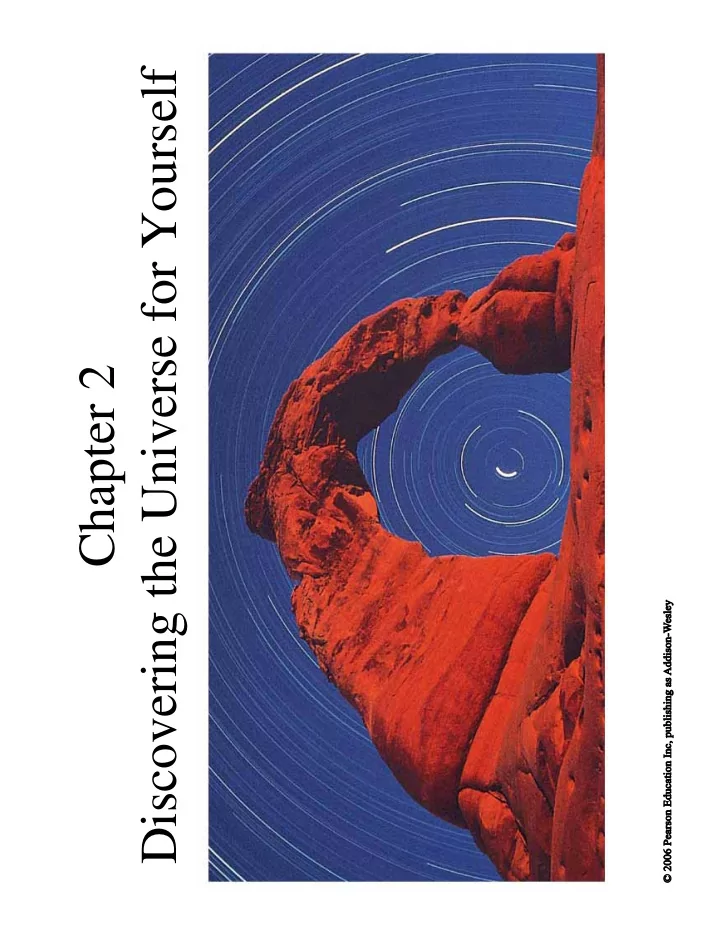
SLIDE 1
Chapter 2 Discovering the Universe for Yourself
SLIDE 2 2.1 Patterns in the Night Sky
- What does the universe look like from
Earth?
- Why do stars rise and set?
- Why do the constellations we see depend on
latitude and time of year?
Our goals for learning:
SLIDE 3
What does the universe look like from Earth?
With the naked eye, we can see more than 2,000 stars as well as the Milky Way.
SLIDE 4
Constellations
A constellation is a region of the sky.
88 constellations fill the entire sky.
SLIDE 5
The Celestial Sphere
Stars at different distances all appear to lie on the celestial sphere. Ecliptic is Sun’s apparent path through the celestial sphere.
SLIDE 6
The Celestial Sphere
The 88 official constellations cover the celestial sphere.
SLIDE 7
The Milky Way
A band of light making a circle around the celestial sphere. What is it? Our view into the plane of our galaxy.
SLIDE 8
The Milky Way
SLIDE 9
The Local Sky
An object’s altitude (above horizon) and direction (along horizon) specifies its location in your local sky
SLIDE 10
The Local Sky
Zenith: The point directly overhead Horizon: All points 90° away from zenith Meridian: Line passing through zenith and connecting N and S points on horizon
SLIDE 11
We measure the sky using angles
SLIDE 12 Angular Measurements
- Full circle = 360º
- 1º = 60′ (arcminutes)
- 1′ = 60″ (arcseconds)
SLIDE 13 Angular Size
angular size = physical size × 360 degrees 2π × distance An object’s angular size appears smaller if it is farther away
SLIDE 14
Why do stars rise and set?
Earth rotates west to east, so stars appear to circle from east to west.
SLIDE 15 Our view from Earth:
- Stars near the north celestial pole are circumpolar and
never set.
- We cannot see stars near the south celestial pole.
- All other stars (and Sun, Moon, planets) rise in east and
set in west.
Celestial Equator Your Horizon A circumpolar star never sets This star never rises
SLIDE 16 Why do the constellations we see depend
- n latitude and time of year?
- They depend on latitude because your position on
Earth determines which constellations remain below the horizon.
- They depend on time of year because Earth’s orbit
changes the apparent location of the Sun among the stars.
SLIDE 17 Review: Coordinates on the Earth
- Latitude: position north or south of equator
- Longitude: position east or west of prime meridian
(runs through Greenwich, England)
SLIDE 18
The sky varies with latitude but not longitude.
SLIDE 19
Altitude of the celestial pole = your latitude
SLIDE 20 The sky varies as Earth orbits the Sun
- As the Earth orbits the Sun, the Sun appears to move eastward
along the ecliptic.
- At midnight, the stars on our meridian are opposite the Sun in
the sky.
SLIDE 21 What have we learned?
- What does the universe look like from Earth?
– We can see over 2,000 stars and the Milky Way with our naked eyes, and each position
- n the sky belongs to one of 88 constellations
– We can specify the position of an object in the local sky by its altitude above the horizon and its direction along the horizon
- Why do stars rise and set?
– Because of Earth’s rotation.
SLIDE 22 What have we learned?
- Why do the constellations we see depend on
latitude and time of year? – Your location determines which constellations are hidden by Earth. – Time of year determines location of Sun in sky
SLIDE 23 2.2 The Reason for Seasons
Our goals for learning:
- What causes the seasons?
- How do we mark the progression of the
seasons?
- How does the orientation of Earth’s axis
change with time?
SLIDE 24 What causes the seasons?
Seasons depend on how Earth’s axis affects the directness of sunlight
SLIDE 25
Direct light causes more heating.
SLIDE 26
Axis tilt changes directness of sunlight during the year.
SLIDE 27 Sun’s altitude also changes with seasons
Sun’s position at noon in summer: higher altitude means more direct sunlight. Sun’s position at noon in winter: lower altitude means less direct sunlight.
SLIDE 28 Summary: The Real Reason for Seasons
- Earth’s axis points in the same direction (to
Polaris) all year round, so its orientation relative to the Sun changes as Earth orbits the Sun.
- Summer occurs in your hemisphere when sunlight
hits it more directly; winter occurs when the sunlight is less direct.
- AXIS TILT is the key to the seasons; without it,
we would not have seasons on Earth.
SLIDE 29 Why doesn’t distance matter?
- Variation of Earth-Sun distance is small — about
3%; this small variation is overwhelmed by the effects of axis tilt.
SLIDE 30 How do we mark the progression of the seasons?
- We define four special points:
summer solstice winter solstice spring (vernal) equinox fall (autumnal) equinox
SLIDE 31 We can recognize solstices and equinoxes by Sun’s path across sky:
Summer solstice: Highest path, rise and set at most extreme north of due east. Winter solstice: Lowest path, rise and set at most extreme south of due east. Equinoxes: Sun rises precisely due east and sets precisely due west.
SLIDE 32
Seasonal changes are more extreme at high latitudes
Path of the Sun on the summer solstice at the Arctic Circle
SLIDE 33 How does the orientation of Earth’s axis change with time?
- Although the axis seems fixed on human time scales,
it actually precesses over about 26,000 years. ⇒ Polaris won’t always be the North Star. ⇒ Positions of equinoxes shift around orbit; e.g., spring equinox, once in Aries, is now in Pisces!
Earth’s axis precesses like the axis of a spinning top
SLIDE 34 What have we learned?
– The tilt of the Earth’s axis causes sunlight to hit different parts of the Earth more directly during the summer and less directly during the winter – We can specify the position of an object in the local sky by its altitude above the horizon and its direction along the horizon
SLIDE 35 What have we learned?
- How do we mark the progression of the seasons?
– The summer and winter solstices are when the Northern Hemisphere gets its most and least direct sunlight, respectively. The spring and fall equinoxes are when both hemispheres get equally direct sunlight.
- How does the orientation of Earth’s axis change
with time? – The tilt remains about 23.5 degrees (so the season pattern is not affected), but Earth has a 26,000 year precession cycle that slowly and subtly changes the orientation of the Earth’s axis
SLIDE 36 2.3 The Moon, Our Constant Companion
- Why do we see phases of the Moon?
- What causes eclipses?
Our goals for learning:
SLIDE 37 Why do we see phases of the Moon?
consequence of the Moon’s 27.3-day
SLIDE 38 Phases of Moon
illuminated by Sun and half is dark
combination of the bright and dark faces as Moon orbits
SLIDE 39
Phases of the Moon
SLIDE 40
Moon Rise/Set by Phase
SLIDE 41 Phases of the Moon: 29.5-day cycle
new crescent first quarter gibbous full gibbous last quarter crescent
waxing
- Moon visible in afternoon/evening.
- Gets “fuller” and rises later each day.
waning
- Moon visible in late night/morning.
- Gets “less” and sets later each day.
SLIDE 42 We see only one side of Moon
Synchronous rotation: the Moon rotates exactly
That is why only one side is visible from Earth
SLIDE 43 What causes eclipses?
- The Earth and Moon cast shadows.
- When either passes through the other’s shadow, we
have an eclipse.
SLIDE 44
Lunar Eclipse
SLIDE 45 When can eclipses occur?
- Lunar eclipses can
- ccur only at full
moon.
be penumbral, partial, or total.
SLIDE 46
Solar Eclipse
SLIDE 47 When can eclipses occur?
- Solar eclipses can occur
- nly at new moon.
- Solar eclipses can be
partial, total, or annular.
SLIDE 48 Why don’t we have an eclipse at every new and full moon?
– The Moon’s orbit is tilted 5° to ecliptic plane… – So we have about two eclipse seasons each year, with a lunar eclipse at full moon and solar eclipse at new moon.
SLIDE 49 Summary: Two conditions must be met to have an eclipse:
1. It must be full moon (for a lunar eclipse) or new moon (for a solar eclipse). AND
- 2. The Moon must be at or near one of the two points in its
- rbit where it crosses the ecliptic plane (its nodes).
SLIDE 50 Predicting Eclipses
- Eclipses recur with the 18 yr, 11 1/3 day saros
cycle, but type (e.g., partial, total) and location may vary.
SLIDE 51 What have we learned?
- Why do we see phases of the Moon?
– Half the Moon is lit by the Sun; half is in shadow, and its appearance to us is determined by the relative positions of Sun, Moon, and Earth
– Lunar eclipse: Earth’s shadow on the Moon – Solar eclipse: Moon’s shadow on Earth – Tilt of Moon’s orbit means eclipses occur during two periods each year
SLIDE 52 2.4 The Ancient Mystery of the Planets
- What was once so mysterious about planetary
motion in our sky?
- Why did the ancient Greeks reject the real
explanation for planetary motion?
Our goals for learning:
SLIDE 53 Planets Known in Ancient Times
– difficult to see; always close to Sun in sky
– very bright when visible; morning or evening “star”
– noticeably red
– very bright
– moderately bright
SLIDE 54 What was once so mysterious about planetary motion in our sky?
- Planets usually move slightly eastward from night to
night relative to the stars.
- But sometimes they go westward relative to the stars
for a few weeks: apparent retrograde motion
SLIDE 55
We see apparent retrograde motion when we pass by a planet in its orbit.
SLIDE 56 Explaining Apparent Retrograde Motion
- Easy for us to explain: occurs when we
“lap” another planet (or when Mercury or Venus laps us)
- But very difficult to explain if you think that
Earth is the center of the universe!
- In fact, ancients considered but rejected the
correct explanation
SLIDE 57 Why did the ancient Greeks reject the real explanation for planetary motion?
- Their inability to observe stellar parallax was a major factor.
SLIDE 58 The Greeks knew that the lack of observable parallax could mean one of two things:
- 1. Stars are so far away that stellar parallax is
too small to notice with the naked eye
- 2. Earth does not orbit Sun; it is the center of
the universe
With rare exceptions such as Aristarchus, the Greeks rejected the correct explanation (1) because they did not think the stars could be that far away
Thus setting the stage for the long, historical showdown between Earth-centered and Sun-centered systems.
SLIDE 59 What have we learned?
- What was so mysterious about planetary motion
in our sky?
– Like the Sun and Moon, planets usually drift eastward relative to the stars from night to night; but sometimes, for a few weeks or few months, a planet turns westward in its apparent retrograde motion
- Why did the ancient Greeks reject the real
explanation for planetary motion?
– Most Greeks concluded that Earth must be stationary, because they thought the stars could not be so far away as to make parallax undetectable