Disclosure I have nothing to disclose Trying to Prevent Illness in - - PDF document

disclosure
SMART_READER_LITE
LIVE PREVIEW

Disclosure I have nothing to disclose Trying to Prevent Illness in - - PDF document

5/16/13 Disclosure I have nothing to disclose Trying to Prevent Illness in Kids Who TravelDiagnosing it when they Return 46 th Advances and Controversies in Clinical Pediatrics Jay Tureen, M.D. International Travel with Kids Health


slide-1
SLIDE 1

5/16/13 1

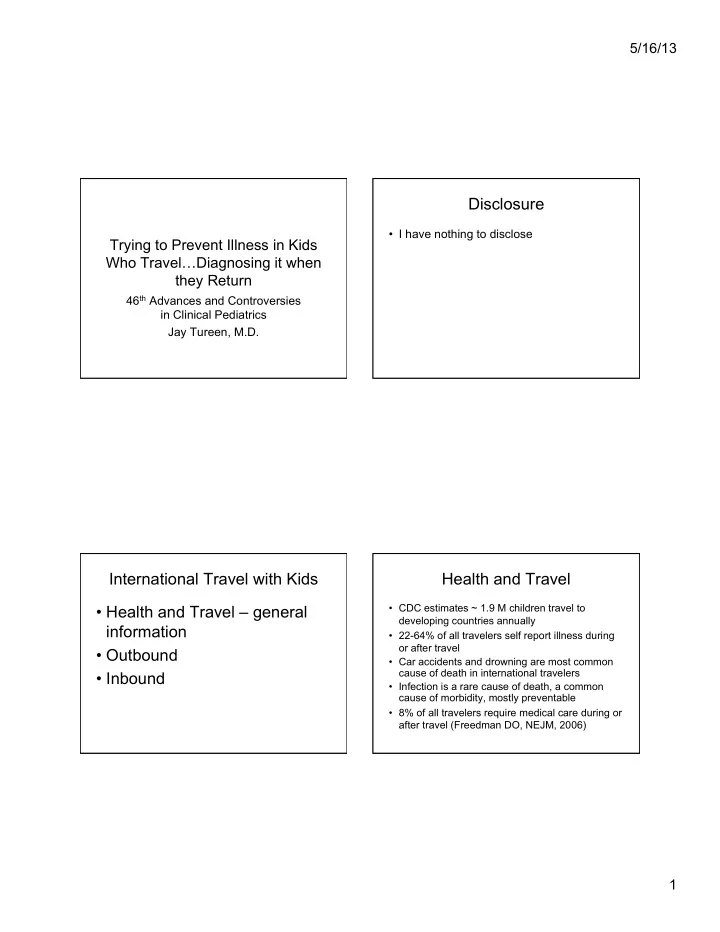
Trying to Prevent Illness in Kids Who Travel…Diagnosing it when they Return

46th Advances and Controversies in Clinical Pediatrics Jay Tureen, M.D.

Disclosure

  • I have nothing to disclose

International Travel with Kids

  • Health and Travel – general

information

  • Outbound
  • Inbound

Health and Travel

  • CDC estimates ~ 1.9 M children travel to

developing countries annually

  • 22-64% of all travelers self report illness during
  • r after travel
  • Car accidents and drowning are most common

cause of death in international travelers

  • Infection is a rare cause of death, a common

cause of morbidity, mostly preventable

  • 8% of all travelers require medical care during or

after travel (Freedman DO, NEJM, 2006)

slide-2
SLIDE 2

5/16/13 2

Outbound

  • Anticipatory guidance
  • Immunizations
  • Medications
  • Other stuff

Anticipatory guidance: Data

  • Contact Card with information to have in
  • ne place
  • Personal ID for minor children (but not

visible)

  • Notarized letter from other parent if single

parent traveling with child internationally

Contact Card

  • Travelers should carry a contact card with the

addresses and phone numbers of the following:

  • Designated person back home contact information
  • Health care provider(s) at home
  • Place of lodging at the destination
  • Medical insurance information, Travel insurance and

medical evacuation insurance information

  • Area hospitals or clinics, including emergency services
  • MDs in other countries: ISTM.org, IAMAT.org
  • US embassy or consulate in the destination country or

countries

Anticipatory Guidance: Stuff

  • Safety considerations – car seats,

sunblock

  • Medical kits (CDC website)
  • Water sterilization tabs/ORS powder
  • Chart for estimating dehydration
slide-3
SLIDE 3

5/16/13 3

Immunizations for Travelers

  • General principles
  • Required
  • Recommended

Immunizations: General

  • Make sure current on routine
  • Anticipate risk of exposure
  • Season, Location and Type of travel
  • Traveler specific issues
  • PCP can do all (easily) except

– YF, JE, rabies

Immunizations: Required

  • Yellow Fever

– For endemic countries or regions – Sub- Saharan Africa, Tropical So America – or if traversing – Live virus – contraindicated if immune-comp – For 9 mos or older, contraindicated < 4 mo

  • Meningococcal vaccine
  • Required for pilgrims to Hajj age 15
  • r older

Immunizations: Recommended

  • Routine immunizations need to be UTD
  • Hepatitis A (common vaccine preventable)
  • Meningococcal

– Recommended for Sub Saharan meningitis belt in dry winter months of Nov-June

  • Typhoid

– Vi polysaccharide, IM, 2y/0; Ty 21a, oral, 6 yr)

  • Rabies (risk determined)
  • Japanese B encephalitis (risk determined)
slide-4
SLIDE 4

5/16/13 4

Immunizations: Planning

  • Hep A: 0, 6 mos
  • Rabies: 0, 7, 21-28d
  • JE: 0, 7, 14-30d (delayed hypersensitivity

up to 10 d)

  • Typhoid: IM x1, PO over 7 d; 2 wks before

exposure

  • YF: SQ 10 d before travel (will need

referral to YF licensed provider)

Outbound: Issues to anticipate

  • Malaria

– Bite prevention – Meds

  • Travelers diarrhea

– Avoidance – Management

Malaria

  • 3 M cases worldwide
  • ~1800/yr in US civilians

– 59% in Sub Saharan Africa – 19% Asia – 14% Caribbean, Central and So America – 7% other

slide-5
SLIDE 5

5/16/13 5

Malaria: Prevention

  • Mosquito bite avoidance

– Anopheles are dusk to dawn feeders – avoid exposure – Repellents – DEET (20-30%) – Long sleeves, pants – Permethrin-treated mosquito netting

  • Chemoprophylaxis

Malaria: Resistant P. falciparum

  • Chloroquine-resistant P.

falciparum

– Africa, Asia, tropical So. America

  • Chloroquine-sensitive P.f.

– Mexico to Costa Rica; So South America – North Africa, Turkey-Iraq, Soviet republics, Korea

Malaria Chemoprophylaxis

  • Mefloquine

– infants (5 kg) and children

  • Malarone (atovaquone-proquanil)

– toddlers (11 kg) and children

  • Doxycyline

– children >8 yr

  • Chloroquine

– infants and children

Malaria: terminal prophy

  • Primaquine

– Used to eliminate hepatic reservoir of P vivax and P ovale – Contraindicated in G6PD def (test if at risk) – Used in patients with prolonged exposure

slide-6
SLIDE 6

5/16/13 6

Traveler’s Diarrhea

  • Most common travel health problem

– Fecal-oral transmission

  • Bacteria (80%)

– ETEC, campylobacter, salmonella, shigella

  • Viruses

– rotavirus, norovirus

  • Parasites
  • Giardia, amoeba, cryptosporidium

TD: Prevention

  • Risk reduction

– “Cook it, peel it, boil it or don’t eat it” – Advise bottled drinks, no ice

  • Prophylaxis

– bismuth subsalicylate: (65% effective) – Antibiotic prophylaxis: (90% effective)

  • Short-term manage with loperamide with Abx as

back up – Cipro, azithro (esp SE Asia), rifamaxin

TD: if it happens

  • Assessment of fluid losses
  • Assessment of Clinical severity

Assessment of dehydration in infants (Modified from CDC)

SIGN MILD MODERATE SEVERE GENERAL Thirsty, agitated Thirsty, irritable Less responsive, rapid respiration FONTANELLE, EYES Normal Sunken Very sunken TEARS Present Absent Absent MUCOUS MEMBRANES Slightly dry Dry Dry URINE OUTPUT Normal Reduced None for several hours

slide-7
SLIDE 7

5/16/13 7

TD: if it happens

  • Assessment of clinical severity

– Mild (1-2/24h, minimal sx, watch hydration) – Moderate (>3/24 hr, add loperamide) – Severe (mod-severe abdominal pain, bloody, fever)

  • Start antibiotics, maintain hydration

Inbound

  • GeoSentinel survey
  • Clinician-based surveillance of ill child

travelers in travel clinics worldwide

  • 1997-2007

» Pediatrics 2010

Demographics

  • 1840 children
  • Age evenly distributed 0-5, 6-11, 12-17
  • 14% req’d hospitalization, highest < 5y/o
  • 40-45% were <7 d from travel
  • c/w adults, less likely to have pre-travel

information

Clinical Syndromes

  • 21 broad syndromic categories identified
  • 93% in 5 categories:

– Diarrheal disorders (28%) – Dermatologic disorder (25%) – Systemic febrile illness (23%) – Respiratory disorders (11%) – Non-diarrheal GI disorder (7%)

slide-8
SLIDE 8

5/16/13 8

Syndrome: Diarrheal Disorder

  • Acute (80%)

– Bacterial (29%) [campylobacter, salmonella] – Parasitic (25%) [giardia 47%] – Gastroenteritis, no cause identified (28%)

  • Chronic [> 2 wks] (20%)

– “post-infectious IBS”

Syndrome: Dermatologic dz

  • Animal bites (24%)
  • Cutaneous larva migrans (17%)
  • Insect bites (12%)

Cutaneous Larva Migrans

  • Most common skin dz

in travelers to tropics

  • Larvae of dog

hookworm (Ancystoloma braziliense)

  • Soil, sand contact
  • Rx topical

thiabendazole, PO ivermectin

Syndrome: Systemic febrile illness

  • Malaria (35%)
  • Viral syndromes (28%)
  • Unspecified febrile illness (11%)
  • Dengue (6%)
  • Enteric fever (6%)
  • “Mononucleosis Sd” (4%)

– [EBV,CMV, Toxo]

slide-9
SLIDE 9

5/16/13 9

Syndrome: Respiratory dz

  • URI (38%)
  • Reactive airway dz (20%)
  • AOM (17%)

Syndrome: Non-diarrheal GI

  • Schistosomiasis (15%)

– Middle East, SubSaharan Africa, Caribbean

  • Strongyloidiasis (11%)
  • Hepatitis A (11%)

Geographic association with illness

  • Malaria: Sub Saharan Africa
  • Dengue: Asia, Latin America, Caribbean
  • Dermatologic (CLM): Latin America, Carib
  • Derm (animal bites): Asia, N Africa
  • Diarrheal illness: N Africa, Middle East

Final Thoughts

  • Travel advice within the purview of PCP
  • Handouts, checklists can be developed (or

modified from existing)

  • Most vaccines can be given in ofc (x YF)

with pre-planning

  • Prophylaxis can be rx’d
  • Anticipatory guidance relating to most

common conditions can be provided.

slide-10
SLIDE 10

5/16/13 10

References: Travel Medicine

  • www.cdc.gov/travel
  • www.who.int
  • Travel Medicine; Keystone, Kozarsky, Freedman,

Nothdurft, Connor, 2004

  • Health Information for International Travel 2005-2006;

Arguin, Kozarsky, Navin, Eds. CDC

  • Illness in Children after International Travel: Analysis

from the GeoSentinal Surveillance Network. Hagmann S et al, Pediatrics 2010, e1072