DISCL DI SCLOSURE OSURE I have no commercial interests to - - PDF document

discl di sclosure osure
SMART_READER_LITE
LIVE PREVIEW

DISCL DI SCLOSURE OSURE I have no commercial interests to - - PDF document

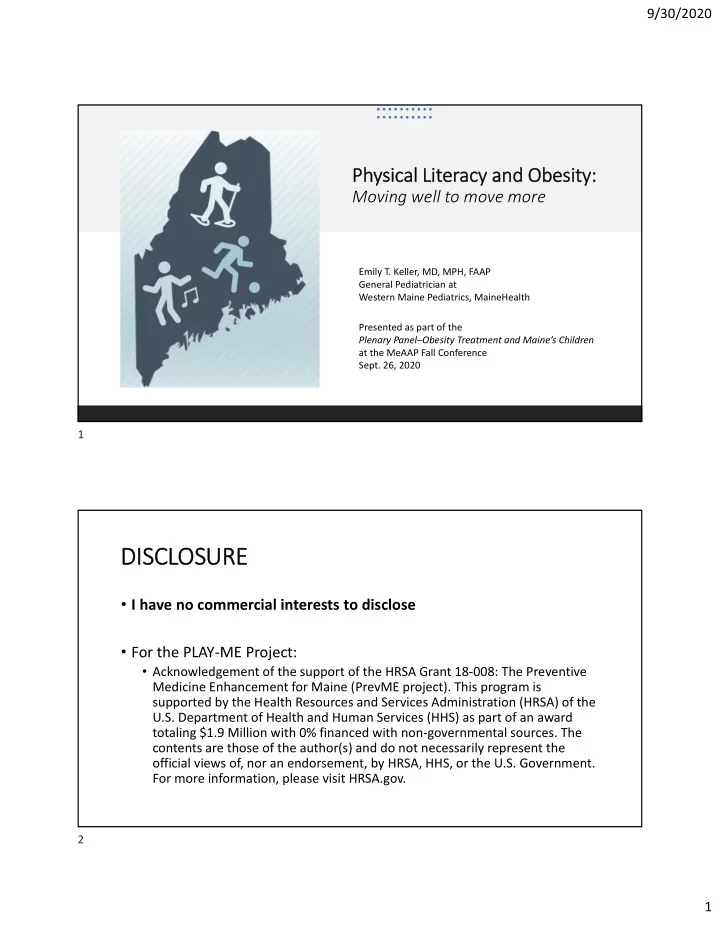
9/30/2020 Ph Physic ical al Lit Literacy and and Obesity: Obesity: Moving well to move more Emily T. Keller, MD, MPH, FAAP General Pediatrician at Western Maine Pediatrics, MaineHealth Presented as part of the Plenary PanelObesity Treatment


slide-1
SLIDE 1

9/30/2020 1

Ph Physic ical al Lit Literacy and and Obesity: Obesity:

Moving well to move more

Emily T. Keller, MD, MPH, FAAP General Pediatrician at Western Maine Pediatrics, MaineHealth Presented as part of the Plenary Panel–Obesity Treatment and Maine’s Children at the MeAAP Fall Conference

  • Sept. 26, 2020

DI DISCL SCLOSURE OSURE

  • I have no commercial interests to disclose
  • For the PLAY‐ME Project:
  • Acknowledgement of the support of the HRSA Grant 18‐008: The Preventive

Medicine Enhancement for Maine (PrevME project). This program is supported by the Health Resources and Services Administration (HRSA) of the U.S. Department of Health and Human Services (HHS) as part of an award totaling $1.9 Million with 0% financed with non‐governmental sources. The contents are those of the author(s) and do not necessarily represent the

  • fficial views of, nor an endorsement, by HRSA, HHS, or the U.S. Government.

For more information, please visit HRSA.gov.

1 2

slide-2
SLIDE 2

9/30/2020 2

OBJE OBJECTIVE CTIVES

  • 1. Review the current physical activity recommendations for youth
  • 2. Define physical literacy and describe its connection to physical

activity and obesity

  • 3. Explore how physical literacy assessment, counseling, and referral

can be incorporated into the clinical care of youth with obesity

Def Defining ning te terms: ph physic ical al activity activity

  • Physical activity is any action that gets

a body moving and expending energy above its resting state

  • Includes different types of activities:
  • Aerobic
  • Muscle‐strengthening
  • Bone‐strengthening
  • Flexibility
  • Balance
  • Multiple health benefits to all ages

3 4

slide-3
SLIDE 3

9/30/2020 3

Def Defining ning te terms: ph physic ical al activity activity

  • Physical activity is any action that gets

a body moving and expending energy above its resting state

  • Includes different types of activities:
  • Aerobic
  • Muscle‐strengthening
  • Bone‐strengthening
  • Flexibility
  • Balance
  • Multiple health benefits to all ages

https://www.youtube.com/watch?v=OI6t6S2Wb6Q

Ph Physic ical al acti activity vity recomm mmenda endations tions fo for yo youth

  • Physical Activity Guidelines for

Americans, 2nd edition provides guidance for youth ages 3‐17

5 6

slide-4
SLIDE 4

9/30/2020 4

  • Children ages 3‐5 should be physically

active throughout the day to enhance growth and development

  • 3 hrs per a day is a “reasonable target”
  • Caregivers should encourage a variety
  • f activity types
  • Aerobic
  • Most of the 1 hr+/day should be MV aerobic PA

and should include vigorous PA on at least 3 days/week

  • Muscle‐strengthening
  • As part of 1 hr+/day PA, youth should include

muscle‐strengthening PA on at least 3 days/week

  • Bone‐strengthening
  • As part of 1 hr+/day PA, youth should include

bone‐strengthening physical activity on at least 3 days/week

=

Youth ages 6‐17 years should do 1hr+ of moderate‐to‐ vigorous (MV) physical activity (PA) daily 7 8

slide-5
SLIDE 5

9/30/2020 5

Lobelo F, Muth ND, Hanson S, et al. Pediatrics. 2020;145(3).

Ma Marc rch 2020 2020 in in Pedi diat atrics cs: Ma Maine yo youth & PA PA guidelines guidelines

  • How are young Mainers doing?

9 10

slide-6
SLIDE 6

9/30/2020 6

Ma Maine yo youth & PA PA guidelines guidelines

MIYHS Question Grade level 2019 2017 Significance Tests

How many days each week do you exercise, dance or play sports for at least an hour?

(Percentage of students who answered at least 7 days)

5th/6th grade 23% 28%

60+ minutes of total physical activity daily

(Percentage of students who were physically active for a total of 60 minutes/day on all of the past 7 days)

Middle school 26% 26% Same as for MS High school 21% 20%

Adapted from: http://data.mainepublichealth.gov/miyhs/home

“…we remain stuck in a mindset grounded in guidelines that focus almost solely on the achievement of at least 60 min MVPA each day.”

Faigenbaum AD, Rebullido TR, MacDonald JP. Curr Sports Med Rep. 2018;17(2):45‐47.

11 12

slide-7
SLIDE 7

9/30/2020 7

“The time has come to expand

  • ur conceptual approach…”

Faigenbaum AD, Rebullido TR, MacDonald JP. Curr Sports Med Rep. 2018;17(2):45‐47.

“The time has come to expand

  • ur conceptual approach…”

Faigenbaum AD, Rebullido TR, MacDonald JP. Curr Sports Med Rep. 2018;17(2):45‐47.

13 14

slide-8
SLIDE 8

9/30/2020 8

“Simply asking physically inactive boys and girls to ‘‘walk to school’’

  • r ‘‘play outside’’ is not enough.”

Faigenbaum AD, Rebullido TR, MacDonald JP. Curr Sports Med Rep. 2018;17(2):45‐47.

So So wha what is is ph physic ical al lit liter eracy? y?

  • The motivation,

confidence, physical competence, knowledge and understanding that individuals develop in order to maintain physical activity at an appropriate level throughout life.

Whitehead, M, ed. Physical literacy: Throughout the lifecourse. London, UK and New York, NY: Routledge; 2010. Healthy Active Living and Obesity Research Group. Canadian assessment for physical literacy, 2nd ed. 2017.

Daily Behavior Knowledge & Understanding Physical Competence Motivation & Confidence

Dom Domains ins of

  • f

Ph Physic ical al Lit Literacy cy

15 16

slide-9
SLIDE 9

9/30/2020 9

https://activeforlife.com/physical‐literacy‐2/ https://activeforlife.com/physical‐literacy‐2/

17 18

slide-10
SLIDE 10

9/30/2020 10

Fun Fundamen ental mov movement skills skills (FM (FMS)

  • Locomotor skills
  • crawl, walk, run, hop, skip,

jump, swim, push, pull

  • Object‐control skills
  • throw, catch, kick
  • Stability skills
  • static balance

The Aspen Institute, Project Play. Physical literacy in the United States: A model, strategic plan, and call to action. 2015.

Physical Competence

Gr Group

  • ups at

at risk risk of

  • f lo

low ph physic ical al lit liter eracy

  • Low income
  • Racial/ethnic minorities
  • Girls
  • Children and youth with special health

care needs (CYSHCN)

  • Children with obesity

Lobelo F, Muth ND, Hanson S, et al.

  • Pediatrics. 2020;145(3).

Faigenbaum AD, Rebullido TR, MacDonald JP. Curr Sports Med Rep. 2018;17(2):45‐47. The Aspen Institute, Project Play. Physical literacy in the United States: A model, strategic plan, and call to action. 2015

19 20

slide-11
SLIDE 11

9/30/2020 11

How How to to ev eval alua uate te kid kids

Physical Literacy assessment

.

How How to to ev eval alua uate te kid kids

Physical Activity assessment

  • Questionnaires
  • Activity logs
  • Pedometers
  • Research‐grade and consumer‐
  • riented accelerometers

Physical Literacy assessment vs.

21 22

slide-12
SLIDE 12

9/30/2020 12

Ph Physic ical al lit liter eracy acy assessm ssessmen ent

Daily Behavior Knowledge & Understanding Physical Competence Motivation & Confidence

Do Domains of

  • f

Ph Physical al Li Literacy

Ph Physic ical al Lit Literacy cy fo for All All Yo Youth in in Ma Maine (PL (PLAY‐ME ME) Wo Workgroup

PrevME Project

Left to Right: Victoria Rogers MD, Sarah Hoffman DO, Carrie Gordon MD, Michele Labotz MD, Emily Keller MD, Marin Johnson MS, Christina Holt MD Matt Douglas PT Chris Pribish ATC

23 24

slide-13
SLIDE 13

9/30/2020 13

Ph Physic ical al Lit Literacy cy fo for Al All Yo Youth in in Ma Maine: PLA PLAY‐ME ME

HEAL HEALTHCARE THCARE SCREENIN SCREENING FOR FOR PH PHYSIC YSICAL AL LI LITERA TERACY CY

Project Goals:

  • IDENTIFY children who lack physical literacy
  • REFER to help them improve physical literacy
  • FOLLOW UP to monitor improvement
  • SPREAD awareness of the concept of physical literacy

Primary Screen

(Medical office)

Secondary Screen

(PT, ATC, School, Other)

Beginner skills Intermediate skills Advanced skills Reinforcement = Goal of communication between all parties woven throughout this process Beginner Program

Reassess

Intermediate Program

Reassess

Cycle of Intervention

(PT, ATC, School, Other)

Higher risk Lower risk

Medical Follow‐up

PLAY ME Screening & Referral Overview

25 26

slide-14
SLIDE 14

9/30/2020 14

2‐St Step ep Pr Primary Scr Screen een in in Of Office fice

Can be done via telemedicine or in office

https://www.capl‐eclp.ca/physical‐literacy‐screening‐tasks/ https://www.haloresearch.ca/2015/10/12/putting‐physical‐literacy‐within‐reach‐project‐develops‐two‐physical‐literacy‐screening‐tasks‐for‐use‐by‐ recreation‐education‐allied‐health‐coaching‐and‐healthcare‐professionals/

Da Data on

  • n accur

curacy cy of

  • f thi

this scr screenin ing pr process fo for ad adequate ph physical al lit literacy: Positive predictive value: 89% Negative predictive value: 67% Sensitivity: 72% Specificity: 86%

St Step ep 1: 1: Ques Questions tions

https://www.capl‐eclp.ca/physical‐literacy‐screening‐tasks/

Lower risk Higher risk

27 28

slide-15
SLIDE 15

9/30/2020 15

St Step ep 2: 2: Wa Wall Sit Sit

  • Time until child gives up, or

cannot maintain the proper position

https://www.capl‐eclp.ca/physical‐literacy‐screening‐tasks/

St Step ep 2: 2: Wa Wall Sit Sit Re Results

Goal = >20 seconds

https://www.capl‐eclp.ca/physical‐literacy‐screening‐tasks/

29 30

slide-16
SLIDE 16

9/30/2020 16

Primary Screen

(Medical office)

Secondary Screen

(PT, ATC, School, Other)

Beginner skills Intermediate skills Advanced skills Reinforcement = Goal of communication between all parties woven throughout this process Beginner Program

Reassess

Intermediate Program

Reassess

Cycle of Intervention

(PT, ATC, School, Other)

Higher risk Lower risk

Medical Follow‐up

PLAY ME Screening & Referral Overview

Re Refer higher higher risk risk fo for Sec Second ndary ary Scr Screen een wi with: th:

  • School‐based
  • Physical Educators
  • Adapted PE
  • PT/OT
  • Physical Therapists
  • Athletic Trainers
  • Community resources (ie – YMCA, personal trainers, recreation

departments, gyms)

  • Medically Oriented Fitness Facilities

31 32

slide-17
SLIDE 17

9/30/2020 17

Sec Secondary ary Scr Screen een at at ref referral partner: partner: 3 parts parts

  • 1. Assessment of

functional motor skills

  • 6 minute walk
  • 10 x 5 m shuttle run
  • Broad Jump
  • Medicine ball chest

throw

  • Throw, kick, catch
  • 2. Longer

questionnaire

  • Knowledge
  • Motivation
  • Confidence
  • 3. Daily activity

log for 7 days

  • Pedometer

tracking (or smart device)

  • Daily log of

activity

Motivation & Confidence Physical Competence Daily Behavior Knowledge & Understanding

PLA PLAY‐ME ME Pr Project St Status us

Primary Screen

(Medical office)

Secondary Screen

(PT, ATC, School, Other)

Intermediate skills Advanced skills Reinforcement

R

Higher risk Lower risk

  • Testing the 2‐step primary screen

with pilot group of physician practices

– Cycle 1: weight/wellness/obesity clinicscompleted – Cycle 2: primary care physician

  • fficesin development

33 34

slide-18
SLIDE 18

9/30/2020 18

OBJE OBJECTIVE CTIVES

  • 1. Review the current physical activity

recommendations for youth

  • 2. Define physical literacy and describe

its connection to physical activity and obesity

  • 3. Explore how physical literacy

assessment, counseling, and referral can be incorporated into the clinical care of youth with obesity

Daily Behavior Knowledge & Understanding Physical Competence Motivation & Confidence

Dom Domains of

  • f

Ph Physic ical Lit Literacy

Ph Physic ical al Lit Literacy and and Obesi Obesity: y: Moving well to move more

REFEREN REFERENCES

1. U.S. Department of Health and Human Services. Physical Activity Guidelines for Americans, 2nd ed. https://health.gov/paguidelines/second‐ edition/pdf/Physical_Activity_Guidelines_2nd_edition.pdf. Published 2018. Accessed August 29, 2020. 2. Piercy KL, Troiano RP, Ballard RM, et al. The physical activity guidelines for Americans. JAMA. 2018;320(19):2020‐2028. doi:10.1001/jama.2018.14854. 3. US Preventive Services Task Force. Screening for obesity in children and adolescents: US Preventive Services Task Force Recommendation Statement. JAMA. 2017;317(23):2417–2426. doi:10.1001/jama.2017.6803. 4. Moore, S. Canadian Assessment for Physical Literacy, Healthy Active Living and Obesity Research Group. Canadian kids need to move more to boost their brain health [Video]. YouTube. https://www.youtube.com/watch?v=OI6t6S2Wb6Q.. Published June 26, 2018. Accessed August 31, 2020. 5. Tools, pediatric and family practices. MaineHealth Let’s Go! website. https://mainehealth.org/lets‐go/childrens‐program/pediatric‐family‐practices/tools. Accessed August 30, 2020. 6. Lobelo F, Muth ND, Hanson S, et al. AAP COUNCIL ON SPORTS MEDICINE AND FITNESS, AAP SECTION ON OBESITY. Physical Activity Assessment and Counseling in Pediatric Clinical Settings. Pediatrics. 2020;145(3). doi: 10.1542/peds.2019‐3992. 7. Maine Integrated Youth Health Survey data. Maine Integrated Youth Health Survey website. http://data.mainepublichealth.gov/miyhs/home. Accessed August 29, 2020. 8. Maine Department of Health and Human Services and Maine Department of Education. Maine Integrated Youth Health Survey. MIYHS CORE QUESTIONS: 2017 VERSUS 2019 COMPARISON REPORT, MAINE, 2019 MIYHS GRADE 5‐6 REPORT. http://data.mainepublichealth.gov/miyhs/files/2019_Reports/Core_Reports/5th6th/MIYHS2019_Core_Reports_56_State/Maine_2019_MIYHS_Grade_5‐ 6_Report.pdf. Accessed August 29, 2020. 9. Maine Department of Health and Human Services and Maine Department of Education. Maine Integrated Youth Health Survey. MIYHS CORE QUESTIONS: 2017 VERSUS 2019 COMPARISON REPORT, MAINE, 2019 MIYHS MIDDLE SCHOOL REPORT. http://data.mainepublichealth.gov/miyhs/files/2019_Reports/Core_Reports/MS/MIYHS2019_Core_Reports_MS_State/Maine_2019_MIYHS_Middle_School_ Report.pdf. Accessed August 29, 2020.

  • 10. Maine Department of Health and Human Services and Maine Department of Education. Maine Integrated Youth Health Survey. MIYHS CORE QUESTIONS:

2017 VERSUS 2019 COMPARISON REPORT, MAINE, 2019 MIYHS HIGH SCHOOL REPORT. http://data.mainepublichealth.gov/miyhs/files/2019_Reports/Core_Reports/HS/MIYHS2019_Core_Reports_HS_State/Maine_2019_MIYHS_High_School_Rep

  • rt.pdf. Accessed August 29, 2020.
  • 11. Maine’s Youth Health Data Atlas. Maine Integrated Youth Health Survey website. https://data.mainepublichealth.gov/miyhs/files/atlas/atlas.html. Accessed

August 29, 2020.

  • 12. Schwarzfischer P, Gruszfeld D, Stolarczyk A, et al. Physical Activity and Sedentary Behavior From 6 to 11 Years. Pediatrics. 2019;143(1):e20180994.

doi:10.1542/peds.2018‐0994.

  • 13. Faigenbaum AD, Rebullido TR, MacDonald JP. Pediatric Inactivity Triad: A Risky PIT. Curr Sports Med Rep. 2018;17(2):45‐47.

doi:10.1249/JSR.0000000000000450. Daily Behavior Knowledge & Understanding Physical Competence Motivation & Confidence

Dom Domains of

  • f

Ph Physic ical Lit Literacy

35 36

slide-19
SLIDE 19

9/30/2020 19

REFEREN REFERENCES

14.

  • Krader. C. Physical literacy: new paradigm for fighting physical inactivity. Contemporary Pediatrics. 2018;35(12).

https://www.contemporarypediatrics.com/view/physical‐literacy‐new‐paradigm‐fighting‐physical‐inactivity. Published December 1, 2018. Accessed August 30, 2020. 15. Stracciolini A, Luz J, Walker G, Edwards N, Faigenbaum AD, Myer GD. Are primary care physicians ill equipped to evaluate and treat childhood physical inactivity?. Phys Sportsmed. 2020;48(2):199‐207. doi:10.1080/00913847.2019.1673685. 16. The Aspen Institute, Project Play. Physical literacy in the United States: A model, strategic plan, and call to action. https://assets.aspeninstitute.org/content/uploads/files/content/docs/pubs/PhysicalLiteracy_AspenInstitute.pdf?_ga=2.204629464.918199076.1549810 659‐1330082187.1549810659. Published June 28, 2015. Accessed August 30, 2020. 17. Whitehead, M, ed. Physical literacy: Throughout the lifecourse. London, UK and New York, NY: Routledge; 2010. https://books.google.com/books?hl=en&lr=&id=2GN6AgAAQBAJ&oi=fnd&pg=PP1&dq=Physical+literacy:+Throughout+the+lifecourse.+Oxfordshire,+En gland:+Routledge.&ots=5h23bTBEd1&sig=zJsDIOMgoMHcVEUw2EcXztFrzbs#v=onepage&q=Physical%20literacy%3A%20Throughout%20the%20lifecour se.%20Oxfordshire%2C%20England%3A%20Routledge.&f=false. Accessed August 30, 2020. 18. Healthy Active Living and Obesity Research Group. Canadian assessment for physical literacy, 2nd ed. Manual for test administration. https://www.capl‐ eclp.ca/wp‐content/uploads/2017/10/capl‐2‐manual‐en.pdf. Published 2017. Accessed August 30, 2020. 19. Edwards LC, Bryant AS, Keegan RJ, Morgan K, Cooper SM, Jones AM. 'Measuring' physical literacy and related constructs: A systematic review of empirical findings. Sports Med. 2017;48(3):659‐682. doi:10.1007/s40279‐017‐0817‐9. 20. Belanger K, Barnes JD, Longmuir PE, et al. The relationship between physical literacy scores and adherence to Canadian physical activity and sedentary behaviour guidelines. BMC Public Health. 2018;18(Suppl 2):1042. doi:10.1186/s12889‐018‐5897‐4. 21. What is physical literacy?. Active for Life website. https://activeforlife.com/physical‐literacy‐2/ . Accessed August 30, 2020. 22. Assessing and Defining Physical Activity Environments. National Collaborative on Childhood Obesity Research website. https://www.nccor.org/tools‐ mruserguides/physical‐activity‐environment/assessing‐and‐defining‐physical‐activity‐environments/. Accessed August 30, 2020. 23. Physical Literacy Screening Tasks, Canadian Assessment of Physical Literacy website. https://www.capl‐eclp.ca/physical‐literacy‐screening‐tasks/. Accessed August 30, 2020. 24. Puttling physical literacy within REACH Project develops two physical literacy screening tasks for use by recreation, education, allied‐health, coaching, and healthcare professionals. Healthy Active Living and Obesity Research Group website. https://www.haloresearch.ca/2015/10/12/putting‐physical‐ literacy‐within‐reach‐project‐develops‐two‐physical‐literacy‐screening‐tasks‐for‐use‐by‐recreation‐education‐allied‐health‐coaching‐and‐healthcare‐ professionals/. Published October 12, 2015. Accessed August 30, 2020. 25. CAPL‐2 Questionnaire. Canadian Assessment of Physical Literacy website. https://www.capl‐eclp.ca/wp‐content/uploads/2018/02/CAPL‐2‐ questionnaire.pdf. Published October 2017. Accessed August 30, 2020. 26. Delisle Nyström C, Traversy G, Barnes JD, Chaput JP, Longmuir PE, Tremblay MS. Associations between domains of physical literacy by weight status in 8‐ to 12‐year‐old Canadian children. BMC Public Health. 2018;18(Suppl 2):1043. Published 2018 Oct 2. doi:10.1186/s12889‐018‐5898‐3 Daily Behavior Knowledge & Understanding Physical Competence Motivation & Confidence

Dom Domains of

  • f

Ph Physic ical Lit Literacy

Thank Thank yo you fo for listening! ning! In Interested in in mo more in info on

  • n ph

physic ical al lit literacy, or

  • r the

the PLA PLAY‐ME ME Pr Projec ect? Re Reach out

  • ut to

to:

Sarah Hoffman, DO Pediatric Sports Medicine Physician MMP Orthopedics and Sports Medicine sarahghoffman@gmail.com Michele LaBotz, MD Pediatric Sports Medicine Physician InterMed mlabotz@gmail.com 37 38