Director General’s Information meeting for Permanent Delegations on Priority Africa
Implementation of the Operational strategy for Africa
Mr Loïteohin Félix Ye, Director of the UNESCO Regional Office in Yaounde Wednesday 28 May 2014, UNESCO, Paris
Director Generals Information meeting for Permanent Delegations on - - PowerPoint PPT Presentation
Director Generals Information meeting for Permanent Delegations on Priority Africa Implementation of the Operational strategy for Africa Mr Loteohin Flix Ye, Director of the UNESCO Regional Office in Yaounde Wednesday 28 May 2014,
Mr Loïteohin Félix Ye, Director of the UNESCO Regional Office in Yaounde Wednesday 28 May 2014, UNESCO, Paris
With a GDP growth rate of 6% in 2012 - 2013, macroeconomic performance
Serious violations of peace and security of civilian population in CAR, in the
East of Democratic Republic of Congo and also on persons and property in the Far North of Cameroon constitute serious obstacles to socio-economic development.
The rich biodiversity of Central African sub-region remains threatened by
deforestation, forest degradation and the legal and clandestine exploration and mining activities in protected areas.
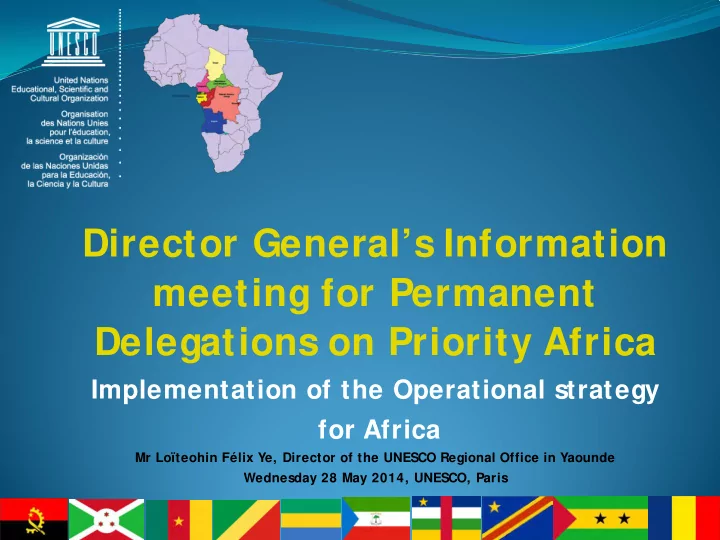
Regional Programmes Angola, Burundi, Cameroon, Gabon, Central African Republic, Chad, Republic of Congo, Democratic Republic of Congo, Guinea Equatorial, Sao Tome & Principe
Education for citizenship and promotion of
culture of peace for peaceful coexistence in countries of the ECCAS region.
Support countries of ECCAS to render effective,
through curricula development and educational tools (manuals, guides), citizenship education (human rights, peace, intercultural dialogue) at the level of primary, secondary and high schools.
This activity includes the strengthening of the
capacities of youth peer educators in citizenship education in formal and informal environments in the Central African region.
FLAGSHIP 1 – Promote a Culture of Peace and Non-violence
Mobilization of partnerships and contribution to the amelioration of policies, strategies and the reinforcement of capacities of Educational Systems
Education Sector strategy and
Global Education Partnership process: UNESCO and UNICEF are the Chair or Co-Chair Executive Lead
Partnership in the development of Education Sector Strategy in the Global Education Partnership in countries
the sub-region (Cameroon, Congo Brazzaville, Chad, RCA, DRC)
FLAGSHIP 2 – Strengthening Education Systems for Sustainable Development in Africa: Improving equity, quality and relevance
Angola, Burundi, Cameroon, Gabon, Central African Republic, Chad, Republic of Congo, Democratic Republic of Congo, Guinea Equatorial, , Sao Tome & Principe Support to Higher Education:
Technical and financial support to member states of the sub region since July 2010, for the creation of University Poles of Technological Excellence (PETU) in the ECCAS zone. The funding request is under consideration by the African Development Bank (ADB).
An assessment by the ADB for funding for the project is underway in the 10 countries of ECCAS. Harmonization of the SIGE in the ECCAS sub-region:
In collaboration with the AfDB, ADEA and the ECCAS Secretariat, UNESCO with the strong involvement of the UIS, technically and financially assists in a process of harmonization and strengthening of Educational systems through the regular production of Quality Educational Statistics. The funding request is under consideration by the African Bank of development (ADB)
Beyond the national directories, a consolidated regional directory will also be
directory of Educational Statistics will be provided by the African Union.
FLAGSHIP 2 – Strengthening Education Systems for Sustainable Development in Africa: Improving equity, quality and relevance
Angola, Burundi, Cameroon, Gabon, Central African Republic, Chad, Republic of Congo, Democratic Republic of Congo, Guinea Equatorial, , Sao Tome & Principe
Reproductive Health / HIV and AIDS
Harmonization of policies, strategies for the integration of reproductive health aspects including HIV and AIDS in the curricula of primary, secondary and high schools in the countries of the CEMAC (Cameroon, Congo Brazzaville, Gabon, Equatorial Guinea, Central African Republic and Chad) region.
All six countries of CEMAC have developed pedagogical training tools (step by step tutorials, radio programs training manuals and guides). The various trainings are
This project is funded by the Japanese Government, UNAIDS, UNESCO and OFID.
FLAGSHIP 2 – Strengthening Education Systems for Sustainable Development in Africa: Improving equity, quality and relevance
Regional Programmes Angola, Burundi, Cameroon, Gabon, Central African Republic, Chad, Republic of Congo, Democratic Republic of Congo, Equatorial Guinea, Sao Tome & Principe Curricula Development and Teacher Training
With the technical and financial cooperation of IICBA, the
harmonization of training programmes in Mathematics, Science and Technology for primary and secondary school teachers in the ECCAS countries is underway. Citizenship Education and Promotion of Culture of Peace for peaceful coexistence in ECCAS countries
Support ECCAS countries to render effective citizenship
education through the development of curricula and educational tools (manuals, guides) on human rights, peace, intercultural dialogue at the level of primary, secondary schools.
FLAGSHIP 2 – Strengthening Education Systems for Sustainable Development in Africa: Improving equity, quality and relevance
Angola, Burundi, Cameroon, Gabon, Central African Republic, Chad, Republic
Principe
Climate change and Education for Sustainable Development in the countries of the ECCAS: (Emergency Fund)
Support countries of ECCAS to render effective, through
curricula and educational tools (manuals, guides) education for sustainable development at the level of primary and secondary schools Education of Girls and women
In the context of the Global Partnership on Education (GPE)
favoring the emancipation of girls and women and the promotion of sex equality, UNESCO in collaboration with ECCAS and CEMAC, has technically and financially supported the development of a harmonized strategy including an action plan to accelerate the enrolment of girls in schools in the ten countries of the ECCAS.
FLAGSHIP 2 – Strengthening Education Systems for Sustainable Development in Africa: Improving equity, quality and relevance
Regional Programmes Angola, Burundi, Cameroon, Gabon, Central African Republic, Chad, Republic of Congo, Democratic Republic of Congo, Equatorial Guinea, Sao Tome & Principe
Development of partnership for the improvement of access of young people to ICT in the context of socio-economic integration
Establishment of National Youth Councils (NYC) in the ECCAS countries.
Needs assessment for strengthening the capacities of these structures in charge of the integration of young people and the NYC; and the implementation of national and regional action plans.
Development of educational training tools using ICTs for socioeconomic integration and employment opportunities of young people,
Accompany National Youth Councils (NYC) in the creation of a Regional Youth Council (adopted by the General meeting held for that purpose, in Yaoundé in October 2013)
Establishment of a UNESCO Chair on the development of entrepreneurial skills among young people and women through ICTs,
Monitoring and evaluation of the National Youth Councils (NYC) in the sub region.
FLAGSHIP 3 – Harnessing STI and Knowledge for the Sustainable Socio- economic development of Africa
Forests
World Heritage (WH) site with strong anthropogenic pressure (mining, forestry and agricultural
IUCN activities to support the reform of the management structure, establishment of a consultative framework, creation of income-generating and anti-poaching activities;
promote green economy through support to women and youth associations;
Biosphere Reserve. (UNESCO-UNDP-UNOPS) Water
(Biosphere Reserve and the World Heritage (WH) site)
into account climate change to reduce disasters, floods and other extreme catastrophes;
Finalize the studies and the mapping of trans-boundary aquifers in Africa in order to promote management and trans-boundary cooperation on shared groundwater for the benefit of peace.
FLAGSHIP 4 – Fostering Science for Sustainable management of Africa’s Natural resources and disaster risk reduction
ENGINEERING SCIENCES AND SCIENTIFIC POLICIES
Capacity building
Regional Capacity building workshop (ECCAS) on the GO-SPIN and STIGAP analysis, Advocacy and orientation tools on STI policies for the focal points of the African STI Observatory based in Malabo;
Training of Trainers workshop on installations of solar photovoltaic in Cameroon;
African Regional School on Solar Energy (UNESCO-ISESCO-UNIDO): Practical training
Innovative training workshop for teachers in the teaching of Mathematics and Basic Science through an innovative system using mobile phone.
FLAGSHIP 4 – Fostering Science for Sustainable management of Africa’s Natural resources and disaster risk reduction
FLAGSHIP 5 – Harnessing the power of Culture for Sustainable Development and Peace in a context of Regional Integration
Development of human resources in the Departments of Journalism Training
UNESCO fielded a mission from the Yaounde School of Journalism (ESSTIC) to the University of N'Djamena to assist in the restructuring of the curricula on journalism training in conformity with UNESCO’s model Curricula on Journalism Eductaion;
A similar initiative is underway at the University Marien Ngouabi to upgrade the new school of journalism according to standards defined in the UNESCO Model Curricula on Journalism Education.
press articles on issues relating to climate change.
Gabon) are programmed for the second semester of 2014 and the other 5 in 2015.
Media Training on Climate Change
FLAGSHIP 6 – Promoting an environment conducive to freedom of expression and media development
Community Radio in Garoua Boulai (ONE UN)
This initiative consisted in installing a community radio in the East Region of
Cameroon in favor of the refugees from Central African Republic and local populations and focused on producing and broadcasting information on food distribution schedule by PAM, FAO, WFP; thematic issues such as agriculture, security measures in the refugee camps, education, health issues such as HIV/AIDS, hygiene and sanitation, vaccination campaigns, etc…
The UN Agencies in Cameroon : UNDP, UNICEF, UNFPA, HCR and UNESCO
contributed in the installation of this radio within the spirit of ONE UN.
FLAGSHIP 6 – Promoting an environment conducive to freedom of expression and media development
Strengthening the capacity
the media professionals in the use of new media
UNESCO supported the Yaounde School of Journalism
(ESSTIC) in enabling its lecturers acquire skills in the use of new media. Training of journalists on Science Journalism
UNESCO in collaboration with the Yaoundé School of
Journalism (ESSTIC) organized a capacity building workshop for journalists from the sub region on science reporting to promote the acquisition, development and dissemination
scientific and technological information by the media.
FLAGSHIP 6 – Promoting an environment conducive to freedom of expression and media development
Participation in meetings focusing on issues related to security, policies, strategies and programmes of cooperation with the member countries
Promote and strengthen harmonious cooperation and balanced development in all areas of socio-economic development.
Advocate and support the Member States in the formulation of national policies within UNESCO’s fields of competence
Promote the scientific cooperation with the Chantal BIYA International Research Centre (CIRCB) on HIV/AIDS.
CEMAC /ECCAS YAOUNDE OFFICE CIVIL SOCIETY ORGANISATIONS NATIONAL AUTHORITIES UNITED NATIONS SYSTEM
Project to Support local development through community radio
The Yaounde Office developed a project to support local development through the use of community radios.
This project aims at contributing to local development and poverty reduction through the production and broadcast of thematic radio programmes on specific issues as defined by the Cameroon Government in its Strategic Document for Growth and Employment (DCSE).
This programme will also seek to expand access to information and relevant knowledge, as well as improve
expression at the grassroots level thus strengthening the capacity of rural communities to participate actively in local and national life.
The Protocol Agreement was signed the 18th of September 2013.
The disbursement of project funds (5,550 802) is still being awaited.
The Yaounde Office has as its strategy for better visibility the following communication tools:
A dynamic and up-to-date website A monthly electronic newsletter (online), A bi-annual bulletin An intranet, A Follow-up unit of the national press with a monthly
review of the national and international newspapers,
A Notice board for announcements, news publications
relating to activities in the field,
A documentation Centre open to the public and
equipped with Internet connection,
A brochure and a leaflet of the Regional Office defining
its mission, objectives, its biennial activities (programs and projects).