Direct neutrino mass search 56 th International Winter Meeting on - - PowerPoint PPT Presentation

direct neutrino mass search
SMART_READER_LITE
LIVE PREVIEW

Direct neutrino mass search 56 th International Winter Meeting on - - PowerPoint PPT Presentation

Direct neutrino mass search 56 th International Winter Meeting on Nuclear Physics, January 22-26, 2018, Bormio, Italy Christian Weinheimer Institut fr Kernphysik, Westflische Wilhelms-Universitt Mnster weinheimer@uni-muenster.de


slide-1
SLIDE 1

Christian Weinheimer 1 Bormio, nucl. phys. winter meet., January 2018

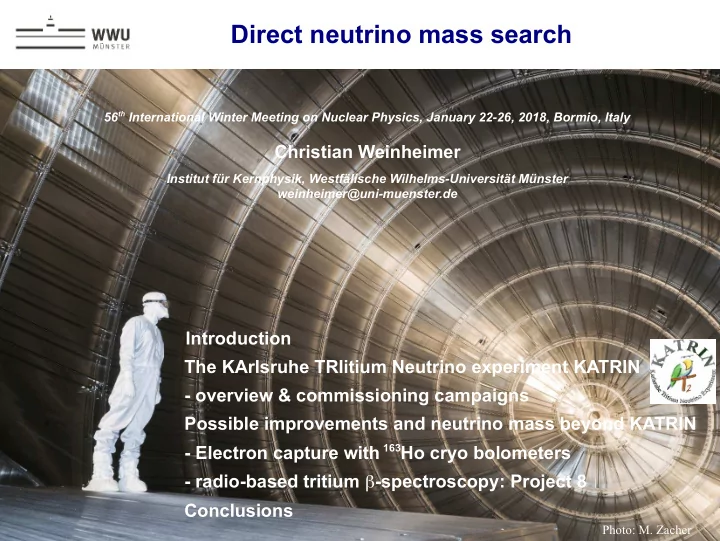
Photo: M. Zacher

Direct neutrino mass search

56th International Winter Meeting on Nuclear Physics, January 22-26, 2018, Bormio, Italy

Christian Weinheimer

Institut für Kernphysik, Westfälische Wilhelms-Universität Münster weinheimer@uni-muenster.de

Introduction The KArlsruhe TRIitium Neutrino experiment KATRIN

  • overview & commissioning campaigns

Possible improvements and neutrino mass beyond KATRIN

  • Electron capture with 163Ho cryo bolometers
  • radio-based tritium β-spectroscopy: Project 8

Conclusions

slide-2
SLIDE 2

Christian Weinheimer 2 Bormio, nucl. phys. winter meet., January 2018

atmospheric neutrinos

(Kamiokande, Super-Kamiokande, IceCube, ANTARES)

accelerator neutrinos

(K2K, T2K, MINOS, OPERA, MiniBoone)

solar neutrinos

(Homestake, Gallex, Sage, Super-Kamiokande, SNO, Borexino)

reactor neutrinos

(KamLAND, CHOOZ, Daya Bay, Double CHOOZ, RENO, ...)

4 non-trivial ν-mixing

0.37 < sin2(θ23) < 0.63 maximal! 0.26 < sin2(θ12) < 0.36 large ! 0.018 < sin2(θ13) < 0.030 8.4° 7.0 10-5 eV2 < Δm12

2 < 8.2 10-5 eV2

2.2 10-3 eV2 < | Δm13

2 | < 2.6 10-3 eV2

4 m(νj) / 0, but unknown

additional sterile neutrinos ?

Clear evidence by so many ν oscillation experiments

Matter effects (MSW)

slide-3
SLIDE 3

Christian Weinheimer 3 Bormio, nucl. phys. winter meet., January 2018

νe νµ ντ ν1 ν2 ν3

Results of recent oscillation experiments: Θ23, Θ12, Θ13, |Δm2

13|, Δm2 12

0.001 0.01 0.1 1

Ω Δm2

23

Δm2

12

hierarchical masses

e.g. seesaw mechanism type 1 explains smallness of masses, but not large (maximal) mixing

degenerated masses

cosmological relevant e.g. seesaw mechanism type 2

relic neutrinos: 336 ν / cm3 -

Need for the absolute ν mass determination

slide-4
SLIDE 4

Christian Weinheimer 4 Bormio, nucl. phys. winter meet., January 2018

1) Cosmology

very sensitive, but model dependent compares power at different scales current sensitivity: Σm(νi) 0 0.23 eV

Three complementary ways to the absolute neutrino mass scale

slide-5
SLIDE 5

Christian Weinheimer 5 Bormio, nucl. phys. winter meet., January 2018

PLANCK measurement of CMBR

(Cosmic Microwave Background Radiation)

measurement of matter density distribution LSS

(Large Scale Structure)

by 2dF, SDSS, ... compare to

  • numeric. models

including relic neutrino densitiy

  • f 336 cm-3

Millenium simulation → http://www.mpa-garching.mpg.de/galform/presse/

Neutrino mass from cosmology

SDSS

Planck Collaboration:

  • P. A. R. Ade et al., arXiv:1502.01589
slide-6
SLIDE 6

Christian Weinheimer 6 Bormio, nucl. phys. winter meet., January 2018

Planck Collaboration: P. A. R. Ade et al., arXiv:1502.01589

Relies on ΛCDM model ! Is this fully correct, there are some discrepancies ? More than 95% of the energy distribution in the universe is not known (dark energy, dark matter)

Neutrino mass from cosmology

slide-7
SLIDE 7

Christian Weinheimer 7 Bormio, nucl. phys. winter meet., January 2018

1) Cosmology

very sensitive, but model dependent compares power at different scales current sensitivity: Σm(νi) 0 0.23 eV

2) Search for 0νββ

Sensitive to Majorana neutrinos Upper limits by EXO-200, KamLAND-Zen, GERDA, CUORE

3) Direct neutrino mass determination: No further assumptions needed,

use E2 = p2c2 + m2c4 4 m2(ν) is observable mostly Time-of-flight measurements (ν from supernova) SN1987a (large Magellan cloud) 4 m(νe) < 5.7 eV Kinematics of weak decays / beta decays measure charged decay prod., E-, p-conservation β-decay searchs for m(νe) - tritium, 187Re β(spectrum

  • 163Ho electron capture (EC)

Three complementary ways to the absolute neutrino mass scale

slide-8
SLIDE 8

Christian Weinheimer 8 Bormio, nucl. phys. winter meet., January 2018

m(νe) mββ [eV]

Comparison of the different approaches to the neutrino mass

4 absolute scale/cosmological relevant neutrino mass in the lab by single β decay

Direct kinematic measurement: m2(νe) = Σ |Uei

2| m2(νi)

(incoherent) Neutrinolesss double β decay: mββ(ν) = | Σ |Uei

2| eiα(i) m(νi)|

(coherent)

if no other particle is exchanged (e.g. R-violating SUSY) without additional uncertainties of nuclear matrix elements M and quenching factor gA m(νe) mββ [eV]

uncertainty due to unknowns

  • f the neutrino

mixing, essentially the Majorana-phases

slide-9
SLIDE 9

Christian Weinheimer 9 Bormio, nucl. phys. winter meet., January 2018

averaged neutrino mass

  • const. offset .m2(νe)

:= Σ |Uei

2| m2(νi)

Need:

low endpoint energy 4 Tritium 3H (187Re, 163Ho) very high energy resolution & very high luminosity & 4 MAC-E-Filter very low background (or bolometer for 187Re, 163Ho)

Direct determination of m(νe) from β(decay (and EC)

β: dN/dE = K F(E,Z) p Etot (E0-Ee) Σ |Uei|2 2(E0-Ee)2 – m(νi)2

with “electron neutrino mass”: m(νe)2 := Σ |Uei|2 m(νi)2 , complementary to 0νββ & cosmology (modified by electronic final states, recoil corrections, radiative corrections) essentially phase space: pe Ee Eν pν Eν pν →

m(ν) < 2 eV (Mainz, Troitsk) ν do not solve DM problem

slide-10
SLIDE 10

Christian Weinheimer 10 Bormio, nucl. phys. winter meet., January 2018

The classical way: Tritium β-spectroscopy with a MAC-E-Filter

Magnetic Adiabatic Collimation + Electrostatic Filter (A. Picard et al., Nucl. Instr. Meth. 63 (1992) 345)

  • Two supercond. solenoids

compose magnetic guiding field

  • adiabatic transformation:

µ = E,/ B = const. 4 parallel e- beam

  • Energy analysis by
  • electrostat. retarding field

ΔE = E3 Bmin/Bmax = 0.93 eV (KATRIN) 4 sharp integrating transmission function without tails -

slide-11
SLIDE 11

Christian Weinheimer 11 Bormio, nucl. phys. winter meet., January 2018

The KATRIN experiment

windowless gaseous T2 source 1011 e- / s tritium pumping & e- transport MAC-E type spectrometer 10 m diameter, 24 m length electron detector < 1 e- / s

~70 m beamline KATRIN at Karlsruhe Institute for Technology

  • Int. Collaboration: 20 institutions from 6 countries

Sensitivity on m(νe): 2 eV → 200 meV

slide-12
SLIDE 12

Christian Weinheimer 12 Bormio, nucl. phys. winter meet., January 2018

WGTS: tube in long superconducting solenoids 1 9cm, length: 10m, T = 30 K Tritium recirculation (and purification) pinj = 0.003 mbar, qinj = 4.7Ci/s allows to measure with near to maximum count rate using ρd = 5 3 1017/cm2 with small systematics check column density by e-gun, T2 purity by laser Raman

T2

Molecular Windowless Gaseous Tritium Source WGTS

per mill stability source strength request: dN/dt ~ fT 3N / τ ~ n = fT 3 p V / R T tritium fraction fT 5 ideal gas law

slide-13
SLIDE 13

Christian Weinheimer 13 Bormio, nucl. phys. winter meet., January 2018

WGTS at Tritium Laboratory Karlsruhe

Molecular Windowless Gaseous Tritium Source WGTS

slide-14
SLIDE 14

Christian Weinheimer 14 Bormio, nucl. phys. winter meet., January 2018

Essential for diagnostics of tritium source & spectrometer transmission

  • photo-electron gun:

spectrometer transmission column density & energy losses in source

  • rear wall: definition of source potential,

neutralization of tritium plasma

Calibration and monitoring rear system: controling and studying systematics

Rear Wall: Au surface creates stable and homogeneous electrostatic potential (~10-20 mV) in the source plasma, can be illuminated by UV light ∅ 150 mm

  • X-ray detectors:
  • nline monitoring of tritium

ß-decay activity via X-rays (BIXS)

slide-15
SLIDE 15

Christian Weinheimer 15 Bormio, nucl. phys. winter meet., January 2018

  • active pumping:

4 TMPs

  • Tritium retention: 105
  • magnetic field:

5.6 T

  • Ion monitoring by FTICR and ion manipulation

by dipole and monopole electrodes inside

Differential and cryo pumping sections: supression of T2 by 1014 (incl. WGTS)

  • based on by cryo-sorption

at Ar snow at 3-4 K

  • Tritium retention: >107
  • magnetic field:

5.6 T

slide-16
SLIDE 16

Christian Weinheimer 16 Bormio, nucl. phys. winter meet., January 2018

Monitoring and calibration instrumentation of the CPS

Condensed 83mKr conversion electron source for energy calibration and studies of transmission properties HOPG @T=25K, UHV, on HV, can scan full flux tube surface control: heating & laser ablation, laser ellipsometry Electron rate monitor scanning small SD or PIN diode

slide-17
SLIDE 17

Christian Weinheimer 17 Bormio, nucl. phys. winter meet., January 2018

Pre spectrometer:

  • successful tests & developments of new concepts

Main spectrometer:

  • huge size: 10m diameter, 24m length

1240 m3 volume, 690 m2 inner surface

  • ultra-high vacuum: p = O(10-11 mbar)
  • ultra-high energy resolution: ΔE = 0.93eV
  • vacuum vessel on precise high voltage (ppm precision)

KATRIN spectrometers

  • f MAC-E-Filter type

log B

4 ΔE = E 3 Bmin / Bmax = E 3 1 / 20000 = 0.93 eV adiabatic transform.: µ = E,/ B = const. 4 parallel e- beam ΔE/E = Bmin/Bmax

slide-18
SLIDE 18

Christian Weinheimer 18 Bormio, nucl. phys. winter meet., January 2018

KATRIN main spectrometer

slide-19
SLIDE 19

Christian Weinheimer 19 Bormio, nucl. phys. winter meet., January 2018 SUPPORT STRUCTURE

Requirements

  • detection of β-electrons (mHz to kHz)
  • high efficiency (> 90%)
  • low background (< 1 mHz)

(passive and active shielding)

  • good energy resolution (< 1 keV)

Properties

  • 90 mm Ø Si PIN diode
  • thin entry window (50nm)
  • detector magnet 3 - 6 T
  • post acceleration (30kV)

(to lower background in signal region)

  • segmented wafer (148 pixels)

→ record azimuthal and radial profile of the flux tube → investigate systematic effects → compensate field inhomogeneities

The detector

slide-20
SLIDE 20

Christian Weinheimer 20 Bormio, nucl. phys. winter meet., January 2018

Commissioning of main spectrometer (ΔE = 0.93 eV) and detector

σE = 50 meV (single angular emittance)

  • angular-selective

pulsed photo-electron source pixel detector section

slide-21
SLIDE 21

Christian Weinheimer 21 Bormio, nucl. phys. winter meet., January 2018

Background sources at KATRIN: detailed understanding, but ...

slide-22
SLIDE 22

Christian Weinheimer 22 Bormio, nucl. phys. winter meet., January 2018

Background due to ionization of Rydberg atoms sputtered off by α decays

τ = τ(212Pb)

H* Rydberg atoms:

  • desorbed from walls due to 206Pb recoil ions

from 210Po decays

  • non-trapped electrons on meV-scale
  • bg-rate: ~0.5 cps

counter measures:

  • reduce H-atom surface coverage:

a) extended bake-out phase: done b) strong UV illumination source Testing this hypothesis: artifically contaminating the spectrometer with implanted short-living daughters of 220Rn

slide-23
SLIDE 23

Christian Weinheimer 23 Bormio, nucl. phys. winter meet., January 2018

[M. Slezak, PhD thesis, 2015]

July 2017: calibration and comissioning campaign with all 3 83mKr sources

83mKr

from 1 GBq 83Rb source

gaseous 83mKr source decaying 83mKr atoms fill whole WGTS (at 100 K) condensed 83mKr source point-like source full flux tube scanable implanted 83Rb/83mKr source → sharp electron (Γ 0 2 eV) lines at 7 keV - 32 keV

E0

slide-24
SLIDE 24

Christian Weinheimer 24 Bormio, nucl. phys. winter meet., January 2018

preliminary stability of L3-32 line position, 30.47 keV: Just one example:

  • ne out of many lines

from 7 keV to 32 keV much more statistics

Line scan & stability gaseous (condensed) Kr source GKrS (CKrS)

± 60 meV

fitting well, line near tritium endpoint: K-32 line (17.82 keV, Γ ~2.7 eV) preliminary

GKrS GKrS CKrS

sending electrons

  • n individual

magnetic field lines

slide-25
SLIDE 25

Christian Weinheimer 25 Bormio, nucl. phys. winter meet., January 2018

Absolute energy scale calibration by difference of electron conversion lines

Last calibration at PTB in 2013: M = 1972.4531(20) Measure retarding voltage with ultra-high precision HV divider: Determine difference of conversion electron line positions: considering line difference → systematic effects (ΔΦ, Eγ) cancel out

K-32 line: 17.8 keV, Γ ~2.7 eV L3-32 line: 30.5 keV, Γ ~1.2 eV

GKrS 2017: M = 1972.449(10) → both values agree very well ! HV divider scale factor changes only by 2 ppm over 4 years (5 ppm uncertainty) !

preliminary preliminary

slide-26
SLIDE 26

Christian Weinheimer 26 Bormio, nucl. phys. winter meet., January 2018

Statistical & systematic uncertainties

Statistical Final-state spectrum T– ions in T2 gas Unfolding energy loss Column density fluct. Background slope HV fluctuations Source (plasma) potential Source B-field variation

  • Elast. scattering in T2 gas

σ(m2)

σ(m2)stat= 0.018 eV2 σ(m2)syst = 0.017 eV2

c h e c k s y s t e m a t i c s b y c

  • m

p a r i s

  • n
  • f

Q

  • v

a l u e a n d Δ M (

3

H e ,

3

H ) f r

  • m

P e n n i n g t r a p m e a s u r e m e n t

slide-27
SLIDE 27

Christian Weinheimer 27 Bormio, nucl. phys. winter meet., January 2018

Statistical & systematic uncertainties

Statistical Final-state spectrum T– ions in T2 gas Unfolding energy loss Column density fluct. Background slope HV fluctuations Source (plasma) potential Source B-field variation

  • Elast. scattering in T2 gas

σ(m2)

σ(m2)stat= 0.018 eV2 σ(m2)syst = 0.017 eV2

3 yr of data taking sensitivity on the neutrino mass (stat.+sys. uncertainties): → 200 meV (design value) Higher (Rydberg) background rate → using larger data range (E0-60 eV) and a bit less energy res.: → 240 meV (without further mitigation of the Rydberg background)

0.38 mT 0.50 mT 0.80 mT

slide-28
SLIDE 28

Christian Weinheimer 28 Bormio, nucl. phys. winter meet., January 2018

M.Kleesiek, PhD thesis, KIT (2014)

KATRIN will measure an ultra-precise β-spectrum → search for physics beyond the SM

keV ν+

see e.g.

  • S. Mertens et al., JCAP 02 (2015) 020
  • M. Drewes et al. JCAP 01 (2017) 025

non SM currents, ...

see e.g.: N. Steinbrink et al., JCAP 6 (2017) 15 (RH currents & sterile ν)

dN/dE = K F(E,Z) p Etot (E0-Ee) ( cos2(θ) 2(E0-Ee)2 – m(ν1,2,3)2 + sin2(θ) 2(E0-Ee)2 – m(ν4)2 )

Sterile neutrinos

eV ν:

see e.g.:

  • J. A. Formaggio, J. Barret, PLB 706 (2011) 68
  • A. Sejersen Riis, S. Hannestad, JCAP02 (2011) 011
  • A. Esmaili, O.L.G. Peres, arXiv:1203.2632
slide-29
SLIDE 29

Christian Weinheimer 29 Bormio, nucl. phys. winter meet., January 2018

Can we go beyond or improve KATRIN ? Problems to be solved

Possible ways out:

a) source inside detector (compare to 0νββ) using cryogenic bolometers (ECHo, HOLMES, NuMECS)

1) The source is already opaque → need to increase size transversally magnetic flux tube conservation requests larger spectrometer too but a Ø100m spectrometer is not feasible

slide-30
SLIDE 30

Christian Weinheimer 30 Bormio, nucl. phys. winter meet., January 2018

First 163Ho spectrum with MMC P.C.-O. Ranitzsch et al., J Low Temp Phys 167 (2012) 1004

3 ECHo neutrino mass project: 163Ho electron capture with metallic magnetic calorimeters (MMC)

courtesy L. Gastaldo

163Ho + e- → 163Dy* + νe → 163Dy + γ/e- + νe

neutrino phase space: Eν pν → MMC: determine ΔT by measuring change

  • f magnetic properties

ΔT = ΔE/C, C . T3

slide-31
SLIDE 31

Christian Weinheimer 31 Bormio, nucl. phys. winter meet., January 2018

  • Independent 163Ho QEC measurement

QEC = (2.833 ± 0.030stat ± 0.015sys) keV

  • High purity 163Ho source has been produced
  • 163Ho ions have been successfully implanted

in offline process @ISOLDE-CERN in 32 pixels @RISIKO in 8 pixels @RISIKO in 64 pixels

  • Large MMC arrays have been tested and

microwave SQUID multiplexing has been successfully proved

  • New limit on the

electron neutrino mass is approaching

Current status of ECHo

courtesy L. Gastaldo

slide-32
SLIDE 32

Christian Weinheimer 32 Bormio, nucl. phys. winter meet., January 2018

ECHo neutrino mass project: timeline

Prove scalability with medium large experiment ECHo-1K (2015-2018)

  • total activity 1000 Bq, high purity 163Ho source (produced at reactor)

Δ ( EFWHM < 5 eV τ (

rise < 1 µs

  • multiplexed arrays → microwave SQUID multiplexing
  • 1 year measuring time 1010 counts → neutrino mass sensitivity m < 10 eV
  • Data taking will starting early 2018

Future: ECHo-10M sub-eV sensitivity In addition: high energy resolution and high statistics

163Ho spectra allow to investigate

the existence of sterile neutrinos in the eV-scale and keV-scale courtesy L. Gastaldo

Other 163Ho EC projects: HOLMES: 163Ho implanted in Au absorber with transition edge sensor (TES) readout NuMECS

slide-33
SLIDE 33

Christian Weinheimer 33 Bormio, nucl. phys. winter meet., January 2018

Possible ways out:

a) source inside detector (compare to 0νββ) using cryogenic bolometers (ECHo, HOLMES, NuMECS) b) hand-over energy information of β electron to other particle (radio photon), which can escape tritium source (Project 8)

1) The source is already opaque → need to increase size transversally magnetic flux tube conservation requests larger spectrometer too but a Ø100m spectrometer is not feasible

Can we go beyond or improve KATRIN ? Problems to be solved

slide-34
SLIDE 34

Christian Weinheimer 34 Bormio, nucl. phys. winter meet., January 2018

β electron radiates coherent cyclotron radiation

B field

T2 gas

Project 8's goal: Measure coherent cyclotron radiation of tritium β electrons

  • B. Monreal and J. Formaggio, PRD 80 (2009) 051301

General idea:

  • Source = KATRIN tritium source technology :

uniform B field + low pressure T2 gas But tiny signal: P (18 keV, θ=90°, B=1T) = 1 fW

  • Antenna array (interferometry) for cyclotron radiation detection

since cyclotron radiation can leave the source and carries out the information

  • f the β-electron energy
slide-35
SLIDE 35

Christian Weinheimer 35 Bormio, nucl. phys. winter meet., January 2018

Project 8's phase 1: detection single electrons from 83mKr

  • D. M. Asner et al., Phys. Rev. Lett. 114, 162501

courtesy J. Formaggio, RGH Robertson

slide-36
SLIDE 36

Christian Weinheimer 36 Bormio, nucl. phys. winter meet., January 2018

Project 8's phase 1: detection single electrons from 83mKr

  • D. M. Asner et al., Phys. Rev. Lett. 114, 162501

courtesy J. Formaggio, RGH Robertson

slide-37
SLIDE 37

Christian Weinheimer 37 Bormio, nucl. phys. winter meet., January 2018

First detection of single electrons successfull – tritium spectroscopy starting in 2017/18 but still a lot of R&D necessary

  • final goal: atomic tritium source
  • Is a large scale experiment possible ?
  • What are the systematic uncertainties

& other limitations?

Project 8's phase 2: Measure tritium beta spectrum

first tests with deuterium loading

  • A. A. Esfahani et al. J. Phys. G 44 (2017) 5

courtesy J. Formaggio, RGH Robertson

slide-38
SLIDE 38

Christian Weinheimer 38 Bormio, nucl. phys. winter meet., January 2018

Possible ways out:

a) source inside detector (compare to 0νββ) using cryogenic bolometers (ECHo, HOLMES, ..) b) hand-over energy information of β electron to other particle (radio photon), which can escape tritium source (Project 8) c) make better use of the electrons by differential measurement instead of integral (measure all retarding voltage settings at once) → differential detector, e.g. cryobolometer array (but 90mm diameter and multi Tesla field) → time-of-flight spectroscopy, e.g. by electron tagging

1) The source is already opaque → need to increase size transversally magnetic flux tube conservation requests larger spectrometer too but a Ø100m spectrometer is not feasible

→ Factor 5 improvement in mν

2 by TOF

w.r.t. standard KATRIN in ideal case !

  • N. Steinbrink et al. NJP 15 (2013) 113020

Can we go beyond or improve KATRIN ? Problems to be solved

slide-39
SLIDE 39

Christian Weinheimer 39 Bormio, nucl. phys. winter meet., January 2018

Conclusions

KATRIN collaboration of 2009 Direct neutrino mass experiments: complementary to cosmological analyses and 0νββ can look also for sterile neutrinos (eV, keV) and other BSM KATRIN: direct neutrino mass experiment with 200 meV sensitivity

  • System is complete (except tritium loops and rear wall and calibration system):

1st light in October 2016, 83mKr calibration measurements in July 2017 very successful

  • Tritium data taking: start in 2018

KATRIN inauguration ceremony: June 11, 2018 (after Neutrino 2018 at Heidelberg) Micro calorimeters experiments for 163Ho EC ECHo: technology ready, ECHo-1k will start in early 2018, ECHo-10M planned HOLMES: large progress: start data taking in 2018 NuMECS: similar technology Project 8: Spectroscopy of tritium β-deday by radio-detection of cyclotron radiation

83mKr measurements successful, first tritium R&D run in 2017/2018