Digital Technologies Hub - Auditing capacity D Digital literacy - - PDF document

digital technologies hub auditing capacity
SMART_READER_LITE
LIVE PREVIEW

Digital Technologies Hub - Auditing capacity D Digital literacy - - PDF document

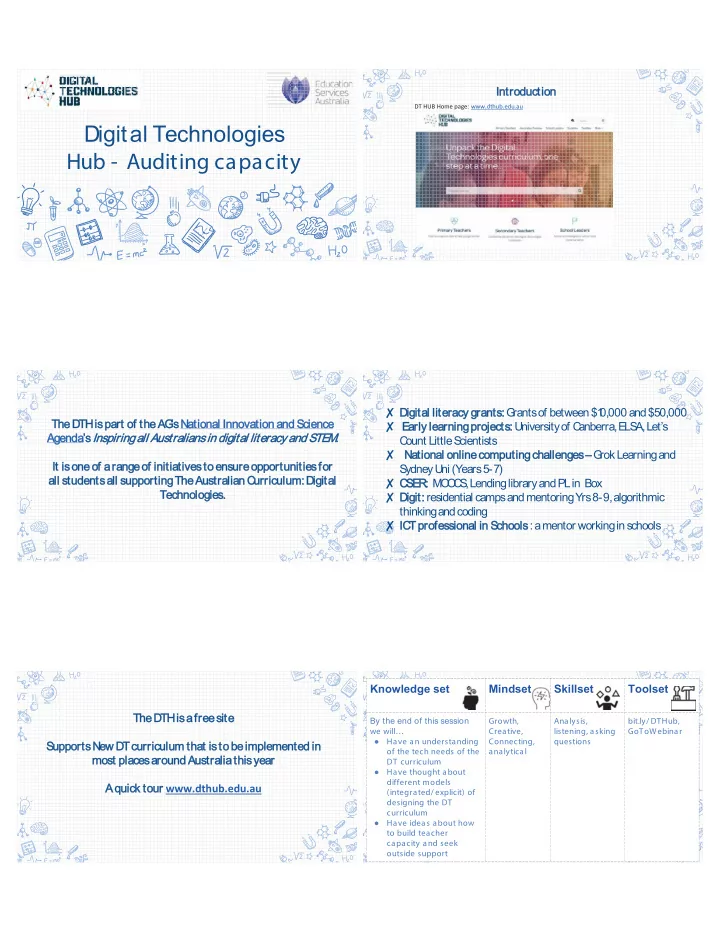
Introduction DT HUB Home page : www.dthub.edu.au Digital Technologies Hub - Auditing capacity D Digital literacy grants: G rants of between $1 0,000 and $50,000 The DTH is part of the AG sNational Innovation and Science Early


slide-1
SLIDE 1

Digital Technologies Hub - Auditing capacity

Introduction

DT HUB Home page: www.dthub.edu.au

The DTH is part of the AG ’sNational Innovation and Science Agenda’sInspiring all Australians in digital literacy and STEM. It is one of a range of initiatives to ensure opportunities for all students all supporting The Australian C urriculum: Digital Technologies. D Digital literacy grants: G rants of between $1 0,000 and $50,000 Early learning projects: U niversity of C anberra, E LS A, Let’s C

  • unt Little S

cientists

  • National online computing challenges –G

rok Learning and S ydney U ni (Years 5-7) C SER : M O O C S , Lending libraryand PL in Box Digit: residential camps and mentoring Yrs 8-9, algorithmic thinking and coding IC T professional in Schools : a mentor working in schools The DTH is a free site Supports New DT curriculum that is to be implemented in most places around Australia this year A quick tour www.dthub.edu.au Knowledge set Mindset Skillset Toolset

By the end of this session we will…

  • Have an understanding
  • f the tech needs of the

DT curriculum

  • Have thought about

different models (integrated/ explicit) of designing the DT curriculum

  • Have ideas about how

to build teacher capacity and seek

  • utside support

Growth, Creative, Connecting, analytical Analysis, listening, asking questions bit.ly/ DTHub, GoToWebinar

t

slide-2
SLIDE 2

Digital Technologies Curriculum

Digital Technologies specifically aims to develop the knowledge, understanding and skills to ensure that, individually and collaboratively, students: design, create, manage and evaluate sustainable and innovative digital solutions to meet and redefine current and future needs use computational thinking and the key concepts of abstraction; data collection, representation and interpretation; specification, algorithms and implementation to create digital solutions confidently use digital systems to efficiently and effectively automate the transformation of data into information and to creatively communicate ideas in a range of settings apply protocols and legal practices that support safe, ethical and respectful communications and collaboration with known and unknown audiences apply systems thinking to monitor, analyse, predict and shape the interactions within and between information systems and the impact of these systems on individuals, societies, economies and environments.

Integr ated STEAM pr ojects Develop thinking skills Enhance numer acy Authentic audience for liter acy # Digital Wor ld

Auditing Technology

iPads Chromebooks Laptop Trolley BYOD BYOB

slide-3
SLIDE 3

McKinnon Secondary College

2500 managed C hromebooks

Bertram Primary School

900 iPads

W hat kind of learning are we designing this infrastructure for – collaborative, creative, consumption of resources? What are the minimum viable and maximum desired device ratios – computer labs, laptop trolleys or BYO(M)D (bring your own multiple devices)? How do we fund access – leasing, purchasing, BYOD… ? How do we fund support – external provider, in-house technical support? What level of access to the Internet do learners need? How does our infrastructure help to keep our learners safe online? What else would we need to do?

Digital Learning Now! Blended Learning Implementation Guide

Auditing Curriculum

E xplicit Integrated Explicit or Integrated?

E xplicit - Lifts level of importance “Easier” to assess (?) More resources available for explicit teaching Integrated - Less time pressure Learning in context Merging on knowledge, mindset, skillset and toolset

“IF TE TR IS HAS TAU G HT U S ANYTHING , IT IS THAT U NC O NNE C TE D C U R R IC U LU M C AN PILE UP, BUT LINKING ACROSS THE CURRICULUM CAN BE A BIG WIN AND RELIEVE TIME PRESSURE”

slide-4
SLIDE 4

Hexagonal C urriculum Planning - St Mel’s C ampsie

Integrated STEAM Unit at Minimbah Primary - Survivor

Auditing Expert Capacity

Resour ces / Scootle Lesson sequences Case studies & advice

Parents and the school community! Student mentors

Other sources of expertise

slide-5
SLIDE 5

D Digital literacy grants - http:/ / education.gov.au/ digital- literacy-school-grants-dlsg Early learning projects - https:/ / www.education.gov.au/ nisa- early-learning-initiatives National O nline C

  • mputing challenges –info coming later this

year C SER MO O C S https:/ / csermoocs.adelaide.edu.au/ moocs/ Lending library https:/ / csermoocs.adelaide.edu.au/ library/ PL in a Box https:/ / csermoocs.adelaide.edu.au/ pdbox/ digit (http:/ / www.amt.edu.au/ information/ for-students/ digit)

W e would love more of your feedback & suggestions!

digitaltechnologieshub@ esa.edu.au

THANKS!

Any questions?

You can contact us at digitaltechnologieshub@esa.edu.au Or contact Chris Harte on chris@unstucklearning.com