Digital strategies for time and energy measurement for ultra fast - - PowerPoint PPT Presentation

digital strategies for time and energy measurement for
SMART_READER_LITE
LIVE PREVIEW

Digital strategies for time and energy measurement for ultra fast - - PowerPoint PPT Presentation

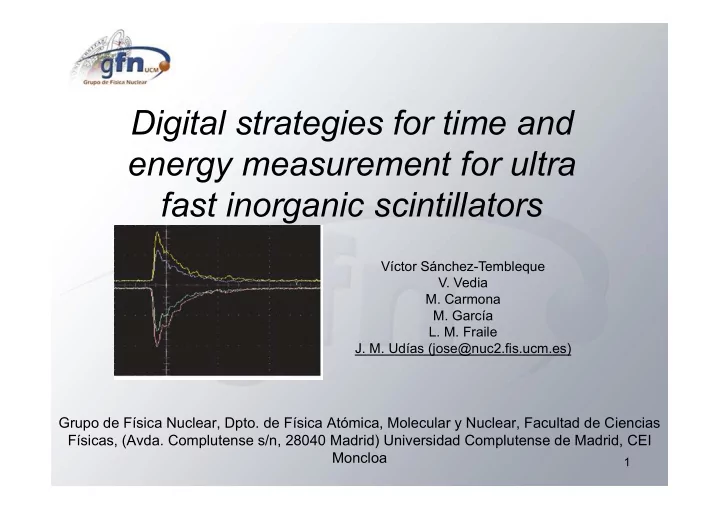
Digital strategies for time and energy measurement for ultra fast inorganic scintillators Vctor Snchez-Tembleque V. Vedia M. Carmona M. Garca L. M. Fraile J. M. Udas (jose@nuc2.fis.ucm.es) Grupo de Fsica Nuclear, Dpto. de Fsica


slide-1
SLIDE 1

Digital strategies for time and energy measurement for ultra fast inorganic scintillators

Grupo de Física Nuclear, Dpto. de Física Atómica, Molecular y Nuclear, Facultad de Ciencias Físicas, (Avda. Complutense s/n, 28040 Madrid) Universidad Complutense de Madrid, CEI Moncloa

Víctor Sánchez-Tembleque

  • V. Vedia
  • M. Carmona
  • M. García
  • L. M. Fraile
  • J. M. Udías (jose@nuc2.fis.ucm.es)

1

slide-2
SLIDE 2

Fully digital (FD-DAQ) nuclear pulse processing for (from) the layman

JM Udias NUSPIN-2017

slide-3
SLIDE 3

What and why?

JM Udias FD-DAQ 3/34

slide-4
SLIDE 4

Fully digital

  • Digitize the raw (or as raw as convenient)

signal (ADC) with adequate resolution and number of samples per second. Process the pulse to get time and/or energy numerically, i.e., with a program

JM Udias FD-DAQ 4/34

slide-5
SLIDE 5

Why?

  • Simplicity: the same board can acquire

and digitize data for energy and time

  • coincidences. Preserve pulse properties.
  • Flexibility. Any kind of processing and filter

is possible, median filter, recursive filters, is possible, median filter, recursive filters, FFT and frequency based filters. It is not limited to the ones implemented in analog circuits

  • Stability and noiseless: digitized data are

further inmune to noise, temperature changes, etc

JM Udias FD-DAQ 5/34

slide-6
SLIDE 6

Coincidence experiment

Conventional DAQ

ificad lificad Pre- Amplificad

  • r

Shaper Shaper

CFD CFD TAC

GATE 6

Pre- Amplificad

  • r
slide-7
SLIDE 7

FD-DAQ

Full wave digitizer

7

slide-8
SLIDE 8

Actual FD-DAQ system

Truncated conical crystals 1x1.5x1.5" LaBr3(Ce) PMT Hamamatsu R9779

FATIMA http://nuclear.fis.ucm.es/fasttiming 8

Performance evaluation of novel LaBr3 (Ce) scintillator geometries for fast-timing applications, V. Vedia, M. Carmona-Gallardo , L.M. Fraile , H. Mach, , J.M. Udías, https://doi.org/10.1016/j.nima.2017.03.030

slide-9
SLIDE 9
  • Disadvantages: quite a different world

from the one of analog electronics

  • designers. Different expertise and
  • equipment. Extremely fast evolving

technologies, difficult to keep up with progress

  • A lot on information on continuous D-DAQ

and Digital Signal Proccesing (DSP) (audio, video), but much less on Digital Pulse Procesing (DPP)

JM Udias FD-DAQ 9/34

slide-10
SLIDE 10

Resolution, speed, price

  • High speed, high resolution, continuous

(free-running) ADC exist, Acquitek digitizers, >20 Gs/s, >10 GHz bandwidth,

  • continuous. Expect them in the 50 keuro

range

  • We have pulses, do we need continuous

digitizing capabilities? Not really

JM Udias FD-DAQ 10/34

slide-11
SLIDE 11

DRS4 @ PSI http://drs.web.psi.ch

  • S. Ritt

DRS4 Evaluation Board 4 channels, 1024 samples per channel in a pulse 1-5 GS/s 12 bit USB power 500 pulses / s in the PC, full 4 channels, 12 bits at 5 GS/s

slide-12
SLIDE 12
slide-13
SLIDE 13

How to measure energy

  • All the algorithms commonly implemented in analog

stages are available: semigaussian shaping plus peak detection, gated integrator, trapezoidal shaping

  • But a simple Simpson or trapezoidal integration plus

substraction of the baseline would do just as well. Pulse Shape correction / balistic deffect may be Pulse Shape correction / balistic deffect may be needed, but it is trivial with FD-DAQ

JM Udias FD-DAQ 13/34

slide-14
SLIDE 14

Energy

Balistic deffect / pulse shape correction

More conspicuous with HPGe detectors 0.3% (FWHM/E) – 662 keV* resolution Same energy resolution is obtained with trapezoidal shaping, or by Pseudo-gaussian shaping plus peak height analysis

slide-15
SLIDE 15

Back to LaBr results

Energy resolution (FWHM/E) Method 511 keV 662 keV 1333 keV Conventional 5.4% 4.6% 3.4% FD 5.3% 4.6% 3.3%

15

slide-16
SLIDE 16

How to measure time

  • We need to start/stop a clock based upon the arrival
  • f the electronic signal (pulse).
  • We can use the rise time part of the pulse (high

slope), and a threshold (leading edge) to create a time stamp at the precise moment that the pulse crossed the level. crossed the level.

  • Interpolation may be useful. We can set the

crossing level at a given value, similar to analog leading edge discrimination.

  • With this method significant time-energy walk will be
  • expected. Larger pulses will cross sooner the level

than smaller ones.

JM Udias FD-DAQ 16/34

slide-17
SLIDE 17

Time-energy walk can be corrected

truncated 1X1X1.5” LaBr3 Co-60 Absolute upper level discriminator time stamps

17

slide-18
SLIDE 18

Solutions to the time energy walk problem

1.) The traditional way, turn the pulse into a bipolar one, use the

crossing point as time stamp. Should be more independent on the amplitude of the peak. Use a timing filter: CR, Constant fraction discrimination (CFD) or similar strategies. Valid both for digital or analog pulse processing

JM Udias FD-DAQ 18/34

slide-19
SLIDE 19

Solutions to the time energy walk problem

2.) A simple procedure, use crossing of relative thresholds for time stamping, instead of absolute ones: provides absolute ones: provides independence on the amplitude of the pulse. Easier implemented in digital world than in analog one

JM Udias FD-DAQ 19/34

slide-20
SLIDE 20

Solutions to the time energy walk problem

4.) FD-DAQ opens the way to sophisticated algorithms to produce accurate time stamp for each pulse. Machine-learning algorithms are being employed succesfully.

JM Udias FD-DAQ 20/34

slide-21
SLIDE 21

Solutions to the time energy walk problem

Time filters depend on several parameters: threshold levels in both detectors, delay and amplitude of inverted signal (CFD), time filter parameters, etc. We have the pulses digitized, let’s have a machine We have the pulses digitized, let’s have a machine

  • ptimization algorithm to look for the best

combination of parameters. We use a Genetic Algorithm to pick the parameters Promote this to a more general strategy: optimize all the parameters of an ‘arbitrary’ digital filter

JM Udias FD-DAQ 21/34

slide-22
SLIDE 22

Solutions to the time energy walk problem

Promote this machine learning strategy. Let’s try a rather general digital filter: This is a recursive filter (0<A<1, -1<B,C<1) , let’s allow for a machine learning algorithm to look for the best combination of parameters A, B; C. It is a generalization of a CR+R’C’ digital filter. To the resulting pulse we apply the relative upper level crossing time stamp. The GA choses the best relative thresholds for each detector.

JM Udias FD-DAQ 22/34

slide-23
SLIDE 23

JM Udias FD-DAQ 23/34

slide-24
SLIDE 24

JM Udias FD-DAQ 24/34

slide-25
SLIDE 25

Results for CRT, FWHM, two BrLa(Ce) truncated cone+PMT Hamamatsu R9779 A -1300 V

JM Udias FD-DAQ 25/34

Machine learning processing led to 15% better time resolution than the conventional approach

Performance evaluation of novel LaBr3 (Ce) scintillator geometries for fast-timing applications, V. Vedia, M. Carmona-Gallardo , L.M. Fraile , H. Mach, , J.M. Udías, https://doi.org/10.1016/j.nima.2017.03.030

slide-26
SLIDE 26

SiPM FD, with DRS4

  • 2x SensL FJ 30035, 3x3 mm2, 27 V

bias

  • SiPM with slow and fast output
  • 2x 1.5x1.5x7 mm3 LYSO crystals
  • CRT with FD-DAQ (relative threshold,

Radioactive Radioactive Source Source Radioactive Radioactive Source Source

  • CRT with FD-DAQ (relative threshold,

manually chosen parameters)

60Co: 88 ps FWHM fast output,

103 ps slow output

22Na: 103 ps FWHM fast output,

122 ps slow output

JM Udias FD-DAQ 26/34

Readout Readout Electronics Electronics Case Case SiPM SiPM MLS MLS Optical Optical Grease Grease Teflon Teflon Readout Readout Electronics Electronics Case Case SiPM SiPM MLS LYSO Optical Optical Grease Grease Teflon Teflon

slide-27
SLIDE 27

Conclusions

  • FD-DAQ of pulses from very fast inorganic

scintillators become possible with unexpensive digitizers

  • FD procesing opens the way to machine

learning algorithms to improve the performance of time pickup performance of time pickup

  • Up to a 15% better time resolution is obtained

with the unguided machine learning algorithm

  • Time resolutions smaller than 100 ps FWHM

per detector is made possible on large detectors.

JM Udias FD-DAQ 27/34