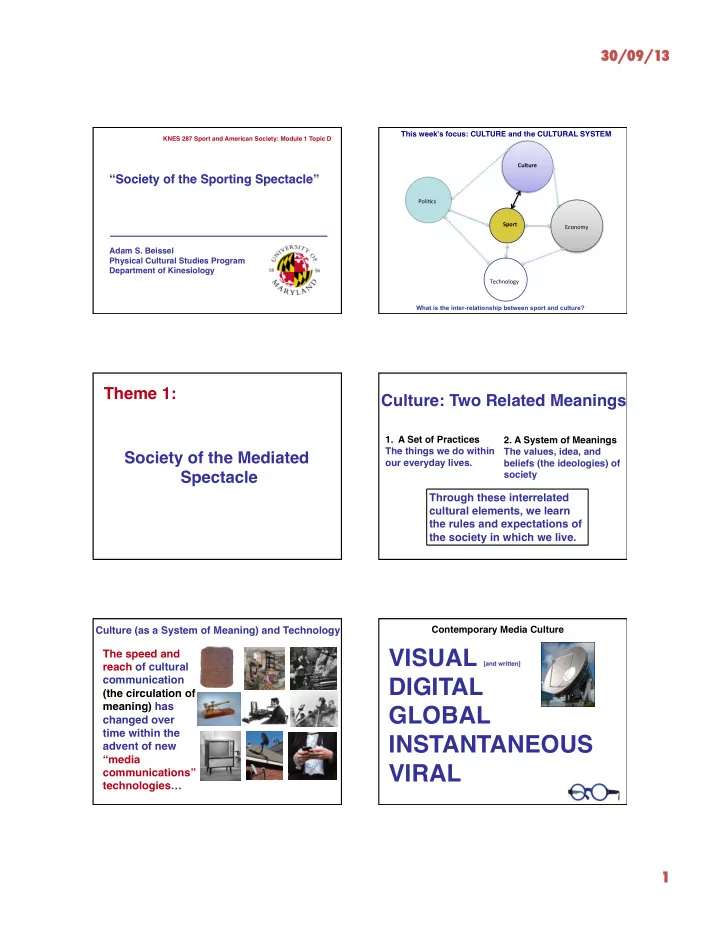
DIGITAL (the circulation of meaning) has GLOBAL changed over - - PDF document

digital
SMART_READER_LITE
LIVE PREVIEW

DIGITAL (the circulation of meaning) has GLOBAL changed over - - PDF document

30/0 /09/1 /13 This weeks focus: CULTURE and the CULTURAL SYSTEM KNES 287 Sport and American Society: Module 1 Topic D Culture Society of the Sporting Spectacle Poli+cs Sport


slide-1
SLIDE 1

30/0 /09/1 /13 1

  • “Society of the Sporting Spectacle”
  • Adam S. Beissel

Physical Cultural Studies Program Department of Kinesiology

KNES 287 Sport and American Society: Module 1 Topic D Economy ¡ Culture ¡ Poli+cs ¡ Technology ¡ Sport ¡

This week’s focus: CULTURE and the CULTURAL SYSTEM

What is the inter-relationship between sport and culture?

  • Society of the Mediated

Spectacle

  • Theme 1:

Culture: Two Related Meanings

  • 1. A Set of Practices

The things we do within

  • ur everyday lives.
  • 2. A System of Meanings

The values, idea, and beliefs (the ideologies) of society

Through these interrelated cultural elements, we learn the rules and expectations of the society in which we live. The speed and reach of cultural communication (the circulation of meaning) has changed over time within the advent of new “media communications” technologies…

Culture (as a System of Meaning) and Technology

Contemporary Media Culture

VISUAL [and written] DIGITAL GLOBAL INSTANTANEOUS VIRAL

slide-2
SLIDE 2

30/0 /09/1 /13 2

Social Welfare Functions of Mass Communications Media Inform Educate

  • Entertain
  • Neo-Liberal Functions of

Mass Communications Media

Inform

Educate
  • Entertain

(capital accumulation/ profit)

  • It could be argued that the MASS MEDIA is

the primary ENERGY SOURCE/MOTOR of the CONTEMPORARY ECONOMY.

  • As important as STEAM, COAL, and OIL,

were to earlier stages of economic development, so the MASS MEDIA is within the LATE (CULTURAL) CAPITALIST ECONOMY. Within the LATE (CULTURAL) CAPITALIST ECONOMY, the mass media is an important:

  • CULTURAL


PRODUCT and CULTURAL PROCESS

IN THE WORKING OF THE ECONOMY (THE ACCUMULATION OF CAPITAL).

The COMMERCIAL MEDIATION of culture The manufacture of CULTURAL MEANINGS in marketing/branding commodities and services

French Situationist: Guy Debord “media spectacles are those phenomena of media culture that embody contemporary society’s basic values, serve to initiate individuals into its way of life, and dramatize its controversies and struggles, as well as its modes of conflict resolution” (Kellner, 2003, p.2)

  • The Triumph of the Spectacle

Source: Kellner, D. (2003). Media culture and the triumph of the spectacle Media Spectacle (pp. 1-33). London: Routledge.

slide-3
SLIDE 3

30/0 /09/1 /13 3

Debord’s Society of the Spectacle

Monumental Spectacle (mass mediated happenings: mega-events)

  • Commodity
  • Spectacle
  • (mass mediated
  • commodities:

brands)

  • Individual

Spectacle (mass mediated personas: celebrities)

  • Society of
  • the Spectacle

Monumental Spectacle

  • (mass mediated happenings:
  • mega-events)
  • Individual Spectacle
  • (mass mediated personas:
  • celebrities)
  • Commodity Spectacle
  • (mass mediated commodities:
  • brands)
  • Individual
  • Spectacle
  • (mass mediated
  • personas:
  • SPORT celebrities)
  • Commodity
  • Spectacle
  • (mass mediated
  • commodities:

SPORT brands)

  • Monumental

Spectacle (mass mediated happenings: SPORT mega-events)

Society of the Sporting Spectacle

  • The Economics of the

Society of the Monumental Sporting Spectacle

  • Theme 2:
slide-4
SLIDE 4

30/0 /09/1 /13 4

“mediasport” the “media-sport complex” the “sport-business-TV nexus” “the high-flying entertainment-media- sports industry”

Sport-Media CONVERGENCE

SPORT ENTERTAINMENT SPORTAINMENT

XFL (2001): The Pinnacle of Sportainment?

“I don’t care how [the fans] are

  • entertained. If they’re

entertained by the quality of football, great. If they’re entertained from cheerleaders,

  • terrific. If they’re entertained

from the reality show and get to see and hear coaches and what they say at halftime where the NFL would never allow you to go, great.”

(Vince McMahon, quoted in Morgan, 2001)

XFL Television Ratings 2001 2 4 6 8 10 10 1 1 3 3 5 5 7 7 9 9 1 1 1 1 1 3 1 3

NBC NBC TNN TNN UP UPN

Week of Coverage Television Rating

Of course, the XFL failed, but why?

  • Perhaps because primetime NFL is already

better sportainment?

  • Better SPORT?
  • Better ENTERTAINMENT?

In other words, it was already more XFL than the XFL?

  • The sportainment NORM has led to

televised sport coverage (especially that for primetime network television) augmenting the basic nature of the sporting event in order to make it more spectacular, and thereby more entertaining to a primetime audience.

slide-5
SLIDE 5

30/0 /09/1 /13 5

Why the proliferation of sportainment?

  • It is hugely:

POPULAR

(and thereby commercially attractive)

  • “The media have no inherent interest in sport. It is

merely a means for profit making. For newspapers and magazines, sport sells the

  • publications. For TV and radio, sport gets

consumers in front of their sets to hear and see commercials; in effect, TV and radio broadcasts rent their viewers and listeners attention”

  • The Mass Media’s Interest in Sport

Sage, G. H. (1990). Power and ideology in American sport: A critical perspective (p.123). Champaign: Human Kinetics.

Reason #1. Its explicit and telegenic physicality (conjoined as it is with an implicit hetero/homoeroticism).

  • Reason #2. Its innate competitive structure (which encourages

empathy inducing personal narratives).

  • Reason #3. Its potential for generating visceral excitement (created by

the uncertainty, real or imagined, surrounding the outcomes of live sporting contests)

  • Reason #4. Its nurturing of deep-rooted individual identifications and

loyalties (about which corporate brand managers must surely fantasize).

  • Reason #5. Its relatively straight forward and inexpensive production

demands (especially compared with equivalent programming lasting more than two hours).

  • WHY SPORT/SPORTAINMENT?

“In corporate/Americanized sport, the game has become somewhat less important than its capacity to be a vehicle presenting particular [commercial] messages to a particular select and often massive audience.”

  • Source: . Donnelly, “The Local and the Global: Globalization in the

Sociology of Sport,” Journal of Sport and Social Issues 20:3 (1996): 246.

  • A Promotional Conduit

The Profit Engine: Advertising Revenue

Exclusive rights to high profile events (for high audience ratings) have resulted in an ability to charge exorbitant costs to advertisers and sponsors:

  • $725,000 for a 30 second spot

during NBC’s primetime London 2012 Olympic Games coverage

  • $3.80 million for a 30 second spot

during the 2013 Super Bowl

  • 1. High-Level (Monumental) Sportainment
slide-6
SLIDE 6

30/0 /09/1 /13 6

Top Rated U.S. Television Shows of All-Time

11 out of 20 sport related.

Source: Nielsen Ratings

Average audience of 111.3 million viewers “said to be the most-watched television program of all time”.

  • Viewed in 53.3 million

households.

  • U.S. household rating of 47.8

(meaning 47.8% of households were tuned in).

Television’s “Most Watched”

Source: Ogg, J.C. (2013, Feburary 2). Super Bowl XLVII by the numbers. USA Today. http://www.usatoday.com/story/money/business/2013/02/01/ super-bowl-factoids-24-7/1880601/ Source: Sports Media Watch

8 out of 14 football related.

Source: Sports Media Watch

  • 2. Medium-Level (Everyday) Sportainment

Source: Nielsen Ratings

6 out of 10 football related.

slide-7
SLIDE 7

30/0 /09/1 /13 7

  • 3. Low-Level (Manufactured) Sportainment

XFL Project Runway? Dancing with the Stars Survivor The Amazing Race

The Ultimate Low-Level (Manufactured) Sportainment?

See Video Clip 1

  • The Olympic Sport
  • Spectacle as Sportainment
  • Theme 3:
  • THE MONUMENTAL SPORT

SPECTACLE

  • (a high profile, mass interest, commercially
  • riented sporting event)

Year Location Network Hours Rights Fees 1960 Rome CBS 20 $394,000 1964 Tokyo NBC 14 $1.5 million 1968 Mexico City ABC 43.75 $4.5 million 1972 Munich ABC 62.75 $7.5 million 1976 Montreal ABC 76.5 $25 million 1980 Moscow NBC 150 (planned) $87 million 1984 Los Angeles ABC 180 $225 million 1988 Seoul NBC 179.5 $300 million 1992 Barcelona NBC 161 $401 million 1996 Atlanta NBC 171 $456 million 2000 Sydney NBC 441.5 $705 million 2004 Athens NBC 806.5 $793 million 2006 Torino NBC Universal 416 $613 million 2008 Beijing NBC Universal 3,600 $894 million 2012 London NBC Universal 5,535 $1.18 billion 2016 Rio De Janeiro NBC Universal

  • $1.226 billio

2020 ? NBC Universal $1.418 billion

Olympic TV Rights for US National Broadcasters

The NBC-Olympic Convergence

See Video Clip 2

slide-8
SLIDE 8

30/0 /09/1 /13 8

As Richard Pound, then IOC vice president, brazenly admitted, in relation to NBC’s commitment to the Olympic Games:

  • “If you owe them [the bank] $10,000,

you’re a customer. If you owe them $10,000 billion you’re a partner” (Thurow, 1996, p.14).

Thurow, R. (1996, July 19). Lord of the Rings. The Wall Street Journal Interactive Edition.

  • NBC:
  • The primetime platform for

manufacturing the Olympics Games SPECTACLE into a high revenue generating form of SPORTAINMENT.

“the main concern of television producers is to prevent viewer boredom. From the point of view of the networks, the sports spectacle is, after all, spectacle first and sports second….to the network, the game is to catch the viewer”

  • Source: Morris, B.S. and Nydahl, J. (1985) ‘Sports pectacle as

drama: Image, language and technology’, Journal of Popular Culture, 18: 101-110.

Creating an Olympic Hyperreality

NBC’s Olympic HYPERREALITY

Jean Baudrillard’s Hyperreality

HYPERREALITY: A culture associated with the blurring of the boundary between the “real” and the “fictional”.

  • HYPERREALITY: A situation within which models or

SIMULATIONS of reality–with no basis in reality–come to represent and influence the perception and experience of reality.

  • In other words, a HYPERREAL culture is one in which

MEDIA SIMULATIONS (particularly from television and advertising) of shape our view of the world, the way we perceive it, and the way we act within it.

  • Source: Baudrillard, J. (1983). Simulations. New York: Semiotext(e).

Source: Baudrillard, J. (1995). The Gulf war did not take place. Bloomington, IA: Indiana University Press.

slide-9
SLIDE 9

30/0 /09/1 /13 9

According to Baudrillard:

  • The televisual reality of the media Gulf conflicted

with the material reality of the Gulf War.

  • “Collateral Damage”:

Sanctioned Televisual Representation

  • f the Gulf War, 1991

“Collateral Damage”:

  • Non-Sanctioned, Realist

Representation

  • f the Gulf War materiality, 1991
  • beijing

beijing olympics

  • lympics

In Baudrillard’s terms:

  • We do not watch the

Olympics on primetime NBC; rather, we are fed the televisual NBC Olympics: the Olympics as primetime entertainment.

Televisual Representation

  • f the Olympic Games

Material experience of the

  • Olympic Games
  • In Baudrillard’s :
  • The televisual reality of the mediated Olympics

sometimes conflicted with the material reality of the Beijing Games.

  • NBC manufacture a mediated

primetime Beijing Olympic reality, designed for maximum ratings (and thereby profits), which did not necessarily reflect the material reality of the Olympic experience.

“I live more than anything else to produce the Games”

(Dick Ebersol, chairman of NBC Universal Sports & Olympics, August 2004).

NBC’s Beijing Olympic Authority NBC’s $894 investment in the IOC (more than 50% of the television revenue generated by the Games), provided it with considerable influence:

  • 1. Changing the date of the Games, from

September to early August: school vacation/ avoiding NFL

  • 2. Changing time of events (specifically

swimming and gymnastics) to comply with US primetime ET

slide-10
SLIDE 10

30/0 /09/1 /13 10 10

Dick Ebersol, chairman of NBC Universal Sports & Olympics, 1996.

“I get to arrange how all these things are perceived in the world”

  • “These are NBC's games, and by now we should

know how they're played.

  • The network sees the Olympics less as sports

than as spectacle, at least in prime time, and it packages them accordingly into a sort of athletic variety show. Events are delayed, results are hidden, and while bad news is not ignored, it's not stressed, either. This is not Monday Night

  • Football. The game is not the thing.”

Bianco, R. (2006, February 13). Prime-time Olympics: A variety show. USA Today, p. 1D.

  • Ebersol’s Olympic Time
  • 1. Purely live
  • 2. Live-on-tape
  • 3. Plausibly live

NBC’s Manipulation of Olympic Time (Emotions)

See Video Clip 3

“Soap opera games”

Produced for maximum sentiment,

  • maximum ratings, and maximum

revenue

Carlson, M. (1996). The soap opera games: Determined to make every event a tearjerker, NBC overplays the personal stories. Time: 48.

Media Manufacturing of the Olympic Spectacle: Narrativizing the Event

See Video Clip 4

slide-11
SLIDE 11

30/0 /09/1 /13 11 11

Ebersol’s Emotive Olympic Broadcast Philosophy/Narrativizing:

  • 1. Story
  • 2. Reality
  • 3. Possibility
  • 4. Idealism
  • 5. Patriotism

NBC’s “Selective” Primetime Hyperreality

(90% of NBC’s viewership)

NBC’s Beijing 2008: The “Michael Phelps Mini-Series”

Primetime Audiences Demand Mainstream Value/ Belief Systems (hints of neoliberal ideology)

NATIONALISM COMPETITIVE INDIVIDUALISM HEROISM HETERO-SEXISM

Such are the IDEOLOGIES driving NBC’s Olympic narrative.

RUGGED INDIVIDUALISM PROGRESS/ SELF-BETTERMENT

NBC’s Ideological Framing of Beijing 2008

See Video Clip 5

Sportainment spectacles as “a sort of athletic variety show…The game is not the thing.”

Bianco, R. (2006, February 13). Prime-time Olympics: A variety show. USA Today, p. 1D.

  • 1. High-Level (Monumental) Sportainment
slide-12
SLIDE 12

30/0 /09/1 /13 12 12

  • 2. Medium-Level (Everyday) Sportainment
  • 3. Low-Level (Manufactured) Sportainment

XFL Project Runway? Dancing with the Stars Survivor The Amazing Race

Primetime Audiences Demand Mainstream Value/ Belief Systems (hints of neoliberal ideology)

NATIONALISM COMPETITIVE INDIVIDUALISM HEROISM HETERO-SEXISM

Where are these ideologies present within sportainment, and how are they communicated?

RUGGED INDIVIDUALISM PROGRESS/ SELF-BETTERMENT Ebersol’s Emotive Olympic Broadcast Philosophy/Narrativizing:

  • 1. Story
  • 2. Reality
  • 3. Possibility
  • 4. Idealism
  • 5. Patriotism

Where are these narrative elements present within sportainment, and how are they communicated?

Ebersol’s Olympic Time

  • 1. Purely live
  • 2. Live-on-tape
  • 3. Plausibly live

Where, and how, and why is time manipulated within within sportainment?

Identify and analyse

  • the HYPERREALITY
  • f a contemporary
  • SPORTAINMENT

SPECTACLE

slide-13
SLIDE 13

30/0 /09/1 /13 13 13

  • Popular Physical Inertia and

Sportainment Spectacles

  • Theme 4:

One of the main stated LEGACIES of the London Olympic Games (which contributed to the winning of the bid) was the encouragement of involvement in SPORT and PHYSICAL ACTIVITY among the world’s youth (inspiring 2 million youth in the UK to become more active).

However, research has suggested there is in fact no correlation between staging Olympic Games (or other major sport spectacles) and raised levels of physical activity among the general populace.

Source: Weed, M., Coren, E., Fiore, J., Wellard, I., Mansfield, L., Chatziefstathiou, D., & Dowse, S. (2012). Developing a physical activity legacy from the London 2012 Olympic and Paralympic Games: a policy-led systematic review. Perspectives in Public Health, 132(2), 75-80.

Amusing Ourselves to Death Revisited?

The Consequences of Sportainment? Stimulating Active Involvement? Stimulating Passive Consumption?

SOCIAL CULTURAL PHYSIOLOGICAL GLOBESITY and the SPORT SPECTACLE?

Dickson, G., & Schofield, G. (2005). Globalization and globesity: The impact

  • f the 2008 Beijing Olympics in China. International Journal of Sport

Management and Marketing, 1(1-2), 169-179.

slide-14
SLIDE 14

30/0 /09/1 /13 14 14

CALORIFIC INCREASE

Dickson, G., & Schofield, G. (2005). Globalization and globesity: The impact

  • f the 2008 Beijing Olympics in China. International Journal of Sport

Management and Marketing, 1(1-2), 169-179.

Increased Calorie Intake

Dickson, G., & Schofield, G. (2005). Globalization and globesity: The impact

  • f the 2008 Beijing Olympics in China. International Journal of Sport

Management and Marketing, 1(1-2), 169-179.

Reduced Energy Expenditure +

ENERGY DECREASE PHYSIOLOGICAL RESTRUCTURING?

Dickson, G., & Schofield, G. (2005). Globalization and globesity: The impact

  • f the 2008 Beijing Olympics in China. International Journal of Sport

Management and Marketing, 1(1-2), 169-179.

= Increased Obesity Levels

GLOBESITY and the SPORT SPECTACLE?

Dickson, G., & Schofield, G. (2005). Globalization and globesity: The impact

  • f the 2008 Beijing Olympics in China. International Journal of Sport

Management and Marketing, 1(1-2), 169-179.

Reduced Energy Expenditure + Increased Calorie Intake =

  • Increased

Obesity Levels

KFC Couchgating – Sport Spectacle and Globesity?

See Video Clip 6

Critical Intervention in the Globesity Sport Spectacle

See Video Clip 7

slide-15
SLIDE 15

30/0 /09/1 /13 15 15

See course website for related lectures slides, podcast, thematic review questions, video clips, required readings, key concepts, discussion tasks, and essay question.