Dialogue Systems Emerging interdisciplinary area since the early - - PowerPoint PPT Presentation

dialogue systems
SMART_READER_LITE
LIVE PREVIEW

Dialogue Systems Emerging interdisciplinary area since the early - - PowerPoint PPT Presentation

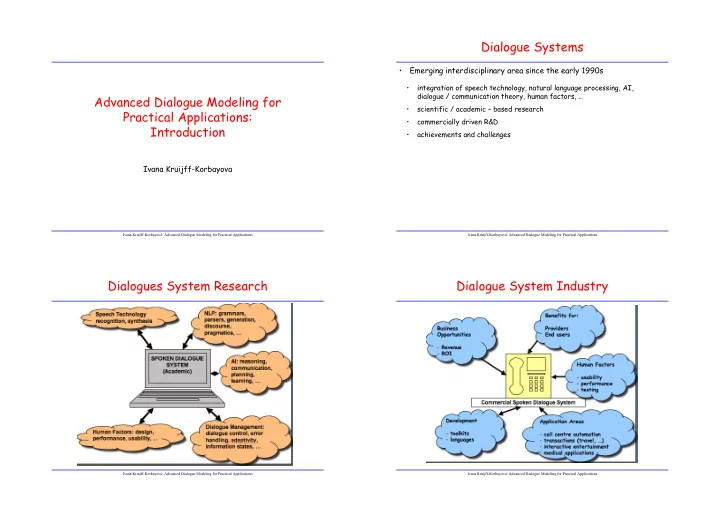
Dialogue Systems Emerging interdisciplinary area since the early 1990s integration of speech technology, natural language processing, AI, dialogue / communication theory, human factors, Advanced Dialogue Modeling for


slide-1
SLIDE 1

Ivana Kruijff-Korbayová: Advanced Dialogue Modeling for Practical Applications

Advanced Dialogue Modeling for Practical Applications: Introduction

Ivana Kruijff-Korbayova

Ivana Kruijff-Korbayová: Advanced Dialogue Modeling for Practical Applications

  • integration of speech technology, natural language processing, AI,

dialogue / communication theory, human factors, …

  • scientific / academic – based research
  • commercially driven R&D
  • achievements and challenges

Dialogue Systems

  • Emerging interdisciplinary area since the early 1990s

Ivana Kruijff-Korbayová: Advanced Dialogue Modeling for Practical Applications

Dialogues System Research

Ivana Kruijff-Korbayová: Advanced Dialogue Modeling for Practical Applications

Dialogue System Industry

slide-2
SLIDE 2

Ivana Kruijff-Korbayová: Advanced Dialogue Modeling for Practical Applications

Typical Pipeline Architecture

Ivana Kruijff-Korbayová: Advanced Dialogue Modeling for Practical Applications

Typical Pipeline Architecture (Multimodal)

Dialogue management Audio & Video / GUI Modality-Specific recognition Interpretation & Fusion Fission & generation Back end

Ivana Kruijff-Korbayová: Advanced Dialogue Modeling for Practical Applications

Dialogue Control

  • Finite state systems

– Sequence of predefined steps (dialogue script)

  • Frame-based systems (form-filling)

– Task represented as a set of slots to fill (frame, template)

  • Agent-based systems

– Joint problem solving by collaborating agents Task complexity

Ivana Kruijff-Korbayová: Advanced Dialogue Modeling for Practical Applications

Finite State Systems

  • Sequence of predefined steps (dialogue script)
  • Set of states and transitions

– State determines system utterance

  • Carefully designed prompts at each state

– User utterance determines transition to next state (deterministic)

  • Speech recognition tailored to expected responses given the state
  • No recursion! (=no nested subdialogues)
  • System-driven interaction (system initiative)
  • Rigid dialogue flow
slide-3
SLIDE 3

Ivana Kruijff-Korbayová: Advanced Dialogue Modeling for Practical Applications

FSM: Example 1

Welcome Ask_floor Floor_1

floor n init

U: Elevator? S: Hello. Which floor would you like to go to? U: Third floor. S: OK, I am taking you to the third floor.

Floor_n

floor 1

  • Not_und

unknown States: … Init-State: … Alphabet: … Transition function: …

Ivana Kruijff-Korbayová: Advanced Dialogue Modeling for Practical Applications

FSM: Example 1 (extended)

welcome Ask_floor Go_floor

floor #

Person>Floor #

person init

Not_und

unknown U: Elevator? S: Hello. Where would you like to go to? U: Prof. Barry. S: Prof. Barry is on the fourth floor. I am taking you to the fourth floor. (variable for floor number)

Ivana Kruijff-Korbayová: Advanced Dialogue Modeling for Practical Applications

FSM: Example 2

get_acct# get_pin# Lookup

balance good # correct pin

repeat acct#

bad # bad # good #

repeat pin

bad # bad # correct pin unknown

init

what service

States: … Init-State: … Alphabet: … Transition function: …

[McTear 2002]

Ivana Kruijff-Korbayová: Advanced Dialogue Modeling for Practical Applications

FSM: Example 3

depart_city dest_city Lookup

flight city city

repeat depart

unknown unknown city

repeat dest

unknown unknown city unknown

init

what info

States: … Init-State: … Alphabet: … Transition function: …

….

slide-4
SLIDE 4

Ivana Kruijff-Korbayová: Advanced Dialogue Modeling for Practical Applications

Finite State Systems: Sum Up

  • Advantages

– Fixed prompts can be pre-recorded – Speech recognition and input interpretation can be tuned for each state

  • Disadvantages

– Very rigid dialogue flow – Inhibiting user initiative – In principle can make more flexible, but it quickly gets very complex – Only suitable for simple fixed tasks

Ivana Kruijff-Korbayová: Advanced Dialogue Modeling for Practical Applications

departure_city ? departure_date ? destination_city ? return_date ? …

Frame-Based Models

  • Task represented as a set of slots to fill

– Frame (form): what info should be supplied by user – Dialogue states: which slots are filled

  • Strategies for selecting the next system action (given dialogue state)
  • Enables mixed initiative (“over-answering”)
  • Somewhat more flexibility

Ivana Kruijff-Korbayová: Advanced Dialogue Modeling for Practical Applications

Frame-Based Models

departure_city ? departure_date ? destination_city Paris return_date ? ... S: What can I do for you? U: I want to fly to Paris S: Where will you fly from? U: From Berlin on August 1st. departure_city Berlin departure_date 1/8/05 destination_city Paris return_date ? ...

Ivana Kruijff-Korbayová: Advanced Dialogue Modeling for Practical Applications

Frame-Based Models

  • Deciding what to do next

– Next unfilled slot (similar to FS-based) – Slot-combination weighting – Ontology-based coherence

  • Database lookup

– Delayed (typically; after certain slots filled) – Immediate (can be “expensive”, but helpful )

slide-5
SLIDE 5

Ivana Kruijff-Korbayová: Advanced Dialogue Modeling for Practical Applications

Ontology-based coherence

S: What is the patient’s sex? U: Female with severe nipple discharge S: What is the patient’s age? U: Fifty five S: Is the discharge bilateral? U: No S: What is the patient’s sex? U: Female with severe nipple discharge S: Is the discharge bilateral? U: No S: What is the patient’s age? U: Fifty five [Milward&Beveridge 2003]

Ivana Kruijff-Korbayová: Advanced Dialogue Modeling for Practical Applications

Delayed vs. Immediate Lookup

S: What can I do for you? U: I want to fly from Saarbruecken to Luxembourg. S: When would you like to fly? U: April 1st. S: At what time would like to fly? U: In the morning. S: Sorry. There is no flight from Saarbruecken to Luxembourg on April 1st in the morning. S: What can I do for you? U: I want to fly from Saarbruecken to Luxembourg. S: Sorry. There is no flight from Saarbruecken to Luxembourg.

Ivana Kruijff-Korbayová: Advanced Dialogue Modeling for Practical Applications

VoiceXML

  • VoiceXML is a web-based markup language for representing spoken dialogs

– Form: basic unit of functionality – Field: prompts for and accepts user input – Prompt: sequence of audio elements or TTS messages – Audio: audio file or TTS message to play – Filled: processes input, can pass control to other forms

  • Form Interpretation Algorithm

– Defines how fields in a form are filled in , and how the fill ordering can be modified

  • Global event handlers for (e.g., error handling, help)

– Define behavior when predefined global conditions occur

  • VoiceXML application collects and processes info, and plays back info
  • VoiceXML assumes a voice browser

– Info conveyed to user by audio output (synthesized and/or recorded) – Info received from user as audio input (voice and/or telephone keypad tones) – (analogical to HTML)

Ivana Kruijff-Korbayová: Advanced Dialogue Modeling for Practical Applications

Frame-Based DM: Sum Up

  • Advantages

– Enables some user initiative – More flexible

  • Disadvantages

– Speech recognition more difficult, because user input less restricted – Not every task can be represented by a frame

slide-6
SLIDE 6

Ivana Kruijff-Korbayová: Advanced Dialogue Modeling for Practical Applications

Agent-Based DM

  • (Collaborative) problem solving by (rational) agents
  • Dialogue involves recognition, construction and execution of plans
  • Agents have knowledge about solving tasks

– deciding on goals (objectives): adopt, select, defer, abandon, release – forming plans to achieve goals (recipes) – executing those plans (acting) – revising decisions (re-planning, abandoning goals, etc.)

  • Agents communicate to establish common ground
  • Agents reason about beliefs and actions

Ivana Kruijff-Korbayová: Advanced Dialogue Modeling for Practical Applications

Collaboration

  • Communication is a joint activity: agents collaborate to establish and

achieve their goals

  • Neither agent can accomplish the task alone
  • -> mixed initiative
  • Need joint goals and mutual understanding
  • -> cooperation
  • -> grounding

Ivana Kruijff-Korbayová: Advanced Dialogue Modeling for Practical Applications

Intention Recognition

German101(fall03) AcademicPlan GetGermanCredits Math/LangReq GetBA(PolySci)

U: I’ll take German 101 fall semester.

Given: plan for getting a BA

Ivana Kruijff-Korbayová: Advanced Dialogue Modeling for Practical Applications

Interleaved Planning&Acting

User: Send ambulance one to Parma right away. System: OK. [sends ambulance] System: Where should we take the victim once we pick them up? User: Rochester General Hospital. System: OK.

[Blaylock et al. 2003]

slide-7
SLIDE 7

Ivana Kruijff-Korbayová: Advanced Dialogue Modeling for Practical Applications

Agent-based: Sum Up

  • Advantages

– Enables flexible and adaptive dialogue modeling – Any task can be modeled

  • Disadvantages

– Intention recognition is difficult – Lots of reasoning (see QUD-based DM for “shortcuts”)

  • -> “expensive”

Ivana Kruijff-Korbayová: Advanced Dialogue Modeling for Practical Applications

Development Methodologies

  • Requirement Specification

– Analysis of human-human dialogues – Wizard-of-Oz experiments (simulations) to gather user behavior samples and test design ideas in early stages of development

  • e.g., the TALK project WOZ experiment setup:

Ivana Kruijff-Korbayová: Advanced Dialogue Modeling for Practical Applications

Development Methodologies

  • Usability Evaluation

– PARADISE framework [Walker et al. 1997]:

  • Maximize user satisfaction through maximizing

task success while minimizing dialogue costs

  • User satisfaction (surveys)
  • Objective measures:

– Task success (in terms of filling a set of slots) – Dialogue costs: » Efficiency, e.g., no. of turns and time » qualitative phenomena, e.g., no. of inappropriate utterances or repairs

  • Performance function: relative contribution of
  • bjective factors to user satisfaction

Ivana Kruijff-Korbayová: Advanced Dialogue Modeling for Practical Applications

Deployment Platforms

  • PC

– GoDIS – Circuit-Fix-It Shop, TRIPS/TRAINS – Autotutor, Why-Atlas, BE&E, PACO …

  • Telephone

– Philips Train Timetable System, Deutsche Bahn info, … – It-Spoke weather

  • Embedded voice systems

– HAL (Home Automated Living), D’Homme project

  • In-car voice or multimodal systems

– BMW navigation, TALK project: MP3 player

  • PDA, tablet PCs, next generation phones

– MATCH, SmartKom

  • Embodied agents and robots

– REA, SAM, MRE, … – WITAS – MEL, BIRON, COSY system, Companions

DEMOS

slide-8
SLIDE 8

Ivana Kruijff-Korbayová: Advanced Dialogue Modeling for Practical Applications

Key Issues for the Future

  • Pervasive systems

– distributed dialogues: shifts between dialogue situations – concurrent dialogues: multitasking (co-ordination, synchronisation, redundancy) – interaction model needs to be predominantly event-based (external events,

  • pportunistic)
  • Adaptivity:

– Systems need to be dynamically adaptive in a number of different ways: to the environments in which they are used (modality), to their user’s preferences and needs (personalisation), to changes in task and context, to interaction progress.

  • Ability to learn:

– Systems need to be able to learn from interactions with users in order to provide an optimally usable interface that matches the current environment and user.

  • Standardization:

– There is a need for a common set of standards to support re-usability for developers and to support usability for the users of spoken dialogue systems, e.g. constraining vs. open-ended prompts, explicit vs. implicit verification.

Ivana Kruijff-Korbayová: Advanced Dialogue Modeling for Practical Applications

References

  • D. Jurafsky and J. Martin (2000): Speech and Language Processing,

Chapter 19.

  • McTear (2002): Spoken Dialogue technology. In ACM Surveys. pp. 1-

80

  • VoiceXML Forum: http://www.voicexml.org/
  • Walker, Marilyn A., Litman, Diane J., Kamm, Candace A., Abella,

Alicia (2000): PARADISE: A Framework For Evaluating Spoken Dialogue Agents. In Proc. Of the ACL Conference.