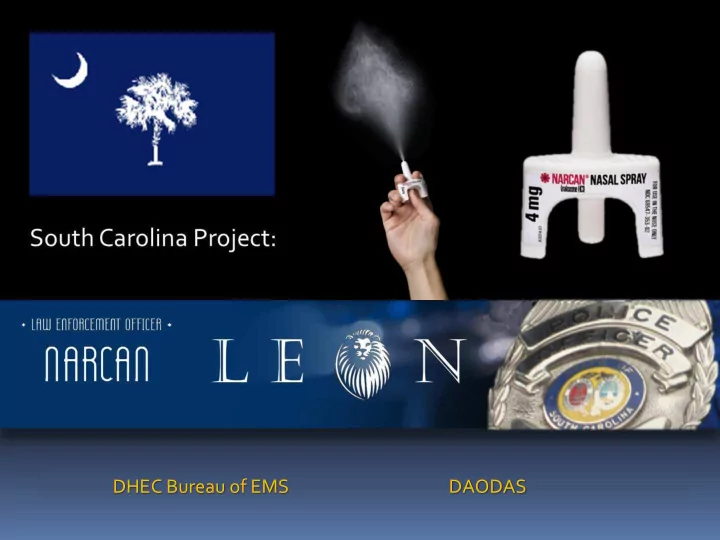
DHEC Bureau of EMS DAODAS
DHEC Bureau of EMS DAODAS The - - PowerPoint PPT Presentation
DHEC Bureau of EMS DAODAS The LEON's goal is to provide a comprehensive training to law enforcement agencies across South Carolina that focuses on The identification The treatment The reporting
The LEON's goal is to provide a comprehensive training to law enforcement agencies across South Carolina that focuses on The identification The treatment The reporting
- f drug overdoses attributed to opiates/opioids,
such as heroin and narcotic pharmaceutical drugs (Scheduled II).
- The program was created pursuant to the 2015
passing of the South Carolina Overdose Prevention Act (S.C. Code Section 44-130-60).
- The Act seeks to grant immunity from both civil
and criminal prosecution, to doctors, pharmacists, caregivers, and first responders, who are engaged in the prescription, dispensation and administration of Naloxone (Narcan) in an opioid-
- verdose suspected case.
- Drug overdose is currently the leading cause of
accidental death in the U.S., with 62,497* lethal drug overdoses in 2016 or an average of one life every 8½ minutes.
- In 2016 there were 5.2 million opioid prescriptions
dispensed in South Carolina (population 4,961,119).
- In 2016 there were 366** murders in South Carolina
but 616*** opioid deaths.
Prescription & Opioid Abuse
* New York Times, 6/5/2017 ** FBI Annual Crime Report, 10/18/2017 *** DHEC Vital Statistics
2016 Opioid Related Deaths
616 Opioid Deaths 366 Murders
4,610 people
Per 100,000 people Pickens 200 Horry 165 Greenville 144 Spartanburg 105 Anderson 97 Charleston 67 Richland 36
Yearly Narcan Usage by EMS
132 243 709 188 311 168 167 147 509 262 117 117 132 94 109 103
Yearly Narcan Usage by EMS
6,427 people
Per 100,000 people Horry 342 Pickens 274 Greenville 160 Spartanburg 160 Anderson 142 Charleston 119 Richland 62
South Carolina EMS Narcan Administration – 2016
111 and Above 81 to 110 51 to 80 Less than 50
1,043
To date 12% increase over 2016
S.C. EMS Usage of Narcan in 2017
7,278 administrations
- For many reasons, EMS is usually not the first
emergency responder of the scene of medical emergencies.
- Average current response time for EMS to all 9-1-1
calls in S.C. is 11:9 minutes (2016 – 675,514 calls)
- Average response time for FD’s running medical
first response 6:41 minutes (2016 – 40,775 calls)
- Average law enforcement response is usually 3-5
minutes depending on setting (rural / urban / suburban).
WHY LEO: Comparative Response Times
- To date LEON has trained 4,351 officers in 140 agencies in 34
counties with 214 deployments and 191 lives saved.
- The program offers for free the training, the online reporting
portal, access to DHEC pharmacies, statewide standing orders by a physician to carry and administer the Narcan.
- LEON was awarded a federal SAMHSA grant to continue the
program and to purchase Narcan for the program
- Unless a LEO agency chooses another Narcan product from the
- ne we provide, there is no other cost
- Your next steps: Memo of Agreement (MOA), scheduling 2
hours for training, and officer list with SC CJA numbers
Addressing the Problem in South Carolina
- LEON program emphasizes Tactics and Safety: there
may be situations where it may not be safe to use Narcan. It is 100% up to the individual officer’s discretion.
- Because of the high potency of the illicit fentanyl and
- pioid analogues, we recommend officers to carry Narcan
to save fellow officers who inadvertently come in contact
- r inhale the powdered forms.
- The dosage and route given by LEON is enough to keep
an overdosed person breathing and alive.
- None of the 214 deployments to date have resulted in a
- problem. Data from other states concur.
Addressing Officer Safety
- Narcan can also save a canine officer’s life: powdered
- pioids like fentanyl and carfentanil can be inhaled by
them as well as absorbed through the pads on their feet.
Addressing Officer Safety
Legal Stuff: S.C. 44-130-60
(A) A first responder may administer an
- pioid antidote in an emergency if the
first responder believes in good faith that the person is experiencing an opioid
- verdose.
S.C. Overdose Prevention Act of 2015
Legal Stuff: S.C. 44-130-60
(B)The first responder must comply with all applicable requirements for possession, administration, and disposal of the opioid antidote and administration device. The Department (DHEC) may promulgate regulations to implement this section, including appropriate training for first responders who carry or have access to an
- pioid antidote.
S.C. Overdose Prevention Act of 2015
Legal Stuff: S.C. 44-130-60
(C) A first responder who administers an
- pioid antidote in accordance with the
provisions of this section to a person whom the first responder believes in good faith is experiencing an opioid overdose is not by an act or omission subject to civil or criminal liability or to professional disciplinary action.
S.C. Overdose Prevention Act of 2015
Questions?
Arnold Alier EMS Division Director DHEC Bureau of EMS aliera@dhec.sc.gov 803-760-5493 Joseph Y. Shenkar Legal Counsel SC DAODAS jshenkar@daodas.sc.gov 803-315-3357 Kenny Polson Narcan Coordinator DHEC Bureau of EMS polsonkb@dhec.sc.gov 803-429-9636
South Carolina
https://www.facebook.com/SCLEONprogram