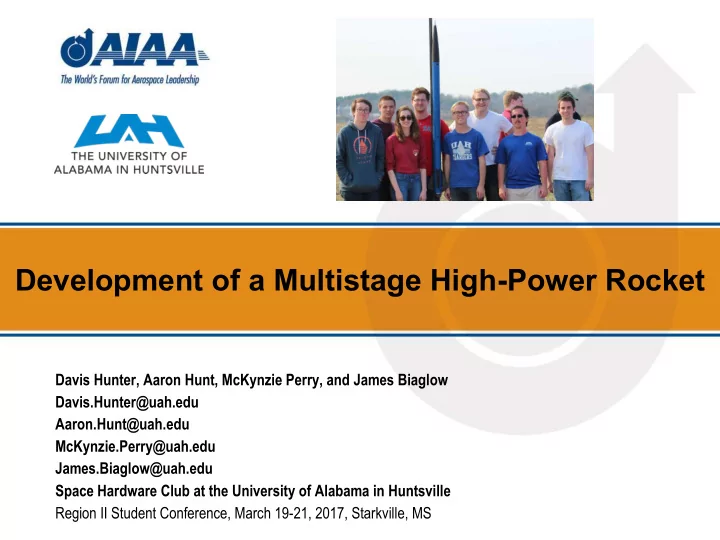
Development of a Multistage High-Power Rocket Davis Hunter, Aaron - - PowerPoint PPT Presentation

development of a multistage high power rocket
SMART_READER_LITE
LIVE PREVIEW

Development of a Multistage High-Power Rocket Davis Hunter, Aaron - - PowerPoint PPT Presentation

Development of a Multistage High-Power Rocket Davis Hunter, Aaron Hunt, McKynzie Perry, and James Biaglow Davis.Hunter@uah.edu Aaron.Hunt@uah.edu McKynzie.Perry@uah.edu James.Biaglow@uah.edu Space Hardware Club at the University of Alabama in


slide-1
SLIDE 1

Development of a Multistage High-Power Rocket

Davis Hunter, Aaron Hunt, McKynzie Perry, and James Biaglow Davis.Hunter@uah.edu Aaron.Hunt@uah.edu McKynzie.Perry@uah.edu James.Biaglow@uah.edu Space Hardware Club at the University of Alabama in Huntsville Region II Student Conference, March 19-21, 2017, Starkville, MS

slide-2
SLIDE 2

Project URSA

  • Project Goal
  • Design, manufacture,

test, and fly a high powered rocket with two stages to at least 30,000 feet

The Team:

Sparky Shelton Team Manager

Davis Hunter

Chief Engineer

McKynzie Perry

Subsystem Lead

Aaron Hunt

Subsystem Lead

Upper Stage Lower Stage

Brendan Luke Jacob Zilke Mike Zaluki

Manufacturing Liaisons

James Biaglow Nick Jordan Kyle Renfroe Daniel Dorey

2

slide-3
SLIDE 3

Concept of Operations

# Event Initial Altitude (feet)

  • Max. Velocity

(ft/s Mach#) 1 Combined Powered Ascent 3,370 0.93 2 Separation 2,750 3,000 0.83 3 Initial Coast 3,000 3,000 0.83 4 2nd Stage Powered Ascent 6,650 6,330 1.77 5 Coast to Apogee 11,000 6,200 1.74 6a Sustainer Deploy 31,200 175 . 6b Booster Deploy 6,250 94 . 7 Main Deploy 1,000 ~25 .

1 4 3 2 6 a 7 6b 5

3

slide-4
SLIDE 4

System Overview

  • Full System

▪ Total Length - 144 in ▪ Total Mass - 16,318 g ▪ Simulated Apogee - 31,232 ft ▪ Simulated Top Speed - 6,330 ft/s (Mach 1.77) ▪ Maximum Acceleration - 20.1 G

144” 74” 70”

4

slide-5
SLIDE 5

Airframe Overview

  • Nose Cone

▪ Von Kármán Profile ▪ Section of Sears-Haack Body ▪ Optimized for Supersonic Flight

  • Body Tubes

▪ G12 Fiberglass ▪ Sustainer - 0.1 inch thickness ▪ Booster - 0.125 inch thickness

5

slide-6
SLIDE 6

Airframe Overview Cont.

  • Fins

▪ Carbon Fiber Fins ▪ 1/16th inch thickness ▪ ABS Fin Brackets ▪ Aluminum bolts

6

  • Boattail

▪ 3D Printed ABS ▪ Decreases pressure drag significantly ▪ Contains wiring for second stage ignition

slide-7
SLIDE 7

Motors

  • Sustainer

▪ Aerotech L1090 ▪ 6 grain 54mm ▪ Solid NH4ClO4 and White Thunder ▪ 4% L (Level 2)

  • Booster

▪ Aerotech M1780 ▪ 4 grain 75mm ▪ Solid NH4ClO4 and Mojave Green ▪ 8% M (Level 3)

Thrust curves courtesy of thrustcurve.org

7

slide-8
SLIDE 8

Motor Seating

  • Forward Motor

Retention System

▪ Tapped forward closure ▪ Eyebolt inserted through retention bulkhead ▪ Bulkhead bolted into airframe

  • Centering Rings

▪ CNC machined polycarbonate ▪ Eliminate need for motor tube

8

slide-9
SLIDE 9

Recovery

  • Drogue Parachutes

▪ Deploy at apogee of each stage ▪ Booster - 12 inches, 70 ft/s descent rate ▪ Sustainer - Drogue-less, 175 ft/s descent rate

  • Main Parachutes

▪ Deploy at 1,000 feet AGL ▪ Booster - 60 inches, 27 ft/s descent rate ▪ Sustainer - 60 inches, 22 ft/s descent rate

9

slide-10
SLIDE 10

Finite Element Analysis of Load Path Components

  • Thrust Plates

▪ Yield Stress of 1060 Aluminum: 40 ksi ▪ Force: thrust of each motor in lbf ▪ Sustainer: – Maximum Stress 6.5 ksi ▪ Booster – Maximum Stress 3.2 ksi

  • Transition

▪ Yield Stress of ABS Plastic: 4.5 ksi ▪ Force: max acceleration * mass of sustainer + weight of sustainer ▪ Maximum Stress: 0.438 ksi

Transition under 169 lbf Sustainer Thrust Plate under 334 lbf 10

slide-11
SLIDE 11

Transition Breakdown

  • Transition Components

▪ ABS Aerobowl (Blue)

▪ ABS Piston Plate (White) ▪ Ejection Charge Plate (Grey)

  • Dimensions

▪ A- 3.000 inches ▪ B- 2.062 inches ▪ C- 6.925 inches A B C

11

slide-12
SLIDE 12

Sustainer Ignition Component Overview

  • Sustainer Ignition

▪ Pyrogen Igniter (orange)

▪ Nylon Male/Female Connectors (pink/blue) ▪ Wires (red outline)

12

slide-13
SLIDE 13

Separation and Ignition Sequence

The sustainer coasts for a predetermined amount of time before ignition The sustainer motor is ignited by PET timer in avionics package A black powder charge pushes sustainer out of booster.

13

slide-14
SLIDE 14

Second Stage Ignition Delay

  • If the velocity is too

low, the risk of tilt increases

  • Acceptable range

between 3 and 6 seconds

  • Wind conditions on

launch day will be final determining factor

14

slide-15
SLIDE 15

Avionics

Lower Stage

  • Recovery: Two

PerfectFlite Stratologgers

  • Tracking: SPOT

Trace GPS tracker Upper Stage

  • Recovery: Two PerfectFlite

Stratologgers

  • Staging: Two MissileWorks

PET 2+ Timers

  • Tracking: SPOT Trace

GPS tracker

15

slide-16
SLIDE 16

CNC Machining

  • Haas VF-1 CNC Mill
  • Coupler bulkheads,

centering rings, thrust plates, retainer bulkheads, and nose cone tip

Manufacturing

Additive Manufacturing

  • Stratasys Fortus 360mc
  • Avionics sled, fin

brackets, boattails, and transition assembly

16

slide-17
SLIDE 17

Testing

  • Ground Testing

▪ Recovery ejection ▪ Transition – Binding and charge

  • Flight Testing

▪ Upper Stage validation

– Confirmed accuracy of sims – Validated hardware at Mach 0.93

▪ Boosted dart – Will fly using 1st stage final motor

– Validate lower stage and staging event

17

slide-18
SLIDE 18

Acknowledgments

This project would not be possible without:

  • Club Advisor

  • Dr. Francis Wessling, UAH MAE department
  • Project Funding

  • Dr. John Gregory & Alabama Space Grant

Consortium ▪

  • Dr. Mahalingam, Dean of the UAH College of

Engineering

  • Team Members

▪ Sparky Shelton, Mike Zaluki, Brendan Luke, Jacob Zilke, Kyle Renfroe, Nick Jordan, Daniel Dorey

  • Manufacturing Advisor

▪ Steve Collins, UAH Prototyping Specialist

18

slide-19
SLIDE 19

19

The Space Hardware Club at UAH is a volunteer student organization dedicated to the design, development, fabricating, testing, and flying of student engineering and science hardware, to make students better engineers. Find out more about SHC Projects, and how you can help, at space.uah.edu.

Davis Hunter Davis.Hunter@uah.edu McKynzie Perry McKynzie.Perry@uah.edu James Biaglow James.Biaglow@uah.edu Aaron Hunt Aaron.Hunt@uah.edu

Development of a Multistage High-Power Rocket

19