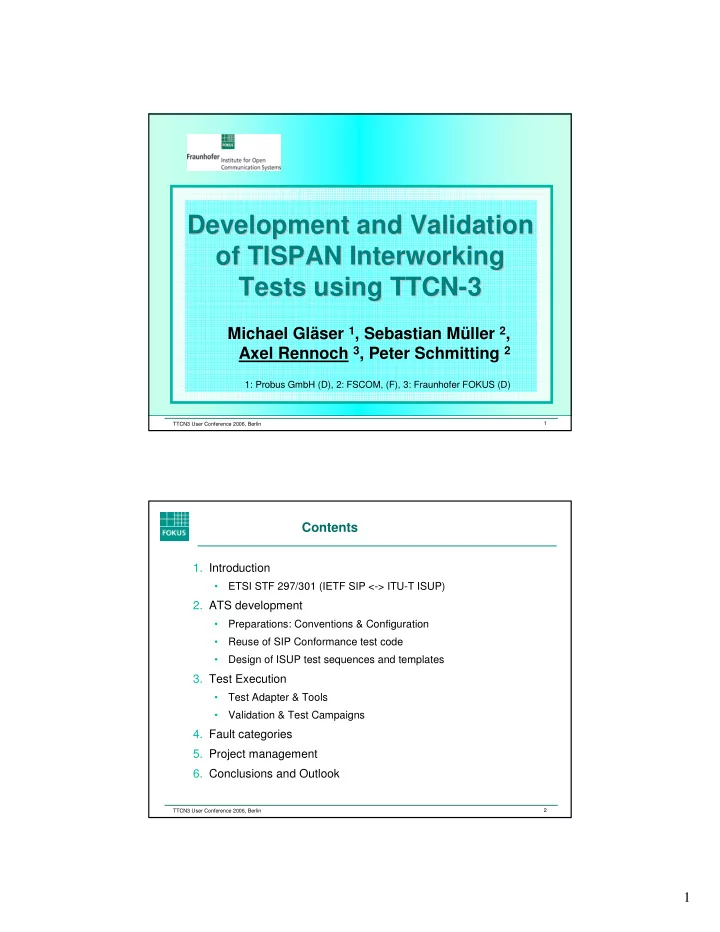
Development and Validation Development and Validation of TISPAN - - PDF document

development and validation development and validation of
SMART_READER_LITE
LIVE PREVIEW

Development and Validation Development and Validation of TISPAN - - PDF document

Development and Validation Development and Validation of TISPAN Interworking of TISPAN Interworking Tests using TTCN- -3 3 Tests using TTCN Michael Glser 1 , Sebastian Mller 2 , Axel Rennoch 3 , Peter Schmitting 2 1: Probus GmbH (D), 2:


slide-1
SLIDE 1

1

TTCN3 User Conference 2006, Berlin 1

Development and Development and Validation Validation

  • f TISPAN Interworking
  • f TISPAN Interworking

Tests using TTCN Tests using TTCN-

  • 3

3

Michael Gläser 1, Sebastian Müller 2, Axel Rennoch 3, Peter Schmitting 2

1: Probus GmbH (D), 2: FSCOM, (F), 3: Fraunhofer FOKUS (D)

TTCN3 User Conference 2006, Berlin 2

Contents

  • 1. Introduction
  • ETSI STF 297/301 (IETF SIP <-> ITU-T ISUP)
  • 2. ATS development
  • Preparations: Conventions & Configuration
  • Reuse of SIP Conformance test code
  • Design of ISUP test sequences and templates
  • 3. Test Execution
  • Test Adapter & Tools
  • Validation & Test Campaigns
  • 4. Fault categories
  • 5. Project management
  • 6. Conclusions and Outlook
slide-2
SLIDE 2

2

TTCN3 User Conference 2006, Berlin 3

TTCN-3 programs are

  • like other software products
  • subject of a development process (incl. validation)

knowledge of the test language notations is not sufficient experiences with larger projects need to be collected & exchanged Motivation

TTCN3 User Conference 2006, Berlin 4

SUT protocol stack

Signalling Gateway between “old” ISDN telephony and IP-based Networks SIP over UDP/TCP ISDN user part over SS7

IP SIP UDP TCP G.703 MTP L2 MTP ISUP Media Gateway Controller / Signalling Gateway INVITE IAM ANM 200 (OK) VoIP ISDN Interworking Unit

slide-3
SLIDE 3

3

TTCN3 User Conference 2006, Berlin 5

TTCN-3 test development process

Naming conventions Module decomposition Test configuration Type system Analysis features TSS & TP PICS Test scenarios [pr, tb, po, def] and templates prototypes + mass production validation activities / test campaigns codec SA ext. fct. ext. libraries

TTCN3 User Conference 2006, Berlin 6

ATS requirements (selection)

  • 1. Top-down design.
  • 2. A uniquely defined testing architecture and test method.
  • 3. Uniform TTCN-3 style and naming conventions.
  • 4. TTCN-3 is human-readability.
  • 5. TTCN-3 specification is compilable and maintainable.
  • 6. Test cases shall be designed to be easily adaptable, upwards

compatible with future releases of the base protocols.

  • 7. The test declarations, data structures and data values shall be largely

reusable.

  • 8. Modularity and modular working method.
  • 9. Minimizing the requirements on the implementation of test adapter

(e.g. external functions). 10.Giving enough design freedom to the test equipment manufacturers.

slide-4
SLIDE 4

4

TTCN3 User Conference 2006, Berlin 7

ATS component ports & configuration

MTC SIP component ISUP component

SIPP ISUP Sync Sync

most important definitions

  • identification of ports and types
  • use of parallel test components?

basic principles:

  • independent behaviour
  • reuse of SIP definitions
  • reuse of IPv6 synchr. lib
  • synchronization via MTC
  • message-based ports

TTCN3 User Conference 2006, Berlin 8

TTCN-3 modules imports - overview

root module of the ATS: test control part Test Excecution Test Cases PICS aux. def. SIP TCfunctions ISUP TCfunctions LibCommon Sync PIXIT SIP steps SIP templates SIP Types ISUP steps ISUP templates ISUP Types LibCommon steps LibCommon templates LibCommon Types

slide-5
SLIDE 5

5

TTCN3 User Conference 2006, Berlin 9

Naming conventions

no rules for identifiers defined within TTCN-3 standards existing rules for the SIP part existing rules from the IPv6 synchronization lib no renaming for available definitions, to keep existing knowledge/adapter all new definitions will use the prefixes approach used in the IPv6 ATS in praxis prefixes and suffixes are often used, e.g.:

  • f_mystep, f_Sip_TC_101_001
  • v_myvariable, c_myconst
  • m_mytemplate, mw_mytemplate
  • ...

follow your own rules suitable for your project, depending on existing standards etc.

TTCN3 User Conference 2006, Berlin 10

LibCommon Sync

  • source STF 276 (IPv6 project)
  • TTCN-3 framework
  • set of TTCN-3 functions to e.g.
  • start and control parallel components,
  • exchange synronization signals between components
  • set of charstring constants for synchronization points:

„preambleDone“, „sync1“, „sync2“, ... , „testbodyDone“

  • predefined timers e.g. to avoid deadlocks at

synchronization points

slide-6
SLIDE 6

6

TTCN3 User Conference 2006, Berlin 11

SIP related part

  • reuse / benefit of STF270 work (snapshot Sep. 2005)
  • initial idea: import of existing definitions
  • problem:
  • some definitions need to be extended:

SIP component, data structures (sets, records etc.)

  • problem: ETSI SIP ATS has been changed end of 2005
  • insufficient SDP type definition (one „charstring“ only):

needs to be analysed, composed/modified

TTCN3 User Conference 2006, Berlin 12

ISUP related part

  • no preconditions
  • simple design:

a pair of functions for sending/receiving each message type: f_send_ACM, f_awaiting_ACM

  • systematic approach for test data
  • generation of stereotype template definitions for all messages and

parameters using PIXIT entries for outgoing and incoming values

  • manual refinements
  • use of microsoft word macros for automatic production of TTCN-3

code for templates and test behaviour skeletons

slide-7
SLIDE 7

7

TTCN3 User Conference 2006, Berlin 13

TTCN-3 behaviour generation

f_awaiting_IAM(mw_IAM_USI(mw_USI_Std(mw_USIContents_Std(?, c_USI_userInfoL1_ALaw)) ifpresent)); /*Send default ACM message*/ f_send_ACM(m_ACM_MSG_Def, true); /*Send default ANM message*/ f_send_ANM(m_ANM_MSG_Def, true); // Check Conversation f_IsupBicc_CheckConversation(); /*Await default REL message*/ f_awaiting_REL(mw_REL_MSG_Def); /*Send default RLC message*/ f_send_RLC(m_RLC_MSG_Def, true);

SIP SUT ISUP INVITE > > IAM 180 Ringing > > ACM 200 OK INVITE > > ANM Conversation BYE > > REL 200 OK BYE > > RLC TP101009

IN OUT

TTCN3 User Conference 2006, Berlin 14

Test case sample

testcase TC_101_001(inout CSeq loc_CSeq_s) runs on ServerSyncComp system TestAdapter { //Variables var SipComponent v_sipComponent ; var IsupBiccComponent v_isupBiccComponent ; f_cf00Up(v_sipComponent, v_isupBiccComponent); //Start f_IncCSeq(loc_CSeq_s); v_sipComponent.start(f_Sip_TC_101_001(loc_CSeq_s)); v_isupBiccComponent.start(f_IsupBicc_TC_101_001()) ; // synchronize both PTCs on 3 sychronization points f_serverSync2ClientsAndStop({c_prDone, c_sync1, c_tbDone}); f_cfTwoPtcsDown(v_sipComponent, v_isupBiccComponent); } // end TC_101_001

slide-8
SLIDE 8

8

TTCN3 User Conference 2006, Berlin 15

System Adapter & CoDec

  • reuse of the SIP Codec
  • High investigation for the production of the adapter
  • SA has to satisfy assumptions made in the TTCN-3 spec:

external functions (e.g. on ISUP/BICC distinction)

TTCN3 User Conference 2006, Berlin 16

Test Validation Environment

SIP Codec SIP System Adaptor System Under Test

TTCN-3 test executable

Catapult

ISUP SA

TCP connection LAN

slide-9
SLIDE 9

9

TTCN3 User Conference 2006, Berlin 17

Fault categories

ATS:

  • unexpected messages due to incomplete test purpose description
  • SIP messages retransmisisons (due to test system late answer):

extension of default

  • incorrect component synchronization (e.g. missing in one component)
  • change of TTCN-3 semantic (str2oct -> char2oct)

SA/Codec

  • incomplete message types:

e.g. incorrect SIP message ignored by SUT SUT

  • missing feature implementation

TTCN3 User Conference 2006, Berlin 18

TTCN-3 tools

various Test development environments:

  • comfortable editor:

syntax support (highlight, formating), navigator, outline

  • use of different compilers at ETSI helps to identify problems

(e.g. differences on warning/error rating) TestingTech Test execution management: due to environment at validation lab + data and graphical sequence result analysis

  • long compilation time due to big ATS size (up to 15 min!)
  • test case parameter use need implementations within SA
slide-10
SLIDE 10

10

TTCN3 User Conference 2006, Berlin 19

Project management Test suite volume: 357 test cases ATS development:

  • STF297: 98 mandays
  • up to four persons in parallel

ATS validation:

  • STF301: 50 mandays
  • 19 lab days involving three persons

TTCN3 User Conference 2006, Berlin 20

Project experiences

Test purpose description quality is key issue

  • corrections reported to ETSI TISPAN WG6

System Adapter is an essential working item

  • SA validation requires ATS (parallel process)

high time pressure due to limited resources

  • some quality impact!

never trust an ATS without validation activities transparent and suitable tests campaign, but high investigations

slide-11
SLIDE 11

11

TTCN3 User Conference 2006, Berlin 21

Conclusions & proposals

complete TTCN-3 development process reuse of synchronization library but limited reuse of SIP conf. ATS abstract test suites are (frameworks) that could be extended by the customers possible improvements: core language: overloading of TTCN-3 functions tools:

detect/remove (un)used definitions advanced tools features to support manual development steps: structured template creation and maintenance, naming conventions etc. debugger to avoid “log” statements!

TTCN3 User Conference 2006, Berlin 22

Future outlook

STF 306: Interworking SIP ./. ISDN test suite (basic call, suppl. service partly) development and validation 4 persons, 150 man days May - Nov 2006 continuation planned in 2007 (complete TP list) improvements reformation of “old” SIP ATS conventions refined SDP type system

slide-12
SLIDE 12

12

TTCN3 User Conference 2006, Berlin 23

Martin Brandt (ETSI TISPAN WG6) Andrej Ciglic (Iskratel Ltd.) & Team Antony Wiles (ETSI PTCC)

Thank you !