SLIDE 1
1
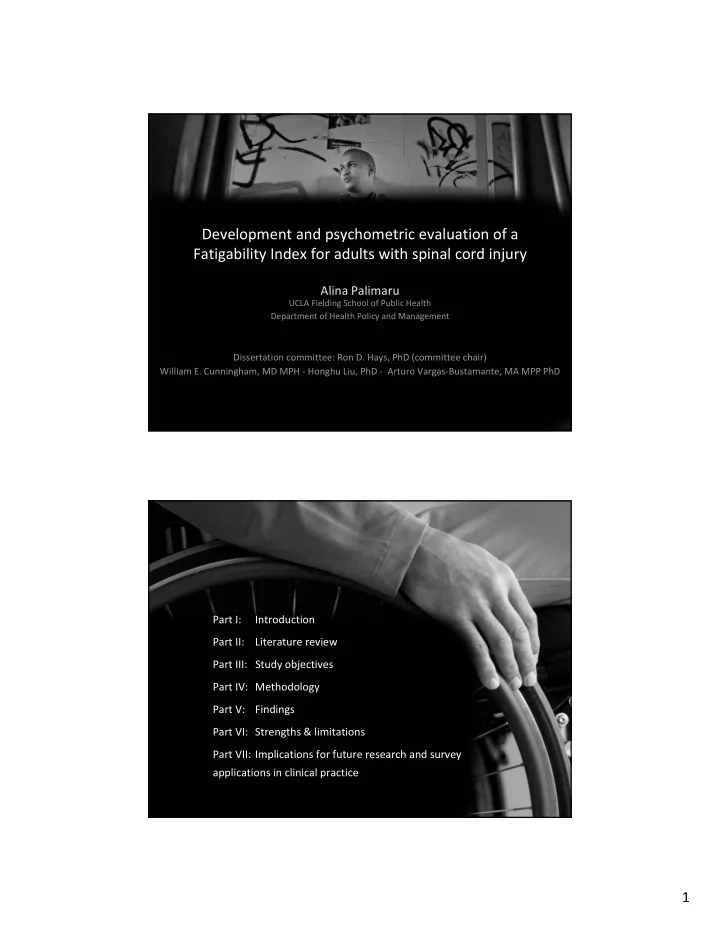
Development and psychometric evaluation of a Fatigability Index for adults with spinal cord injury
Alina Palimaru
UCLA Fielding School of Public Health Department of Health Policy and Management
Dissertation committee: Ron D. Hays, PhD (committee chair) William E. Cunningham, MD MPH ‐ Honghu Liu, PhD ‐ Arturo Vargas‐Bustamante, MA MPP PhD
Part I: Introduction Part II: Literature review Part III: Study objectives Part IV: Methodology Part V: Findings Part VI: Strengths & limitations Part VII: Implications for future research and survey applications in clinical practice
SLIDE 2
2
Part I: Introduction Why study fatigue in spinal cord injury? Approximately 300,000 individuals with SCI in the US, and about 40,000 in the UK SCI patients typically require long‐term and evolving care Fatigue is a significant issue in SCI The impact of fatigue will depend on clinical problems, environmental, and lifestyle characteristics Perceptions of fatigue are important in rehabilitation medicine Part I: Introduction Key Definitions Fatigue: “A subjective lack of physical and/or mental energy that is perceived by the individual or caregiver to interfere with usual or desired activities”*
* National Institutes of Health, 2015
SLIDE 3 3
Part I: Introduction Key Definitions Physical Fatigue:
- Reduced function due to wear or disease
(tiredness and weakness are symptoms of fatigue)
- Fatigue is a progressive state that may
increase in severity over time.
- Tiredness may be ameliorated by a
reduction in fatigue‐inducing activity (e.g. rest)
- Weakness may be reduced by:
exercise (e.g. fitness training) augmentation (e.g. medical supports) repair (e.g. hip replacement) Part I: Introduction Key Definitions Mental Fatigue:
- Reduced mental function due to
Perceived high level of stress Worries about the future Perceived need for extensive logistical planning Perceived bureaucratic burden
SLIDE 4 4
Part I: Introduction Key Definitions Fatigability:
- “Characteristic describing an
individual’s susceptibility to experiencing fatigue for a given quantifiable demand”*
* National Institutes of Health, 2015
Part I: Introduction Key Definitions Fatigability:
- The measure of an individual’s
susceptibility to fatigue resulting from activities in which they participate.
SLIDE 5 5
*Hammell et al., 2009. Fatigue and spinal cord injury: a qualitative analysis. Spinal Cord, 47, 44‐49. **Palimaru et al., 2017. A comparison of perceptions of quality of life among adults with spinal cord injury in the United States versus the United Kingdom. Manuscript under review.
Part II: Literature Review
- Fatigue research in this population has been
limited
- Factors associated with fatigue:
- Pain, depression, medication side‐effects
sleeplessness, spasticity, poor posture diet, daily functioning tasks*
- Distinction between physical and mental
fatigue**
- Absence of fatigue from discussions between
medical providers and patients**
- Need for an SCI‐specific fatigability survey**
Part II: Literature Review
*Anton et al., 2008. Measuring fatigue in persons with spinal cord injury. Arch Phys Med Rehabil, 89(3): 538‐542.
Fatigue Severity Scale*: 1. My motivation is lower when I am fatigued. 2. Exercise brings on my fatigue. 3. I am easily fatigued. 4. Fatigue interferes with my physical functioning. 5. Fatigue causes frequent problems for me. 6. My fatigue prevents sustained physical functioning. 7. Fatigue interferes with carrying out certain duties and responsibilities. 8. Fatigue is among my most disabling symptoms. 9. Fatigue interferes with my work, family, and social life. Answer options: Strongly Disagree (1) – Strongly Agree (7)
SLIDE 6 6
Part III: Study Objectives
- Develop a self‐reported Fatigability
Index for adults with spinal cord injury
- Evaluate its psychometric properties:
Reliability & validity (US sample) Reliability & validity (UK sample) Followed ISOQOL standards and recommendations
- Conducted literature review
- Identified existing fatigue and fatigability surveys
- Conducted in‐depth interviews with adults with SCI
- Drafted survey items with expert input
- Drafted two scales: Physical & Mental Fatigability
- Conducted cognitive interviews (n=8)
- Conducted field test (n=464)
- Completed psychometric analyses
Part IV: Methodology Survey Development Overview
SLIDE 7 7
Part IV: Methodology Cognitive Interviews
- Conducted by phone
- Participants had all four types of injury
(NUS=4; NUK=4)
- Changes after first three interviews:
Order and phrasing of several items Wrote and added two new items
- Changes after two more interviews:
Adjusted answer range
- Last three interviews resulted in no changes
Part IV: Methodology Cognitive Interviews (Continued)
- Survey formatting based on cognitive design
principles*
- Assessment of items’ reading ease**
Flesch‐Kincaid (F‐K) Grade Level scale Flesch Reading Ease (FRE) scale
* *Mullin et al. (2000). Applying cognitive design principles to formatting HRQOL instruments. Quality of Life Research, 9, 13‐27. **Paz et al. (2009). Readability estimates for commonly used health‐related quality of life surveys. Quality of Life Research, 18, 889‐900.
SLIDE 8 8
Part IV: Methodology Cognitive Interviews (Continued)
Mean, median, standard deviation, and range of item readability scores Scale Score Mean (95% CI) SD Median Range Physical Fatigability F‐K without answers 6.11 (5.9‐6.4) 0.83 6.17 4.84‐8.02 F‐K with answers 9.04 (8.9‐9.2) 0.57 9.08 8.18‐10.36 FRE without answers 67.38 (65.6‐69.1) 5.71 67.44 52.86‐76.27 FRE with answers 53.47 (52.2‐54.7) 3.96 53.66 43.41‐60.47 Mental Fatigability F‐K without answers 5.67 (5.4‐5.9) 0.84 5.75 4.33‐7.59 F‐K with answers 8.73 (8.6‐8.9) 0.58 8.79 7.84‐10.05 FRE without answers 70.5 (68.8‐72.3) 5.72 70.46 56.25‐79 FRE with answers 55.67 (54.5‐56.9) 3.94 55.83 45.7‐62.44
Part IV: Methodology 82‐Item Fatigability Pool
Physical and Mental Fatigue (PF/MF) Item Pool ItemID Item Stem and Item Content Health During the past 4 weeks did you experience each of the following? If so, how much physical & mental fatigue did each cause you? PF&MF Hlth1 Sleep problems PF&MF Hlth2 Pain PF&MF Hlth3 Indigestion problems PF&MF Hlth4 Dehydration problems PF&MF Hlth5 Poor posture PF&MF Hlth6 Spasticity PF&MF Hlth7 Stress PF&MF Hlth8 Medication side‐effects
SLIDE 9 9
Part IV: Methodology 82‐Item Fatigability Pool (Continued)
Physical and Mental Fatigue (PF/MF) Item Pool ItemID Item Stem and Item Content Home environment During the past 4 weeks did you experience each of the following? If so, how much physical & mental fatigue did each cause you? PF&MF Envr1 Lack of peace and quiet PF&MF Envr2 Inadequately adapted home PF&MF Envr3 Inadequate medical care when at home PF&MF Envr4 Inadequate non‐medical care when at home
Part IV: Methodology 82‐Item Fatigability Pool (Continued)
Physical and Mental Fatigue (PF/MF) Item Pool ItemID Item Stem and Item Content Activities at home During the past 4 weeks did you experience each of the following? If so, how much physical & mental fatigue did each cause you? PF&MF Home1 Wheelchair transfer to and from bed PF&MF Home2 Sitting in a wheelchair for an hour or more PF&MF Home3 Concentrating for an hour or more (such as reading, writing, or holding a conversation) PF&MF Home4 Using a computer for an hour or more PF&MF Home5 Wheelchair use around the home PF&MF Home6 Spending all day in your wheelchair PF&MF Home7 Pressure management (preventing pressure sores) PF&MF Home8 Posture management PF&MF Home9 Household chores, such as cleaning and tidying PF&MF Home10 Preparing and clearing away a meal PF&MF Home11 Eating a meal PF&MF Home12 Letter‐writing, form filling or paying bills
SLIDE 10 10
Part IV: Methodology 82‐Item Fatigability Pool (Continued)
Physical and Mental Fatigue (PF/MF) Item Pool ItemID Item Stem and Item Content Activities away from home During the past 4 weeks did you experience each of the following? If so, how much physical & mental fatigue did each cause you? PF&MF Away1 Wheelchair use over a smooth surface PF&MF Away2 Wheelchair use over an uneven surface PF&MF Away3 Wheelchair transfer to and from car PF&MF Away4 Traveling in your vehicle for an hour or more PF&MF Away5 Using an adapted taxi PF&MF Away6 Using a bus PF&MF Away7 Using a train PF&MF Away8 Receiving a session of physiotherapy PF&MF Away9 Going to a doctor's appointment PF&MF Away10 Shopping, such as having access and reaching merchandise PF&MF Away11 Going out to a restaurant PF&MF Away12 Attending an event, such as cinema, theater, or a show PF&MF Away13 Visiting friends PF&MF Away14 Attending a sporting event PF&MF Away15 Taking a day trip away from home PF&MF Away16 Taking an overnight trip away from home PF&MF Away17 Taking a vacation away from home
Data collection: calibration (field‐test) sample
- Non‐probability (convenience) sample
- Recruited nationally through
Print advertisements Online advertisements Paid ad campaign on Facebook
- All respondents chose to complete survey online
- No remuneration provided for participation
- Final US sample: N=464
Part IV: Methodology
SLIDE 11 11
Data Analysis: Missing Data
- Inappropriately missing data were 5.6%
- Appropriately missing data 21%
Using adapted taxi; bus; and train Receiving physiotherapy Attending a sporting event Taking a vacation away from home Inadequate medical care when at home Inadequate non‐medical care when at home Dehydration problems Part IV: Methodology Data Analysis: Categorical Confirmatory Factor Analysis
- Hypothesized data structure for Physical
Fatigability Health challenges Seating challenges Daily living challenges Mental tasks Social challenges Environmental challenges Use of public transit Long‐distance travel Part IV: Methodology
SLIDE 12 12
Data Analysis: Categorical Confirmatory Factor Analysis (continued)
- Hypothesized data structure for Mental
Fatigability Health challenges Activities at home Environmental challenges Activities away from home Part IV: Methodology Data Analysis: Categorical Confirmatory Factor Analysis (continued)
- Weighted least squares with mean and variance
adjustment (WLSMV) estimation
- Specified correlations among the domains
(factors)
- No correlations among the item error variances
- Model fit indices:
RMSEA < 0.06; CFI > 0.95; TLI > 0.95
- Estimated item means, standard deviations,
corrected item‐total correlations, and coefficient alpha
Part IV: Methodology
SLIDE 13 13
Data Analysis: Item Response Theory – Graded Response Model
- Assessed assumptions: local independence and
monotonicity
- Assessed item fit using Pearson chi‐square test
- Differential item functioning based on injury
level and gender Fitted model with freely estimated slope and difficulty parameters Fitted constrained model with parameters equal across all groups Wald chi‐square statistic of the model contrasts (p < 0.05) Part IV: Methodology Part V: Findings Calibration Sample Clinical Characteristics
Calibration sample participant characteristics (N=464)
Time Since Injury (Mean, SD) 13 (12) Spinal Cord Diagnosis (%) Complete paraplegia 139 (30) Incomplete paraplegia 149 (32) Complete quadriplegia 70 (15) Incomplete quadriplegia 106 (23) Type of Wheelchair Used (%) Manual (I self‐propel) 321 (69) Manual (I am pushed) 39 (8) Power chair 160 (34)
SLIDE 14 14
Part V: Findings Calibration Sample Demographic Characteristics
Table 5. Calibration sample participant characteristics (N=464)
Age (Mean years, SD) 45 (12) Sex (%) Male 222 (48) Female 242 (52) Ethnicity (%) Hispanic 16 (3) Race (%) White 424 (91) Black or African American 14 (3) Asian 6 (1) Native Hawaiian or Other Pacific Islander ‐ ‐ American Indian or Alaska Native 5 (1) Other 14 (3) Living Arrangements (%) Alone with no caregiver support 70 (15) Alone but with visiting caregiver support 62 (13) With a live‐in caregiver who is a family member 213 (46) With a live‐in caregiver who is not a family member 7 (2) With someone who is not your caregiver 111 (24) In a nursing home ‐ ‐ In some other living arrangement 1 (0.2)
Part V: Findings Calibration Sample Demographic Characteristics (Continued)
Table 5. Calibration sample participant characteristics (N=464)
Education (%) 8th grade or less 44 (9) Some high school, but did not graduate 10 (2) High school graduate or GED 60 (13) Some college or 2‐year degree 162 (35) 4‐year college graduate 104 (22) More than 4‐year college degree 84 (18) Employment Status (%) Full‐time paid work (30 or more hours a week) 61 (13) Full‐time voluntary work (less than 30 hours a week) ‐ ‐ Part‐time paid work (30 or more hours a week) 48 (10) Part‐time voluntary work (less than 30 hours a week) 51 (11) Not working, but seeking work 14 (3) Not working due to disability 210 (45) Student 33 (7) Retired 46 (10) Worries about financial situation (%) All the time 187 (40) Occasionally 162 (35) Rarely 90 (20) Never 23 (5)
SLIDE 15 15
Part V: Findings Physical Fatigability Preliminary Analysis and Dimensionality
- Hypothesized eight‐factor model was a poor fit
RMSEA=0.091; CFI=0.833; TLI=0.841
- New hypothesized six‐factor model:
Health challenges; Seating challenges; Mental tasks Access challenges; Daily living challenges; Social challenges
- Dropped 6 items based on factor loadings < 0.30 and R2 < 0.10
- Better fit: RMSEA=0.063; CFI=0.942; TLI=0.951
Part V: Findings Physical Fatigability Preliminary Analysis and Dimensionality (Continued)
- Factor loadings for all 35 items were statistically significant
- Standardized loadings ranged from 0.378 to 0.921
- 30 items had loadings higher than 0.50
- 23 items had loadings higher than 0.70
- R2 ranged from 0.14 to 0.84
- R2 for 22 items was greater than 0.50
- No item pairs with residual correlations higher than 0.20
SLIDE 16
16
Part V: Findings Physical Fatigability: Preliminary Analysis and Dimensionality (Continued) Domain Name Cronbach’s α Corrected item‐total correlation range Health challenges 0.757 0.370 – 0.652 Seating challenges 0.833 0.568 – 0.736 Mental tasks 0.817 0.551 – 0.768 Daily living challenges 0.868 0.379 – 0.712 Social challenges 0.862 0.641 – 0.754 Access challenges 0.920 0.569 – 0.830 Part V: Findings Physical Fatigability: Item Response Theory Assumptions
SLIDE 17 17
Part V: Findings Physical Fatigability: Item Response Theory Parameters and Model Fit
- Slopes (discrimination parameters) ranged from 0.77 to 2.90
- Thresholds (difficulty parameters) ranged from ‐2.81 to 3.98
- All but one item had adequate fit (PFHome7: Pressure
management)
- Marginal reliability was equal to 0.92
Part V: Findings Physical Fatigability: Test Information Function
SLIDE 18
18
Part V: Findings Physical Fatigability: Test Characteristic Curve Part V: Findings Physical Fatigability: Category Characteristic Curves
SLIDE 19
19
Part V: Findings Physical Fatigability: Category Characteristic Curves Part V: Findings Physical Fatigability: Differential Item Functioning 12 items flagged in at least one category Sleep problems; indigestion problems; spasticity; stress; medication side‐effects; lack of peace and quiet; inadequately adapted home; inadequate medical care when at home; inadequate non‐medical care when at home; wheelchair transfer to and from bed; sitting all day in wheelchair; posture management.
SLIDE 20 20
Part V: Findings Physical Fatigability: Construct Validity
Physical Fatigability scale means (SE) by validity variables: F statistic (p value)
Scale Means (SD) Complete Paraplegia Incomplete Paraplegia Complete Quadriplegia Incomplete Quadriplegia Health challenges 9.34 (3.524) 8.79 (0.319) 10.92 (0.257) 7.94 (0.416) 8.75 (0.288) 9.89 (0.212) 8.43 (0.241) Seating challenges 4.74 (2.624) 5.00 (0.256) 5.32 (0.209) 4.57 (0.157) 3.71 (0.247) 5.16 (0.164) 4.05 (0.164) Daily living challenges 9.48 (5.102) 8.94 (0.417) 11.98 (.427) 8.03 (0.431) 7.63 (0.457) 10.51 (0.311) 7.79 (0.324) Mental tasks 2.91 (2.103) 2.99 (0.190) 3.41 (0.180) 2.43 (0.176) 2.42 (0.192) 3.21 (0.131) 2.42 (0.135) Social challenges 4.47 (2.844) 3.99 (0.273) 5.71 (0.220) 3.14 (0.249) 4.25 (0.223) 4.88 (0.181) 3.81 (0.171) Access challenges 12.73 (5.871) 11.81 (0.499) 15.83 (0.496) 10.97 (0.418) 10.75 (0.496) 13.89 (0.371) 10.84 (0.341)
Part V: Findings Mental Fatigability: Preliminary Analysis and Dimensionality
- Hypothesized four‐factor model was a poor fit
RMSEA=0.101; CFI=0.766; TLI=0.785
- New hypothesized four‐factor model:
Health challenges; Daily living challenges; Mental tasks; Access challenges
- Dropped 4 items based on factor loadings < 0.30 and R2 < 0.10
- Better, but not optimal, fit: RMSEA=0.080; CFI=0.901; TLI=0.929
SLIDE 21 21
Part V: Findings Mental Fatigability: Preliminary Analysis and Dimensionality (Continued)
- Factor loadings for all 37 items were statistically significant
- Standardized loadings ranged from 0.368 to 0.942
- 31 items had loadings higher than 0.50
- 15 items had loadings higher than 0.70
- R2 ranged from 0.14 to 0.89
- R2 for 15 items was greater than 0.50
- No item pairs with residual correlations higher than 0.20
Part V: Findings Mental Fatigability: Preliminary Analysis and Dimensionality (Continued) Domain Name α Corrected item‐total correlation range Health challenges 0.716 0.361 – 0.521 Mental tasks 0.727 0.309 – 0.731 Daily living challenges 0.874 0.490 – 0.666 Access challenges 0.914 0.391 – 0.738
SLIDE 22
22
Part V: Findings Mental Fatigability: Item Response Theory Assumptions Part V: Findings Mental Fatigability: Item Response Theory Parameters and Model Fit Slopes (discrimination parameters) ranged from 0.46 to 3.95 Thresholds (difficulty parameters) ranged from ‐3.93 to 3.99 All but one item had adequate fit (MFAway6: Using a bus) Marginal reliability was equal to 0.93
SLIDE 23
23
Part V: Findings Mental Fatigability: Test Information Function Part V: Findings Mental Fatigability: Test Characteristic Curve
SLIDE 24
24
Part V: Findings Mental Fatigability: Category Characteristic Curves Part V: Findings Mental Fatigability: Category Characteristic Curves
SLIDE 25 25
Part V: Findings Mental Fatigability: Differential Item Functioning Eight items flagged in at least one category Pain; stress; medication side‐effects; inadequately adapted home; concentrating for an hour or more; sitting all day in wheelchair; household chores; eating a meal Part V: Findings Mental Fatigability: Construct Validity
Mental Fatigability scale means (SE) by validity variables: F statistic (p value)
Scale Means (SD) Complete Paraplegia Incomplete Paraplegia Complete Quadriplegia Incomplete Quadriplegia Health challenges 9.31 (4.205) 8.88 (0.313) 11.42 (0.364) 7.86 (0.343) 7.89 (0.398) 10.19 (0.253) 7.88 (0.275) Daily living challenges 10.90 (7.884) 11.19 (0.715) 13.76 (0.691) 8.60 (0.461) 8.01 (0.665) 12.52 (0.502) 8.24 (0.440) Mental tasks 3.00 (2.369) 2.78 (0.192) 3.83 (0.215) 2.90 (0.216) 2.17 (0.205) 3.32 (0.148) 2.46 (0.152) Access challenges 15.62 (9.949) 13.35 (0.703) 22.02 (0.873) 12.86 (0.788) 11.42 (0.812) 17.83 (0.619) 11.99 (0.582)
SLIDE 26
26
Part VI: Limitations Non‐representative sample Model fit Differential item functioning Part VI: Strengths Items are most informative for those in the mild and moderate range Items are moderately informative for those with extreme fatigability Good discrimination: item category characteristics well‐differentiated for 64 out of 72 items
SLIDE 27
27
Reliability and validity in new UK sample Further testing of items on larger samples Responsiveness over time Short‐form to reduce respondent burden Part VII: Implications for future research Part VII: Survey application in clinical practice Present data in a simple and meaningful way Deliver an instant picture of a person’s susceptibility to fatigue Immediately highlight areas for possible intervention Facilitate comparison between physical and mental fatigue Enable results comparison over time
SLIDE 28 28
ZERO Conceptualized & designed by Marcus Dillistone
ZERO
Conceptualized & designed by Marcus Dillistone
SLIDE 29 29
ZERO
Conceptualized & designed by Marcus Dillistone
ZERO
Conceptualized & designed by Marcus Dillistone
SLIDE 30 30
ZERO
Conceptualized & designed by Marcus Dillistone
ZERO
Conceptualized & designed by Marcus Dillistone
SLIDE 31 31
ZERO
Conceptualized & designed by Marcus Dillistone
ZERO
Conceptualized & designed by Marcus Dillistone
SLIDE 32 32
PHYSICAL FATIGUE
Conceptualized & designed by Marcus Dillistone
PHYSICAL FATIGUE
Conceptualized & designed by Marcus Dillistone
SLIDE 33 33
PHYSICAL FATIGUE
Conceptualized & designed by Marcus Dillistone
PHYSICAL FATIGUE
Conceptualized & designed by Marcus Dillistone
SLIDE 34 34
PHYSICAL FATIGUE
Conceptualized & designed by Marcus Dillistone
PHYSICAL FATIGUE
Conceptualized & designed by Marcus Dillistone
SLIDE 35
35
PHYSICAL FATIGUE PHYSICAL FATIGUE
SLIDE 36 36
PHYSICAL FATIGUE
Conceptualized & designed by Marcus Dillistone
SLIDE 37 37
MENTAL FATIGUE
Conceptualized & designed by Marcus Dillistone
MENTAL FATIGUE
Conceptualized & designed by Marcus Dillistone
SLIDE 38 38
MENTAL FATIGUE
Conceptualized & designed by Marcus Dillistone
MENTAL & PHYSICAL FATIGUE
Conceptualized & designed by Marcus Dillistone
SLIDE 39 39
MENTAL & PHYSICAL FATIGUE
Conceptualized & designed by Marcus Dillistone
Thank you
Alina Palimaru 2017