Development Action Plan Grafting tomato and eggplant M R . U O N B - - PowerPoint PPT Presentation

development action plan
SMART_READER_LITE
LIVE PREVIEW

Development Action Plan Grafting tomato and eggplant M R . U O N B - - PowerPoint PPT Presentation

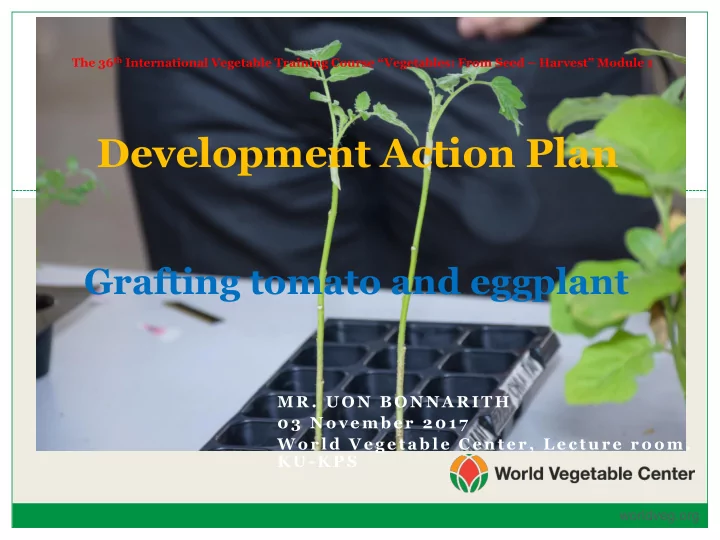
The 36 th International Vegetable Training Course Vegetables: From Seed Harvest Module 1 Development Action Plan Grafting tomato and eggplant M R . U O N B O N N A R I T H 0 3 N o v e m b e r 2 0 1 7 W o r l d V e g e t a b l e C


slide-1
SLIDE 1

worldveg.org

M R . U O N B O N N A R I T H 0 3 N o v e m b e r 2 0 1 7 W o r l d V e g e t a b l e C e n t e r , L e c t u r e r o o m . K U - K P S

Development Action Plan

The 36th International Vegetable Training Course “Vegetables: From Seed – Harvest” Module 1

Grafting tomato and eggplant

slide-2
SLIDE 2

2 of x worldveg.org

Part I Part II

➢ Introduction

▪ Bio Data ▪ Work experience ▪ Project Overview

  • Variety trial
  • ToT to NGO Partner staff on

horticulture and nutrition

  • Home garden demonstration

site

  • Nutrition awareness

▪ The three interested topics

➢ Development Action Plan

▪ Why grafting is selected? ▪ Result ▪ Objective ▪ Methodology

How to do? Where and When?

Materials and treatments

IPM and GAPs technical package

▪ Potential challenges ▪ Activity planning ▪ Budget planning

Content

slide-3
SLIDE 3

worldveg.org

I- Introduction

 Bio Data

➢ Name: Mr. Uon Bonnarith ➢ Education: ▪ Bachelor Degree of Agriculture Science ▪ Master of Business Administrative (MBA) of General Management ➢ Work Experience: ▪ Worked as Vegetable Technician for MAFF ▪ Worked for projects funded by EU, IFAD, ADB and USAID ▪ Current career: staff of WVC for project calls ”Deploying Vegetable

Seed Kits to Tackle Malnutrition in Cambodia”

3 of x

slide-4
SLIDE 4

4 of x worldveg.org

Where is Cambodia?

  • Population: 16, 085,769 (UN Estimates)
  • 80% is doing agriculture
  • Area: 181, 035 square kilometers

Flag of Cambodia

I- Introduction (Con)

slide-5
SLIDE 5

5 of x worldveg.org ➢ Funded by USAID (Burau Food

Security, Washington DC)

➢ Four staff (PM, PC and 2 agriculture

specialists), WVC

➢ Six local NGO Partners ➢ Households reach: 3,537 ➢ Vulnerable households: 3,537

I- Introduction (Con) Project Overview

slide-6
SLIDE 6

6 of x worldveg.org ➢ Child<5 years old supported: 4,576

(2,230 females)

➢ Individual receive agriculture training:

4,581 (3,689 females)

➢ Individual applied technologies: 6,301

(3,868 females)

➢ Private/community organization

supported: 43

I- Introduction (Con) Project Overview

slide-7
SLIDE 7

7 of x worldveg.org

1- Vegetable Trail

  • 12 commodities and 70 varieties were

tested in Siem Reap 2016-2017

  • 19 promising varieties were selected

Technical Supervision

I- Introduction (Con) Project Overview

slide-8
SLIDE 8

8 of x worldveg.org

1- Vegetable Trail Promising variety

I- Introduction (Con) Project Overview

slide-9
SLIDE 9

9 of x worldveg.org

1- Vegetable Trail Promising variety

I- Introduction (Con) Project Overview

slide-10
SLIDE 10

10 of x worldveg.org

1- Vegetable Trail Promising variety

I- Introduction (Con) Project Overview

slide-11
SLIDE 11

11 of x worldveg.org

2- Capacity building to NGO partner staff on horticulture (4 days) Training to NGO partners staff on nutrition (2 days)

I- Introduction (Con) Project Overview

slide-12
SLIDE 12

12 of x worldveg.org

3- Home garden demo site 4- Nutrition activity

I- Introduction (Con) Project Overview

slide-13
SLIDE 13

13 of x worldveg.org

4- Nutrition Awareness

I- Introduction (Con) Project Overview

slide-14
SLIDE 14

14 of x worldveg.org

1- Conservation of plant genetic resource

2- Developing IPM Packages for Major Vegetable Crops

Three topics in Module I found

slide-15
SLIDE 15

worldveg.org

Three topics in Module I found (Con)

3- Vegetable Grafting

15 of x

Practice: 15 plants/14 plants are survival

slide-16
SLIDE 16

16 of x worldveg.org

Problem

The local tomato production is not met the demand (low yielding) ranges from 17- 23t/ha

Cambodia has been importing vegetables such: Pepper, Tomato, Carrot, Onion, Cabbage, Potato, cauliflower from Vietnam every day ranges 200-400 tons (37 tons is tomato)

~150-200 million dollars lose every year Source: Presentation Chan Sophal, Center for Policy Study 2017

Land covered with vegetable production ranges from 43,000-47,000 hectares, tomato is 1,100 hectares Source: Agriculture Census 2013

Farm gate price of tomato 1kg is $0.41, net return is $0.07/s.q.m, high production cost Source: Culculated based on crop budget data from iDE/Lors Thmey PADEE 2017

Problem statement
slide-17
SLIDE 17

17 of x worldveg.org

Why tomato yield is low?

Problem statement

Weather condition

Infected by soil-born diseases, water logging and nematodes

Lack of cultivation technology (improved variety, IPM technical package and GAPs)

Lack of research and extension of tomato crop

➢ Negative Effect

➢ If the problem is not solved it will effect

  • loss of yield and loss of producer’s

profit

  • Unemployment and high rate of

migration

slide-18
SLIDE 18

18 of x worldveg.org

 Enlarge of tomato

production area

 The safe tomato

yielding is consistently increased and get better profit by selling tomato

 Documentation on

tomato grafting will be published and shared to relevant agencies

Result

slide-19
SLIDE 19

19 of x worldveg.org

Objective

 To improve tomato yielding

through applying tomato and eggplant grafting technique, Integrated Pest Management (IPM) and Good Agricultural Practices (GAPs) techniques.

 Where?

1- University of Battambang 2- Shinta Moni farm, Siem Reap

 When? December to May 2018

slide-20
SLIDE 20

20 of x worldveg.org

A- How to do?

 Establish the tomato’s

IPM and GAP technical package

 Organize the training on

tomato and eggplant grafting to 150 students

 Practice on grafting  Carry out the

demonstration field (extension and promotion)

 Organize the field day

Methodology

slide-21
SLIDE 21

21 of x worldveg.org

B- Who will do?

 Technical Support team

1- Mr. Uon Bonnarith, Provincial Coordinator 2- Mr. Pong Samnang, agriculture specialist

 Field Implementing

1- Staff and students of University of Battambang 2- Staff at Shinta Moni farm, Siem Reap province

Methodology

slide-22
SLIDE 22

22 of x worldveg.org

C- Materials

➢ Tomato variety (scion) Makis

F1 and Hawaii (rootstock)

➢ Eggplantroot stock): wild

eggplant

➢ Peat moss for seedling ➢ Materials for chamber ➢ Three treatments will be

testing 1- Tomato graft with tomato 2- Tomato graft with wild eggplant 3- Non grafting tomato

Methodology (Con)

slide-23
SLIDE 23

23 of x worldveg.org

D1- Physical and cultural control

  • Use good planting materials, for

example healthy seedling

  • Cover UV light plastic & insect proof

netting

  • Eliminate the alternative hosts at

surrounding the plot

  • Plough, raise the bed cover the plastic

mulching and good drainage

  • Crop rotation and crop trap (corn for

livebearer) and (solanum viarum, white eggplant) to control tomato fruit worm, Helicoverpa armigera

  • Inter cropping of tomato and marigold

to control root-knock nematode via crop rotation with sun herm (crotalaria)

  • Staking, pruning and weeding

D- IPM and GAP Technical Package

slide-24
SLIDE 24

24 of x worldveg.org

D2- Natural Predator

D- IPM and GAP Technical Package

Predatory bugs can feed on caterpillar pests on various vegetables An effective predators for controlling aphids

slide-25
SLIDE 25

25 of x worldveg.org

D3- Parasitoids

D- IPM and GAP Technical Package

Parasitoid can feed on caterpillar pests on various vegetables

slide-26
SLIDE 26

26 of x worldveg.org

D4- Chemical control

▪ Use botanical

pesticide such need bark extract

▪ Use chemical pesticide

such Thiametoxam to prevent the insects

▪ Use fungicide such

Azoxystrobin to control Fusarium

D- IPM and GAP Technical Package

➢ Active ingredient: Thiametoxam ➢ Trad name: Aktara ➢ PHI: 2 days after spraying ➢ Active ingredient: Azoxystrobin ➢ Trad name: Amistar ➢ PHI: 1-2 days after spraying

slide-27
SLIDE 27

27 of x worldveg.org

D5- Bio-pesticide control

▪ Bio-fungicide: ✓ Trichoderma used to prevent

soil-born diseases, especially “Damping off”

D- IPM and GAP Technical Package

slide-28
SLIDE 28

28 of x worldveg.org

D5- Bio-pesticide control

✓ Beauveria bassiana used to control

sucking insects such aphid, white fly, Thrips

D- IPM and GAP Technical Package

slide-29
SLIDE 29

29 of x worldveg.org

D5- Bio-pesticide control

Bacteria

✓ Bacillus Thuringiensis (Bt) used to

control Lepidoptera Larvae, for example: fruit worm: Helicoverpa zea.

D- IPM and GAP Technical Package

slide-30
SLIDE 30

worldveg.org

Potential challenges

 Insufficient financial support  New technology will take time for grower’s

adaptation (Extension Approach????)

30 of x

slide-31
SLIDE 31

worldveg.org

Activity Planning

Activity Implementation period 2018 Dec Jan Feb Mar April May Consultation with PM and develop the technical package XX Train student of grafting & IPM XX Seedling and grafting X XX Demonstration and trial XX

XXXX

XXXX XXXX

Field mentoring and data collection

XX XXXX

XXXX

XXXX XXXX Organize the field day X Analyze data and report writing XXX XXXX

31 of x

slide-32
SLIDE 32

worldveg.org

Budget Estimation

Items to be spent Amount Estimated $ Supporting for seedling and grafting 01 400.00 Training on grafting technique 01 650,00 Demonstration and field management 02 1,000.00 Organize the field day 02 1,000.00 Unforeseen Lumpsum 150.00 Grand total 3,200.00

32 of x

slide-33
SLIDE 33

33 of x worldveg.org

Laboratory Activity

slide-34
SLIDE 34

worldveg.org

Thank you for your attention!

34 of x

Question and comment?