Developing a Sustainable Remediation Approach for Portland, Oregon - - PowerPoint PPT Presentation

developing a sustainable remediation approach for
SMART_READER_LITE
LIVE PREVIEW

Developing a Sustainable Remediation Approach for Portland, Oregon - - PowerPoint PPT Presentation

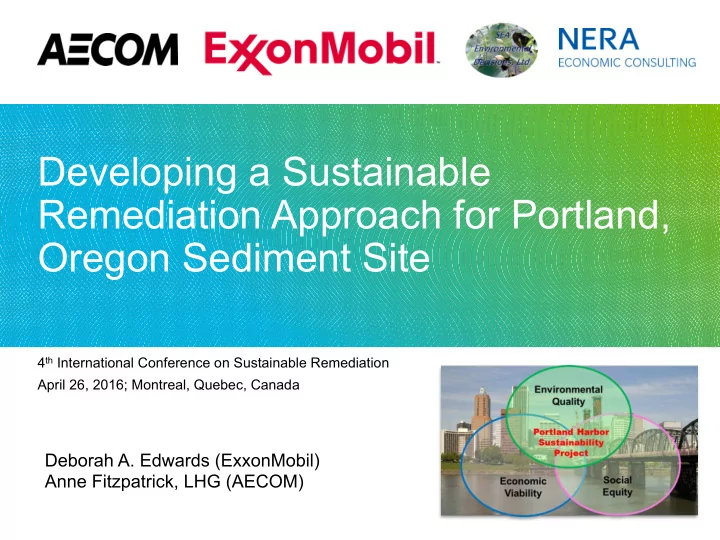
Developing a Sustainable Remediation Approach for Portland, Oregon Sediment Site 4 th International Conference on Sustainable Remediation April 26, 2016; Montreal, Quebec, Canada Deborah A. Edwards (ExxonMobil) Anne Fitzpatrick, LHG (AECOM)


slide-1
SLIDE 1

Developing a Sustainable Remediation Approach for Portland, Oregon Sediment Site

Deborah A. Edwards (ExxonMobil) Anne Fitzpatrick, LHG (AECOM)

4th International Conference on Sustainable Remediation April 26, 2016; Montreal, Quebec, Canada

slide-2
SLIDE 2

Presentation Outline – Background – Portland Harbor Sustainability Project

  • Net Environmental Benefit Analysis (NEBA)
  • Regional Economic Impact Analysis (using REMI model)
  • Social Sustainability Analysis
  • Mapping sustainability metrics to stakeholder values;

identifying trade-offs

– Conclusions & Next Steps

April 26, 2016 Portland Harbor Page 2

Objective: Conduct sustainability analysis of four EPA FS remediation options to assist in selection of the most sustainable remedial option

slide-3
SLIDE 3

Portland Harbor Superfund Site Willamette River; 11 River Miles in Portland, Oregon, US

April 26, 2016 Portland Harbor Page 3

slide-4
SLIDE 4

Sustainability Approach for Sediment Remediation

  • 1. Incorporate environmental metrics into a Net

Environmental Benefit Analysis (NEBA)

  • 2. Conduct regional economic impact analysis with state-of-

the-art REMI Model to compare impacts of EPA alternatives

  • 3. Map environmental, economic and social metrics to

stakeholder values to develop holistic sustainability assessment

  • Identified ~300 community and stakeholder groups; values and

priorities incorporated into assessment

April 26, 2016 Portland Harbor Page 4

This is the first comprehensive sustainability analysis for a sediment remediation project

slide-5
SLIDE 5

EPA Feasibility Study Alternatives

April 26, 2016 Portland Harbor Page 5

Remedial Alternative Total Dredging Capping (acres) EMNR (acres) AECOM Adjusted Cost (Million US $) AECOM Adjusted Construction Time (Years)

Acres Cubic Yards (High)

B 81 818,830 9 103 $1,290 5 D 152 1,563,900 22 88 $1,780 10 E 236 2,748,520 34 59 $2,430 17 F 424 5,843,380 90 24 $3,890 36

slide-6
SLIDE 6

Alternatives Have Increasing Environmental Footprint

April 26, 2016 Portland Harbor Page 6

Relative Impacts – SiteWiseTM Results

Remedial Alternatives GHG Emissions Energy Usage Onsite NOx Emissions Onsite SOx Emissions Onsite PM10 Emissions Total NOx Emissions Total SOx Emissions Total PM10 Emissions *Accident Risk Fatality *Accident Risk Injury Alternative B

Low Low Low Low Medium Low Low Low Low Low

Alternative D

Medium Medium Medium Medium Medium Medium Medium Medium Low Low

Alternative E

Medium Medium Medium Medium Medium Medium Medium Medium Medium Medium

Alternative F

High High High High High High High High High High

0 ¡ 100,000 ¡ 200,000 ¡ 300,000 ¡ 400,000 ¡ 500,000 ¡ 600,000 ¡

Alterna1ve ¡B ¡ Alterna1ve ¡D ¡ Alterna1ve ¡E ¡ Alterna1ve ¡F ¡

Metric ¡Tons ¡

GHG ¡Emissions ¡(CO2, ¡CH4, ¡N2O) ¡

> 52 acres of Douglas Fir needed to sequester 500,000 tons
  • f GHG
slide-7
SLIDE 7

Remedial Construction Will Impact Shoreline Activities

April 26, 2016 Portland Harbor Page 7

EPA Alternative % Overlap of Remedial Footprint with Shoreline Uses B

17%

D

23%

E

33%

F

45%

slide-8
SLIDE 8

Net Environmental Benefit Analysis Aggregates Disparate Metrics to Generate Benefit Scores

– To generate meaningful numbers, and develop a transparent, systematic framework:

  • Score measures using consistent values (e.g., 1-10)
  • Weight measures in terms of certainty or relevance
  • Aggregate/combine scores considering weights

May 4, 2016 Portland Harbor Page 8

Evaluation Criteria Weight Remedial Alternatives and Scores A B D E F

Overall Protectiveness of Human Health and the Environment 25% 2.0 7.5 8.1 8.3 8.0 Permanence 16% 0.0 2.4 2.9 3.6 5.1 Effectiveness Over the Long-Term 16% 0.0 6.2 6.4 6.7 7.1 Management of Short-term Risks 16% 10.0 7.7 6.4 4.5 0.0 Technical and Administrative Implementability 16% 10.0 8.0 6.0 4.0 2.0 Consideration of Public Concerns 10% 5.3 5.6 5.2 4.6 3.2 Total Weighted Benefits 4.3 6.4 6.1 5.6 4.6 AECOM ADJ Cost (0% Discount) ($millions net present value) $ - $ 1,272 $ 1,738 $ 2,317 $ 3,816 Benefit/cost (Benefit points per $billion) NA 5.0 3.5 2.4 1.2

slide-9
SLIDE 9

500 1,000 1,500 2,000 2,500 3,000 3,500 4,000 4,500 1 2 3 4 5 6 7 8 9 10

A B D E F

AECOM ADJ Cost (0% Discount) ($millions net present value) Weighted benefits Remedial Alternative Ranked by Cost and Construction Years

Weighted Benefits AECOM ADJ Cost 5 years 17 years 36 years 10 years years

Disproportionate Cost Analysis

April 26, 2016 Portland Harbor Page 9

More Expensive Alternatives Have Lower Benefit Scores

slide-10
SLIDE 10

Portland Regional Economic Impact Analysis

– Considers the aggregate impacts of EPA remedial options on the Portland regional economy

  • Market-based impacts (employment, income, regional output, population)
  • Inputs developed for city of Portland, metropolitan area , state

– Includes some distributional impacts of EPA remedial options (e.g., sectors, wage groups affected)

April 26, 2016 Portland Harbor Page 10

Note: EPA has not evaluated the Portland regional economic impacts of the remedial options it has identified

slide-11
SLIDE 11

Prior Portland Harbor Regional Economic Impact Studies – Two prior economic studies come to seemingly conflicting conclusions on the regional economic impacts of Portland Harbor Superfund remediation (prior to EPA cost study)

  • 1. Brattle Study (January 2012)
  • Evaluated impacts assuming all local financing of expenditures
  • Predicted negative regional economic impacts
  • 2. ECONorthwest (June 2012)
  • Evaluated impacts assuming all non-local financing of expenditures
  • Predicted positive regional economic impacts

April 26, 2016 Portland Harbor Page 11

NERA’s economic impact study uses EPA cost information to model the net impacts of expenditures and financing based on a mix of local and non-local financing

slide-12
SLIDE 12

Combined Expenditures and Financing: Average Annual Impacts (2020-2050) on Portland Regional Employment and Gross Regional Product (GRP)

April 26, 2016 Portland Harbor Page 12

All EPA alternatives lead to net losses, and losses are substantially greater for the more expensive alternatives. The size of the negative impacts is uncertain and depends on uncertain financing assumptions.

slide-13
SLIDE 13

Inferred and Elicited Values – Where did we find data?

May 4, 2016 Portland Harbor Page 13

slide-14
SLIDE 14

Map Stakeholder Values to Metrics

Key Value Stakeholder Group Values Environ- mental Quality Fish & Wildlife Restoration Climate & Disaster Resilience Low Impact Remedy Economic Viability Economic Vitality Jobs Infrastructure Cost-Effectiveness Social Equity Quality of Life/Recreation Community Values Acceptable Remedy Health & Safety

April 26, 2016 Portland Harbor Page 14

What do stakeholders value when selecting a remedial option?

  • Values identified in each

pillar; narrowed and focused during project

  • “Translate” technical

assessments into key stakeholder issues

  • These terms are used to

aggregate metrics and assess remedial options in terms of stakeholder values

slide-15
SLIDE 15

Value scores * Value weights = Value ranks Value scores Value weights

Option trade-off evaluation

Metrics scored Metrics Aggregated Values Evaluated Values Prioritized Values Weighted

April 26, 2016 Portland Harbor Page 15

slide-16
SLIDE 16

Aggregate Weighted and Ranked Values

April 26, 2016 Portland Harbor Page 16

Consideration of stakeholder group values can change importance and perception of differences

Economic Viability

slide-17
SLIDE 17

Sustainability Framework – Discussion & Next Steps

– New metrics not previously considered

  • Habitat, beach access, shoreline and water dependent business disturbance

during construction using overlap analysis

  • Realistic construction timeframes that recognize community burden
  • Environmental benefits quantified and compared to costs
  • Regional economic impact modeling that includes gains from expenditures and

losses from local financing– a balanced analysis

  • Robust stakeholder & value mapping

– White paper supporting a sustainable remedy for Portland Harbor

  • Summarize framework, analysis, results
  • Provide balanced information on trade-offs to diverse stakeholders
  • Submit white paper to USEPA during Proposed Plan public comment period

(May– June 2016)

– Apply framework to other sites to support sustainable remedy selection

April 26, 2016 Portland Harbor Page 17

slide-18
SLIDE 18

Questions? Thank you

Contributing authors: Deborah A Edwards, PhD, ExxonMobil Anne Fitzpatrick, LHG, AECOM Amanda McNally, PE, AECOM Sabine Apitz, PhD, SEA Environmental Decisions Ltd David Harrison, PhD, NERA Economic Consulting Conor Coughlin, NERA Economic Consulting

April 26, 2016