Developing a Resilient Child through Effective Communication - - PDF document

developing a resilient child through effective
SMART_READER_LITE
LIVE PREVIEW

Developing a Resilient Child through Effective Communication - - PDF document

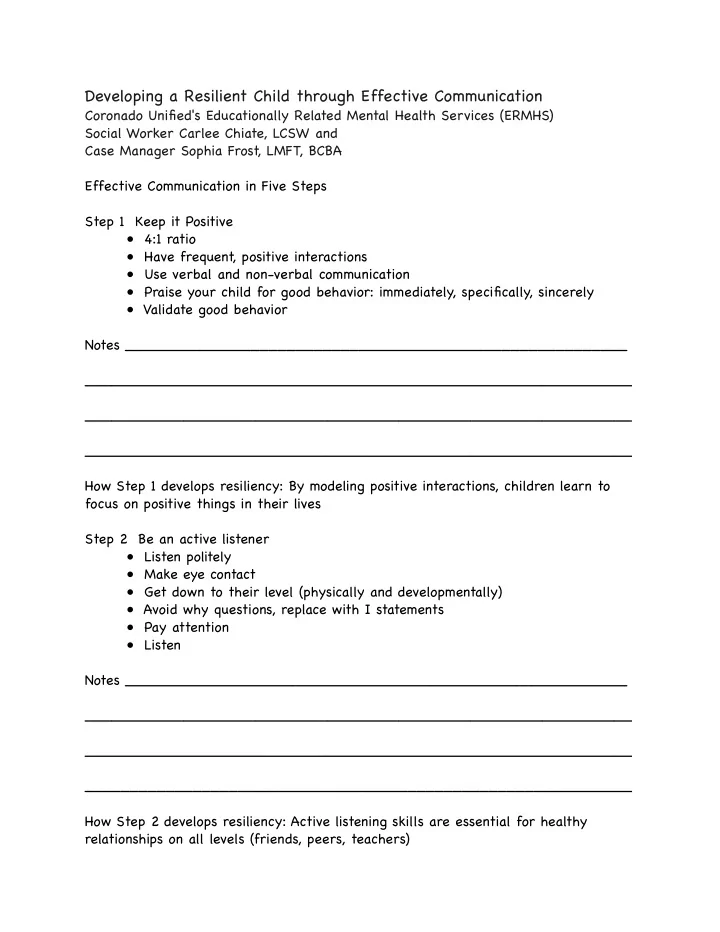
Developing a Resilient Child through Effective Communication Coronado Unified's Educationally Related Mental Health Services (ERMHS) Social Worker Carlee Chiate, LCSW and Case Manager Sophia Frost, LMFT, BCBA Effective Communication in Five


slide-1
SLIDE 1

Developing a Resilient Child through Effective Communication

Coronado Unified's Educationally Related Mental Health Services (ERMHS) Social Worker Carlee Chiate, LCSW and Case Manager Sophia Frost, LMFT, BCBA Effective Communication in Five Steps Step 1 Keep it Positive

  • 4:1 ratio
  • Have frequent, positive interactions
  • Use verbal and non-verbal communication
  • Praise your child for good behavior: immediately, specifically, sincerely
  • Validate good behavior

Notes ________________________________________________________ _____________________________________________________________ _____________________________________________________________ _____________________________________________________________ How Step 1 develops resiliency: By modeling positive interactions, children learn to focus on positive things in their lives Step 2 Be an active listener

  • Listen politely
  • Make eye contact
  • Get down to their level (physically and developmentally)
  • Avoid why questions, replace with I statements
  • Pay attention
  • Listen

Notes ________________________________________________________ _____________________________________________________________ _____________________________________________________________ _____________________________________________________________ How Step 2 develops resiliency: Active listening skills are essential for healthy relationships on all levels (friends, peers, teachers)

slide-2
SLIDE 2

Step 3 Communicate expectations clearly

  • Mandatory expectations: Define task, what to do, when to do it, how often
  • Discretionary expectations: Child can make choices
  • Supervise-don’

t punish, follow through until the job is done

  • Praise progress
  • Be consistent across caretakers

Notes ________________________________________________________ _____________________________________________________________ _____________________________________________________________ _____________________________________________________________ How Step 3 develops resiliency: Develops and promotes framework for how society works Step 4 Avoiding conflict

  • Give choices
  • Ignore
  • Stay neutral
  • Take time to cool down
  • Recognize when to give space
  • Avoid situations that frustrate your child
  • Pick your battles

Notes ________________________________________________________ _____________________________________________________________ _____________________________________________________________ _____________________________________________________________ How Step 4 develops resiliency: Models effective conflict resolution strategies, teaches your child to advocate for him/herself

slide-3
SLIDE 3

Step 5 Keep communication open

  • Avoid conversation stoppers
  • Instead of “End of discussion”
  • Say “Let’

s talk about this later” Instead of “Because I said so…” Say “When…,then…” Instead of “No running” Say “Inside, we walk, outside, you may run. ”

  • Put it back on them and buy time
  • Say yes more often than no

How Step 5 develops resiliency: Promotes compliance and cooperation and helps to maintain a more positive environment for growth and development Notes ________________________________________________________ _____________________________________________________________ _____________________________________________________________ _____________________________________________________________ In conclusion:

  • Make sure your child knows he/she is loved
  • Handling mistakes - acknowledge, apologize, move on -- and use it as a
  • teaching opportunity!
  • Use “101 Way to Praise Kids” often

Notes ________________________________________________________ _____________________________________________________________ _____________________________________________________________ Record interactions with your child for a 15-minute window by placing a tally in the appropriate box -- goal is 4 praise statements to 1 request/demand Requests/Demands Praise Statements

slide-4
SLIDE 4

Resources:

  • Dr. Glenn I. Latham, The Power of Positive Parenting

http:/ /ocw.usu.edu/Family__Consumer____Human_Development/oer-power-of- positive-parenting/ Adele Faber and Elaine Mazlish, How to Talk So Kids Will Listen and Listen So Kids Will Talk and How to Talk So Teens Will Listen and Listen So Teens Will Talk Thomas W . Phelan, 1-2-3 Magic Parenting Book parentmagic.com Gregory Bodenhamer, Parent in Control Child Development Institute Parenting Today http:/ /childdevelopmentinfo.com/parenting/communication/shtml