Developed by the Marquette County Community Health Assessment Team: - - PDF document

developed by the marquette county community health
SMART_READER_LITE
LIVE PREVIEW

Developed by the Marquette County Community Health Assessment Team: - - PDF document

2012 Marquette County Community Health Assessment & Improvement Process Developed by the Marquette County Community Health Assessment Team: Marquette County Health Department Marquette General Health System Bell Hospital Marquette County ACHIEVE


slide-1
SLIDE 1

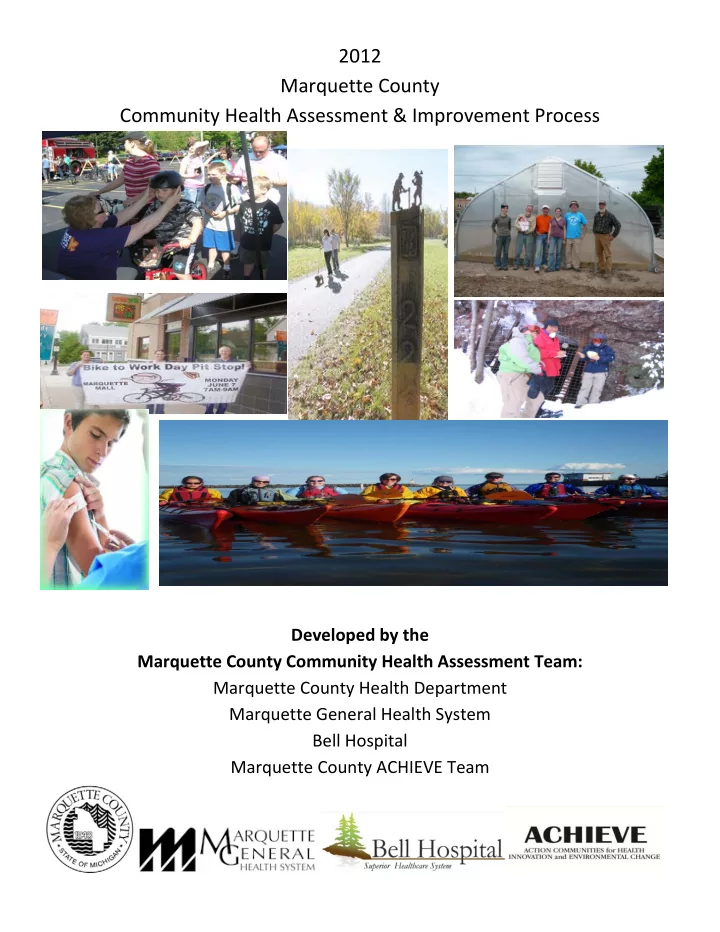
2012 Marquette County Community Health Assessment & Improvement Process

Developed by the Marquette County Community Health Assessment Team: Marquette County Health Department Marquette General Health System Bell Hospital Marquette County ACHIEVE Team

slide-2
SLIDE 2

This report is the culmination of extensive research and data analysis and provides an excellent summary of the process undertaken in 2011 and 2012 for the 2012 Marquette County Health Assessment and Improvement Process. There is a wealth of detailed information and data in the report with full data sources located in the background attachments. A full report of the findings

  • f each data gathering process is available on the websites as indicated below.

Final Report: Marquette County Community Health Assessment & Improvement Process Background Documents: (Active Links) 2011 Marquette County Consumer Health Survey 2011 Marquette County Community Organization/Leader Priority Session Results 2010 Marquette County Critical Health Indicators 2010 Marquette County Kids Count Data 2012 Marquette County Health Rankings Acknowledgements:

The Marquette County Community Health Assessment Team wishes to thank all of the people and organizations that have made the 2012 Community Health Assessment report and process possible. Nearly 1,000 community residents and representatives from local organizations participated in the health assessment process in 2010‐2012. Without them, the assessment would not be as meaningful. December, 2012 Marquette County CHAI Report Marquette County Health Department 184 US 41 E Negaunee, MI 49866 www.mqthealth.org Marquette General Health System 580 W. College Ave. Marquette, MI 49855 www.mgh.org

slide-3
SLIDE 3

Table of Contents

  • I. Executive Summary

A. Introduction: What is Community Health Assessment? Community Health Assessment Team How is the Community Health Assessment done? Next Steps B. Marquette County 2012‐2014 Three Priorities: Obesity Tobacco and Substance Abuse Access to Health Resources Marquette County Board of Health Endorsement C. Priority Strategies

  • II. Detailed Data and Analysis: (Active Links)

A. Marquette County CHA Process Storyboard B. Marquette County Health Department Strategic Plan C. MGHS Community Health Needs Assessment Matrix D. 2010 Critical Health Indicators E. 2012 County Health Rankings F. 2009 Marquette County Older Adults Needs Survey G. 2010 Marquette County Kids Count Data

You can access these links at: www.co.marquette.mi.us/departments/health_department/community_health/ community_health_assessment_‐_2012.htm

slide-4
SLIDE 4

I. Executive Summary A. Introduction

What is the Community Health Assessment? The purpose of the community health assessment is to identify what factors affect the health of a population and what resources are available within the community to address these factors. Like politics, all health issues are local. When we get sick, what we get sick of, and potentially even when we die are often times contingent on our social environment. It’s more than just having access to health insurance. Research is clear that many of the chronic diseases such as heart disease, diabetes, and cancer can be prevented in many

  • cases. Public health and health care providers

must develop innovative partnerships to achieve success to help improve the health and quality of lives in Marquette County. The health assessment is also required for local health departments in Michigan though the Michigan Dept

  • f

Community Health’s Accreditation Program. Marquette General Health System and Bell Hospital are also required to conduct a community health assessment every three years as part of their non‐profit status. It’s in the best interest of the residents of Marquette County that all Health Organizations work together to improve the health of residents. Community Health Assessment Steering Team The Marquette County Community Health Assessment Steering Team is made of community members who are part of the ACHIEVE Team (Action Communities for Health Innovation and EnVironmental change), and representatives of the two area hospitals and local health department. The group began meeting in August 2010 to plan how the Community Health Assessment would be

  • completed. Monthly meetings took place to review

data and procedures. The Assessment and Prioritization phase was completed by January, 2012 with the Improvement phase completed at the end of March 2012. All priority areas have current benchmark established as well as intervention strategies identified accompanied by timelines that result in documented improvements by the end of the 3 year cycle. How is the Community Health Assessment done? The Community Health Assessment is done by working with community members to identify, collect, analyze, and disseminate information on community assets, strengths, resources, and

  • needs. Data resources such as the Marquette

County Health Rankings, Marquette County’s 2010 Critical Health Indicators have been printed and distributed to community members. Beginning on November 9th, 45 community organizations and leaders attended a work session to review the health status data and begin the process of prioritizing health concerns. In addition a Community Opinion Survey online was completed by 941 Marquette County residents to find out what residents think are the top health priorities and concerns. The Community Health Assessment Team reviewed the results in December, 2011. The top three health issues identified by the Community work session and the community

  • nline survey are:

 Obesity Prevention  Substance Abuse Prevention which includes tobacco use reduction  Access to Health Resources Next Steps The priorities outlined in this report focus on helping all of our people stay healthy. Gathering a wealth of information, reviewing data, and setting Priorities are only the first steps. Now we begin the search for strategies that can push our community forward and reduce death and disease. Our health and well‐being depend on it. It is time to stop thinking of health as something we get at the doctor’s office but instead as something that starts in our families, in our schools and workplaces, in our playgrounds and

  • parks. The more you see the problem of health

this way, the more opportunities you have to improve it. It’s time we expand the way we think about health to include how to keep it, not just how to get it back.

Excerpt from Robert Wood Johnson Foundation: A New Way to Talk about the Social Determinants of Health, 2010

slide-5
SLIDE 5

B. Marquette County’s 2012 – 2014 Health Priorities

After examining the data that was generated during the Community Health Assessment (CHA) process and listening to input from community members, three priority areas have been chosen by the Community Health Assessment Team and endorsed by the Marquette County Board of Health and the Marquette County Family Coordinating Council. By focusing on these three areas during 2012‐2014, Marquette County residents and

  • rganizations will move forward toward our long‐term goal of improving health.

PRIORITIES:

PROMOTE HEALTHY WEIGHTS THROUGH HEALTHY LIVING: OBESITY REDUCTION

Nearly eight out of every ten Marquette County adult residents are

  • verweight or obese, as measured by

a body mass index (BMI) of 25 or higher

(Marquette County Critical Health indicators/MDCH Behavioral Risk Factor Survey System).

This rate continues to increase in Marquette County as it is in the state and nation. Of particular concern is the rise in obesity among children. Nearly one in three 8th, 10th, or 12th grade male students are overweight

  • r obese as well as one in four female
  • students. (GLCYD SEARCH Data, 2010).

Nearly 59% of respondents to the Marquette County Health Survey (November, 2011) listed obesity as a top threat to good health in the county. This was only slightly second in importance after substance abuse. This “epidemic” of obesity is not just a biological issue but also an economic and lifestyle issue. It will require a focus on improvements of a healthier diet and increased physical activity as well as the promotion of a culture of healthy living supported by environmental improvements such as bike and pedestrian trails, parks, sidewalks. Increased attention to developing and sustaining these environmental supports is very important to be able to reverse the causes of the

  • epidemic. The Marquette County Health Rankings also note that

some Marquette County residents may not have daily access to fresh fruits and vegetables. This is a problem mostly in the far western and southern parts of the county. The ACHIEVE team in Marquette County is working on community nutrition and physical activity policies that work to make the “Healthy Choice the Easy Choice”. Farmer’s markets and community gardens have grown in popularity in recent years. Complete Streets, Safe Routes to School; non‐motorized bike/pedestrian paths all work to make the environment in Marquette County more conducive for our residents to be able to incorporate physical activity into their daily lives.

I know I need to exercise, and eat

  • healthy. Especially to lose weight

40-50 pounds would be great. My guess is I could come off medication for high blood pressure, diabetes, and depression.

  • 2011 Marquette County Community Survey

Response

Limited access to physical activity and 'quick' healthy food/snack choices, make it too easy to choose poorly.

  • 2011 Marquette County Community

Survey Response

slide-6
SLIDE 6

SUBSTANCE ABUSE PREVENTION INCLUDING TOBACCO USE

Nearly one in five Marquette County adults smoke cigarettes (MCCHI, 2010). One in four births were to mothers who smoked and up to 53% of mothers on Medicaid smoked. Maternal smoking is a leading cause of low birth weight babies. Tobacco use is implicated in 30% of all heart disease and cancer deaths including 85% of all lung cancers. COPD is higher in Marquette County than State averages. The rates after a short period of decline have risen from a low of 15% in 2003, which was well below state averages, to a current level at or slightly above the state average of 20%. The educational and media work thought to play a role in the decline was eliminated due to budget reductions in 2004. A system of cessation support needs to be developed as well as a return to the successful education and media programs that worked so well in the past. There is good news in that substance abuse for both adults and youth continues to be on the decline…but this decline is from a level in which Marquette County exceeded the State’s binge drinking rate by 30% in the late 1990’s to a rate of less than 15% today. We are now slightly below the State rate. (MCCHI, 2010). There is a greater awareness of prescription drug abuse, drug analogs and crystal meth use in the population. These numbers are hard to quantify, yet we know from hospital emergency room reports that this is an important issue to address. Currently, the Marquette County Coalition for Substance Abuse Prevention (MC2) is promoting safe use and disposal of prescription drugs. The Marquette County Health Department continues to work with the local law enforcement officials to ban the sale of drug analog products.

We could use extra resources in

  • ur area for behavioral type

problems including substance abuse/prescription drug abuse.

  • 2011 Marquette County Community Survey

Response High Risk Behaviors – Alcohol and Tobacco

Profiles of S tud ent Life: Attitudes and Behaviors

Marquette and Alger Counties

slide-7
SLIDE 7

ACCESS TO HEALTH RESOURCES

Access to health care in our community has been improving. A dental clinic for low income children has been successful, along with the Marquette County Access to Care Clinic. There has been an improvement in health care coverage in the past few years. In addition, the percentage of adults who are up‐to‐date with age‐ appropriate screening services has improved for mammography, pap tests, colorectal screens, and cholesterol screenings. According to the Centers for Disease Control and Prevention (CDC), 7 out of 10 deaths are due to chronic disease. Heart disease, cancer, and stroke account for more than 50% of all deaths each year. Preventative screenings can help catch chronic diseases at an earlier stage, which increases longevity with the disease and allows the patient to set up a plan with the provider to manage the disease on a long‐term basis.

Community Health Assessment Meetings and Community Survey:

On August 2, 2011, the Michigan Department of Community Health conducted a regional community session to review regional and local responses to critical health issues. The below table outlines health issues and compares Marquette County to regional and state health statistics. The County had worse statistics in the area of heavy drinking, maternal smoking, fruit and vegetable intake, and obesity.

Table 1 Marquette County, Region 8 (U.P.), Michigan and National Data Comparison Issue Marquette County compared to Mich. Region 8 compared to Michigan Region 8 compared to national targets Access to healthcare Better Similar Worse Binge drinking Similar Similar Better Heavy Drinking Worse Worse Worse Fruit and vegetable intake Worse Worse Worse Gonorrhea and Chlamydia Better Better Better Hypertension (controlled) Better Better Better Infant Mortality Better Better Better Leading causes of death 1. Heart Disease 2. Cancer

  • 1. Similar
  • 2. Better

Similar Not applicable Mental health Better Better Similar data not available Obesity Worse Worse Worse Physical Activity Better Better Better Smoking Similar Better Worse Maternal Smoking Worse Worse Worse Teen pregnancy Better Better Better

slide-8
SLIDE 8

In November of 2011, 941 Marquette County residents completed a community health assessment survey. The following are the responses to two questions asking the respondents to rank health issues:

slide-9
SLIDE 9

On November 9, 2011, 46 community organizations and leaders attended a community health needs session to identify the top three health issues, and name strategies necessary to improve these issues. They were identified as: Obesity Prevention through nutrition education and increased physical activity Substance Abuse Prevention including Tobacco Prevention Access to Health Resources

Marquette County Board of Health Adoption of Community Health Priorities:

The Marquette County Board of Health, upon review of the community health data and the results of the community health assessment sessions and survey, endorses the following three community health priorities as health issues in which the Marquette County Health Department will work with the community to improve

  • ver the next three years:

Obesity, Substance Abuse including tobacco use, and Access to Health Resources __________________________________ ___________________

Chair, Marquette County Board of Health Date

C. Marquette County 2012‐ 2014 Priority Strategies

The following strategy section is based on collaborative work between the Marquette General Health System, Marquette County Health Department, Bell Memorial Hospital, YMCA, and the Marquette County ACHIEVE

  • Team. In addition, the Marquette County Coalition for Substance Abuse Prevention (MC2), and the Marquette

County Tobacco Free Coalition provided strategy input. In addition, many of the strategies were identified during the “Community Health Priority Session” and the “Community Health Survey” conducted in October and November of 2011 respectively.

slide-10
SLIDE 10

C. Priority Strategies

Focus Area National Objectives State/Regional Objectives Local Objectives Strategy/Strategy

Environmental Approaches

Promote interventions that support health and reinforce healthful behaviors (statewide in schools, worksites, and communities) Empowered People: Support people in making healthy choices

  • A. National Prevention

Strategy Healthy and Safe Community Environments: Create, sustain, and recognize communities that promote health and wellness through prevention.

  • B. National Prevention

Strategy Area. Enhance the coordination and integration of clinical, behavioral, and complementary heath strategies. (#6 p.20)

  • C. HP 2020, EH-2

Alternative modes of transportation

  • D. HP 2020, ECBP-8

Worksite health promotion programs

  • a. Michigan Strategy: Enhance coordination

and integration of clinical, behavioral, and complementary services through support and enhancement of patient-centered medical homes and coordinated care management.

  • b. Michigan Strategy: Engage and empower

people and communities to plan and implement prevention policies and programs to promote tobacco-free living, healthy eating and active living

  • c. 4X4; Collaboration with the community hub

initiative, establish the process to identify, gather and disseminate coordinated chronic disease prevention resources for communities to use when implementing policies and environmental changes to promote and support healthy behaviors.

  • d. 4X4: Create a coordinated chronic disease

and injury prevention media campaign to increase healthy behaviors (physical activity, healthy eating, tobacco-free lifestyle and preventive annual physicals) among County residents.

  • e. 4X4: increase the number of communities

(including worksite, faith-based

  • rganizations, and schools) assessing

environments and policies that support healthy behaviors f. 4X4: Promote and provide policy and environmental change materials and resources (including worksite, faith-based

  • rganizations, and schools) that have

completed an assessment.  Promote and participate in efforts for healthcare delivery system change (BCBSM PGIP, CMS MiPCT Demo, YMCA’s Health Innovations)  Promote and support alternative means of community transportation

  • Safe Routes to School
  • Complete Streets
  • Bike paths/Iron Ore Heritage Trail
  • sidewalks

 Promote and support recreational activities

  • Bike/ski trails
  • Sponsor health related events (Ore-to –Shore, Teal

Lake Swim, Noquemanon ski race, YMCA Run, YMCA Triathlon)

  • Tennis courts
  • Soccer, baseball fields

 Collaborate with ACHIEVE, YMCA and other health serving

  • rganizations in disseminating chronic disease prevention

resources  Collaborate with NMU and YMCA to increase availability of healthy activities to the community (e.g. Dome for walking)  Promote expansion and enforcement of tobacco free areas (hospital campus, NMU campus, ice arenas, public beaches, parks…)  Memorial Gardens/quiet area  Safe Crosswalk  Use of Green technologies  Recycling efforts  Promote use of stairways/improve décor  Worksite Wellness promotion

  • ACHIEVE worksite policy toolkit for health promotion
slide-11
SLIDE 11

Focus Area National Objectives State/Regional Objectives Local Objectives Strategy/Strategy

Neonatal/Child Obesity Prevention

  • A. HP 2020 NWS;
  • 10.4 Leading Health

Indicator Reduce childhood obesity ages 2-19yo

  • 15.1 Increase fruits

and vegetables to the diets for 2 yrs and older B. HP 2020 AH-1 Increase proportion of adolescents with wellness check up C. HP 2020 EMC-4, EBCP-2 and ECBP-4 School Health Education D. HP 2020 EBCP-7 Health Risk Behavior in higher education E. HP 2020 MICH- 21 Increase the proportion of infants that are breastfed.

  • F. HP 2020 MICH-21

Worksite Lactation support programs  Initiate a Nurse - Family Partnership providing home visits to at risk 1st time expecting mothers  Promote and Support Blueprint 4 Health  Promote and support the Healthy eating and Physical Activity Standards (HEPA)  Record Body Mass Index (BMI) in MCIR  Initiate a “No Child Left Inside” Program to reduce childhood Obesity

  • Encourages sound nutrition and outdoor

activity/stewardship

  • Implement local Healthy Kids Policy recommended

by Michigan’s Healthy Kids Task Force for daycare providers.

  • Continue Program providing bike and ski helmets at

reduced rates  Promote and support speakers/consultants for school based health education  Support and expand the “Ask the Doctors” program in the High School  Coordinate similar activities with NMU Health Services and the YMCA Health Innovations Team.  Support continuation of Lactation Workgroup at MGH

  • Breastfeeding conf for professionals in Mqt County
  • On-Call breastfeeding resources
  • Collaborate with Bell Hospital as “Baby Friendly”

Hospitals

  • Public Awareness Campaign of advantages of

breastfeeding

  • NMU Public Service infomercial
  • Support the MGHS/YMCA BLOOM Program

 Develop “model” worksite lactation support and promote to community businesses.

slide-12
SLIDE 12

Focus Area National Objectives State/Regional Objectives Local Objectives Strategy/Strategy

Fitness

  • A. HP 2020 PA 2.4 Increase proportion of adults

who meet objectives for aerobic physical activity and for muscle strengthening activity

  • B. HP 2020 NWS-9 Leading Health Indicator

Decrease proportion of adults who are obese

  • C. HP 2020 D-1 Reduce the annual number of new

cases of diagnosed diabetes in the population

  • D. HP 2020 D-14 Increase the proportion of

persons with diagnosed diabetes who receive formal diabetes education

  • E. HP 2020 D-16 Increase prevention behaviors in

persons at high risk for diabetes with pre-diabetes.

  • D–16.1 Increase the proportion of persons at

high risk for diabetes with pre-diabetes who report increasing their levels of physical activity

  • D–16.2 Increase the proportion of persons at

high risk for diabetes with pre-diabetes who report trying to lose weight.

  • 16.3 Increase the proportion of persons at high

risk for diabetes with pre-diabetes who report reducing the amount of fat or calories in their diet.

  • F. HP 2020 NWS–5: Increase the proportion of

primary care physicians who regularly measure the body mass index of their patients.

  • G. HP 2020 NWS–6: Increase the proportion of

physician office visits that include counseling or education related to nutrition or weight.

  • H. HP 2020 NWS–7: Increase the proportion of

worksites that offer nutrition or weight management classes or counseling. I. HP 2020 PA–1: Reduce the proportion of adults who engage in no leisure-time physical activity.

  • J. HP 2020 PA–2: Increase the proportion of adults

who meet current Federal physical activity guidelines for aerobic physical activity and for muscle- strengthening activity.

  • K. HP 2020 PA–3: Increase the proportion of

adolescents who meet current Federal physical activity guidelines for aerobic physical activity and for muscle-

  • a. Michigan 4x4 Engage

in Regular Exercise  Continue to offer discounted rates for local fitness centers  Continue to sponsor walking at the Dome  Continue to support the YMCA’s CDC – Diabetes Prevention Program  Consider rejuvenating the “Fit Strip” and sponsor activities there  Continue to support YMCA, MDCH funded Before/After School Food and Fitness program  Work with the schools to assure daily physical activity is a component of each school day  Incorporate “Prescriptions for Health” into everyday practice  Map walking routes and distance at worksites

slide-13
SLIDE 13

Nutrition

strengthening activity.

  • L. HP 2020 PA–4: Increase the proportion of the

Nation’s public and private schools that require daily physical education for all students

  • M. HP 2020 PA–5: Increase the proportion of

adolescents who participate in daily school physical education

  • N. HP 2020 PA–11: Increase the proportion of

physician office visits that include counseling or education related to physical activity

  • O. HP 2020 PA–12: Increase the proportion of

employed adults who have access to and participate in employer-based exercise facilities and exercise programs.

  • P. HP 2020 PA–13: Increase the proportion of trips

made by walking.

  • Q. HP 2020 PA–14: Increase the proportion of trips

made by bicycling.

  • A. HP 2020 NWS–14: Increase the contribution of

fruits to the diets of the population aged 2 years and

  • lder
  • B. HP 2020 NWS–15: Increase the variety and

contribution of vegetables to the diets of the population aged 2 years and older

  • C. HP 2020 NWS–16 Increase the contribution of

whole grains to the diets of the population aged 2 years and older

  • D. HP 2020 NWS–17: Reduce consumption of

calories from solid fats and added sugars in the population aged 2 years and older

  • E. HP 2020 NWS–18: Reduce consumption of

saturated fat in the population aged 2 years and older

  • F. HP 2020 NWS–19: Reduce consumption of

sodium in the population aged 2 years and older

  • G. HP 2020 NWS–20: Increase consumption of

calcium in the pop. aged 2 years and older

  • b. Michigan 4x4 Maintain

a Healthy Diet  Start “Veggie U” program at Sandy Knoll and extend to additional schools in future  MGH to continue Michigan Health & Hospital Association 4 Star Plan

  • Encourage other businesses with

cafeterias to follow the same principles  Support ACHIEVE in the Healthy Restaurant Menu Initiative  Community Gardens and Hoop Houses  Promote Access to fresh produce

  • Farmer’s Market’s throughout county and

when feasible at MGH

  • Continue CSA program

 Continue Annual Nutrition and Medicine Conference annually  Continue Baby Boomer Health & Wellness Day at the YMCA

slide-14
SLIDE 14

Focus Area National Objectives State/Regional Objectives Local Objectives Strategy/Strategy

Substance Abuse

  • A. Tobacco
  • B. Alcohol
  • C. Prescription

Drug abuse

  • D. Illicit Drugs
  • A. HP 2020 TU
  • 1.1 – 1.3 Decrease Cigarette Smoking,

smokeless tobacco use, cigars in Adults

  • 2.2 – 2.4 Decrease Cigarette Smoking,

smokeless tobacco use, cigars in Adolescents

  • B. HP 2020 TU 11.1 Reduce secondhand smoke

exposure 3-11 year olds

  • C. HP 2020 TU-6 Increase smoking cessation

during pregnancy

  • D. HP 2020 TU 9.1-4 Increase tobacco screening

in healthcare settings

  • E. HP 2020 TU-10 Increase tobacco cessation

counseling in healthcare settings  HP 2020 SA

  • 13.1 Decrease proportion of

adolescents reporting use of alcohol during past 30 days

  • 14.3 Decrease Binge drinking during

past 30 days 18 and older

  • a. Michigan 4x4 Avoid

ALL Tobacco use and exposure  Support, promote and expand tobacco cessation counseling

  • Provide services throughout county

 YMCA – ALA Freedom from Smoking  UPHP to actively case manage smokers during pregnancy  Develop referral services for smokers during pregnancy  Increase tobacco screening in healthcare settings  Increase tobacco cessation counseling in healthcare settings  MGH to pursue Joint Commission tobacco cessation performance improvement measures  Campaign to raise awareness of increasing use of tobacco products in Marquette County  Continue to conduct SYNAR retailer checks to insure reduced availability of tobacco products to minors  Continue support of the Marquette County Substance Abuse Prevention Coalition: Annual Objectives including support for Action Troupes and other youth prevention activities  Increase Prescription Drug Disposal program throughout county  Encourage all healthcare providers to utilize Michigan Automated Prescription Service (MAPS)  Encourage all practices that prescribe narcotics for chronic use to employ drug contracts  Reduce the number of infants born with neonatal abstinence syndrome  Maintain Center for Intensive Addiction Services (MGHS)  Coordinate treatment services with Great Lakes Recovery

slide-15
SLIDE 15

Focus Area National Objectives State/Regional Objectives Local Objectives Strategy/Strategy

Access to Health Resources

  • A. HP 2020 AHS-3: Increase the proportion of

persons with a usual primary care provider

  • B. HP 2020 OH-7 Increase the proportion of

children, adolescents, and adults who used the

  • ral health care system in the past 12 months
  • C. HP 2020 OH-8 Increase the proportion of low-

income children and adolescents who received any preventive dental service during the past year

  • D. HP 2020 OH-9 Increase the proportion of

school-based health centers with an oral health component

  • E. HP 2020 MHMD-9 Increase the proportion of

adults with mental health disorders who receive treatment

  • F. HP2020 MHMD 2: Reduce suicide attempts by

Adolescents

  • a. Michigan Strategy

Develop Resource to help guide people with insurance needs  Publish and disseminate MGH policy on provision

  • f care to under and un-insured

 Continue support of MCAC

  • Increase # of volunteer providers at

MCAC clinic

  • Continue accepting MCAC patients at

MGMG clinics  Continue support and development of Federally Qualified Health Centers (Michigan only has 29 of 1028 nationwide) and Rural Health Centers  Work with MCDC to expand access to Dental Services  NMU to assess feasibility of dental hygienist program  Explore possibility of Dental Residency program  MCHD - Gwinn School based clinic to assess dental program (Gwinn has non-fluoridated water)  Increase awareness of palliative care services  Promote and expand PATH (Stanford Model) classes for chronic disease management  CDC Preventing Suicide: Program Activities Guide (ACHIEVE/YMCA CDC grant submission)