Determinants of Social Discount Rate, general case The resulting - - PowerPoint PPT Presentation

determinants of social discount rate general case
SMART_READER_LITE
LIVE PREVIEW

Determinants of Social Discount Rate, general case The resulting - - PowerPoint PPT Presentation

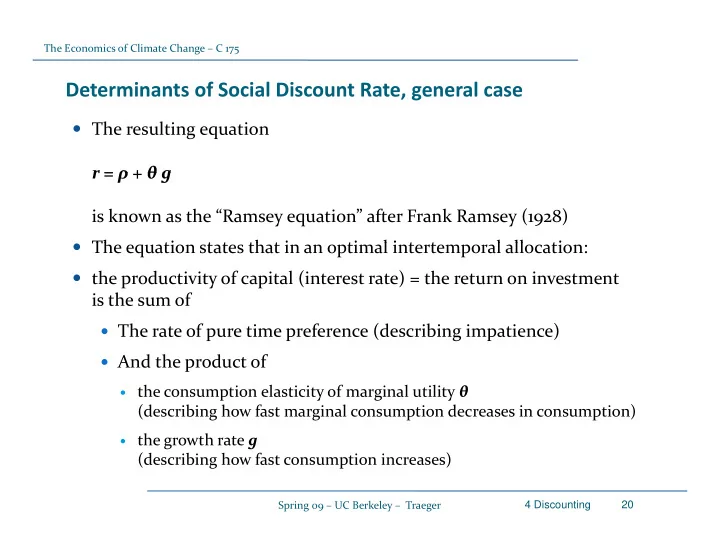
The Economics of Climate Change C 175 Determinants of Social Discount Rate, general case The resulting equation r = + g r = + g is known as the Ramsey equation after Frank Ramsey (1928) The equation states that in an


slide-1
SLIDE 1

Determinants of Social Discount Rate, general case

The Economics of Climate Change – C 175

 The resulting equation

r = ρ + θ g r = ρ + θ g is known as the “Ramsey equation” after Frank Ramsey (1928) Th ti t t th t i ti l i t t l ll ti

 The equation states that in an optimal intertemporal allocation:  the productivity of capital (interest rate) = the return on investment

is the sum of

 The rate of pure time preference (describing impatience)  And the product of

 the consumption elasticity of marginal utility θ

(describing how fast marginal consumption decreases in consumption)

 the growth rate g

(d b h f ) (describing how fast consumption increases)

Spring 09 – UC Berkeley – Traeger 4 Discounting 20

slide-2
SLIDE 2

The Economics of Climate Change – C 175

The Economics of Climate Change C 175 ‐ Christian Traeger 75 g Part 4: Discounting continued Lecture 17

Background still Cameron Hepburn’s (2006), “Discounting climate change damages: Working note for the Stern review”.

Spring 09 – UC Berkeley – Traeger 3 Instruments 21

slide-3
SLIDE 3

Review

The Economics of Climate Change – C 175

Problem:

 How to compare costs and benefits that occur at different points in

time? time? Economic solution concept involves:

 Discounting: Describes the valuation in present day terms of future

g

  • utcomes (damages, costs, benefits, utility values)

 Cost Benefit analysis:

 Assess costs and benefits in monetary units

Assess costs and benefits in monetary units

 Express all benefits and costs in present value terms

 Net present value NPV:

S t j t if t l b fit d t l t Support a project if present value benefits exceed present value costs

 

  

T t t t t

r C B NPV ) 1 (

Spring 09 – UC Berkeley – Traeger 4 Discounting 22

 r) 1 (

slide-4
SLIDE 4

Answer to Homework

The Economics of Climate Change – C 175

Example II Cost Benefit analysis:

 Consider the two modified projects and a discount rate of 5%.

Benefits (in $) Year 1 2 3 Project A 30 20 10 10 Project A

  • 30

20 10 10 Project B

  • 30

10 20 20

Assume you only have $30 that you can invest in the first period. Which project would you invest in?

 NPV

$30+$20/(1 05) +$10/(1 05)2 +$10/(1 05)3 $6 76

 NPVA=‐$30+$20/(1,05) +$10/(1,05)2 +$10/(1,05)3 = $6.76  NPVB =‐$30+$10/(1,05) +$20/(1,05)2 +$20/(1,05)3 = $14.94

Project B because NPVB >NPVA j

B A

4 Discounting 23 Spring 09 – UC Berkeley – Traeger

slide-5
SLIDE 5

Review: How to find the discount rate?

The Economics of Climate Change – C 175

 Recall importance of discounting for long time horizons: At a

 10% discount rate $ 1 Mio in 150 years have present value of

% di Mi i h l f

 1% discount rate $ 1 Mio in 150 years have present value of $ 225 000

 High discount rate implies

 A dollar today is much more valuable than a dollar tomorrow  Hard to justify climate policy where costs occur today but benefits

(abated damages) accrue later

 How do we find the “correct” discount rate?

 Market Intertest Rate ‐> BUT: might not exist for long time

horizons or not represent “correct” information (market failures, responsibilities for future generations) d if f h S i l Di R

 Identify components of the Social Discount Rate

Spring 09 – UC Berkeley – Traeger 4 Discounting 24

slide-6
SLIDE 6

Review: The Social Discount Rate

The Economics of Climate Change – C 175

We have derived how the optimal real interest rate should be composed if markets were perfect and represented all information:

 Then: MRS MRT  Then: MRS = MRT

(Marginal rate of substitution = Marginal rate of transformation)

 Where:

G d i d

 Good 1 = consumption today  Good 2 = consumption tomorrow

 Result is the Ramsey equation: r = ρ + θ g

y q ρ g

 We derived the equation for a two period setting, but holds in general,

also in continuous time: r(t) = ρ + θ(x(t)) g(t)

Remark: θ(x(t)) is determined by the utility function. If utility is a power function (i e xα) then θ α independent of x(t) (i.e. xα) then θ = α independent of x(t).

Spring 09 – UC Berkeley – Traeger 4 Discounting 25

slide-7
SLIDE 7

Review: Determinants of Social Discount Rate

The Economics of Climate Change – C 175

 Ramsey equation: r(t) = ρ + θ g(t)

Optimal productivity of capital (r) equals p p y p ( ) q

 The rate of pure time preference (ρ) (describing impatience)  And the product of

 the consumption elasticity of marginal utility θ

(describing how fast marginal utility decreases in consumption) Relative change of marginal utility

X dX X U X dU X U X X U ) ( ' ) ( ' ) ( ' ) ( ' '     

Relative change of marginal utility under a relative change of consumption.

  • r

By how many percent does marginal

 the growth rate g

(describing how fast consumption increases)

X

utility change if consumption increases by one percent ( g p )

Spring 09 – UC Berkeley – Traeger 4 Discounting 26

slide-8
SLIDE 8

So what’s the rate? ‐ Normative vs Descriptive

The Economics of Climate Change – C 175

 Two approaches

 Descriptive:

Observe r(t) and g(t). Either in market or in experiments. Different combinations of ρ and θ are generally compatible with these

  • bservations.

D t i i θ b b ti i h d b t ld id tif di Determining θ by observation is harder but would identify corresponding ρ.

 Prescriptive:

Start with deciding on ρ and θ. Then growth rate g(t) determines the di l i ( ) A f i ki d θ corresponding real interest rate r(t). Arguments for picking ρ and θ generally rely on ethical reasoning.

Spring 09 – UC Berkeley – Traeger 4 Discounting 27

slide-9
SLIDE 9

So what’s the rate? ‐ Pure Time Preference

The Economics of Climate Change – C 175

 ρ: Some opinions that it should be zero:

 Ramsey (1928) describes placing different weights upon the utility of

diff i ‘ hi ll i d f ibl ’ different generations, as ‘ethically indefensible’.

 Harrod (1948) stated that discounting utility represented a

‘polite expression for rapacity and the conquest of reason by passion’.

 …  Stern Review (2007) – to be encountered in integrated assessment part

Th l hi l d h i i ‐> These are mostly ethical arguments and thus prescriptive

 Remark:

 Ramsey equation including (undetermined!) parameter ρ can be derived from

y q g p ρ axioms, i.e. assumptions on behavior rather than starting with our utility model

Changing the axioms to include risk attitude in a more comprehensive way can eliminate ρ, that is, make it zero starting from assumptions on rational and i b h i h h f hi l ( h ) consistent behavior rather than for ethical reasons (paper on my homepage)

Spring 09 – UC Berkeley – Traeger 4 Discounting 28

slide-10
SLIDE 10

So what’s the rate? ‐ Descriptive

The Economics of Climate Change – C 175

 Descriptive take on ρ: By reverse engineering from observations economists

  • ften take values between 2% and 3%.

Si il l i i d b b d

 Similarly θ is engineered to be between 1 and 4.

Remark: The high (& even higher) values of θ are obtained from risk studies where θ also represents risk aversion rather than just reduction in marginal utility from growth over time.

 The growth rate g is observed and predicted to be approximately in the

range 1% to 3%

 The real interest rate employed as observed rate ranges approximately from  The real interest rate employed as observed rate ranges approximately from

2% to 7% A convenient example of somewhat reasonable values (Weitzman 2007)

ρ=2%, θ=2, g=2%, r=6%

Other examples ‐ Stern review (2007) Nordhaus (2007) – on problem set Other examples Stern review (2007), Nordhaus (2007) on problem set.

Spring 09 – UC Berkeley – Traeger 4 Discounting 29

slide-11
SLIDE 11

So what’s the rate? ‐ Prescriptive

The Economics of Climate Change – C 175

 ρ: possibly zero for ethical reasons as proposed on earlier slide  θ: Normative/ethical information conveyed:

Equalizing consumption across generations

 If θ =0, then more or less consumption in the future does not

change willingness to invest (r independent of growth rate g) change willingness to invest (r independent of growth rate g)

 If θ is large, then with positive growth ‐> not willing to invest in

future (future generations have more anyhow)

 If θ is large, then with negative growth ‐> very willing to invest in

future (future generations are poorer than today’s)

 Proposed range for θ ranges from 1 to 4

Proposed range for θ ranges from 1 to 4

Remark: Willing to invest in future = low real interest rate in optimal allocation.

Spring 09 – UC Berkeley – Traeger 4 Discounting 30

slide-12
SLIDE 12

Distributive Justice

The Economics of Climate Change – C 175

 Excursion: Rawls theory of justice applied to intertemporal distribution

 Would set ρ to zero and increase θ to ∞

 More generally, an egalitarian perspective with respect to

 time yields ρ small and thus r small  distribution across generations (stripping off the time dimension)  distribution across generations (stripping off the time dimension)

yields θ large and thus r large if positive growth

Spring 09 – UC Berkeley – Traeger 4 Discounting 31

slide-13
SLIDE 13

Sustainability

The Economics of Climate Change – C 175

is another normative value theory that relates to the discount rate

 Definitions: “S t i bl d l t i d l t th t t th d f th

“Sustainable development is development that meets the needs of the present without compromising the ability of future generations to meet their

  • wn needs” (WCED 1987).

 Common denominator of sustainability theories is the acknowledgment of

h “l l d d f i l li d the “long‐run mutual dependence of environmental quality and resource availability on the one hand, and economic development on the other hand”. Van den Bergh & Hofkes (1998, 11)  One distinguishes:

g

 weak sustainability: preservation of a non‐decreasing overall

  • welfare. To this end, a substitution between environmental and man‐

made capital is permitted.

 strong sustainability: requires a non‐declining value or physical

amount of natural capital and its service flows. Substitution possibilities between man‐made goods and natural resources and service flows are either limited or ethically indefensible. y f

Spring 09 – UC Berkeley – Traeger 4 Discounting 32

slide-14
SLIDE 14

Sustainability – A Formalization

The Economics of Climate Change – C 175

 To formalize this idea, we need to model

 environmental goods xE AND  produced goods xP AND  the fact that both goods are not perfect substitutes

 Assume that substitutability between environmental goods and

produced goods is of Cobb Douglas form.

 Assume that the decrease of marginal utility in overall consumption is

g y p is parameterized by a power function (parameter θ, see problem 3.3)

  ) ( 1 ) (

P E P E

x x U x x U W

   

  

 

    

 

1 ) ( ) ( 1 1 1 ) ( ) ( ) , ( 1 ) , (

1 5 . 1 5 . 1 1 5 . 5 . 2 2 1 1 P E P E

x x x x x x U x x U W

Spring 09 – UC Berkeley – Traeger 4 Discounting 33

      1 1 1

slide-15
SLIDE 15

Sustainability & Discounting

The Economics of Climate Change – C 175

 In general growth rates of environmental goods gE lie below the growth

rates of produced goods gP: gE < gP

 Now we can derive two discount rates:

 A discount rate for environmental goods rE and  A discount rate for produced goods rP  A discount rate for produced goods rP

 A similar but slightly more complicated derivation as earlier yields:

 rE= ρ + θ (.5 gE + .5 gP ) ‐ (.5 gP ‐ .5 gE )

ρ ( 5 g 5 g ) ( 5 g 5 g )

 rP= ρ + θ (.5 gE + .5 gP ) + (.5 gP ‐ .5 gE )

 For coinciding growth rates gE= gP = g we have same formulas as

li earlier

 For gE < gP however, we find that environmental goods have to be

discounted at a lower than average rate and produced goods have to be discounted at a higher than average rate.

Spring 09 – UC Berkeley – Traeger 4 Discounting 34

slide-16
SLIDE 16

Sustainability & Discounting

The Economics of Climate Change – C 175

 rE = ρ + θ (.5 gE + .5 gP ) ‐ (.5 gP ‐ .5 gE )  rP= ρ + θ (.5 gE + .5 gP ) + (.5 gP ‐ .5 gE )

 For gE < gP however:

 environmental goods have to be discounted at a lower than average rate

d d d h b di d hi h h

 produced goods have to be discounted at a higher than average rate

 In general it can be shown that

 The more substitutable both classes of goods, the smaller the reduction

e

  • e subs

u ab e bo c asses o goods, e s a e e educ o

  • f rE and the smaller the increase in rP

 The less substitutable both classes of goods, the larger the reduction of

rE and the larger the increase in rP r and the larger the increase in r

Remark: The reasoning in terms of lower discount rates for environmental goods is equivalent to arguing in an aggregate one commodity model that due to increasing relative scarcity the monetary value of environmental goods increases in the future.

Spring 09 – UC Berkeley – Traeger 4 Discounting 35

slide-17
SLIDE 17

Hyperbolic Discounting I

The Economics of Climate Change – C 175

 It has been suggested from a normative perspective:  to discount the close future at higher/observed rates  to discount the far future at relatively lower rates  Analogy:

 I care more for myself than for someone close (e g my close relatives)  I care more for myself than for someone close (e.g. my close relatives).  I care more for someone close than for someone I hardly know

(e.g. more for my close relatives than for my far relatives). B I ll d ’ k bi diff b h dl k i d

 But I really don’t make a big difference between hardly knowing and

not knowing (or I really don’t care whether it’s my cousin of degree 100 or 101).

 F

ll (V i ) h

a a

) ( 1

T

 Formally (Version 1):

where ρa

t+1< ρa t

Here ρa

t is the average discount rate between t and the present

) ( ) 1 ( 1

t T t t t a

x U W     

Spring 09 – UC Berkeley – Traeger 4 Discounting 36

slide-18
SLIDE 18

Hyperbolic Discounting II

The Economics of Climate Change – C 175

 Alternatively (Version 2):  Can express the welfare evaluation in terms of per period discount rates.  Here ρt is the rate that discounts period t welfare into period t‐1 values

(also called instantaneous discount rate).

 The corresponding welfare function writes as  The corresponding welfare function writes as

) ( ) 1 ( 1

t T t t

x U W 

) ( ) 1 ) ( 1 ( 1 ... ) ( ) 1 )( 1 ( 1 ) ( ) 1 ( 1 ) ( ) 1 (

2 1 T

x U x U x U x U 

 

     

 again with ρt+1< ρt

) ( ) 1 )...( 1 ( ) ( ) 1 )( 1 ( ) ( ) 1 ( ) (

1 2 2 1 1 1 T T

         

Spring 09 – UC Berkeley – Traeger 4 Discounting 37

slide-19
SLIDE 19

Hyperbolic Discounting III

The Economics of Climate Change – C 175

 Both forms are equivalent for modeling hyperbolic discounting  The second form looks more complicated, but turns out to be preferable

in many occasions.

 A similar discounting problem of form 2 appears in problem 3.2, however,

in terms of real interest discounting consumption rather than pure time g p p preference discounting utility.

 In that problem you will learn that hyperbolic (=falling) discount rates

can make a project worth investing in the present not worth inversing can make a project worth investing in the present not worth inversing anymore in the future.

 This dependence of the worthiness of a project on the period in which it

is evaluated is referred to as time inconsistency is evaluated is referred to as time inconsistency.

 Time inconsistencies can lead to a continuous reversion of a (thought to

be optimal) project and lead to dynamic inefficiencies.

Spring 09 – UC Berkeley – Traeger 4 Discounting 38

slide-20
SLIDE 20

Heterogeneity

The Economics of Climate Change – C 175

So far we have not looked at distribution and heterogeneity!

 Distribution: ‐> see problem 3.3 and Integrated Assessment section  Example of heterogeneity:

 What happens if individuals have different rates of pure time

preference? p

 Aggregating individual utility functions yields:  The further into the future, the more important become the smaller

i f i h lf f i time preferences in the aggregate welfare function (yielding hyperbolic discounting)

 In the long‐run limit only the lowest discount rate counts

Spring 09 – UC Berkeley – Traeger 4 Discounting 39

slide-21
SLIDE 21

So what’s the rate? ‐ Asking the experts:

The Economics of Climate Change – C 175

W i ( ) d 6 i ki

 Weitzman (2001) surveyed 2160 economists asking:

“Taking all relevant considerations into account, what real interest rate do you think should be used to discount over time the (expected) benefits and (expected) costs of projects being proposed to mitigate the possible effects of global climate change?”

Spring 09 – UC Berkeley – Traeger 4 Discounting 40

slide-22
SLIDE 22

So what’s the rate? ‐ Asking the experts:

The Economics of Climate Change – C 175

 The result:

Spring 09 – UC Berkeley – Traeger 4 Discounting 41

slide-23
SLIDE 23

Final Remarks

The Economics of Climate Change – C 175

 Note that discount rates changes, if growth rate changes.

 In the extreme: discount rates could be negative if negative growth.

 The “correct” discount rate has not yet been agreed upon  The parameters ρ and θ can be associated with individual trade‐offs

  • ver time as well as with intergenerational trade offs
  • ver time as well as with intergenerational trade‐offs.

 Building a model that depicts both as different parameters is likely

to help in the dispute between the normative and the descriptive i i f d θ interpretations of ρ and θ

 Related thought:

 Assume we give less weight to generations born at a later date.

Assume we give less weight to generations born at a later date.

 Those generations overlap with generations born earlier.  Thus, we effectively discriminate between welfare of different

ti li t th ti Ethi ll t? generations alive at the same time. Ethically correct?

Spring 09 – UC Berkeley – Traeger 4 Discounting 42