Design of Solar Powered Airplanes for Continuous Flight Andr Noth - - PowerPoint PPT Presentation

design of solar powered airplanes for continuous flight
SMART_READER_LITE
LIVE PREVIEW

Design of Solar Powered Airplanes for Continuous Flight Andr Noth - - PowerPoint PPT Presentation

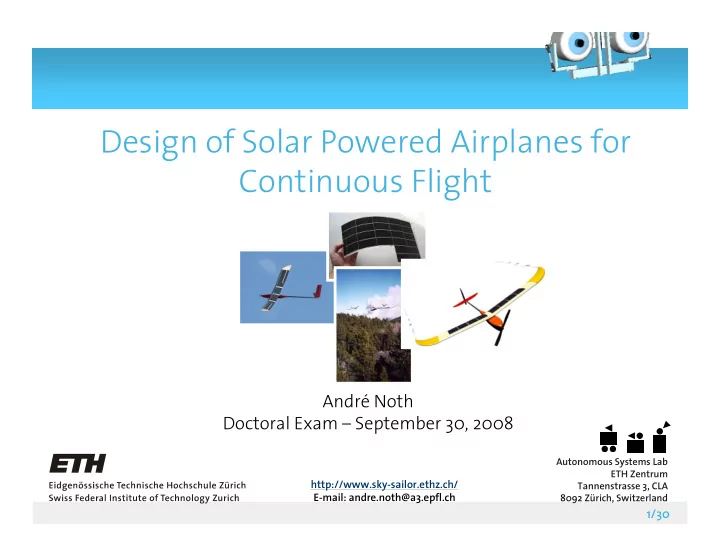
A UTONOMOUS S YSTEMS L AB A UTONOMOUS S YSTEMS L AB Design of Solar Powered Airplanes for Continuous Flight Andr Noth Doctoral Exam September 30, 2008 Autonomous Systems Lab ETH Zentrum http://www.sky-sailor.ethz.ch/ Tannenstrasse 3,


slide-1
SLIDE 1

Autonomous Systems Lab ETH Zentrum Tannenstrasse 3, CLA 8092 Zürich, Switzerland

AUTONOMOUS SYSTEMS LAB AUTONOMOUS SYSTEMS LAB

Design of Solar Powered Airplanes for Continuous Flight

André Noth Doctoral Exam – September 30, 2008

1/30

http://www.sky-sailor.ethz.ch/ E-mail: andre.noth@a3.epfl.ch

slide-2
SLIDE 2

André Noth Phd Defense Autonomous Systems Lab ETH Zürich, 24.09.08

Outline

1/30

  • Introduction
  • Design Methodology
  • Sky-Sailor Design
  • Sky-Sailor Prototype
  • Scaling
  • Conclusion
slide-3
SLIDE 3

André Noth Phd Defense Autonomous Systems Lab ETH Zürich, 24.09.08

Motivations & Objective

2/30

  • Project started with an ESA feasibility study

Introduction

Motivations History of Solar Flight State of the Art Contributions

Design Methodology Sky-Sailor Design Sky-Sailor Prototype Scaling Conclusion

Mars exploration

Satellites + extensive coverage, good resolution

  • place of interest not freely selectable

Rovers + excellent resolution, ground interaction

  • reduced range, limited by terrain

?

Gap for systems with + high-resolution imagery + extensive & selectable coverage

  • Study the feasibility of solar powered flight on Mars
  • Develop and realize a fully functional prototype on Earth

and demonstrate continuous flight

slide-4
SLIDE 4

André Noth Phd Defense Autonomous Systems Lab ETH Zürich, 24.09.08

History of Solar Flight

3/30

70’s 80’s 90’s 2000’s

Introduction

Motivations History of Solar Flight State of the Art Contributions

Design Methodology Sky-Sailor Design Sky-Sailor Prototype Scaling Conclusion

  • Started in 1974
  • 90 solar powered airplanes listed from 1974 to 2008

Sunrise (1974) 1st solar powered flight Solar Riser (1979) manned, battery solar charged for short flights Gossamer Penguin (1980) 1st manned solar powered flight Sunseeker (1990) manned, crossed the USA in 21 flight Solar Challenger (1981) manned, channel crossing Helios (1999) umanned, flew at > 29’000 m Zephyr (2005) umanned, flew 83h Solong (2005) 1st continuous flight, used thermals

slide-5
SLIDE 5

André Noth Phd Defense Autonomous Systems Lab ETH Zürich, 24.09.08

State of the art

4/30

Many solar airplanes in History … but no clear design methodologies explained anyway useful practical papers on case studies [BOUCHER79, MACCREADY83, COLELLA94] Many design methodologies… … but rarely validated with a prototype [REHMET97, WEIDER06] very often nice design methods [IRVING74, YOUNGBLOOD82, BAILEY92] but based on weak models for:

  • Weight prediction
  • Efficiencies

ends with irrealistic designs [RIZZO08, ROMEO04]

Introduction

Motivations History of Solar Flight State of the Art Contributions

Design Methodology Sky-Sailor Design Sky-Sailor Prototype Scaling Conclusion

design method math. models

[ULM96,BRUSS91]

slide-6
SLIDE 6

André Noth Phd Defense Autonomous Systems Lab ETH Zürich, 24.09.08

Contributions

5/30

  • Design methodology

– Simplicity – Large design space – Concrete and experienced based – Flexible and versatile

  • Theory validation with a prototype

– Achieve > 24h flight – Autonomous control

  • Draw up a state of the art on solar aviation

– History – Publications

Introduction

Motivations History of Solar Flight State of the Art Contributions

Design Methodology Sky-Sailor Design Sky-Sailor Prototype Scaling Conclusion

slide-7
SLIDE 7

André Noth Phd Defense Autonomous Systems Lab ETH Zürich, 24.09.08

Design Methodology

6/30

Introduction Design Methodology

Required Energy Solar Energy Weight Models Resolution

Sky-Sailor Design Sky-Sailor Prototype Scaling Conclusion

slide-8
SLIDE 8

André Noth Phd Defense Autonomous Systems Lab ETH Zürich, 24.09.08

Design Methodology

6/30

Energy balance

Introduction Design Methodology

Required Energy Solar Energy Weight Models Resolution

Sky-Sailor Design Sky-Sailor Prototype Scaling Conclusion

Lift L Drag D Thrust T Weight mg

Weight balance

slide-9
SLIDE 9

André Noth Phd Defense Autonomous Systems Lab ETH Zürich, 24.09.08

Methodology

7/30

  • Sizing the airplane : hen & egg problem

?

Airplane Parts

  • Solar cells
  • Battery
  • Airframe
  • Payload

Total weight Aerodynamics & flight conditions Level Flight Power Weight balance Energy balance

  • This loop can be solved:

Iteratively (trying existing components, refining the design) Analytically (using mathematic models of the components) Allows to establish some general design principles

A A B B

Introduction Design Methodology

Required Energy Solar Energy Weight Models Resolution

Sky-Sailor Design Sky-Sailor Prototype Scaling Conclusion

slide-10
SLIDE 10

André Noth Phd Defense Autonomous Systems Lab ETH Zürich, 24.09.08

Required Energy

  • Equilibrium at steady level flight

8/30

2 2

2 2

L D

L mg C Sv D T C Sv ρ ρ = = = =

  • Power required

3 3/2

( ) 2

D level L

C mg P Dv C S ρ = =

  • Daily energy required

night elec tot elec tot day chrg dchrg

T E P T η η ⎛ ⎞ = + ⎜ ⎟ ⎜ ⎟ ⎝ ⎠ 1 1 ( )

electot level ctrl mot grb plr av pld bec

P P P P η η η η η = + +

Introduction Design Methodology

Required Energy Solar Energy Weight Models Resolution

Sky-Sailor Design Sky-Sailor Prototype Scaling Conclusion

level

P

electot

P

grb

η

ctrl

η

mot

η

plr

η

bec

η

av pld

P P +

slide-11
SLIDE 11

André Noth Phd Defense Autonomous Systems Lab ETH Zürich, 24.09.08

Required Energy

8/30

Introduction Design Methodology

Required Energy Solar Energy Weight Models Resolution

Sky-Sailor Design Sky-Sailor Prototype Scaling Conclusion

slide-12
SLIDE 12

André Noth Phd Defense Autonomous Systems Lab ETH Zürich, 24.09.08

Solar Energy

  • Daily average solar irradiance

– Irradiance ~ cosine – Imax Tday = f(date, location, weather)

9/30

  • Daily energy obtained
  • Daily energy required = Daily energy obtained

We compute

/ 2

max day day density wthr

I T E η π =

electot day density sc sc cbr mppt

E E A η η η =

Introduction Design Methodology

Required Energy Solar Energy Weight Models Resolution

Sky-Sailor Design Sky-Sailor Prototype Scaling Conclusion

sc cbr

η η

mppt

η

day density

E

sc

A

electot

E

sc

A

slide-13
SLIDE 13

André Noth Phd Defense Autonomous Systems Lab ETH Zürich, 24.09.08

Required Energy

9/30

Introduction Design Methodology

Required Energy Solar Energy Weight Models Resolution

Sky-Sailor Design Sky-Sailor Prototype Scaling Conclusion

slide-14
SLIDE 14

André Noth Phd Defense Autonomous Systems Lab ETH Zürich, 24.09.08

Weight Prediction Models

  • Fixed Masses

10/30

  • Airplane Structure

– In the literature

  • [BRANDT95, GUGLIERI96,…] consider

valid locally

  • [HALL68] calculated all airframe elements separately

complex, only valid for 1000-3000 lbs airplanes

  • [STENDER69] proposed

very widely adopted adapted by [RIZZO04] to UAV

af

W k S = ⋅

  • Payload
  • Avionic System (Autopilot)

pld

m

av

m

Introduction Design Methodology

Required Energy Solar Energy Weight Models Resolution

Sky-Sailor Design Sky-Sailor Prototype Scaling Conclusion

0.311 0.778 0.467

8.763

af

W n S AR =

0.656 0.651

15.19

af

W S AR =

slide-15
SLIDE 15

André Noth Phd Defense Autonomous Systems Lab ETH Zürich, 24.09.08

Weight Prediction Models

  • Verification of these models

– Database of 415 sailplane – Structure Weight vs Area Models don’t fit well

11/30

Introduction Design Methodology

Required Energy Solar Energy Weight Models Resolution

Sky-Sailor Design Sky-Sailor Prototype Scaling Conclusion

pessimistic

  • ptimistic

3.10 0.25

0.44

af

W b AR− = ⋅

  • New model proposed

– Same equation, new coef. – Least square method fit – Data set divided in two – 5 iterations = 5 qualities – Best 5% model:

Keywords: Wing weight to area , wing area as a function

  • f structural weight, great flight diagram, Tennekes, wing

mass to area, mass to surface, area to mass, surface to mass.

slide-16
SLIDE 16

André Noth Phd Defense Autonomous Systems Lab ETH Zürich, 24.09.08

Weight Prediction Models

Overview

Biologists already studied flying in nature to extract tendencies [TENNEKES92] presented the « Great Flight Diagram » Clear cubic tendancy

Introduction Design Methodology

Required Energy Solar Energy Weight Models Resolution

Sky-Sailor Design Sky-Sailor Prototype Scaling Conclusion

Our model is // to Tennekes curve [STENDER69,RIZZO04] seem incoherent

Keywords: Wing weight to area , wing area as a function

  • f structural weight, great flight diagram, Tennekes, wing

mass to area, mass to surface, area to mass, surface to mass.

slide-17
SLIDE 17

André Noth Phd Defense Autonomous Systems Lab ETH Zürich, 24.09.08

Required Energy

12/30

Introduction Design Methodology

Required Energy Solar Energy Weight Models Resolution

Sky-Sailor Design Sky-Sailor Prototype Scaling Conclusion

slide-18
SLIDE 18

André Noth Phd Defense Autonomous Systems Lab ETH Zürich, 24.09.08

Weight Prediction Models

  • Solar Cells

– Surface = f(cells properties, required energy) – Weight proportionnal to the surface

  • Maximum Power Point Tracker

– Study of high efficiency MPPT Weight linear with Pmax

13/30

  • Batterie

– Weight proportionnal to capacity

( )

sc sc sc enc

m A k k = +

m

I

mppt mppt sol max mppt ax sc cbr mppt sc

m k P k A η η η = =

night bat elec tot dchrg bat

T m P k η =

Introduction Design Methodology

Required Energy Solar Energy Weight Models Resolution

Sky-Sailor Design Sky-Sailor Prototype Scaling Conclusion

slide-19
SLIDE 19

André Noth Phd Defense Autonomous Systems Lab ETH Zürich, 24.09.08

Required Energy

13/30

Introduction Design Methodology

Required Energy Solar Energy Weight Models Resolution

Sky-Sailor Design Sky-Sailor Prototype Scaling Conclusion

slide-20
SLIDE 20

André Noth Phd Defense Autonomous Systems Lab ETH Zürich, 24.09.08

Weight Prediction Models

  • Propulsion group

– Existing models but none is proven on a large range – Very large databases created 2264 motors 170 electronics controllers 997 gearboxes 673 propellers

14/30

Introduction Design Methodology

Required Energy Solar Energy Weight Models Resolution

Sky-Sailor Design Sky-Sailor Prototype Scaling Conclusion

Interpolated Models

Keywords: Mass to power ratio of motors / Power to mass ratio of electrical motors, piezoelectric motors, Motor mass to power ratio / Motor power to mass ratio of electromagnetic motors, brushed and brushless motors energy density, power density, density of energy, density of power.

slide-21
SLIDE 21

André Noth Phd Defense Autonomous Systems Lab ETH Zürich, 24.09.08

Summary and Resolution

15/30

Mission parameters Others: Technological parameters Airplane’s shape variables Search b and AR for which the loop has a solution

Introduction Design Methodology

Required Energy Solar Energy Weight Models Resolution

Sky-Sailor Design Sky-Sailor Prototype Scaling Conclusion

slide-22
SLIDE 22

André Noth Phd Defense Autonomous Systems Lab ETH Zürich, 24.09.08

Sky-Sailor Design

16/30

Introduction Design Methodology Sky-Sailor Design

  • Math. Application

Real-Time Simulation

Sky-Sailor Prototype Scaling Conclusion

slide-23
SLIDE 23

André Noth Phd Defense Autonomous Systems Lab ETH Zürich, 24.09.08

Methodology application

  • Mission parameters

– Solar flight possible 3 months in summer (Tday=13.2h) – 50g payload consuming 0.5W – Flight location CH, at 500m above sea level

16/30

Introduction Design Methodology Sky-Sailor Design

  • Meth. Application

Real-Time Simulation

Sky-Sailor Prototype Scaling Conclusion

slide-24
SLIDE 24

André Noth Phd Defense Autonomous Systems Lab ETH Zürich, 24.09.08

Methodology application

  • Sky-Sailor Layout

– 3.2m wingspan – 0.78m2 wing area (0.525m2 covered by cells) – 14.2W for level flight (electrical)

16/30

Introduction Design Methodology Sky-Sailor Design

  • Meth. Application

Real-Time Simulation

Sky-Sailor Prototype Scaling Conclusion

slide-25
SLIDE 25

André Noth Phd Defense Autonomous Systems Lab ETH Zürich, 24.09.08

Real-Time Simulation

Objectives

– Validate the design – Analyze energy flows on the airplane each second – Rapidly see influence of parameters change

17/30

Introduction Design Methodology Sky-Sailor Design

  • Meth. Application

Real-Time Simulation

Sky-Sailor Prototype Scaling Conclusion

slide-26
SLIDE 26

André Noth Phd Defense Autonomous Systems Lab ETH Zürich, 24.09.08

Real-Time Simulation

Simulation of a 48 h flight

– On the 21st of June – On the 4th of August (+1.5 month)

18/30

Introduction Design Methodology Sky-Sailor Design

  • Meth. Application

Real-Time Simulation

Sky-Sailor Prototype Scaling Conclusion

slide-27
SLIDE 27

André Noth Phd Defense Autonomous Systems Lab ETH Zürich, 24.09.08

Sky-Sailor Prototype

19/30

Introduction Design Methodology Sky-Sailor Design Sky-Sailor Prototype

Config & Structure Aerodynamics Solar Generator Propulsion Autopilot Modeling & Control Experiments

Scaling Conclusion
slide-28
SLIDE 28

André Noth Phd Defense Autonomous Systems Lab ETH Zürich, 24.09.08

Sky-Sailor Prototype

19/30

Configuration

3 axis glider, V-tail, constant chord Adapted from « Avance » record airplane of W. Engel Naturally stable

Structure

Composite materials (Carbon, Aramide, Balsa) Spar-Ribs construction method Wingspan 3.2 m Surface 0.776 m2 Empty Weight 0.725 kg

Introduction Design Methodology Sky-Sailor Design Sky-Sailor Prototype

Config & Structure Aerodynamics Solar Generator Propulsion Autopilot Modeling & Control Experiments

Scaling Conclusion

slide-29
SLIDE 29

André Noth Phd Defense Autonomous Systems Lab ETH Zürich, 24.09.08

Aerodynamics

20/30

Dedicated Airfoil we3.55-9.3

Nominal flight speed 8.4 m/s Nominal flight power (2.55 kg) 9 W Glide ratio 23.5 Vertical glide speed 0.35 m/s

Introduction Design Methodology Sky-Sailor Design Sky-Sailor Prototype

Config & Structure Aerodynamics Solar Generator Propulsion Autopilot Modeling & Control Experiments

Scaling Conclusion

slide-30
SLIDE 30

André Noth Phd Defense Autonomous Systems Lab ETH Zürich, 24.09.08

Solar Generator

21/30

216 RWE solar cells (17% eff, ~90 W max)

– encapsulated into 3 solar panels – non reflective encapsulation

Maximum Power Point tracker

– 97 % efficiency for 25 g and 90 W

Lithium-Ion battery

– 250 Wh, 1.056 kg 240 Wh/kg – cycle efficiency 94.8 %

Introduction Design Methodology Sky-Sailor Design Sky-Sailor Prototype

Config & Structure Aerodynamics Solar Generator Propulsion Autopilot Modeling & Control Experiments

Scaling Conclusion

slide-31
SLIDE 31

André Noth Phd Defense Autonomous Systems Lab ETH Zürich, 24.09.08

Propulsion group

22/30

High efficiency Propeller from E. Schöberl

– 60 cm diameter – Carbon

– 85.6 % efficiency

Program created to select the best motor & gearbox combination

  • ut of 2600 motors

Gearbox

– Spur gearhead, own development

Brushless Motor (LRK Strecker)

– 86.8% efficiency – Excellent cooling – Low weight

Jeti Advance 45 Opto Plus brushless controller

Introduction Design Methodology Sky-Sailor Design Sky-Sailor Prototype

Config & Structure Aerodynamics Solar Generator Propulsion Autopilot Modeling & Control Experiments

Scaling Conclusion

slide-32
SLIDE 32

André Noth Phd Defense Autonomous Systems Lab ETH Zürich, 24.09.08

Autopilot

23/30

Introduction Design Methodology Sky-Sailor Design Sky-Sailor Prototype

Config & Structure Aerodynamics Solar Generator Propulsion Autopilot Modeling & Control Experiments

Scaling Conclusion

  • Special needs (solar panels monitoring,…)
  • Extreme weight & power constraints

Own Control & Navigation System

Link to videos:

http://www.sky-sailor.ethz.ch/videos.htm

slide-33
SLIDE 33

André Noth Phd Defense Autonomous Systems Lab ETH Zürich, 24.09.08

Modeling & Control

Goals Tune controller parameters Test Navigation algorithms Evaluate airplane capabilities

24/30

7 1 7 1 = =

= + + = + × + ×

∑ ∑

tot prop Li di i tot i Li i di i i

F F F F M M F r F r

1 2 2 2

( , ) 2 2 2 ρ ρ ρ = = = = ⋅

  • prop

li li i di di i i mi i i

F f x U F C S v F C S v M C S v chord

[ ] [ ] [ ] [ ] [ ]

1 1 1 2 5 5 5 3 6 6 6 4 7 7 7 5

( , ) ( ) fori=2,3,4 ( , ) ( , ) ( , ) = = = = =

l d m i li di mi i l d m i l d m i l d m i

C C C f Aoa U C C C f Aoa C C C f Aoa U C C C f Aoa U C C C f Aoa U

Introduction Design Methodology Sky-Sailor Design Sky-Sailor Prototype

Config & Structure Aerodynamics Solar Generator Propulsion Autopilot Modeling & Control Experiments

Scaling Conclusion

slide-34
SLIDE 34

André Noth Phd Defense Autonomous Systems Lab ETH Zürich, 24.09.08

25/30

Experiments

  • Several tests with subgroups

– Efficiencies increase – Weight reduction – Adding functionnalities – Safety increase

Introduction Design Methodology Sky-Sailor Design Sky-Sailor Prototype

Config & Structure Aerodynamics Solar Generator Propulsion Autopilot Modeling & Control Experiments

Scaling Conclusion

  • Flight tests with a

non-solar proto

– Aerodynamics validation – Power consumption verification – Autopilot electronic tests – Control & Navigation tuning

  • Flight tests with the Sky-Sailor

– Solar charge – Long flights (>3h) – 24 hours flight

Flight videos:

http://www.sky-sailor.ethz.ch/videos.htm

slide-35
SLIDE 35

André Noth Phd Defense Autonomous Systems Lab ETH Zürich, 24.09.08

27 hours flight, 21st of June 2008

Conditions

– Excellent irradiance – Bad wind conditions more power needed during the day

Achievements

– Duration: 27h05 – Distance: 874 km – Av. speed: 8.4 m/s – Mean power: 23+1.9W – Eused: 675 Wh – Eobtained: 768 Wh

25/30

Introduction Design Methodology Sky-Sailor Design Sky-Sailor Prototype

Config & Structure Aerodynamics Solar Generator Propulsion Autopilot Modeling & Control Experiments

Scaling Conclusion

Continuous flight proved to be feasible without thermic or altitude gain

slide-36
SLIDE 36

André Noth Phd Defense Autonomous Systems Lab ETH Zürich, 24.09.08

Scaling & Other considerations

26/30

Introduction Design Methodology Sky-Sailor Design Sky-Sailor Prototype Scaling

Down: MAV Up: Manned & Hale Epot & Thermal

Conclusion

slide-37
SLIDE 37

André Noth Phd Defense Autonomous Systems Lab ETH Zürich, 24.09.08

Down Scaling

26/30

Introduction Design Methodology Sky-Sailor Design Sky-Sailor Prototype Scaling

Down: MAV Up: Manned & Hale Epot & Thermal

Conclusion

Drawbacks

– Efficiency of propulsion group – At low power, DC motor but no BLDC – Efficiency of aerodynamic (low Re) – Servos below 5 grams poor quality – High Edensity batt not easily scalable – Autopilot sensors limited (due to weight, ex: no tiny GPS or IMU – Silicon solar cells scale in 2D (not 3D)

  • Not flexible for low radius
  • Weight percentage

– MPPT efficiency (Vdiode loss/VMPPT ) No 24h solar flight at MAV size, but day flight possible

slide-38
SLIDE 38

André Noth Phd Defense Autonomous Systems Lab ETH Zürich, 24.09.08

Up Scaling

Introduction Design Methodology Sky-Sailor Design Sky-Sailor Prototype Scaling

Down: MAV Up: Manned & Hale Epot & Thermal

Conclusion

Drawback

– Structure weight ~ b3

27/30

– Theory said it should be ~ b2 The bigger they are, the lighter the construction method has to be Fragility & Risks Continuous flight possible

  • nly for 1 or 2 passengers but…

Low speed (long flights) No comfort possible

slide-39
SLIDE 39

André Noth Phd Defense Autonomous Systems Lab ETH Zürich, 24.09.08

Potential Energy & Thermal soaring

Two possibilities to increase flight endurance are:

– Use of altitude to store energy + less battery needed

  • altitude varies aerodynamics not optimized for a

fixed density – Thermal soaring + free climbing, save energy

  • require a method to detect & soar thermal

Introduction Design Methodology Sky-Sailor Design Sky-Sailor Prototype Scaling

Down: MAV Up: Manned & Hale Epot & Thermal

Conclusion

28/30

slide-40
SLIDE 40

André Noth Phd Defense Autonomous Systems Lab ETH Zürich, 24.09.08

Conclusion

  • Methodology developed

– Simple and versatile – Valid on a large range – Solid weight & efficiency models – Allows fast feasibility studies – Allows to identify bottle necks

  • Prototype built

– Validation of the design – Continuous flight proven – Very good know-how acquired

29/30

Introduction Design Methodology Sky-Sailor Design Sky-Sailor Prototype Scaling Conclusion

slide-41
SLIDE 41

André Noth Phd Defense Autonomous Systems Lab ETH Zürich, 24.09.08

Conclusion

  • Scaling problems

– Down: efficiencies and aerodynamics – Up: large wing structure

  • Outlook

– Increase # parameters (efficiency = f(power)) – Flight algorithm learning energy saving – Thermal soaring – Building: improve costs, time & robustness

29/30

Introduction Design Methodology Sky-Sailor Design Sky-Sailor Prototype Scaling Conclusion

slide-42
SLIDE 42

André Noth Phd Defense Autonomous Systems Lab ETH Zürich, 24.09.08

Future of solar aviation

  • MAV size

– Needs still many improvements (eff, aerodynamics, batteries)

  • At 2-10 meters

– Forest fire monitoring – Pipeline surveillance – … In 10 years with tech. improvements (batteries, solar cell)

  • HALE

– Act as mobile phone antenna – Real need to stay airborne Will require many improvements (structure,batteries)

  • Manned airplane (transportation)

– High fragility, risks and long trips – Even with a 100% eff. airplane, problem is the sun! A better idea would be to: Transform Esolar on the ground H2 Use H2 in flight (fuel cell & electrical motor)

29/30

Introduction Design Methodology Sky-Sailor Design Sky-Sailor Prototype Scaling Conclusion

slide-43
SLIDE 43

André Noth Phd Defense Autonomous Systems Lab ETH Zürich, 24.09.08

Thank you for your attention

29/30

Questions ?

Introduction Design Methodology Sky-Sailor Design Sky-Sailor Prototype Scaling Conclusion

Special Thanks to:

– Prof. Siegwart and the entire ASL – Walter Engel & all the people who worked on the project – Doctoral comity

slide-44
SLIDE 44

André Noth Phd Defense Autonomous Systems Lab ETH Zürich, 24.09.08

Appendices

  • Solar Generator

– Spectrum, Albedo, Sun angle – Tday & Imax – Best research cell efficiencies – I-V curve – MPPT – Integration in the wing

  • Energy Storage

– All solutions – Energy density of fuel – Lithium-Ion battery evolution

  • Propulsion Group

– Motors – Propeller – Weight prediction models

  • Autopilot

– Schematic – Telemetry – Power consumption – Placement – GUI (thermals) – Simulation & modeling 29/30

Introduction Design Methodology Sky-Sailor Design Sky-Sailor Prototype Scaling Conclusion

  • Overall

– Energy Chain – Solar Airplane: light and slow – Weight-Power-Autonomy – Methodology Resolution – 30 Parameters – Weight distribution

  • Applications

– Potential applications – Sky-Sailor – MAV – Manned – HALE – Mars

  • Other

– Using thermals – Sun Surfer – Design phases – Airframe model – 27 hours flight

slide-45
SLIDE 45

André Noth Phd Defense Autonomous Systems Lab ETH Zürich, 24.09.08

Solar Generator

Solar Generator

slide-46
SLIDE 46

André Noth Phd Defense Autonomous Systems Lab ETH Zürich, 24.09.08

Solar Energy

Solar Spectrum Direct, diffused and reflected light Angle of incidence variation

slide-47
SLIDE 47

André Noth Phd Defense Autonomous Systems Lab ETH Zürich, 24.09.08

Variation of Tday and Imax along year

slide-48
SLIDE 48

André Noth Phd Defense Autonomous Systems Lab ETH Zürich, 24.09.08

Solar Cells Research

slide-49
SLIDE 49

André Noth Phd Defense Autonomous Systems Lab ETH Zürich, 24.09.08

Solar Cell

slide-50
SLIDE 50

André Noth Phd Defense Autonomous Systems Lab ETH Zürich, 24.09.08

MPPT

slide-51
SLIDE 51

André Noth Phd Defense Autonomous Systems Lab ETH Zürich, 24.09.08

Solar cells integration Structure

slide-52
SLIDE 52

André Noth Phd Defense Autonomous Systems Lab ETH Zürich, 24.09.08

Energy storage

Energy Storage

slide-53
SLIDE 53

André Noth Phd Defense Autonomous Systems Lab ETH Zürich, 24.09.08

Energy storage solutions

slide-54
SLIDE 54

André Noth Phd Defense Autonomous Systems Lab ETH Zürich, 24.09.08

Energy Storage

Energy density of some reactants [kWh/kg] (LHV Lower heating value)

Hydrogen 33.3 Methane 13.9 Propane 12.9 Gasoline 12.2 Diesel 11.7 Ethanol 7.5 Methanol 5.6 Best 2008 LiIon Battery 0.2 Sugar 4.4 Oil (Colza,…) 10.4 10 20 30

Important to keep in mind Availability / Efficiency of converters

slide-55
SLIDE 55

André Noth Phd Defense Autonomous Systems Lab ETH Zürich, 24.09.08

Lithium-Ion battery evolution

Energy density + 6.6%/year Price

  • 17%/year
slide-56
SLIDE 56

André Noth Phd Defense Autonomous Systems Lab ETH Zürich, 24.09.08

Propulsion Group

Propulsion Group

slide-57
SLIDE 57

André Noth Phd Defense Autonomous Systems Lab ETH Zürich, 24.09.08

Motors

slide-58
SLIDE 58

André Noth Phd Defense Autonomous Systems Lab ETH Zürich, 24.09.08

Propeller

Efficiency [-]

Designed by E. Schöberl

  • « Master of Prop »
  • Also worked on Icaré and other solar

airplanes

slide-59
SLIDE 59

André Noth Phd Defense Autonomous Systems Lab ETH Zürich, 24.09.08

Weight prediction models

Brushless controllers Gearboxes Propellers

slide-60
SLIDE 60

André Noth Phd Defense Autonomous Systems Lab ETH Zürich, 24.09.08

Autopilot

Autopilot

slide-61
SLIDE 61

André Noth Phd Defense Autonomous Systems Lab ETH Zürich, 24.09.08

Autopilot overview

slide-62
SLIDE 62

André Noth Phd Defense Autonomous Systems Lab ETH Zürich, 24.09.08

Telemetry

slide-63
SLIDE 63

André Noth Phd Defense Autonomous Systems Lab ETH Zürich, 24.09.08

Autopilot power consumption

slide-64
SLIDE 64

André Noth Phd Defense Autonomous Systems Lab ETH Zürich, 24.09.08

Element placement in fuselage

slide-65
SLIDE 65

André Noth Phd Defense Autonomous Systems Lab ETH Zürich, 24.09.08

GUI (thermals)

slide-66
SLIDE 66

André Noth Phd Defense Autonomous Systems Lab ETH Zürich, 24.09.08

Modeling & Simulation

slide-67
SLIDE 67

André Noth Phd Defense Autonomous Systems Lab ETH Zürich, 24.09.08

Overall Overall

slide-68
SLIDE 68

André Noth Phd Defense Autonomous Systems Lab ETH Zürich, 24.09.08

Energy chain

A succession of losses…. Important to efficiencies

slide-69
SLIDE 69

André Noth Phd Defense Autonomous Systems Lab ETH Zürich, 24.09.08

Why are solar airplanes large and slow ?

2

1 2

L

L C S v ρ = Thrust T Weight mg

2

1 2

D

D C S v ρ = Speed v

  • 2. Ratio between L and D is equal to CL/CD

x

D L

C C

  • 1. Equilibrium of forces

the same ratio occurs between thrust and weight independent of v, it only requires Sv2 constant

x

D L

C C

  • 3. Power for level flight is thus

required

P = T v = (mg / ) v

D L

C C ⋅ ⋅ ⋅

  • 4. A way to reduce the power is to lower the speed v

in order to keep the lift (Sv2 constant), S needs to be increased Solar airplanes generally have large wings and a low speed

slide-70
SLIDE 70

André Noth Phd Defense Autonomous Systems Lab ETH Zürich, 24.09.08

Weight – Power - Autonomy

slide-71
SLIDE 71

André Noth Phd Defense Autonomous Systems Lab ETH Zürich, 24.09.08

Methodology Resolution

ctrl payload struct solar batt mppt prop

m m m m m m m m = + + + + + +

( )

( )

( )

( )

1 10 11

3 2

1

x 0 1 7 8 9 5 6 2 7 9 5 6 3 4 a a

m a a a a a a a m a a a a a a a b b − + + + = + + + +

  • The equation of the total mass is

It can be shown that it has a solution if:

  • 1

13 12

3 2 10 11 4

1

x a a

m a m a a b b − = +

  • 2

12 13

4 27 a a ≤

slide-72
SLIDE 72

André Noth Phd Defense Autonomous Systems Lab ETH Zürich, 24.09.08

30 Parameters

slide-73
SLIDE 73

André Noth Phd Defense Autonomous Systems Lab ETH Zürich, 24.09.08

Sky-Sailor weight distributions

slide-74
SLIDE 74

André Noth Phd Defense Autonomous Systems Lab ETH Zürich, 24.09.08

Applications Applications

slide-75
SLIDE 75

André Noth Phd Defense Autonomous Systems Lab ETH Zürich, 24.09.08

Potential Applications

  • high altitude communication platform
  • law enforcement
  • border surveillance
  • forest fire fighting
  • power line inspection
slide-76
SLIDE 76

André Noth Phd Defense Autonomous Systems Lab ETH Zürich, 24.09.08

Sky-Sailor

What is the influence of battery technology on the maximal flying altitude ?

slide-77
SLIDE 77

André Noth Phd Defense Autonomous Systems Lab ETH Zürich, 24.09.08

MAV

slide-78
SLIDE 78

André Noth Phd Defense Autonomous Systems Lab ETH Zürich, 24.09.08

MAV

slide-79
SLIDE 79

André Noth Phd Defense Autonomous Systems Lab ETH Zürich, 24.09.08

Manned

slide-80
SLIDE 80

André Noth Phd Defense Autonomous Systems Lab ETH Zürich, 24.09.08

Manned

slide-81
SLIDE 81

André Noth Phd Defense Autonomous Systems Lab ETH Zürich, 24.09.08

HALE Platform

Payload: 300 Kg Altitude: 21’000 m Mission time: 3 months in summer

slide-82
SLIDE 82

André Noth Phd Defense Autonomous Systems Lab ETH Zürich, 24.09.08

HALE Platform

slide-83
SLIDE 83

André Noth Phd Defense Autonomous Systems Lab ETH Zürich, 24.09.08

HALE Platform

slide-84
SLIDE 84

André Noth Phd Defense Autonomous Systems Lab ETH Zürich, 24.09.08

Mars design

slide-85
SLIDE 85

André Noth Phd Defense Autonomous Systems Lab ETH Zürich, 24.09.08

Mars design

slide-86
SLIDE 86

André Noth Phd Defense Autonomous Systems Lab ETH Zürich, 24.09.08

Storing Potential Energy

slide-87
SLIDE 87

André Noth Phd Defense Autonomous Systems Lab ETH Zürich, 24.09.08

Using Thermals

Link to videos:

http://www.sky-sailor.ethz.ch/videos.htm

slide-88
SLIDE 88

André Noth Phd Defense Autonomous Systems Lab ETH Zürich, 24.09.08

Sun-Surfer

Sun-Surfer I Wingspan: 0.77 meters Weight: 115 g P level flight: 1 W P solar : 3 W Sun-Surfer II Wingspan: 0.78 meters Weight: 190 g P level flight: 2.4 W P solar : 8 W Objective: reduce the scale and cost develop low-cost solar MAVs with payload capacity of ~40 gr

slide-89
SLIDE 89

André Noth Phd Defense Autonomous Systems Lab ETH Zürich, 24.09.08

Design Phases

slide-90
SLIDE 90

André Noth Phd Defense Autonomous Systems Lab ETH Zürich, 24.09.08

Airframe model

slide-91
SLIDE 91

André Noth Phd Defense Autonomous Systems Lab ETH Zürich, 24.09.08

27 hours flight

slide-92
SLIDE 92

André Noth Phd Defense Autonomous Systems Lab ETH Zürich, 24.09.08

27 hours flight