Design Features of P-180 Avanti Mild Anhedral in Canards Canard - - PowerPoint PPT Presentation

design features of p 180 avanti
SMART_READER_LITE
LIVE PREVIEW

Design Features of P-180 Avanti Mild Anhedral in Canards Canard - - PowerPoint PPT Presentation

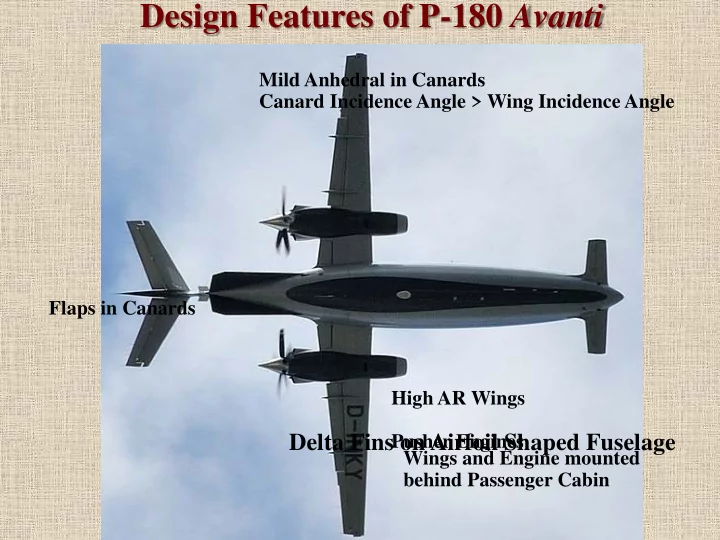
Design Features of P-180 Avanti Mild Anhedral in Canards Canard Incidence Angle > Wing Incidence Angle Flaps in Canards High AR Wings Delta Fins on Airfoil Shaped Fuselage Pusher Engines Wings and Engine mounted behind Passenger Cabin


slide-1
SLIDE 1

High AR Wings Pusher Engines Wings and Engine mounted behind Passenger Cabin

Design Features of P-180 Avanti

Mild Anhedral in Canards Canard Incidence Angle > Wing Incidence Angle Flaps in Canards

Delta Fins on Airfoil Shaped Fuselage

slide-2
SLIDE 2

Design Features of P-180 Avanti

Mild Anhedral in Canards Canard Incidence Angle > Wing Incidence Angle

slide-3
SLIDE 3

Design Features of P-180 Avanti

Flaps in Canards

slide-4
SLIDE 4

Design Features of P-180 Avanti

Delta Fins on Airfoil Shaped Fuselage

slide-5
SLIDE 5

High AR Wings Pusher Engines

Design Features of P-180 Avanti

slide-6
SLIDE 6

Avanti EVO

P-180 Avanti Avanti EVO

slide-7
SLIDE 7
  • Nearly equivalent to span extension w/o increased root bending moment
  • Used where span limitations are important
  • Good wingtip flow crucial to lower drag
  • The local flow field is extremely non uniform:

Requires advanced computational aerodynamics methods to design.

Why Winglets?

slide-8
SLIDE 8

 Improved performance  Vertical Takeoff and Landing Capability

Why Thrust Vectoring ?

F-35 Lightening-II perhaps USA’s last manned fighter aircraft ??

slide-9
SLIDE 9

So Where Have We Come So Far? 747 Productivity improvement

From Boeing

slide-10
SLIDE 10

FEW NOVEL CONCEPTS

slide-11
SLIDE 11

Blended Wing Body

  • Concept from Bob Liebeck (Douglas A/C)
  • Less wetted area (no fuselage as such)
  • Possibly more efficient structure
  • This is now the X-48 series of planes
slide-12
SLIDE 12
  • Concept by R.T. Jones of NASA
  • Fore-aft symmetry of lift
  • Better area distribution
  • Possibly only “practical” SST
  • Flying wing version also

Oblique Wing Supersonic Transport

slide-13
SLIDE 13

Mother-Daughter Configuration

Burt Rutan: Still imagineering! The White Knight SpaceShipOne

Pictures from the Scaled Composites web site

slide-14
SLIDE 14

Strut Braced Wing

  • Werner Pfenninger’s strut-braced wing concept from 1954
  • The strut allows a thinner wing without a weight penalty
  • Also a higher aspect ratio (span), less induced drag
  • Reduced t/c allows less sweep without a wave drag penalty
  • Reduced sweep leads to even lower wing weight
  • Reduced sweep allows for some natural laminar flow
  • Reduced skin friction drag
  • Needs MDO to make it work
slide-15
SLIDE 15

Lockheed, Virginia Tech, NASA Team

Compared to a conventional cantilever design:

  • 12-15% less takeoff weight
  • 20-29% less fuel
  • less noise and emissions
slide-16
SLIDE 16

Recent Configuration (2010)

Courtesy Ohad Gur

slide-17
SLIDE 17

And Hope for Low-Sonic Boom Noise Flight

A modified F-5E demonstrated a low- noise boom on Aug. 27, 2003 So-called “boom shaping” can be used to reduce the part of the boom that hits the ground. NASA Press Release,

  • Sept. 4, 2003
slide-18
SLIDE 18

U C A V

Northrop Grumman Corporation, reprinted by Aviation Week, June 16, 1997

The vertical tail is eliminated for stealth, directional control comes from specially coordinated trailing edge deflections

slide-19
SLIDE 19

Micro AVs

AeroVironment, Inc. Black Widow

  • 6-inch span fixed-wing aircraft
  • Live video downlink
  • Portable launch/control box
  • Pneumatic launcher
  • 60 gram mass
  • 22-minute endurance
  • Estimated 10 km range
  • Electric propulsion
  • World MAV endurance record of 22 minutes
  • Smallest video camera ever flown on a UAV: 2 grams
  • Smallest live video downlink ever flown on a UAV
  • World’s smallest, lightest multi-function, fully

proportional radio control system: 3 grams

  • First aircraft to be flown “heads-down” indoors

Achievements

slide-20
SLIDE 20

The Anatomy of the Airplane, by Darrol Stinton. Few equations and deceptively simple, but it’s not. Lots of good information. Design for Air Combat by Ray Whitford. Takes a deeper look at the details, again without equations and with lots of good graphics showing typical data to use deciding on design options. The title suggests a much narrower focus than the book has. Aircraft Design: A Conceptual Approach, by Daniel Raymer. Chapter 8, “Special Considerations in Configuration Layout” and Chapter 22, “Design of Unique Aircraft Concepts” is good once you’ve read the first two references. Airplane Design, Pt. II Preliminary Configuration Design etc., by Jan

  • Roskam. Chapter 3, and 3.3 “Unusual Configurations”, in

particular.

To Learn More, Read These:
slide-21
SLIDE 21

There is Still Enough Room for Dreamers

We don’t yet know what the ultimate airplane concept is. Concerning the comments on configurations given above, Remember:

there is a time and place for everything.. If you can justify it, you can have it !

slide-22
SLIDE 22

LAYOUT & CONFIGURATION

Next Topic