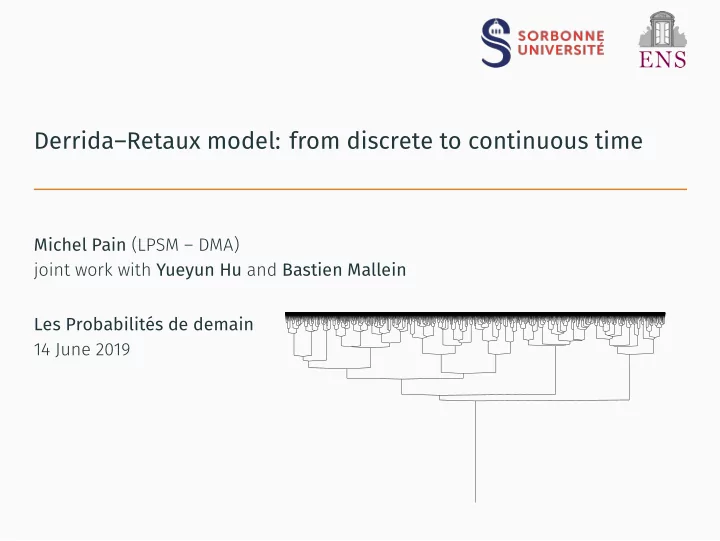
SLIDE 1
Derrida–Retaux model: from discrete to continuous time
Michel Pain (LPSM – DMA) joint work with Yueyun Hu and Bastien Mallein Les Probabilités de demain 14 June 2019
SLIDE 2
Discrete-time Derrida–Retaux model
SLIDE 3
Defjnition
⊲ Introduced by Collet–Eckmann–Glaser–Martin (1984), motivated by spin glass theory. Re-introduced by Derrida–Retaux (2014) for studying the depinning transition. Defjnition: Start with a nonnegative random variable X0 and, for any n 0, Xn
1
Xn Xn 1 where Xn is an independent copy of Xn.
1/12
SLIDE 4
Defjnition
⊲ Introduced by Collet–Eckmann–Glaser–Martin (1984), motivated by spin glass theory. ⊲ Re-introduced by Derrida–Retaux (2014) for studying the depinning transition. Defjnition: Start with a nonnegative random variable X0 and, for any n 0, Xn
1
Xn Xn 1 where Xn is an independent copy of Xn.
1/12
SLIDE 5 Defjnition
⊲ Introduced by Collet–Eckmann–Glaser–Martin (1984), motivated by spin glass theory. ⊲ Re-introduced by Derrida–Retaux (2014) for studying the depinning transition. ⊲ Defjnition: Start with a nonnegative random variable X0 and, for any n ≥ 0, Xn+1 =
Xn − 1
where Xn is an independent copy of Xn.
1/12
SLIDE 6
Defjnition on a tree
Construction of Xn on a binary tree: n 2 3 1 4 1 3 i.i.d. copies of X0 Xn
2/12
SLIDE 7
Defjnition on a tree
Construction of Xn on a binary tree: n 2 3 1 4 1 3 1 3 3 2 i.i.d. copies of X0 Xn a b (a + b − 1)+
2/12
SLIDE 8
Defjnition on a tree
Construction of Xn on a binary tree: n 2 3 1 4 1 3 1 3 3 2 5 1 i.i.d. copies of X0 Xn a b (a + b − 1)+
2/12
SLIDE 9
Defjnition on a tree
Construction of Xn on a binary tree: n 2 3 1 4 1 3 1 3 3 2 5 1 4 i.i.d. copies of X0 Xn a b (a + b − 1)+
2/12
SLIDE 10
Defjnition on a tree
Construction of Xn on a binary tree: n 2 3 1 4 1 3 1 3 3 2 5 1 4 3 i.i.d. copies of X0 Xn a b (a + b − 1)+ Xn
2/12
SLIDE 11
Phase transition
Free energy: F∞ := lim
n→∞
E[Xn] 2n ∈ [0, ∞]. Theorem (Collet–Eckmann–Glaser–Martin 1984): Assume that X0 a.s. (Supercritical) If X02X0 2X0 or 2X0 , then F and Xn 2n
a.s. n
F (Subcritical) If X02X0 2X0 , then F and Xn
probability n 3/12
SLIDE 12
Phase transition
Free energy: F∞ := lim
n→∞
E[Xn] 2n ∈ [0, ∞]. Theorem (Collet–Eckmann–Glaser–Martin 1984): Assume that X0 ∈ N a.s. (Supercritical) If X02X0 2X0 or 2X0 , then F and Xn 2n
a.s. n
F (Subcritical) If X02X0 2X0 , then F and Xn
probability n 3/12
SLIDE 13 Phase transition
Free energy: F∞ := lim
n→∞
E[Xn] 2n ∈ [0, ∞]. Theorem (Collet–Eckmann–Glaser–Martin 1984): Assume that X0 ∈ N a.s. ⊲ (Supercritical) If E
> E
= ∞, then F∞ > 0 and Xn 2n
a.s.
− − − →
n→∞ F∞.
(Subcritical) If X02X0 2X0 , then F and Xn
probability n 3/12
SLIDE 14 Phase transition
Free energy: F∞ := lim
n→∞
E[Xn] 2n ∈ [0, ∞]. Theorem (Collet–Eckmann–Glaser–Martin 1984): Assume that X0 ∈ N a.s. ⊲ (Supercritical) If E
> E
= ∞, then F∞ > 0 and Xn 2n
a.s.
− − − →
n→∞ F∞.
⊲ (Subcritical) If E
≤ E
< ∞, then F∞ = 0 and Xn
probability
− − − − − − →
n→∞
0.
3/12
SLIDE 15 Free energy near criticality
⊲ Let µ be a probability measure on (0, ∞), in the supercritical phase. Consider X0
(d) 1
p p for each p 0 1 . Let F p denote the free energy and pc inf p 0 1 F p 0 . p F p pc 1 1
2
pc
1 5
Conjecture (Derrida–Retaux 2014): If pc 0, F p exp K
p pc 1 2 . Theorem (Chen–Dagard–Derrida–Hu–Lifshits–Shi 2019+): If is supported by and x32x dx , then as p pc F p exp 1 p pc 1 2
4/12
SLIDE 16 Free energy near criticality
⊲ Let µ be a probability measure on (0, ∞), in the supercritical phase. ⊲ Consider X0
(d)
= (1 − p)δ0 + pµ for each p ∈ [0, 1]. Let F p denote the free energy and pc inf p 0 1 F p 0 . p F p pc 1 1
2
pc
1 5
Conjecture (Derrida–Retaux 2014): If pc 0, F p exp K
p pc 1 2 . Theorem (Chen–Dagard–Derrida–Hu–Lifshits–Shi 2019+): If is supported by and x32x dx , then as p pc F p exp 1 p pc 1 2
4/12
SLIDE 17 Free energy near criticality
⊲ Let µ be a probability measure on (0, ∞), in the supercritical phase. ⊲ Consider X0
(d)
= (1 − p)δ0 + pµ for each p ∈ [0, 1]. ⊲ Let F∞(p) denote the free energy and pc := inf{p ∈ [0, 1] : F∞(p) > 0}. p F∞(p) pc 1 1 µ = δ2 pc = 1
5
Conjecture (Derrida–Retaux 2014): If pc 0, F p exp K
p pc 1 2 . Theorem (Chen–Dagard–Derrida–Hu–Lifshits–Shi 2019+): If is supported by and x32x dx , then as p pc F p exp 1 p pc 1 2
4/12
SLIDE 18 Free energy near criticality
⊲ Let µ be a probability measure on (0, ∞), in the supercritical phase. ⊲ Consider X0
(d)
= (1 − p)δ0 + pµ for each p ∈ [0, 1]. ⊲ Let F∞(p) denote the free energy and pc := inf{p ∈ [0, 1] : F∞(p) > 0}. p F∞(p) pc 1 1 µ = δ2 pc = 1
5
Conjecture (Derrida–Retaux 2014): If pc > 0, F∞(p) = exp
(p − pc)1/2
Theorem (Chen–Dagard–Derrida–Hu–Lifshits–Shi 2019+): If is supported by and x32x dx , then as p pc F p exp 1 p pc 1 2
4/12
SLIDE 19 Free energy near criticality
⊲ Let µ be a probability measure on (0, ∞), in the supercritical phase. ⊲ Consider X0
(d)
= (1 − p)δ0 + pµ for each p ∈ [0, 1]. ⊲ Let F∞(p) denote the free energy and pc := inf{p ∈ [0, 1] : F∞(p) > 0}. p F∞(p) pc 1 1 µ = δ2 pc = 1
5
Conjecture (Derrida–Retaux 2014): If pc > 0, F∞(p) = exp
(p − pc)1/2
Theorem (Chen–Dagard–Derrida–Hu–Lifshits–Shi 2019+): If µ is supported by N∗ and ∞ x32xµ(dx) < ∞, then as p ↓ pc F∞(p) = exp
1 (p − pc)1/2+o(1)
4/12
SLIDE 20 Behavior at criticality
⊲ Critical case for X0 ∈ N: E
= E
< ∞. Recall that Xn 0 in probability. Theorem (Chen–Derrida–Hu–Lifshits–Shi 2017): If X3
02X0
, then Xn c n Conjecture (Chen–Derrida–Hu–Lifshits–Shi 2017): If X3
02X0
, then Xn 4 n2 Given Xn 0, what does the subtree bringing mass to the root look like?
5/12
SLIDE 21 Behavior at criticality
⊲ Critical case for X0 ∈ N: E
= E
< ∞. ⊲ Recall that Xn → 0 in probability. Theorem (Chen–Derrida–Hu–Lifshits–Shi 2017): If X3
02X0
, then Xn c n Conjecture (Chen–Derrida–Hu–Lifshits–Shi 2017): If X3
02X0
, then Xn 4 n2 Given Xn 0, what does the subtree bringing mass to the root look like?
5/12
SLIDE 22 Behavior at criticality
⊲ Critical case for X0 ∈ N: E
= E
< ∞. ⊲ Recall that Xn → 0 in probability. ⊲ Theorem (Chen–Derrida–Hu–Lifshits–Shi 2017): If E
02X0
< ∞, then P(Xn > 0) ≤ c n. Conjecture (Chen–Derrida–Hu–Lifshits–Shi 2017): If X3
02X0
, then Xn 4 n2 Given Xn 0, what does the subtree bringing mass to the root look like?
5/12
SLIDE 23 Behavior at criticality
⊲ Critical case for X0 ∈ N: E
= E
< ∞. ⊲ Recall that Xn → 0 in probability. ⊲ Theorem (Chen–Derrida–Hu–Lifshits–Shi 2017): If E
02X0
< ∞, then P(Xn > 0) ≤ c n. ⊲ Conjecture (Chen–Derrida–Hu–Lifshits–Shi 2017): If E
02X0
< ∞, then P(Xn > 0) ∼ 4 n2 . Given Xn 0, what does the subtree bringing mass to the root look like?
5/12
SLIDE 24 Behavior at criticality
⊲ Critical case for X0 ∈ N: E
= E
< ∞. ⊲ Recall that Xn → 0 in probability. ⊲ Theorem (Chen–Derrida–Hu–Lifshits–Shi 2017): If E
02X0
< ∞, then P(Xn > 0) ≤ c n. ⊲ Conjecture (Chen–Derrida–Hu–Lifshits–Shi 2017): If E
02X0
< ∞, then P(Xn > 0) ∼ 4 n2 . ⊲ Given Xn > 0, what does the subtree bringing mass to the root look like?
5/12
SLIDE 25
Continuous-time Derrida–Retaux model
SLIDE 26 Defjnition
Initial condition: a nonnegative random variable X0. For t > 0, Xt is defjned using a painting procedure: Consider a Yule tree of height t (bi- nary tree with i.i.d. exponentially dis- tributed lifetimes). Initially: painters start on the leaves with i.i.d. amount of paint chosen ac- cording to the law of X0. Then, painters climb down the tree, painting the branches with a quantity 1
- f paint per unit of branch length.
When two painters meet, they put their remaining paint in common. Xt is the remaining paint at the root. Xt t
6/12
SLIDE 27 Defjnition
Initial condition: a nonnegative random variable X0. For t > 0, Xt is defjned using a painting procedure: ⊲ Consider a Yule tree of height t (bi- nary tree with i.i.d. exponentially dis- tributed lifetimes). Initially: painters start on the leaves with i.i.d. amount of paint chosen ac- cording to the law of X0. Then, painters climb down the tree, painting the branches with a quantity 1
- f paint per unit of branch length.
When two painters meet, they put their remaining paint in common. Xt is the remaining paint at the root. Xt t
6/12
SLIDE 28 Defjnition
Initial condition: a nonnegative random variable X0. For t > 0, Xt is defjned using a painting procedure: ⊲ Consider a Yule tree of height t (bi- nary tree with i.i.d. exponentially dis- tributed lifetimes). ⊲ Initially: painters start on the leaves with i.i.d. amount of paint chosen ac- cording to the law of X0. Then, painters climb down the tree, painting the branches with a quantity 1
- f paint per unit of branch length.
When two painters meet, they put their remaining paint in common. Xt is the remaining paint at the root. Xt t
6/12
SLIDE 29 Defjnition
Initial condition: a nonnegative random variable X0. For t > 0, Xt is defjned using a painting procedure: ⊲ Consider a Yule tree of height t (bi- nary tree with i.i.d. exponentially dis- tributed lifetimes). ⊲ Initially: painters start on the leaves with i.i.d. amount of paint chosen ac- cording to the law of X0. ⊲ Then, painters climb down the tree, painting the branches with a quantity 1
- f paint per unit of branch length.
When two painters meet, they put their remaining paint in common. Xt is the remaining paint at the root. Xt t
6/12
SLIDE 30 Defjnition
Initial condition: a nonnegative random variable X0. For t > 0, Xt is defjned using a painting procedure: ⊲ Consider a Yule tree of height t (bi- nary tree with i.i.d. exponentially dis- tributed lifetimes). ⊲ Initially: painters start on the leaves with i.i.d. amount of paint chosen ac- cording to the law of X0. ⊲ Then, painters climb down the tree, painting the branches with a quantity 1
- f paint per unit of branch length.
⊲ When two painters meet, they put their remaining paint in common. Xt is the remaining paint at the root. Xt t
6/12
SLIDE 31 Defjnition
Initial condition: a nonnegative random variable X0. For t > 0, Xt is defjned using a painting procedure: ⊲ Consider a Yule tree of height t (bi- nary tree with i.i.d. exponentially dis- tributed lifetimes). ⊲ Initially: painters start on the leaves with i.i.d. amount of paint chosen ac- cording to the law of X0. ⊲ Then, painters climb down the tree, painting the branches with a quantity 1
- f paint per unit of branch length.
⊲ When two painters meet, they put their remaining paint in common. ⊲ Xt is the remaining paint at the root. Xt t Xt
6/12
SLIDE 32
An exactly solvable family of solutions
⊲ From now on, consider X0
(d)
= p0δ0(dx) + (1 − p0)λ0e−λ0x dx. Proposition: For any t 0, Xt
(d p t 0 dx
1 p t t e
t x dx,
where p 0 1 and are the unique solutions of the ODE p 1 p p 1 p with p 0 p0 H p t t log t is an invariant of the dynamics.
7/12
SLIDE 33 An exactly solvable family of solutions
⊲ From now on, consider X0
(d)
= p0δ0(dx) + (1 − p0)λ0e−λ0x dx. ⊲ Proposition: For any t ≥ 0, Xt
(d)
= p(t)δ0(dx) + (1 − p(t))λ(t)e−λ(t)x dx, where p: R+ → [0, 1] and λ: R+ → R+ are the unique solutions of the ODE
λ′ = −λ(1 − p) with
λ(0) = λ0. H p t t log t is an invariant of the dynamics.
7/12
SLIDE 34 An exactly solvable family of solutions
⊲ From now on, consider X0
(d)
= p0δ0(dx) + (1 − p0)λ0e−λ0x dx. ⊲ Proposition: For any t ≥ 0, Xt
(d)
= p(t)δ0(dx) + (1 − p(t))λ(t)e−λ(t)x dx, where p: R+ → [0, 1] and λ: R+ → R+ are the unique solutions of the ODE
λ′ = −λ(1 − p) with
λ(0) = λ0. ⊲ H := p(t) λ(t) + log λ(t) is an invariant of the dynamics.
7/12
SLIDE 35
The phase transition
Xt
(d)
= p(t)δ0(dx) + (1 − p(t))λ(t)e−λ(t)x dx We have p(t) = Hλ(t) − λ(t) log λ(t) with H = p0
λ0 + log λ0.
p 1 1 e One can make explicit computations: Infjnite order transition for the free energy with exponent 1
2.
Precise asymptotic behavior of p t and t in each phase.
8/12
SLIDE 36
The phase transition
Xt
(d)
= p(t)δ0(dx) + (1 − p(t))λ(t)e−λ(t)x dx We have p(t) = Hλ(t) − λ(t) log λ(t) with H = p0
λ0 + log λ0.
λ p 1 1 e One can make explicit computations: Infjnite order transition for the free energy with exponent 1
2.
Precise asymptotic behavior of p t and t in each phase.
8/12
SLIDE 37
The phase transition
Xt
(d)
= p(t)δ0(dx) + (1 − p(t))λ(t)e−λ(t)x dx We have p(t) = Hλ(t) − λ(t) log λ(t) with H = p0
λ0 + log λ0.
subcritical
λ p 1 1 e One can make explicit computations: Infjnite order transition for the free energy with exponent 1
2.
Precise asymptotic behavior of p t and t in each phase.
8/12
SLIDE 38 The phase transition
Xt
(d)
= p(t)δ0(dx) + (1 − p(t))λ(t)e−λ(t)x dx We have p(t) = Hλ(t) − λ(t) log λ(t) with H = p0
λ0 + log λ0.
subcritical
λ p 1 1 e
critical
- One can make explicit computations:
Infjnite order transition for the free energy with exponent 1
2.
Precise asymptotic behavior of p t and t in each phase.
8/12
SLIDE 39 The phase transition
Xt
(d)
= p(t)δ0(dx) + (1 − p(t))λ(t)e−λ(t)x dx We have p(t) = Hλ(t) − λ(t) log λ(t) with H = p0
λ0 + log λ0.
subcritical supercritical
λ p 1 1 e
critical
- One can make explicit computations:
Infjnite order transition for the free energy with exponent 1
2.
Precise asymptotic behavior of p t and t in each phase.
8/12
SLIDE 40 The phase transition
Xt
(d)
= p(t)δ0(dx) + (1 − p(t))λ(t)e−λ(t)x dx We have p(t) = Hλ(t) − λ(t) log λ(t) with H = p0
λ0 + log λ0.
subcritical supercritical
λ p 1 1 e
critical
- One can make explicit computations:
Infjnite order transition for the free energy with exponent 1
2.
Precise asymptotic behavior of p t and t in each phase.
8/12
SLIDE 41 The phase transition
Xt
(d)
= p(t)δ0(dx) + (1 − p(t))λ(t)e−λ(t)x dx We have p(t) = Hλ(t) − λ(t) log λ(t) with H = p0
λ0 + log λ0.
subcritical supercritical
λ p 1 1 e
critical
One can make explicit computations: ⊲ Infjnite order transition for the free energy with exponent 1
2.
Precise asymptotic behavior of p t and t in each phase.
8/12
SLIDE 42 The phase transition
Xt
(d)
= p(t)δ0(dx) + (1 − p(t))λ(t)e−λ(t)x dx We have p(t) = Hλ(t) − λ(t) log λ(t) with H = p0
λ0 + log λ0.
subcritical supercritical
λ p 1 1 e
critical
One can make explicit computations: ⊲ Infjnite order transition for the free energy with exponent 1
2.
⊲ Precise asymptotic behavior of p(t) and λ(t) in each phase.
8/12
SLIDE 43 Behavior at criticality
Theorem: With a critical initial condition, P(Xt > 0) = 2 t2 + 16 log t 3t3 + o log t t3
Question: Given Xt 0, what does the subtree bringing paint to the root look like? Xt t the red tree amount of paint along the branches
9/12
SLIDE 44 Behavior at criticality
Theorem: With a critical initial condition, P(Xt > 0) = 2 t2 + 16 log t 3t3 + o log t t3
Question: Given Xt > 0, what does the subtree bringing paint to the root look like? Xt > 0 t the red tree + amount of paint along the branches
9/12
SLIDE 45
Convergence of the red tree
⊲ Description from root to leaves of the red tree as a time-inhomogeneous branching Markov pro- cess. Renormalizing time and masses by t, it converges to an explicit limit.
10/12
SLIDE 46
Convergence of the red tree
⊲ Description from root to leaves of the red tree as a time-inhomogeneous branching Markov pro- cess. ⊲ Renormalizing time and masses by t, it converges to an explicit limit.
10/12
SLIDE 47
Number and total mass of red leaves
Let Nt be the number of leaves in the red tree of height t and Mt their total mass. Theorem: Given Xt 0, Nt t2 Mt t2 converges in law to an explicit limit.
11/12
SLIDE 48 Number and total mass of red leaves
Let Nt be the number of leaves in the red tree of height t and Mt their total mass. Theorem: Given Xt > 0, Nt t2 , Mt t2
- converges in law to an explicit limit.
11/12
SLIDE 49
Thank you for your attention!
12/12