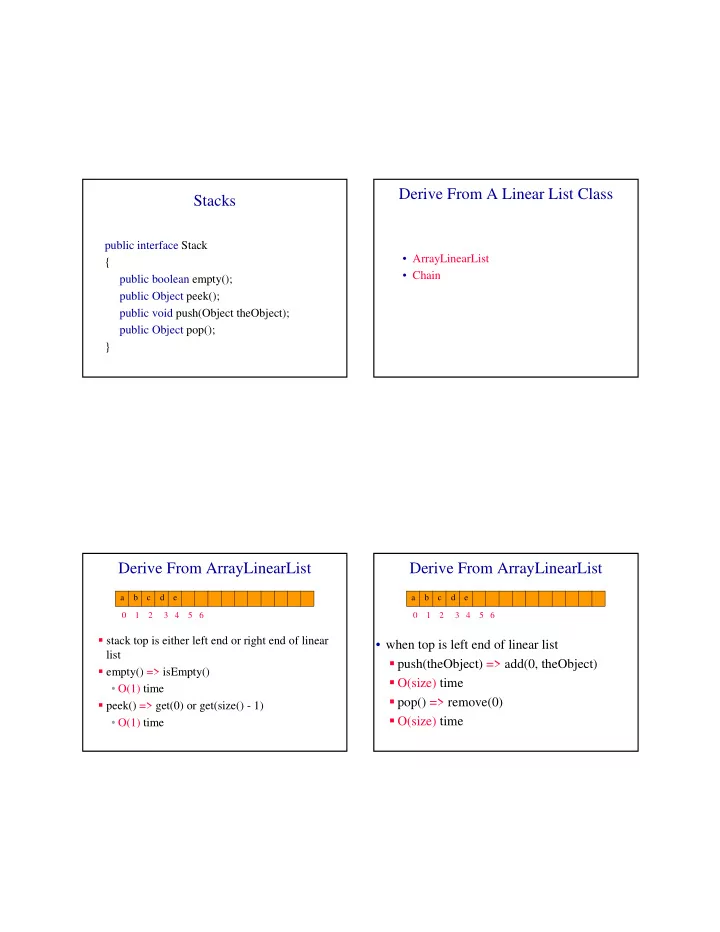
Derive From A Linear List Class Stacks public interface Stack - - PDF document

derive from a linear list class stacks
SMART_READER_LITE
LIVE PREVIEW

Derive From A Linear List Class Stacks public interface Stack - - PDF document

Derive From A Linear List Class Stacks public interface Stack ArrayLinearList { Chain public boolean empty(); public Object peek(); public void push(Object theObject); public Object pop(); } Derive From ArrayLinearList Derive


slide-1
SLIDE 1

Stacks

public interface Stack { public boolean empty(); public Object peek(); public void push(Object theObject); public Object pop(); }

Derive From A Linear List Class

  • ArrayLinearList
  • Chain

Derive From ArrayLinearList

stack top is either left end or right end of linear list empty() => isEmpty()

  • O(1) time

peek() => get(0) or get(size() - 1)

  • O(1) time

1 2 3 4 5 6 a b c d e

Derive From ArrayLinearList

  • when top is left end of linear list

push(theObject) => add(0, theObject) O(size) time pop() => remove(0) O(size) time

1 2 3 4 5 6 a b c d e

slide-2
SLIDE 2

Derive From ArrayLinearList

when top is right end of linear list

  • push(theObject) => add(size(), theObject)
  • O(1) time
  • pop() => remove(size()-1)
  • O(1) time

use right end of list as top of stack

1 2 3 4 5 6 a b c d e

Derive From Chain

stack top is either left end or right end of linear list empty() => isEmpty()

  • O(1) time

a b c d e

null

firstNode

Derive From Chain

a b c d e

null

firstNode

– when top is left end of linear list peek() => get(0)

O(1) time push(theObject) => add(0, theObject)

O(1) time pop() => remove(0) O(1) time

Derive From Chain

a b c d e

null

firstNode

– when top is right end of linear list

  • peek() => get(size() - 1)
  • O(size) time
  • push(theObject) => add(size(), theObject)
  • O(size) time
  • pop() => remove(size()-1)
  • O(size) time

– use left end of list as top of stack

slide-3
SLIDE 3

Derive From ArrayLinearList

package dataStructures; import java.util.*; // has stack exception public class DerivedArrayStack extends ArrayLinearList implements Stack { // constructors come here // Stack interface methods come here }

Constructors

/** create a stack with the given initial * capacity */ public DerivedArrayStack(int initialCapacity) {super(initialCapacity);} /** create a stack with initial capacity 10 */ public DerivedArrayStack() {this(10);}

empty() And peek()

public boolean empty() {return isEmpty();} public Object peek() { if (empty()) throw new EmptyStackException(); return get(size() - 1) }

1 2 3 4 5 6 a b c d e

push(theObject) And pop()

public void push(Object theElement) {add(size(), theElement);} public Object pop() { if (empty()) throw new EmptyStackException(); return remove(size() - 1); }

1 2 3 4 5 6 a b c d e

slide-4
SLIDE 4

Evaluation

  • Merits of deriving from ArrayLinearList

Code for derived class is quite simple and easy to develop. Code is expected to require little debugging. Code for other stack implementations such as a linked implementation are easily obtained.

  • Just replace extends ArrayLinearList with extends Chain
  • For efficiency reasons we must also make changes to use

the left end of the list as the stack top rather than the right end.

Demerits

  • All public methods of ArrayLinearList may be

performed on a stack.

get(0) … get bottom element remove(5) add(3, x) So we do not have a true stack implementation. Must override undesired methods. public Object get(int theIndex) {throw new UnsupportedOperationException();} Change earlier use of get(i) to super.get(i).

Demerits

  • Unecessary work is done by the code.

peek() verifies that the stack is not empty before get is invoked. The index check done by get is, therefore, not needed. add(size(), theElement) does an index check and a for loop that is not entered. Neither is needed. pop() verifies that the stack is not empty before remove is invoked. remove does an index check and a for loop that is not entered. Neither is needed. So the derived code runs slower than necessary.

Evaluation

  • Code developed from scratch will run faster but

will take more time (cost) to develop.

  • Tradeoff between software development cost

and performance.

  • Tradeoff between time to market and

performance.

  • Could develop easy code first and later refine it

to improve performance.

slide-5
SLIDE 5

A Faster pop()

if (empty()) throw new EmptyStackException(); return remove(size() - 1); vs. try {return remove(size() - 1);} catch(IndexOutOfBoundsException e) {throw new EmptyStackException();}

Code From Scratch

  • Use a 1D array stack whose data type is Object.

same as using array element in ArrayLinearList

  • Use an int variable top.

Stack elements are in stack[0:top]. Top element is in stack[top]. Bottom element is in stack[0]. Stack is empty iff top = -1. Number of elements in stack is top+1.

Code From Scratch

package dataStructures; import java.util.EmptyStackException; import utilities.*; // ChangeArrayLength public class ArrayStack implements Stack { // data members int top; // current top of stack Object [] stack; // element array // constructors come here // Stack interface methods come here }

Constructors

public ArrayStack(int initialCapacity) { if (initialCapacity < 1) throw new IllegalArgumentException ("initialCapacity must be >= 1"); stack = new Object [initialCapacity]; top = -1; } public ArrayStack() {this(10);}

slide-6
SLIDE 6

push(…)

public void push(Object theElement) { // increase array size if necessary if (top == stack.length - 1) stack = ChangeArrayLength.changeLength1D (stack, 2 * stack.length); // put theElement at the top of the stack stack[++top] = theElement; }

1 2 3 4 a b c d e

top

pop()

public Object pop() { if (empty()) throw new EmptyStackException(); Object topElement = stack[top]; stack[top--] = null; // enable garbage collection return topElement; }

1 2 3 4 a b c d e

top

Linked Stack From Scratch

  • See text.

java.util.Stack

  • Derives from java.util.Vector.
  • java.util.Vector is an array implementation
  • f a linear list.
slide-7
SLIDE 7

Performance

500,000 pop, push, and peek operations initial capacity Class 10 500,000 ArrayStack 0.44s 0.22s DerivedArrayStack 0.60s 0.38s DerivedArrayStackWithCatch 0.55s 0.33s java.util.Stack 1.15s

  • DerivedLinkedStack 3.20s 3.20s

LinkedStack 2.96s 2.96s