Derivatives of Trigonometric Functions Let f ( x ) = sin x . From the - - PDF document

derivatives of trigonometric functions
SMART_READER_LITE
LIVE PREVIEW

Derivatives of Trigonometric Functions Let f ( x ) = sin x . From the - - PDF document

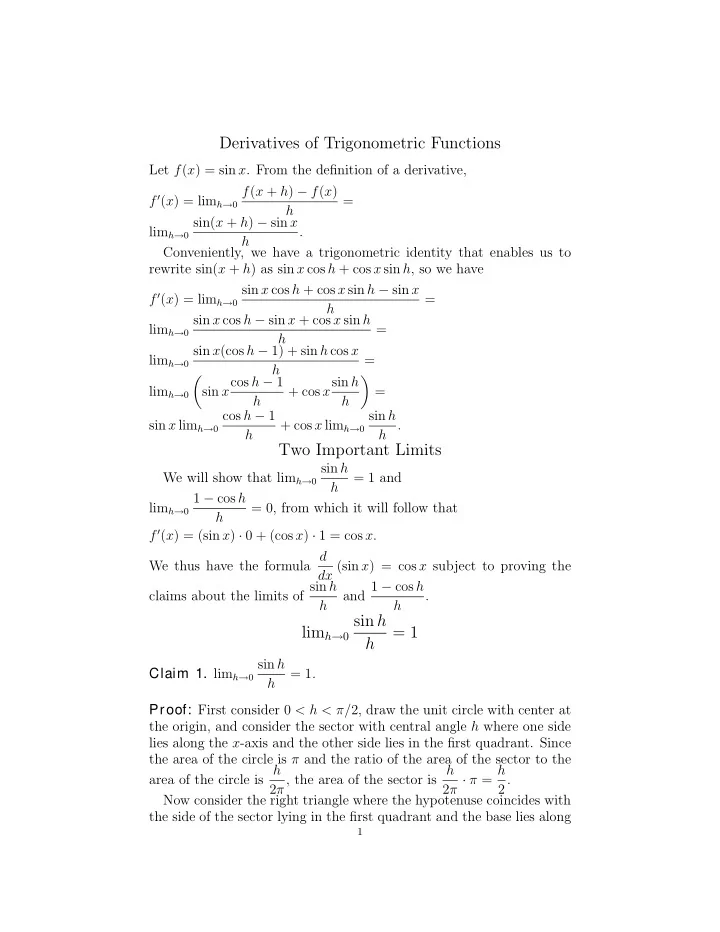
Derivatives of Trigonometric Functions Let f ( x ) = sin x . From the definition of a derivative, f ( x + h ) f ( x ) f ( x ) = lim h 0 = h sin( x + h ) sin x lim h 0 . h Conveniently, we have a trigonometric identity that


slide-1
SLIDE 1

Derivatives of Trigonometric Functions

Let f(x) = sin x. From the definition of a derivative, f ′(x) = limh→0 f(x + h) − f(x) h = limh→0 sin(x + h) − sin x h . Conveniently, we have a trigonometric identity that enables us to rewrite sin(x + h) as sin x cos h + cos x sin h, so we have f ′(x) = limh→0 sin x cos h + cos x sin h − sin x h = limh→0 sin x cos h − sin x + cos x sin h h = limh→0 sin x(cos h − 1) + sin h cos x h = limh→0

  • sin xcos h − 1

h + cos xsin h h

  • =

sin x limh→0 cos h − 1 h + cos x limh→0 sin h h .

Two Important Limits

We will show that limh→0 sin h h = 1 and limh→0 1 − cos h h = 0, from which it will follow that f ′(x) = (sin x) · 0 + (cos x) · 1 = cos x. We thus have the formula d dx (sin x) = cos x subject to proving the claims about the limits of sin h h and 1 − cos h h .

limh→0 sin h h = 1

Claim 1. limh→0 sin h h = 1. Proof: First consider 0 < h < π/2, draw the unit circle with center at the origin, and consider the sector with central angle h where one side lies along the x-axis and the other side lies in the first quadrant. Since the area of the circle is π and the ratio of the area of the sector to the area of the circle is h 2π, the area of the sector is h 2π · π = h 2. Now consider the right triangle where the hypotenuse coincides with the side of the sector lying in the first quadrant and the base lies along

1

slide-2
SLIDE 2

2

the x-axis. The vertices will be (0, 0), (cos h, 0), (cos h, sin h), so its legs will be of length cos h, sin h and its area will be 1 2 · cos h sin h. Since the triangle is contained within the sector, its area will be smaller than the area of the sector. Hence 1 2 · cos h sin h < h 2. Multiplying both sides by 2 h cos h yields the inequality sin h h < 1 cos h. Now consider the right triangle with one leg coinciding with the side

  • f the sector lying along the x-axis and the hypotenuse making an angle

h with that leg. Its vertices are (0, 0), (1, 0), (1, tan h), so its legs will be of length 1, tan h and its area will be 1 2 · tan h. Since the sector is contained within this triangle, its area will be smaller than the area of the triangle. Hence h 2 < 1 2 · tan h. Multiplying both sides by 2 cos h h and making use of the identity tan h cos h = sin h yields the inequality cos h < sin h h . Combining the two inequalities we have obtained yields (1) cos h < sin h h < 1 cos h if 0 < h < π/2. Now, suppose −π/2 < h < 0. Then 0 < −h < π/2 and the double inequality (1) yields (2) cos(−h) < sin(−h) −h < 1 cos(−h). Since cos(−h) = cos h and sin(−h) = − sin h, it follows that sin(−h) −h = − sin h −h = sin h h and (2) becomes (3) cos h < sin h h < 1 cos h. We thus see (1) holds both for 0 < h < π/2 and for −π/2 < h < 0.

slide-3
SLIDE 3

3

Since limh→0 cos h = limh→0 1 cos h = 1, by the Squeeze Theorem it follows that limh→0 sin h h = 1 QED Claim 2. limh→0 1 − cos h h = 0. We make use of the identity involving sin and an algebraic manip- ulation reminiscent of rationalization, enabling us to prove the claim with a fairly routine calculation.

Proof

  • Proof. limh→0

1 − cos h h = limh→0 1 − cos h h · 1 + cos h 1 + cos h = limh→0 1 − cos2 h h(1 + cos h) = limh→0 sin2 h h(1 + cos h) = limh→0 sin h h · sin h 1 + cos h = limh→0 sin h h · limh→0 sin h 1 + cos h = 1 · 0 = 0.