Derek Farrell University of Worcester Institute of Health & - - PDF document

derek farrell
SMART_READER_LITE
LIVE PREVIEW

Derek Farrell University of Worcester Institute of Health & - - PDF document

22/06/2016 REFUGEE POPULATIONS NARRATIVES FROM THE YEZIDI Derek Farrell University of Worcester Institute of Health & Society Chartered Psychologist, Principal Lecturer in Psychology EMDR Europe Accredited Trainer and Consultant


slide-1
SLIDE 1

22/06/2016 1

REFUGEE POPULATIONS – NARRATIVES FROM THE YEZIDI

Derek Farrell

University of Worcester – Institute of Health & Society Chartered Psychologist, Principal Lecturer in Psychology EMDR Europe Accredited Trainer and Consultant BABCP Accredited Cognitive Behavioural Psychotherapist Vice-President EMDR Europe President Trauma Aid Europe

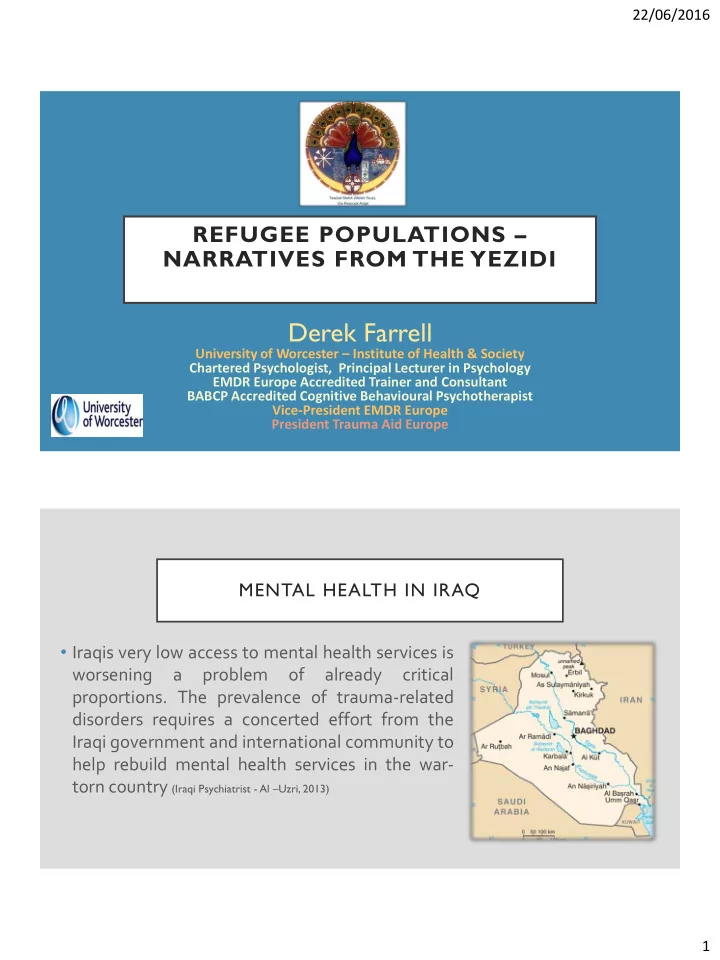
MENTAL HEALTH IN IRAQ

  • Iraqis very low access to mental health services is

worsening a problem

  • f

already critical

  • proportions. The prevalence of trauma-related

disorders requires a concerted effort from the Iraqi government and international community to help rebuild mental health services in the war- torn country (Iraqi Psychiatrist - Al –Uzri, 2013)

slide-2
SLIDE 2

22/06/2016 2

ATTACK BY ISIL – AUGUST 2014

  • Approximate estimates indicate that some 3,500 women

and young girls captured by ISIL were sold as ‘sex slaves’ to ISIL fighters involved in the Sinjar campaign. Upon capture, it is believed many were initially taken to Mosul – before being moved to Syria or Saudi Arabia.

  • A few, approximately 7%, have managed to escape and

safely return to their communities in Kurdistan.

  • Ref: http://www.bbc.co.uk/news/world-middle-east-30573385

ATTACK BY ISIL – AUGUST 2014

  • Large numbers of Yezidi, fearful of further ISIL attacks, and

fearful of returning to their homes, are now living in refugee camps for displaced persons in Northern Iraq;

  • Despite Kurdistan Government forces securing the area,

the on-going threat from ISIL creates high levels of uncertainty for the Yezidi.

slide-3
SLIDE 3

22/06/2016 3

SIX INTERVIEWS WERE CARRIED OUT WITH YEZIDI FEMALE SURVIVORS RANGING FROM 13 – 30 IN TWO IDP CAMPS , NORTHERN IRAQ – JANUARY 2015 (FARRELL, 2015)

  • High levels of terror, fear and violence – presently held
  • Members of the community are segregated with families separated and torn apart
  • ISIL attacks often involve extreme levels of humiliation and dehumanisation
  • Males are brought in front their community and then massacred
  • Females (particularly young women) are abducted and taken away – as well as very young

boys (child soldiers)

  • All the survivors interviewed spent periods in large groups of other women following their

immediate abduction – this increased individual and collective levels of terror and fear – Secondary Traumatisation

SIX INTERVIEWS WERE CARRIED OUT WITH YEZIDI FEMALE SURVIVORS RANGING FROM 13 – 30 IN TWO IDP CAMPS , NORTHERN IRAQ – JANUARY 2015 (FARRELL, 2015)

  • Women and young girls subjected to frequent assault, torture and humiliation
  • These abducted women and young girls are then sold as ‘sex slaves’ to ISIL (Jihadist)

fighters

  • Many survivors are sold for small amounts of money (approximately €15-30)
  • Virgin girls are highly prized by ISIL fighters
  • Once in captivity, survivors are subjected to repeated sexual, physical and psychological

violence.

  • Many survivors described making attempts at suicide and self harm
  • Survivors are given a choice: ‘Convert to Islam and have one husband’ or

‘Keep your faith’ and have multiple abusers

slide-4
SLIDE 4

22/06/2016 4

PSYCHOLOGICAL SYMPTOMS

  • Flashbacks and intrusive recollections
  • Nightmares and poor sleep pattern
  • Heightened anxiety
  • Helplessness
  • High levels of shame/ guilt
  • Feelings of self-blame and ‘over-

responsibility’

  • Powerlessness
  • Feeling detached
  • Suicidal thoughts and self-

destructiveness

  • Low mood/ depression
  • Phobic reactions
  • Low self-esteem
  • Difficulty managing emotions
  • Changes in ‘world view’
  • Changes in consciousness
  • Anger and resentment
  • Shame-based Trauma Symptoms

EMDR THERAPY TRAINING IN

  • KURDISTAN. NORTHERN IRAQ
  • Collaborative project
  • T

erres des Homme, Jiyan Foundation, Free Yezidi Foundation, University of Worcester, Trauma Aid Germany, Trauma Aid Europe

  • Funding
  • $150,000 GUCCI
  • €100,000 T

erres des Homme (Germany)

  • Timeline
  • Free Yezidi Foundation Centre – Khanke Camp – Psychological First Aid (PFA) Training
  • EMDR Therapy Training commenced in November 2015 – Jiyan Foundation
  • 24 staff from Jiyan Foundation – Already trained in psycho-traumatology (Germany)
slide-5
SLIDE 5

22/06/2016 5

BLIND 2 THERAPIST PROTOCOL IN THE TREATMENT OF SHAME BASED TRAUMA IN KURDISTAN – AN EXPERIMENTAL DESIGN

(FARRELL ET AL, 2016) Kurdistan I Research Project 2: Blind 2 Therapist Protocol Derek Farrell

PHASE 3: MODIFIED ASSESSMENT OF TARGET MEMORY (B2T)

Target memory Cue Word Current Emotion

Subjective Level of Disturbance (SUD)

Location

  • f Body

Sensation

slide-6
SLIDE 6

22/06/2016 6

RESEARCH RATIONALE

  • High levels of Shame-Based Trauma within

Yezidi survivors

  • In addition high levels of Shame-Based Trauma amongst Kurdish Population/

Participants

  • Research based on Shapiro (2001), Blore et al (2009; 2013) and slight modification

by research team

  • “Where there are no words’
  • Cultural sensitivity and adaptability
  • Treatment versus No Treatment

RESEARCH DESIGN

  • First experimental design study using Blind 2 Therapist Protocol
  • Research took place during a intensive 6 day EMDR Therapy Level 2 Training (May 2016)
  • Participants – Jiyan Foundation Therapists during Self-experience Practicum
  • Each EMDR Therapy session supervised live by EMDR Europe Accredited Consultant
  • Control Group [N=59] – Standard Protocol
  • Experimental Group [N=39] – Blind 2 Therapist Protocol
  • Null Hypothesis
slide-7
SLIDE 7

22/06/2016 7

TARGET ISSUES FOR SELF-EXPERIENCE – CONTROL & EXPERIMENTAL GROUPS

  • Rape
  • Witnessing a murder
  • Recent Trauma
  • Bereavement
  • Road Traffic Collision
  • Bullying
  • War related conflicts &

incidents

  • T
  • rture
  • Dog attack
  • Imprisonment
  • Vicarious trauma
  • Gender-based violence

IRAQ PROJECT 1: KURDISTAN – BLIND 2 THERAPISTS RESEARCH

(FARRELL & SCOTT, 2016)

1 2 3 4 5 6 7 8 9

Control Group - Standard Protocol [N=59] Experimental Group - B2T Protocol [N=39]

Blind2Therapist Protocol - Kurdistan

VOC (1-7) SUD (0-10)

slide-8
SLIDE 8

22/06/2016 8

RESEARCH FINDINGS

  • 90% of the research participants would NOT have worked on their trauma

experience without using the B2T protocol

  • 95% Disclosed their trauma after EMDR Therapy using the Blind 2 Therapists
  • Omission of C-, C+ and VOC still proved effective
  • Script of Protocol had to be adapted slightly to make more specific to therapists
  • Clear definition of what was meant by ‘CHANGE’ during processing
  • Key Message: B2T Protocol was SAFE, EFFECTIVE & EFFICIENT

TRAUMA CAPACITY BUILDING IN KURDISTAN, NORTHERN IRAQ

(FARRELL & SCOTT, 2016)

Five Levels of Trauma Capacity Building Level 5 Broad Spectrum Community Interventions & Political Approaches Level 4 Trauma Focused Interventions: EMDR, CBT

  • TF, T

estimony, etc. Level 3 Trauma Stabilisation – ‘State Change’ interventions Level 2 Psychological First Aid (PFA), Vulnerability Triage Level 1 Resources, Information, Basic Needs, Community Connection

Adaptive Information Processing (AIP)

slide-9
SLIDE 9

22/06/2016 9

LEVEL 5: BROAD SPECTRUM COMMUNITY INTERVENTIONS AND POLITICAL APPROACHES – YEZIDI & KURDISTAN

  • INTERNAL versus EXTERNAL Models of intervention
  • Revenge and cycles of violence
  • Truth and Reconciliation Commissions
  • Community Integration
  • Addressing Stigma Campaigns
  • Promotion of Gender Equality
  • Anti-violence Initiatives and Challenging of Social Norms
  • Protection of Human Rights and Healthy Relationships

MANY THANKS FOR YOUR TIME

Contact details: Dr Derek Farrell University of Worcester Email: d.farrell@worc.ac.uk