Dependency Grammar Introduction to Dependency Grammar Not a - - PowerPoint PPT Presentation

dependency grammar introduction to dependency grammar
SMART_READER_LITE
LIVE PREVIEW

Dependency Grammar Introduction to Dependency Grammar Not a - - PowerPoint PPT Presentation

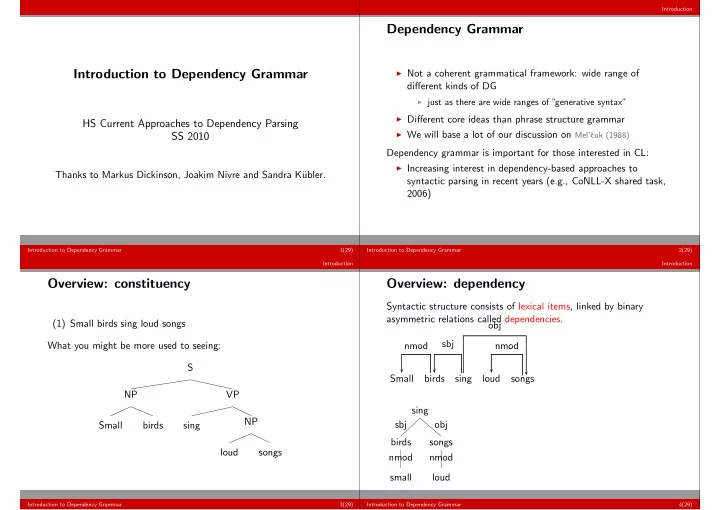
Introduction Dependency Grammar Introduction to Dependency Grammar Not a coherent grammatical framework: wide range of different kinds of DG just as there are wide ranges of generative syntax Different core ideas than phrase


slide-1
SLIDE 1

Introduction to Dependency Grammar

HS Current Approaches to Dependency Parsing SS 2010

Thanks to Markus Dickinson, Joakim Nivre and Sandra K¨ ubler.

Introduction to Dependency Grammar 1(29) Introduction

Dependency Grammar

◮ Not a coherent grammatical framework: wide range of

different kinds of DG

◮ just as there are wide ranges of ”

generative syntax”

◮ Different core ideas than phrase structure grammar ◮ We will base a lot of our discussion on Mel’ˇ

cuk (1988)

Dependency grammar is important for those interested in CL:

◮ Increasing interest in dependency-based approaches to

syntactic parsing in recent years (e.g., CoNLL-X shared task, 2006)

Introduction to Dependency Grammar 2(29) Introduction

Overview: constituency

(1) Small birds sing loud songs What you might be more used to seeing: Small birds NP sing loud songs NP VP S

Introduction to Dependency Grammar 3(29) Introduction

Overview: dependency

Syntactic structure consists of lexical items, linked by binary asymmetric relations called dependencies. Small birds sing loud songs nmod sbj nmod

  • bj

small nmod birds loud nmod songs sbj

  • bj

sing

Introduction to Dependency Grammar 4(29)

slide-2
SLIDE 2

Introduction

Constituency vs. Relations

◮ DG is based on relationships between words, i.e., dependency

relations

◮ A → B means A governs B or B depends on A ... ◮ Dependency relations can refer to syntactic properties,

semantic properties, or a combination of the two

→ Some variants of DG separate syntactic and semantic relations by representing different layers of dependencies

◮ These relations are generally things like subject,

  • bject/complement, (pre-/post-)adjunct, etc.

◮ Subject/Agent: John fished. ◮ Object/Patient: Mary hit John.

◮ PSG is based on groupings (called phrases or constituents)

◮ Grammatical relations are not usually seen as primitives, but as

being derived from structure

Introduction to Dependency Grammar 5(29) Introduction

Simple relation example

For the sentence John loves Mary, we have the relations:

◮ loves →subj John ◮ loves →obj Mary

Both John and Mary depend on loves, which makes loves the head,

  • r root, of the sentence (i.e., there is no word that governs loves)

◮ The structure of a sentence, then, consists of the set of

pairwise relations among words.

Introduction to Dependency Grammar 6(29) Introduction

Dependency Structure

Economic news had little effect

  • n

financial markets .

  • bj

p sbj nmod nmod nmod pc nmod

Introduction to Dependency Grammar 7(29) Introduction

Terminology

Superior Inferior Head Dependent Governor Modifier Regent Subordinate . . . . . .

Introduction to Dependency Grammar 8(29)

slide-3
SLIDE 3

Introduction

Notational Variants

had news sbj Economic nmod effect

  • bj

little nmod

  • n

nmod markets pc financial nmod . p

Introduction to Dependency Grammar 9(29) Introduction

Notational Variants

VBD NN NN PU JJ JJ IN NNS JJ Economic news had little effect on financial markets .

  • bj

p nmod sbj nmod nmod pc nmod

Introduction to Dependency Grammar 9(29) Introduction

Notational Variants

Economic news had little effect

  • n

financial markets .

  • bj

p sbj nmod nmod nmod pc nmod

Introduction to Dependency Grammar 9(29) Introduction

Notational Variants

Economic news had little effect

  • n

financial markets .

  • bj

p sbj nmod nmod nmod pc nmod

Introduction to Dependency Grammar 9(29)

slide-4
SLIDE 4

Introduction

Phrase Structure

JJ Economic NN news NP VBD had VP S JJ little NN effect NP NP IN

  • n

PP JJ financial NNS markets NP PU .

Introduction to Dependency Grammar 10(29) Introduction

Comparison

◮ Dependency structures explicitly represent

◮ head-dependent relations (directed arcs), ◮ functional categories (arc labels), ◮ possibly some structural categories (parts-of-speech).

◮ Phrase structures explicitly represent

◮ phrases (nonterminal nodes), ◮ structural categories (nonterminal labels), ◮ possibly some functional categories (grammatical functions).

◮ Hybrid representations may combine all elements.

Introduction to Dependency Grammar 11(29) Introduction

Some Theoretical Frameworks

◮ Word Grammar (WG) Hudson (1984, 1990) ◮ Functional Generative Description (FGD) Sgall et al. (1986) ◮ Dependency Unification Grammar (DUG) Hellwig (1986, 2003) ◮ Meaning-Text Theory (MTT) Mel’ˇ

cuk (1988)

◮ (Weighted) Constraint Dependency Grammar ([W]CDG)

Maruyama (1990); Harper & Helzerman (1995); Menzel & Schr¨

  • der

(1998); Schr¨

  • der (2002)

◮ Functional Dependency Grammar (FDG) Tapanainen & J¨

arvinen (1997); J¨ arvinen & Tapanainen (1998)

◮ Topological/Extensible Dependency Grammar ([T/X]DG)

Duchier & Debusmann (2001); Debusmann et al. (2004)

Introduction to Dependency Grammar 12(29) Introduction

Some Theoretical Issues

◮ Dependency structure sufficient as well as necessary? ◮ Mono-stratal or multi-stratal syntactic representations? ◮ What is the nature of lexical elements (nodes)?

◮ Morphemes? ◮ Word forms? ◮ Multi-word units?

◮ What is the nature of dependency types (arc labels)?

◮ Grammatical functions? ◮ Semantic roles?

◮ What are the criteria for identifying heads and dependents? ◮ What are the formal properties of dependency structures?

Introduction to Dependency Grammar 13(29)

slide-5
SLIDE 5

Introduction

Capturing Adjuncts and Complements

There are two main kinds of dependencies for A → B:

◮ Head-Complement: if A (the head) has a slot for B, then B is

a complement

◮ Head-Adjunct: if B has a slot for A (the head), then B is an

adjunct B is dependent on A in either case, but the selector is different

◮ The adjunct/complement distinction is captured in the type of

dependency relation and/or in the lexicon

Introduction to Dependency Grammar 14(29) Introduction

Criteria for Heads and Dependents

◮ Criteria for a syntactic relation between a head H and a

dependent D in a construction C Zwicky (1985); Hudson (1990):

  • 1. H determines the syntactic category of C; H can replace C.
  • 2. H determines the semantic category of C; C specifies H.
  • 3. H is obligatory; D may be optional.
  • 4. H selects D and determines whether D is obligatory.
  • 5. The form of D depends on H (agreement or government).
  • 6. The linear position of D is specified with reference to H.

◮ Issues:

◮ Syntactic (and morphological) versus semantic criteria ◮ Exocentric versus endocentric constructions Introduction to Dependency Grammar 15(29) Introduction

Some Clear Cases

Construction Head Dependent Exocentric Verb Subject (sbj) Verb Object (obj) Endocentric Verb Adverbial (vmod) Noun Attribute (nmod) Economic news suddenly affected financial markets .

  • bj

sbj vmod nmod nmod

Introduction to Dependency Grammar 16(29) Introduction

Some Tricky Cases

◮ Complex verb groups (auxiliary ↔ main verb) ◮ Subordinate clauses (complementizer ↔ verb) ◮ Coordination (coordinator ↔ conjuncts) ◮ Prepositional phrases (preposition ↔ nominal) ◮ Punctuation

I can see that they rely

  • n

this and that . ?

Introduction to Dependency Grammar 17(29)

slide-6
SLIDE 6

Introduction

Some Tricky Cases

◮ Complex verb groups (auxiliary ↔ main verb) ◮ Subordinate clauses (complementizer ↔ verb) ◮ Coordination (coordinator ↔ conjuncts) ◮ Prepositional phrases (preposition ↔ nominal) ◮ Punctuation

I can see that they rely

  • n

this and that . vg sbj sbj

Introduction to Dependency Grammar 17(29) Introduction

Some Tricky Cases

◮ Complex verb groups (auxiliary ↔ main verb) ◮ Subordinate clauses (complementizer ↔ verb) ◮ Coordination (coordinator ↔ conjuncts) ◮ Prepositional phrases (preposition ↔ nominal) ◮ Punctuation

I can see that they rely

  • n

this and that . vg sbj sbj ?

Introduction to Dependency Grammar 17(29) Introduction

Some Tricky Cases

◮ Complex verb groups (auxiliary ↔ main verb) ◮ Subordinate clauses (complementizer ↔ verb) ◮ Coordination (coordinator ↔ conjuncts) ◮ Prepositional phrases (preposition ↔ nominal) ◮ Punctuation

I can see that they rely

  • n

this and that . vg sbj sbj sbar

  • bj

Introduction to Dependency Grammar 17(29) Introduction

Some Tricky Cases

◮ Complex verb groups (auxiliary ↔ main verb) ◮ Subordinate clauses (complementizer ↔ verb) ◮ Coordination (coordinator ↔ conjuncts) ◮ Prepositional phrases (preposition ↔ nominal) ◮ Punctuation

I can see that they rely

  • n

this and that . vg sbj sbj sbar

  • bj

? ?

Introduction to Dependency Grammar 17(29)

slide-7
SLIDE 7

Introduction

Some Tricky Cases

◮ Complex verb groups (auxiliary ↔ main verb) ◮ Subordinate clauses (complementizer ↔ verb) ◮ Coordination (coordinator ↔ conjuncts) ◮ Prepositional phrases (preposition ↔ nominal) ◮ Punctuation

I can see that they rely

  • n

this and that . vg sbj sbj sbar

  • bj

co cj

Introduction to Dependency Grammar 17(29) Introduction

Some Tricky Cases

◮ Complex verb groups (auxiliary ↔ main verb) ◮ Subordinate clauses (complementizer ↔ verb) ◮ Coordination (coordinator ↔ conjuncts) ◮ Prepositional phrases (preposition ↔ nominal) ◮ Punctuation

I can see that they rely

  • n

this and that . vg sbj sbj sbar

  • bj

co cj ?

Introduction to Dependency Grammar 17(29) Introduction

Some Tricky Cases

◮ Complex verb groups (auxiliary ↔ main verb) ◮ Subordinate clauses (complementizer ↔ verb) ◮ Coordination (coordinator ↔ conjuncts) ◮ Prepositional phrases (preposition ↔ nominal) ◮ Punctuation

I can see that they rely

  • n

this and that . vg sbj sbj sbar

  • bj

co cj pc vc

Introduction to Dependency Grammar 17(29) Introduction

Some Tricky Cases

◮ Complex verb groups (auxiliary ↔ main verb) ◮ Subordinate clauses (complementizer ↔ verb) ◮ Coordination (coordinator ↔ conjuncts) ◮ Prepositional phrases (preposition ↔ nominal) ◮ Punctuation

I can see that they rely

  • n

this and that . vg sbj sbj sbar

  • bj

co cj pc vc ?

Introduction to Dependency Grammar 17(29)

slide-8
SLIDE 8

Introduction

Some Tricky Cases

◮ Complex verb groups (auxiliary ↔ main verb) ◮ Subordinate clauses (complementizer ↔ verb) ◮ Coordination (coordinator ↔ conjuncts) ◮ Prepositional phrases (preposition ↔ nominal) ◮ Punctuation

I can see that they rely

  • n

this and that . vg sbj sbj sbar

  • bj

co cj pc vc p

Introduction to Dependency Grammar 17(29) Introduction

Dependency Graphs

◮ A dependency structure can be defined as a directed graph G,

consisting of

◮ a set V of nodes, ◮ a set E of arcs (edges), ◮ a linear precedence order < on V

(not in every theory)

◮ Labeled graphs:

◮ Nodes in V are labeled with word forms (and annotation). ◮ Arcs in E are labeled with dependency types.

◮ Notational conventions (i, j ∈ V ):

◮ i → j

≡ (i, j) ∈ E

◮ i →∗ j

≡ i = j ∨ ∃k : i → k, k →∗ j

Introduction to Dependency Grammar 18(29) Introduction

Formal Properties of Dependency Graphs

◮ antisymmetric: if A → B, then B A

◮ cf. box lunch (lunch → box) vs. lunch box (box → lunch)

◮ antireflexive: if A → B, then B = A ◮ antitransitive: if A → B and B → C, then A C

◮ These are direct dependency relations ◮ cf. a usually reliable source: source → reliable & reliable →

usually, but source usually

◮ labeled: ∀ →, → has a label (r)

Introduction to Dependency Grammar 19(29) Introduction

Formal Conditions on Dependency Graphs

◮ G is (weakly) connected:

◮ For every node i there is a node j such that i → j or j → i.

◮ G is acyclic:

◮ If i → j then not j →∗ i.

◮ G obeys the single-head constraint:

◮ If i → j, then not k → j, for any k = i.

◮ G is projective:

◮ If i → j then i →∗ k, for any k such that i <k <j or j <k <i. Introduction to Dependency Grammar 20(29)

slide-9
SLIDE 9

Introduction

Connectedness, Acyclicity and Single-Head

◮ Intuitions:

◮ Syntactic structure is complete (Connectedness). ◮ Syntactic structure is hierarchical (Acyclicity). ◮ Every word has at most one syntactic head (Single-Head).

◮ Connectedness can be enforced by adding a special root node.

Economic news had little effect

  • n

financial markets .

  • bj

sbj nmod nmod nmod pc nmod

Introduction to Dependency Grammar 21(29) Introduction

Connectedness, Acyclicity and Single-Head

◮ Intuitions:

◮ Syntactic structure is complete (Connectedness). ◮ Syntactic structure is hierarchical (Acyclicity). ◮ Every word has at most one syntactic head (Single-Head).

◮ Connectedness can be enforced by adding a special root node.

root Economic news had little effect

  • n

financial markets .

  • bj

p pred sbj nmod nmod nmod pc nmod

Introduction to Dependency Grammar 21(29) Introduction

Projectivity

Projectivity (or, less commonly, adjacency Hudson (1990))

◮ A head (A) and a dependent (B) must be adjacent: A is

adjacent to B provided that every word between A and B is a subordinate of A. (2) with great difficulty (3) *great with difficulty

◮ with → difficulty ◮ difficulty → great

*great with difficulty is ruled out because branches would have to cross in that case

Introduction to Dependency Grammar 22(29) Introduction

Projectivity

◮ Most theoretical frameworks do not assume projectivity. ◮ Non-projective structures are needed to account for

◮ long-distance dependencies, ◮ free word order.

What did economic news have little effect

  • n

?

  • bj

vg p sbj nmod nmod nmod pc

Introduction to Dependency Grammar 23(29)

slide-10
SLIDE 10

Introduction

Valency and Grammaticality

An important concept in many variants of DG is that of valency = the ability of a word to take arguments A lexicon might look like the following Hajiˇ

c et al. (2003):

Slot1 Slot2 Slot3 sink1 ACT(nom) PAT(acc) sink2 PAT(nom) give ACT(nom) PAT(acc) ADDR(dat) To determine grammaticality (roughly) ...

  • 1. Words have valency requirements that must be satisfied
  • 2. Apply general rules to the valencies to see if a sentence is valid

Introduction to Dependency Grammar 24(29) Introduction

Layers of dependencies

Mel’ˇ cuk (1988) allows for different dependency layers

It looks like a subject depends on the verb, but the form of the verb depends on the subject (mutual dependence): (4) a. The child is playing.

  • b. The children are playing.

Solution:

◮ Dependence of child/children on the verb is syntactic ◮ Dependence of the verb(form) on the subject is morphological

Introduction to Dependency Grammar 25(29) Introduction

Double dependencies

Likewise, here it seems that clean depends both on the verb wash and on the noun dish (5) Wash the dish clean. Solution:

◮ Dependence of clean on wash is syntactic (cf. case) ◮ Dependence of clean on dish is semantic (cf. gender)

(6) My We naˇ sli found zal the hallmasc pust-ym emptymasc.sg.inst

Introduction to Dependency Grammar 26(29) Introduction

Double dependencies (2)

Hudson’s Word Grammar Hudson (2004) explicitly allows for structure-sharing, explicitly violating the single-head constraint:

◮ wash → clean ◮ dish → clean

NB: Hudson also uses this to account for non-projectivity, but we’ll ignore the details.

Introduction to Dependency Grammar 27(29)

slide-11
SLIDE 11

Introduction

Relation to phrase structure

After all this discussion, what is the relation between DG and PSG?

◮ If a PS tree has heads marked, then you can derive the

dependencies

◮ Likewise, a DG tree can be converted into a PS tree by

grouping a word with its dependents

◮ But what the constituents are is still open

(binary-branching, flat)

◮ And phrases are not categorized Introduction to Dependency Grammar 28(29) Introduction

Advantages and Disadvantages of DG

Advantages:

◮ Close connection to semantic representation ◮ More flexible structure for, e.g., non-constituent coordination ◮ Easier to capture some typological regularities ◮ Vast & expanding body of computational work on dependency

parsing Disadvantages:

◮ No constituents makes analyzing coordination difficult ◮ No distinction between modifying a constituent vs. an

individual word

◮ Harder to capture things like, e.g., subject-object asymmetries

Introduction to Dependency Grammar 29(29) References

Debusmann, R., D. Duchier & G.-J. M. Kruijff (2004). Extensible Dependency Grammar: A New Methodology. In Proceedings of the Workshop on Recent Advances in Dependency Grammar. pp. 78–85. Duchier, D. & R. Debusmann (2001). Topological Dependency Trees: A Constraint-based Account of Linear Precedence. In Proceedings of the 39th Annual Meeting of the Association for Computational Linguistics (ACL). pp. 180–187. Hajiˇ c, J., J. Panevov´ a, Z. Ureˇ sov´ a, A. B´ emov´ a, V. Kol´ aˇ rov´ a & P. Pajas (2003). PDT-VALLEX: Creating a Large-coverage Valency Lexicon for Treebank

  • Annotation. In Proceedings of the Second Workshop on Treebanks and Linguistic

Theories (TLT 2003). V¨ axj¨

  • , Sweden, pp. 57–68.

http://w3.msi.vxu.se/~rics/TLT2003/doc/hajic_et_al.pdf. Harper, M. P. & R. A. Helzerman (1995). Extensions to constraint dependency parsing for spoken language processing. Computer Speech and Language 9, 187–234. Hellwig, P. (1986). Dependency Unification Grammar. In Proceedings of the 11th International Conference on Computational Linguistics (COLING). pp. 195–198. Hellwig, P. (2003). Dependency Unification Grammar. In V. Agel, L. M. Eichinger, H.-W. Eroms, P. Hellwig, H. J. Heringer & H. Lobin (eds.), Dependency and Valency, Walter de Gruyter, pp. 593–635. Hudson, R. A. (1984). Word Grammar. Blackwell. Hudson, R. A. (1990). English Word Grammar. Blackwell. Hudson, R. A. (2004). Word Grammar. http://www.phon.ucl.ac.uk/home/dick/intro.htm.

Introduction to Dependency Grammar 29(29) References

J¨ arvinen, T. & P. Tapanainen (1998). Towards an Implementable Dependency

  • Grammar. In S. Kahane & A. Polgu`

ere (eds.), Proceedings of the Workshop on Processing of Dependency-Based Grammars. pp. 1–10. Maruyama, H. (1990). Structural Disambiguation with Constraint Propagation. In Proceedings of the 28th Meeting of the Association for Computational Linguistics (ACL). pp. 31–38. Mel’ˇ cuk, I. (1988). Dependency Syntax: Theory and Practice. State University of New York Press. Menzel, W. & I. Schr¨

  • der (1998). Decision Procedures for Dependency Parsing Using

Graded Constraints. In S. Kahane & A. Polgu` ere (eds.), Proceedings of the Workshop on Processing of Dependency-Based Grammars. pp. 78–87. Schr¨

  • der, I. (2002). Natural Language Parsing with Graded Constraints. Ph.D. thesis,

Hamburg University. Sgall, P., E. Hajiˇ cov´ a & J. Panevov´ a (1986). The Meaning of the Sentence in Its Pragmatic Aspects. Reidel. Tapanainen, P. & T. J¨ arvinen (1997). A non-projective dependency parser. In Proceedings of the 5th Conference on Applied Natural Language Processing. pp. 64–71. Zwicky, A. M. (1985). Heads. Journal of Linguistics 21, 1–29.

Introduction to Dependency Grammar 29(29)