DEPARTMENT OF AGRICULTURE FY 201819 JOINT BUDGET COMMITTEE HEARING - - PDF document

department of agriculture fy 2018 19 joint budget
SMART_READER_LITE
LIVE PREVIEW

DEPARTMENT OF AGRICULTURE FY 201819 JOINT BUDGET COMMITTEE HEARING - - PDF document

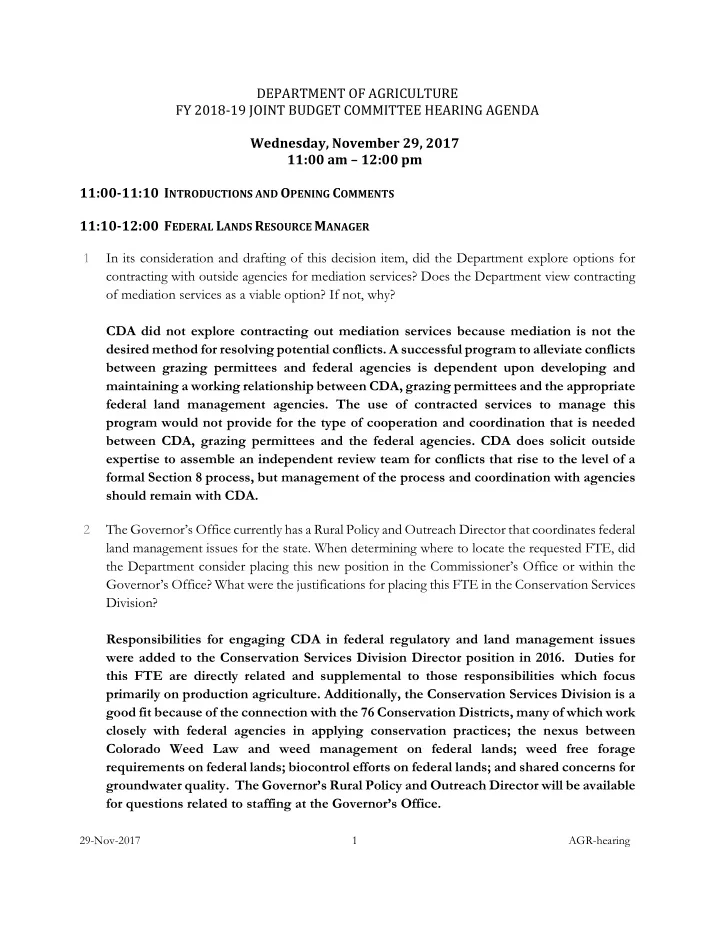
DEPARTMENT OF AGRICULTURE FY 201819 JOINT BUDGET COMMITTEE HEARING AGENDA Wednesday, November 29, 2017 11:00 am 12:00 pm 11:00 11:10 I NTRODUCTIONS AND O PENING C OMMENTS 11:10 12:00 F EDERAL L ANDS R ESOURCE M ANAGER 1 In its


slide-1
SLIDE 1

29-Nov-2017 1 AGR-hearing

DEPARTMENT OF AGRICULTURE FY 2018‐19 JOINT BUDGET COMMITTEE HEARING AGENDA Wednesday, November 29, 2017 11:00 am – 12:00 pm 11:00‐11:10 INTRODUCTIONS AND OPENING COMMENTS 11:10‐12:00 FEDERAL LANDS RESOURCE MANAGER 1 In its consideration and drafting of this decision item, did the Department explore options for contracting with outside agencies for mediation services? Does the Department view contracting

  • f mediation services as a viable option? If not, why?

CDA did not explore contracting out mediation services because mediation is not the desired method for resolving potential conflicts. A successful program to alleviate conflicts between grazing permittees and federal agencies is dependent upon developing and maintaining a working relationship between CDA, grazing permittees and the appropriate federal land management agencies. The use of contracted services to manage this program would not provide for the type of cooperation and coordination that is needed between CDA, grazing permittees and the federal agencies. CDA does solicit outside expertise to assemble an independent review team for conflicts that rise to the level of a formal Section 8 process, but management of the process and coordination with agencies should remain with CDA. 2 The Governor’s Office currently has a Rural Policy and Outreach Director that coordinates federal land management issues for the state. When determining where to locate the requested FTE, did the Department consider placing this new position in the Commissioner’s Office or within the Governor’s Office? What were the justifications for placing this FTE in the Conservation Services Division? Responsibilities for engaging CDA in federal regulatory and land management issues were added to the Conservation Services Division Director position in 2016. Duties for this FTE are directly related and supplemental to those responsibilities which focus primarily on production agriculture. Additionally, the Conservation Services Division is a good fit because of the connection with the 76 Conservation Districts, many of which work closely with federal agencies in applying conservation practices; the nexus between Colorado Weed Law and weed management on federal lands; weed free forage requirements on federal lands; biocontrol efforts on federal lands; and shared concerns for groundwater quality. The Governor’s Rural Policy and Outreach Director will be available for questions related to staffing at the Governor’s Office.

slide-2
SLIDE 2

29-Nov-2017 2 AGR-hearing

3 What is the Department’s policy with regards to mediation, arbitration, and legal action on issues

  • f federal rangeland management? At what point does the Department consider legal action to

protect state equity and assets? Does the Department receive services from the Attorney General’s Office when dealing with the federal government? CDA promotes science-based management of federal lands under the principles of multiple-use and sustained-yield. The mediation services offered by CDA are meant to alleviate the need for legal action between grazing permittees and federal land management agencies. CDA would not pursue legal action as part of the mediation process, as parties participating in mediation prefer to avoid litigation. However, through active participation (including timely, substantive comments submitted to the official record) in the federal land management planning process CDA could have standing to challenge a decision made by a federal agency. Challenges to federal decisions must exhaust administrative appeal opportunities unique to each agency before legal action can be pursued. 4 Prior to H.B. 15-1225 (Federal Land Coordination), what was the Department’s involvement in the federal rangeland management process? Is the current mediation role a continuation of prior practices or a new step toward greater involvement in the process? CDA signed MOUs with the U.S. Forest Service and the Bureau of Land Management in 1989 and 1997 respectively that provided a process by which CDA could assist in resolving federal livestock grazing permit disputes. Responsibilities for engaging CDA in federal regulatory and land management issues were added to the Conservation Services Division Director position in 2016. Since that time CDA has become involved in federal regulatory and land management planning processes in addition to updating MOUs with the Forest Service and BLM (in process) regarding mediation. Participation in federal regulatory and land management decisions at multiple levels represents an expansion of CDA’s role to benefit Colorado’s farmers and ranchers. 5 What are the factors that determine if there is a state interest in the federal rangeland management process? At what point does the Department become involved? Because 36% of Colorado’s land mass is controlled by the federal government, the state has an interest in all federal land management decisions because of the importance of natural resources on federal lands to multiple sectors of the state economy and the way of life of its citizens. CDA’s involvement in an issue is based on multiple factors. It can be reactionary to a request from agency or industry for mediation services particular to a

slide-3
SLIDE 3

29-Nov-2017 3 AGR-hearing

specific allotment or to a request from a local government to become involved in a planning process. CDA may proactively engage in a planning or regulatory process particularly when the issue at hand impacts a large area or is likely to set a precedent for future decisions which will affect Colorado’s producers. 6 Does the state have a coordinated statewide policy concerning federal land use? Please invite the Governor’s Rural Policy and Outreach Director to discuss this and related issues with the Joint Budget Committee. State agencies take the lead in engaging on management of their own state lands, and with the federal government related to federal land management planning processes and

  • policies. State agencies coordinate with the Governor's office staff, as appropriate, to

make staff aware of challenges and to coordinate when there are comments from multiple

  • departments. In addition, the Governor's Office has, at times, coordinated meetings

among interested local governments on federal land-use processes that implicate a broader geographic area than a field office or forest. Most recently, that has included work

  • n greater sage grouse planning and conservation, methane capture from coal mines in

the North Fork Valley, and Gunnison sage grouse conservation. ADDENDUM: OTHER QUESTIONS FOR WHICH SOLELY WRITTEN RESPONSES ARE REQUESTED 1 Provide a list of any legislation that the Department has: (a) not implemented, or (b) partially implemented. Explain why the Department has not implemented or has only partially implemented the legislation on this list. Please explain any problems the Department is having implementing any legislation and any suggestions you have to modify legislation. The Department does not have any legislation to report. 2 Does the Department have any HIGH PRIORITY OUTSTANDING recommendations as identified in the "Annual Report: Status of Outstanding Audit Recommendations" that was published by the State Auditor's Office and dated June 30, 2017 (link below)? What is the Department doing to resolve the HIGH PRIORITY OUTSTANDING recommendations? Please indicate where in the Department’s budget request actions taken towards resolving HIGH PRIORITY OUTSTANDING recommendations can be found. http://leg.colorado.gov/audits/annual‐report‐status‐outstanding‐audit‐ recommendations‐june‐30‐2017

slide-4
SLIDE 4

29-Nov-2017 4 AGR-hearing

The Department has reported all high priority recommendations as implemented. 3 If the Department receives federal funds of any type, please respond to the following:

  • a. Please provide a detailed description of any federal sanctions or potential sanctions

for state activities of which the Department is already aware. In addition, please provide a detailed description of any sanctions that MAY be issued against the Department by the federal government during FFY 2017‐18 or 2018‐19. The Department is not aware of any sanctions.

  • b. Are you expecting any changes in federal funding with the passage of the FFY 2017‐

18 or 2018‐19 federal budget? If yes, in which programs, and what is the match requirement for each program? The Department anticipates a 6.0 percent reduction in funding for two awards from USDA ‐ Animal Disease Traceability and Animal Health National Surveillance and Response. These awards do not require a match.

  • c. Does the Department have a contingency plan if federal funds are eliminated?

No, the Department does not have a contingency plan. 4 Is the Department spending money on public awareness campaigns? If so, please describe these campaigns, the goal of the messaging, the cost of the campaign, and distinguish between paid media and earned media. Further, please describe any metrics regarding effectiveness and whether the Department is working with other state or federal departments to coordinate the campaign? Agricultural Financial Crisis The Colorado Department of Agriculture has met with a number of Colorado agricultural organizations to develop a plan to proactively provide mental health information to rural communities in the hope of preventing tragedies and suicides related to a dip in the ag economy. During this process, CDA staff worked closely with the Colorado Department of Human Services to develop outreach material for the Colorado Crisis Hotline. With the donated time and artwork of a marketing company out of Pueblo, the Media Center owned by Frank Provenza, material has now been distributed to rural communities including flyers, media coverage, newsletters, and radio PSAs.  This campaign also includes the printing and distribution of 20,000 business cards with the Colorado Crisis Hotline contact information at a cost of approximately $800.

slide-5
SLIDE 5

29-Nov-2017 5 AGR-hearing

 An anonymous donation has allowed us to purchase ads in rural papers and most of those papers have donated additional space: AG Journal, La Junta Tribune, Bent County Democrat, Fowler Tribune, Ranchland News, Chaffee County Times, Mountain Mail, Plainsman Herald, Eastern Colorado Plainsman, Limon Leader, Huerfano World, and the Sterling Advocate.  At the invitation of CDA, organizations participating in this effort include: CSU Extension, Colorado Farm Bureau and Rocky Mountain Farmers Union. It will be difficult to ever really know the success of our efforts but we believe it’s an important project. Colorado Proud Colorado Proud was developed by the Colorado Department of Agriculture in 1999 to promote food and agricultural products that are grown, raised or processed in Colorado. Currently there are more than 2,400 members including farmers, ranchers, food manufacturers, associations, restaurants, retailers, distributors, schools and other institutions. Members utilize the common logo that the Department then promotes to consumers, encouraging them to look for the label and buy local. The goals of Colorado Proud are to promote local food and agricultural products, increase the awareness of Colorado Proud, educate the public about Colorado agriculture and encourage consumers to buy local products labeled with the Colorado Proud logo. The 2017, Colorado Proud public awareness campaign included television advertising on CBS4‐KCNCTV and a public relations campaign focused on promoting Colorado’s farming and ranching families. Television Advertising: Budget: $32,503 Colorado Proud contracted with CBS4‐KCNCTV in Denver to produce television ads promoting Colorado potatoes and chilies. The station aired 243 television ads that specifically promoted Colorado grown potatoes and Pueblo, Colorado chilies, August 14‐September 10, 2017. The primary funding source (federal grant) required money to be spent only on promoting fruits and vegetables. The television ads reached 71.5% of households 5.9 times for a total of 6.9 million impressions and 23.2% of adults 25‐54 5.4 times for a total of 1.9 million

  • impressions. Digital components including pre‐roll video, banner ads, homepage

and news takeovers and in‐article video delivered an additional 318,740

  • impressions. Click here to view the ads.

Public Relations: Budget:$112,500

slide-6
SLIDE 6

29-Nov-2017 6 AGR-hearing

Colorado Proud contracted with Philosophy Communication to develop and implement the “Faces and Stories of Colorado Agriculture” campaign and a “Season’s Eatings” holiday promotion. The Colorado Proud team participated in 10 events during the month of August to celebrate the state’s farming and ranching families and Colorado Proud Month. Consumers caught a glimpse of what it is like to be a Colorado farmer or rancher through our series of GoPro videos on the Colorado Proud Facebook page. Media panel lunches were held in Denver, Grand Junction and Colorado Springs to educate the media about Colorado agriculture. Colorado Proud also shared information with customers at six farmers’ markets across the state. The Colorado Proud “Faces and Stories of Agriculture” campaign resulted in 74 media placements, more than 437 million media impressions and $660,831 in PR value. The Colorado Proud Facebook page grew to more than 5,000 “likes,” which was a 29% increase since the beginning of the campaign. Facebook posts reached more than 110,000 people and Facebook videos were viewed nearly 11,000 times. Watch the Colorado Proud “Faces & Stories of Agriculture” recap video at: https://www.youtube.com/watch?v=M4iz0B2v638&feature=youtu.be. The “Season’s Eatings” holiday promotion is currently underway and results are not yet available. We are promoting locally made food and agriculture products as gifts through social media and earned media. In 1999, Colorado Proud started with 65 companies, and now the program has

  • ver 2,400 members that include growers, processors, restaurants, retailers,

schools and associations statewide. According to a 2017 survey:  72% of respondents are very or somewhat familiar with the Colorado Proud logo, up from 59% in 2008.  79% purchase at least some Colorado food products.  62% are looking for the Colorado Proud logo more often when shopping now than they used to.  65% are more likely to buy produce that is labeled with the Colorado Proud logo.  More than 90% of Coloradans are more likely to buy Colorado grown and produced products if they were available and identified as being from Colorado. Colorado Wine The Colorado Wine Industry Development Board (CWIDB) is part of the Colorado Department of Agriculture dedicated to promoting and furthering the development of Colorado’s grape growers and vintners. The CWIDB supports the efforts of more than 140 wineries throughout the state, producing an increasing array of premium‐quality wines, as well as 200 grape growers tending about 1000

slide-7
SLIDE 7

29-Nov-2017 7 AGR-hearing

acres of grape vines. According to C.R.S. 35‐29.5‐105 “(2) In any fiscal year, the board shall budget from moneys in the fund at least one‐third toward research and development and at least one‐third toward promotion and marketing of the Colorado wine industry, including any administrative costs associated therewith.” [emphasis added] Paragraph (1) of that same statute, creates the Colorado Wine Industry Development Fund, which is “continuously appropriated to the [CWIDB] for the expenses of the board in implementing the provisions of this article” and is the sole source of CWIDB spending. The CWIDB is in the fourth renewal period of a contract awarded through an RFP process to Cultivator Ad & Design in Denver. Over the past five years, Cultivator has worked to expand the public’s awareness of Colorado wines, primarily using

  • utdoor billboards in the Denver metro area as well as train‐station domination

in the concourse trains at Denver International Airport during a four week period mid‐November through mid‐December to target the heavy traffic during the Thanksgiving holiday. Marketing contracts include: FY2017: $227,000 total for Cultivator

Digital advertising plus billboards in Denver metro area in spring‐summer and in DIA Nov‐Dec

  • Total impressions for 2016‐17 media plan=31 million.
  • Cost for 2017 contract period (through Sept. 2017)=$100,000.

Rebranding of Colorado wine brand and imagery plus retooling web site

Creation of Governor’s Cup Wine Tasting event held in August 4, 2016 at History Colorado Center Denver to create an opportunity for the wine consuming public to sample the top wines in the state as selected by a panel of national and local judges during the Governor’s Cup Winemaking Competition, held in July at Metropolitan State University of Denver’s Hospitality Learning Center’s sensory lab.

  • Cost of competition judging: $17,754
  • Cost of public event, excluding Cultivator fees: $7,858
  • Cultivator fees for design and implementation of public event (in

marketing contract): $9.765

Cultivator sub‐contracts with VOCA PR for PR activities and placements, part

  • f the total marketing contract:
  • resulted in nearly 341 million impressions since January 2016
  • valued at $2.9 million in ad equivalency from a $50,000 annual budget.

Consumer Awareness Metrics According to the consumer survey conducted by Focus Research and Strategy in May 2017:

slide-8
SLIDE 8

29-Nov-2017 8 AGR-hearing 

awareness of Colorado wine rose from 73% in 2016 to 76% in 2017

future purchase interest for Colorado wine improved from 66% in 2016 to 68% in 2017

consumers that reported purchasing Colorado wine, however, remained flat from 2016 to 2017

The volume of wine reported by Colorado wineries to the DOR in excise tax reports, rose 7.6% 2017 over 2016, a growth rate sustained over the past five years. Other The Colorado Department of Agriculture also participates in a number of “public awareness” efforts that do not include advertising buys in order to communicate with the public including booths, brochures, videos, outreach to schools, Facebook, newsletters, email blasts, news releases, etc. Additionally, CDA produces an annual magazine, Cultivating Colorado, focused on educating the public on the importance of agriculture and its role in their lives. These efforts were not included in the above information since little to no funding is used. 5 Based on the Department’s most recent available record, what is the FTE vacancy and turnover rate by department and by division? To what does the Department attribute this turnover/vacancy? Do the statewide compensation policies administered by the Department of Personnel help or hinder in addressing vacancy or turnover issues? The Department turnover rate will be provided with DPA’s hearing responses. Currently, CDA has 5.0 vacant positions in the Agricultural Products Inspection section and 2.0 vacant positions in the State Fair Division. Statewide compensation policies are at times rigid, leading to some turnover. Often, a state employee is unable to advance in a role within a small agency in a single job classification. Recently, changes were made to the state personnel rules regarding in‐range salary adjustments. It is too early to tell if these changes will lead to positive

  • utcomes. In addition, when employees resign for more competitive

compensation packages outside of State employment, the Department may not have the budget to accommodate both the employee’s payout and provide any cross‐training with that position’s replacement, leading to a loss of institutional knowledge. 6 Please provide an update on the Department’s status, concerns, and plans of action for increasing levels of cybersecurity, including existing programs and resources. How does the Department work with the Chief Information Security Office (CISO) in the Office of Information Technology (OIT)? Have your information technology infrastructure and policies been audited for cybersecurity capabilities? If so, was the audit completed by the

slide-9
SLIDE 9

29-Nov-2017 9 AGR-hearing

legislative auditor or an outside entity? Do you have dedicated cybersecurity personnel? How do your cybersecurity staff interact with the CISO in OIT? What unique security issues does your Department have? Do you handle private or sensitive data? What unique cybersecurity processes or tools do you use to protect this data? The Office of Information Security, under the leadership of the state CISO provides security governance, security architecture, risk management, compliance assessment support, and security operations functions for all executive branch agencies (with a few exceptions, such as: CDE, Department of State, Department of Law, Lottery). Agencies, except those mentioned as exceptions, do not have dedicated cybersecurity personnel. The Office of Information Security has input into the 5‐year plans for each Department, and has worked to prioritize projects benefiting each Department, such as: the Enterprise Firewall Refresh project, new quarterly security awareness training, two‐step verification, and an enterprise security log collection and correlation engine. Additionally, the Office of Information Security, within OIT, produces a quarterly risk report card, in which they measure risk for each Department, and have specific goals set, for reducing risk. Annually, the CISO develops an enterprise information security plan, utilizing input from the Governor’s goals, the 5 year plans for each department, and the OIT

  • playbook. The information security plan includes communication and

information resources that support the operations and assets of each department. The Office of Information security, within the Office of Information Technology (OIT) implements enterprise‐wide security controls, meant to secure sensitive data for each department. Some of these controls are: ensuring encryption is in place to secure data in transmission, utilizing Zix to encrypt sensitive data in email, implementing specific configuration and technologies to encrypt data in

  • storage. Additionally, OIT has implemented two‐step verification to add a layer of

protection to email, contacts, and data stored within G‐Suite. Each department implements additional procedures, such as training, data retention and access control policies, implemented at a department level to further protect and secure sensitive data. These local security procedures augment technical controls implemented by OIT to enhance the department’s continued security health. OIT supports all of the audits that occur for each department. OIT maintains a register of outstanding technology recommendations for each department, and works individually with the department to prioritize and secure funding to implement the recommendations. In addition to performing remediation, OIT

slide-10
SLIDE 10

29-Nov-2017 10 AGR-hearing

continues to implement controls and improve processes in an attempt to proactively (rather than reactively) improve security. 7 What impact do the SMART Act and Lean processes have on your budget requests? Could they be used more effectively? Both SMART Act and Lean processes are taken into account when requesting budget actions through the General Assembly. The Department is not aware of ways in which these could be used more effectively. 8 Does your Department use evidence‐based analysis as a foundation for your budget request? If so, please provide a definition for your use of “evidence‐based,” indicate which programs are “evidence‐based,” and describe the evidence used to support these programs. Currently, CDA is not engaged in this analysis. 9 Please identify how many rules you have promulgated in the past two years (FYs 2015‐ 16 and 2016‐17). With respect to these rules, have you done any cost‐benefit analyses pursuant to Section 24‐4‐103 (2.5), C.R.S., regulatory analyses pursuant to Section 24‐4‐ 103 (4.5), C.R.S., or any other similar analysis? Have you conducted a cost‐benefit analysis

  • f the Department’s rules as a whole? If so, please provide an overview of each analysis.

FY 2015‐16: 14 rules FY 2016‐17: 15 rules CDA has not conducted a cost‐benefit analysis or regulatory analysis in FYs 2015‐ 16 or 2016‐17. 10 Describe the expected fiscal impact of proposed changes to PERA made by both the Governor’s Office and the PERA Board of Directors. In addition to direct budgetary impacts, please describe any anticipated secondary impacts of an increase in employee contribution rates. For instance, does the Department anticipate a need to increase employee salaries to compensate for the increase in PERA contributions? The proposed changes to PERA made by the PERA Board of Directors include a 2.0 percentage point increase in employer contributions from 20.15% to 22.15%, which will have a direct budgetary impact on the department. DPA will provide a

slide-11
SLIDE 11

29-Nov-2017 11 AGR-hearing

statewide estimate for this impact. PERA’s proposal makes this change starting January 2020, thus it will affect the department’s budget starting with FY 2019‐20. The PERA Board proposal also includes a recommendation for contributions to be made on gross pay rather than net pay, which increases the salary base upon which the annual contribution is calculated for both employers and employees. This would have a direct impact on the department’s budget as well as employee take home pay. OSPB and DPA are looking into whether this impact can be estimated, and if so, a statewide response will be provided by DPA. The PERA Board proposal also includes a 3.0 percentage point increase in employee contributions—from 8.0 percent to 11.0 percent of pay—beginning in January 2020. Without an increase in employee salaries, these changes would reduce take home pay for state employees beginning in FY 2019‐20. The Governor’s proposed changes to PERA will not have a direct budgetary impact

  • n the department, with the exception of maintaining the PERA Board’s

recommendation for employee and employer contributions to be made on gross pay rather than net pay. As mentioned above, this would increase the salary base upon which the annual contribution is calculated for both employers and

  • employees. OSPB and DPA are looking into whether this impact can be estimated,

and if so, a statewide response will be provided by DPA. The Governor’s proposal includes a 2.0 percentage point increase in employee contributions—from 8.0 percent to 10.0 percent of pay—beginning in January 2019, a year earlier than the PERA proposal. The Governor’s budget request includes an across‐the‐board salary survey increase of 3.0 percent for most state employees beginning July 1,

  • 2018. With the proposed increase in employee contributions, this will average to a

take home pay increase of 2.0 percent for the fiscal year. The proposed salary survey increase results in an increase of $552,511 total funds, and $181,459 General Fund for FY 2018‐19 for the department. 11 Senate Bill 17‐267 required Departments, other than Education and Transportation, that submit budgets to OSPB to propose a budget that is 2.0 percent below the total funds budget in FY 2017‐18. Please highlight the following regarding the 2.0 percent reduction:  Where these reductions can be found in the Department’s request;  What programs are impacted by the reduction; and  Total amount of the reduction. CDA does not have any budget reduction items. In the course of its statutory duties, the Office of State Planning and Budgeting complied with the provisions of S.B. 17‐267. A provision of the bill required OSPB’s consideration of proposed two percent reductions for certain principal department budgets. OSPB found the process to be useful. In recommending the budget request, especially in the General Fund, while considering each

slide-12
SLIDE 12

29-Nov-2017 12 AGR-hearing

department’s budget reduction items, OSPB also took into account the various pressures on spending and needs throughout the state. Additionally, S.B. 17‐ 267’s provisions informed decision making in the request, in particular the recommendation for a decrease in the Budget Stabilization factor in the School Finance Act as well as the recommendation to increase the statutory reserve in the General Fund. With respect to the two percent target of General Fund spending as defined in the bill, these two items exceeded the suggested target. 12 Please provide the following information for the Department’s custodial funds and continuously appropriated funds:  Name of the fund;  Amount of funds received;  Whether the revenues are one‐time or multi‐year;  Current cash fund balance;  Source(s) of the funds;  A list of FY 2015‐16 and FY 2016‐17 expenditures from these funds;  Expected uses of the funds in FY 2017‐18 and FY 2018‐19; and  Legal authorization and restrictions/limitations on the Department’s use of these funds. This information is contained in the Schedule 9 Budget submissions, and are attached to this document (Attachment A). 13 What is the Department’s process for engaging in (or disputing) federal land, environmental, jurisdictional, and/or water policy issues? How do you coordinate with

  • ther departments, the Governor’s Office, local governments, and/or citizens?

The Department has addressed through questions #1‐6. When an issue is brought to CDA’s attention, regular communications occur with any other impacted agencies including DNR, CDPHE and Local Governments as well as agriculture producers.

slide-13
SLIDE 13

Actual Actual Appropriated Requested FY 2015-16 FY 2016-17 FY 2017-18 FY 2018-19 Year Beginning Fund Balance (A) $1,873,852 $2,236,620 $2,120,206 $1,995,073 Changes in Cash Assets $362,768

  • $114,862
  • $125,133
  • $125,133

Changes in Non-Cash Assets $0 $0 $0 $0 Changes in Long-Term Assets $0 $0 $0 $0 Changes in Total Liabilities $0

  • $1,553

$0 $0 TOTAL CHANGES TO FUND BALANCE $362,768

  • $116,414
  • $125,133
  • $125,133

Assets Total $2,243,803 $2,128,941 $2,003,808 $1,878,675 Cash (B) $2,243,803 $2,128,941 $2,003,808 $1,878,675 Other Assets(Detail as necessary) $0 $0 $0 $0 Receivables $0 $0 $0 $0 Liabilities Total $7,183 $8,735 $8,735 $8,735 Cash Liabilities (C ) $7,183 $8,735 $8,735 $8,735 Long Term Liabilities $0 $0 $0 $0 Ending Fund Balance (D) $2,236,620 $2,120,206 $1,995,073 $1,869,939 Logical Test TRUE TRUE TRUE TRUE Net Cash Assets - (B-C) $2,236,620 $2,120,206 $1,995,073 $1,869,939 Change from Prior Year Fund Balance (D-A) $362,768

  • $116,414
  • $125,133
  • $125,133

Revenue Total $487,852 $23,719 $15,000 $15,000 Fees $468,722

  • $615

$0 $0 Interest $19,131 $24,333 $15,000 $15,000 Expenses Total $125,084 $140,133 $140,133 $140,133 Cash Expenditures $125,084 $140,133 $140,133 $140,133 Change Requests (If Applicable) $0 $0 $0 $0 Net Cash Flow $362,768

  • $116,414
  • $125,133
  • $125,133

Cash Flow Summary Schedule 9: Cash Funds Reports Department of Agriculture FY 2018-19 Budget Request Agriculture Value Added Development Fund - 15C0 35-75-205, C.R.S.

Department of Agriculture Attachment A 29-Nov-2017 Attachment A - 1 AGR-Hearing

slide-14
SLIDE 14

Cash Fund Reserve Balance

Actual Actual Estimated Requested FY 2015-16 FY 2016-17 FY 2017-18 FY 2018-19 Uncommitted Fee Reserve Balance (total reserve balance minus exempt assets and previously appropriated funds; calculated based

  • n % of revenue from fees)

$2,236,620 $2,120,206 $1,995,073 $1,869,939 Target/Alternative Fee Reserve Balance (amount set in statute or 16.5% of total expenses) $20,639 $23,122 $23,122 $23,122 Excess Uncommitted Fee Reserve Balance $2,215,981 $2,097,084 $1,971,951 $1,846,817 Compliance Plan (narrative)

Cash Fund Narrative Information

Purpose/Background of Fund Fee Sources Non-Fee Sources Long Bill Groups Supported by Fund Exempt from Fee Reserve requirement as revenues are from energy grants pursuant to 35-75-205 (1.5) (a), C.R.S. and 35-29- 109.3 (2) (h), C.R.S. As revenues are from severance tax transfers and are not fee based, the excess uncommitted fee reserve balance does not apply. To encourage, promote, and stimulate agriculturally based economic development and employment in rural Colorado. 1% participation fee on loans, Tier 2 severance tax distribution (repealed). Purchase of tax credits. (3) Agricultural Markets Division Department of Agriculture Attachment A 29-Nov-2017 Attachment A - 2 AGR-Hearing

slide-15
SLIDE 15

Actual Actual Appropriated Requested FY 2015-16 FY 2016-17 FY 2017-18 FY 2018-19 Year Beginning Fund Balance (A) $5,702 $18,378 $18,378 $51,394 Changes in Cash Assets $12,675 $12,937

  • $25,000
  • $25,000

Changes in Non-Cash Assets $0 $0 $0 $0 Changes in Long-Term Assets $0

  • $4,356

$0 $0 Changes in Total Liabilities $0

  • $8,581

$58,016 $0 TOTAL CHANGES TO FUND BALANCE $12,675 $0 $33,016

  • $25,000

Assets Total $77,812 $86,394 $61,394 $36,394 Cash (B) $72,812 $85,750 $60,750 $35,750 Other Assets(Detail as necessary) $0 $0 $0 $0 Receivables $5,000 $644 $644 $644 Liabilities Total $59,435 $68,016 $10,000 $10,000 Cash Liabilities (C ) $59,435 $68,016 $10,000 $10,000 Long Term Liabilities $0 $0 $0 $0 Ending Fund Balance (D) $18,378 $18,378 $51,394 $26,394 Logical Test TRUE TRUE TRUE TRUE Net Cash Assets - (B-C) $13,378 $17,734 $50,750 $25,750 Change from Prior Year Fund Balance (D-A) $12,675 $0 $33,016

  • $25,000

Revenue Total $404,924 $379,194 $375,000 $375,000 Fees $404,924 $379,194 $375,000 $375,000 Expenses Total $402,074 $379,194 $400,000 $400,000 Cash Expenditures $402,074 $379,194 $400,000 $400,000 Change Requests (If Applicable) $0 $0 $0 $0 Net Cash Flow $2,850 $0

  • $25,000
  • $25,000

Schedule 9: Cash Funds Reports Department of Agriculture FY 2018-19 Budget Request Vetrinary Vaccine and Service Fund - 1040 35-50-106, C.R.S. Cash Flow Summary

Department of Agriculture Attachment A 29-Nov-2017 Attachment A - 3 AGR-Hearing

slide-16
SLIDE 16

Cash Fund Reserve Balance

Actual Actual Estimated Requested FY 2015-16 FY 2016-17 FY 2017-18 FY 2018-19 Uncommitted Fee Reserve Balance (total reserve balance minus exempt assets and previously appropriated funds; calculated based

  • n % of revenue from fees)

$18,378 $18,378 $51,394 $26,394 Target/Alternative Fee Reserve Balance (amount set in statute or 16.5% of total expenses) $66,342 $62,567 $66,000 $66,000 Excess Uncommitted Fee Reserve Balance ($47,965) ($44,189) ($14,606) ($39,606) Compliance Plan (narrative)

Cash Fund Narrative Information

Purpose/Background of Fund Fee Sources Non-Fee Sources Long Bill Groups Supported by Fund The fund is in compliance. Establish a fund into which the proceeds from the sale of vaccine and services shall be deposited, to buy vaccines an

  • ther laboratory expenses. Funds are continuously

appropriated. Proceeds from sale of vaccines and lab services. N/A Common Policies throughout (1) Commissioner's Office and (2) Agricultural Services Division Department of Agriculture Attachment A 29-Nov-2017 Attachment A - 4 AGR-Hearing

slide-17
SLIDE 17

Actual Actual Appropriated Requested FY 2015-16 FY 2016-17 FY 2017-18 FY 2018-19 Year Beginning Fund Balance (A) $431,435 $437,503 $474,334 $465,140 Changes in Cash Assets $6,067 $36,815

  • $9,194

$9,302 Changes in Non-Cash Assets $0 $0 $0 $0 Changes in Long-Term Assets $0 $0 $0 $0 Changes in Total Liabilities $0 $16 $0 $0 TOTAL CHANGES TO FUND BALANCE $6,067.29 $36,831

  • $9,194

$9,302 Assets Total $437,519 $474,334 $465,140 $474,442 Cash (B) $437,519 $474,334 $465,140 $474,442 Other Assets(Detail as necessary) $0 $0 $0 $0 Receivables $0 $0 $0 $0 Liabilities Total $16 $0 $0 $0 Cash Liabilities (C ) $16 $0 $0 $0 Long Term Liabilities $0 $0 $0 $0 Ending Fund Balance (D) $437,503 $474,334 $465,140 $474,442 Logical Test TRUE TRUE TRUE TRUE Net Cash Assets - (B-C) $437,503 $474,334 $465,140 $474,442 Change from Prior Year Fund Balance (D-A) $6,067 $36,831

  • $9,194

$9,302 Revenue Total $11,191 $37,017 $2,000 $2,000 Fees $11,191 $37,017 $2,000 $2,000 Interest $0 $0 $0 $0 Expenses Total $6,067 $36,831 $6,000 $6,000 Cash Expenditures $6,067 $36,831 $6,000 $6,000 Change Requests (If Applicable) $0 $0 $0 $0 Net Cash Flow $5,124 $186

  • $4,000
  • $4,000

Cash Flow Summary Schedule 9: Cash Funds Reports Department of Agriculture FY 2018-19 Budget Request Diseased Livestock Indemnity - 1060 35-50-114, C.R.S.

Department of Agriculture Attachment A 29-Nov-2017 Attachment A - 5 AGR-Hearing

slide-18
SLIDE 18

Cash Fund Reserve Balance

Actual Actual Estimated Requested FY 2015-16 FY 2016-17 FY 2017-18 FY 2018-19 Uncommitted Fee Reserve Balance (total reserve balance minus exempt assets and previously appropriated funds; calculated based

  • n % of revenue from fees)

$437,503 $474,334 $465,140 $474,442 Target/Alternative Fee Reserve Balance (amount set in statute or 16.5% of total expenses) $1,001 $6,077 $990 $990 Excess Uncommitted Fee Reserve Balance $457,488 $468,256 $464,150 $473,452 Compliance Plan (narrative)

Cash Fund Narrative Information

Purpose/Background of Fund Fee Sources Non-Fee Sources Long Bill Groups Supported by Fund Revenues are not fee based but are rather unexpended Personal Services dollars from State Veterinarian services. Thus, the uncommitted fee reserve balance does not apply. Payment of indemnity to any livestock owner whose herd is voluntarily sold for slaughter because of exposure to a designated disease. Funds are continuously appropriated. N/A Unexpended, unencumbered balance of money appropriated for the State Veterinarian pursuant to section 35-50-104, C.R.S. (2) Agricultural Services Division Department of Agriculture Attachment A 29-Nov-2017 Attachment A - 6 AGR-Hearing

slide-19
SLIDE 19

Actual Actual Requested Requested FY 2015-16 FY 2016-17 FY 2017-18 FY 2018-19 Year Beginning Fund Balance (A) $227,196 $161,604 $167,604 $97,604 Changes in Cash Assets

  • $65,592
  • $7,910
  • $70,000
  • $70,000

Changes in Non-Cash Assets $0 $0 $0 $0 Changes in Long-Term Assets $0 $6,000 $0 $0 Changes in Total Liabilities $0 $7,910 $0 $0 TOTAL CHANGES TO FUND BALANCE

  • $65,592

$6,000

  • $70,000
  • $70,000

Assets Total $310,771 $308,861 $238,861 $168,861 Cash (B) $236,771 $228,861 $158,861 $88,861 Other Assets(Detail as necessary) $0 $0 $0 $0 Receivables $74,000 $80,000 $80,000 $80,000 Liabilities Total $149,167 $141,257 $141,257 $141,257 Cash Liabilities (C ) $149,167 $141,257 $141,257 $141,257 Long Term Liabilities $0 $0 $0 $0 Ending Fund Balance (D) $161,604 $167,604 $97,604 $27,604 Logical Test TRUE TRUE TRUE TRUE Net Cash Assets - (B-C) $87,604 $87,604 $17,604

  • $52,396

Change from Prior Year Fund Balance (D-A)

  • $65,592

$6,000

  • $70,000
  • $70,000

Revenue Total $757,102 $738,786 $750,000 $750,000 Fees $757,102 $738,786 $750,000 $750,000 Interest $0 $0 $0 $0 Expenses Total $872,694 $732,786 $820,000 $820,000 Cash Expenditures $872,694 $732,786 $820,000 $820,000 Change Requests (If Applicable) $0 $0 $0 $0 Net Cash Flow

  • $115,592

$6,000

  • $70,000
  • $70,000

Cash Flow Summary Schedule 9: Cash Funds Reports Department of Agriculture FY 2018-19 Budget Request Wine Promotion - 2260 35-29.5-105, C.R.S.

Department of Agriculture Attachment A 29-Nov-2017 Attachment A - 7 AGR-Hearing

slide-20
SLIDE 20

Cash Fund Reserve Balance

Actual Actual Estimated Requested FY 2015-16 FY 2016-17 FY 2017-18 FY 2018-19 Uncommitted Fee Reserve Balance (total reserve balance minus exempt assets and previously appropriated funds; calculated based

  • n % of revenue from fees)

$255,418 $161,604 $167,604 $97,604 Target/Alternative Fee Reserve Balance (amount set in statute or 16.5% of total expenses) $143,994 $120,910 $135,300 $135,300 Excess Uncommitted Fee Reserve Balance $111,424 $40,694 $32,304 ($37,696) Compliance Plan (narrative)

Cash Fund Narrative Information

Purpose/Background of Fund Fee Sources N/A Non-Fee Sources Long Bill Groups Supported by Fund Revenues are the result of sales tax revenue collected on Colorado wine and grapes sold and are therefore not considered fee revenue. Thus, the uncommitted fee reserve balance does not apply. Resources from the fund are also continuously appropriated per 35-29.5-105 (1), C.R.S. Help fund the promotional efforts of the Colorado wine industry. Wine and grape taxes. Common Policies throughout (1) Commissioner's Office and (3) Agricultural Markets Division Department of Agriculture Attachment A 29-Nov-2017 Attachment A - 8 AGR-Hearing

slide-21
SLIDE 21

Actual Actual Appropriated Requested FY 2015-16 FY 2016-17 FY 2017-18 FY 2018-19 Year Beginning Fund Balance (A) $276,332 $276,222 $276,222 $276,222 Changes in Cash Assets

  • $110

$0 $0 $0 Changes in Non-Cash Assets $0 $0 $0 $0 Changes in Long-Term Assets $0 $0 $0 $0 Changes in Total Liabilities $0 $0 $0 $0 TOTAL CHANGES TO FUND BALANCE

  • $110

$0 $0 $0 Assets Total $290,864 $290,864 $290,864 $290,864 Cash (B) $289,864 $289,864 $289,864 $289,864 Other Assets(Detail as necessary) $0 $0 $0 $0 Receivables $1,000 $1,000 $1,000 $1,000 Liabilities Total $14,641 $14,641 $14,641 $14,641 Cash Liabilities (C ) $14,641 $14,641 $14,641 $14,641 Long Term Liabilities $0 $0 $0 $0 Ending Fund Balance (D) $276,222 $276,222 $276,222 $276,222 Logical Test TRUE TRUE TRUE TRUE Net Cash Assets - (B-C) $275,222 $275,222 $275,222 $275,222 Change from Prior Year Fund Balance (D-A)

  • $110

$0 $0 $0 Revenue Total $0 $67,335 $0 $0 Fees $0 $67,335 $0 $0 Interest $0 $0 $0 $0 Expenses Total $0 $0 $0 $0 Cash Expenditures $0 $0 $0 $0 Change Requests (If Applicable) $0 $0 $0 $0 Net Cash Flow $0 $67,335 $0 $0 Cash Flow Summary Schedule 9: Cash Funds Reports Department of Agriculture FY 2018-19 Budget Request Brand Estray - 7210 35-41-102, C.R.S.

Department of Agriculture Attachment A 29-Nov-2017 Attachment A - 9 AGR-Hearing

slide-22
SLIDE 22

Cash Fund Reserve Balance

Actual Actual Estimated Requested FY 2015-16 FY 2016-17 FY 2017-18 FY 2018-19 Uncommitted Fee Reserve Balance (total reserve balance minus exempt assets and previously appropriated funds; calculated based

  • n % of revenue from fees)

$276,222 $276,222 $276,222 $276,222 Target/Alternative Fee Reserve Balance (amount set in statute or 16.5% of total expenses) $0 $0 $0 $0 Excess Uncommitted Fee Reserve Balance $267,863 $276,222 $276,222 $276,222 Compliance Plan (narrative)

Cash Fund Narrative Information

Purpose/Background of Fund Fee Sources Non-Fee Sources Long Bill Groups Supported by Fund Revenues support operations of an enterprise as defined in 24- 77-102 (3), C.R.S., this fund is exempt from the Fee Reserve requirement. Used for advertising costs and payment of proceeds to owners

  • f estray animals sold at auction by the Brand Board.

N/A Proceeds from sale of estrays. (4) Brand Board and (1) Commissioner's Office Department of Agriculture Attachment A 29-Nov-2017 Attachment A - 10 AGR-Hearing

slide-23
SLIDE 23

Actual Actual Appropriated Requested FY 2015-16 FY 2016-17 FY 2017-18 FY 2018-19 Year Beginning Fund Balance (A) $905,787 $883,149 $513,868 $370,522 Changes in Cash Assets

  • $22,637
  • $438,604
  • $144,000
  • $144,000

Changes in Non-Cash Assets $0 $0 $0 $0 Changes in Long-Term Assets $0 $0 $0 $0 Changes in Total Liabilities $0 $69,323 $654 $0 TOTAL CHANGES TO FUND BALANCE

  • $22,637
  • $369,281
  • $143,346
  • $144,000

Assets Total $953,127 $514,522 $370,522 $226,522 Cash (B) $953,127 $514,522 $370,522 $226,522 Other Assets(Detail as necessary) $0 $0 $0 $0 Receivables $0 $0 $0 $0 Liabilities Total $69,977 $654 $0 $0 Cash Liabilities (C ) $69,977 $654 $0 $0 Long Term Liabilities $0 $0 $0 $0 Ending Fund Balance (D) $883,149 $513,868 $370,522 $226,522 Logical Test TRUE TRUE TRUE TRUE Net Cash Assets - (B-C) $883,149 $513,868 $370,522 $226,522 Change from Prior Year Fund Balance (D-A)

  • $22,637
  • $369,281
  • $143,346
  • $144,000

Revenue Total $421,172 $378 $156,000 $156,000 Fees $409,662 $0 $150,000 $150,000 Interest $11,510 $378 $6,000 $6,000 Expenses Total $443,900 $369,659 $300,000 $300,000 Cash Expenditures $443,900 $369,659 $300,000 $300,000 Change Requests (If Applicable) $0 $0 $0 $0 Net Cash Flow

  • $22,727
  • $369,281
  • $144,000
  • $144,000

Schedule 9: Cash Funds Reports Department of Agriculture FY 2018-19 Budget Request Conservation Grant Fund - 19N0 35-1-106.7, C.R.S. (2017) Cash Flow Summary

Department of Agriculture Attachment A 29-Nov-2017 Attachment A - 11 AGR-Hearing

slide-24
SLIDE 24

Cash Fund Reserve Balance

Actual Actual Estimated Requested FY 2015-16 FY 2016-17 FY 2017-18 FY 2018-19 Uncommitted Fee Reserve Balance (total reserve balance minus exempt assets and previously appropriated funds; calculated based

  • n % of revenue from fees)

$883,149 $513,868 $370,522 $226,522 Target/Alternative Fee Reserve Balance (amount set in statute or 16.5% of total expenses) $73,243 $60,994 $49,500 $49,500 Excess Uncommitted Fee Reserve Balance $809,906 $452,875 $321,022 $177,022 Compliance Plan (narrative)

Cash Fund Narrative Information

Purpose/Background of Fund Fee Sources Non-Fee Sources Long Bill Groups Supported by Fund Revenues are from Severance Tax collections and are statutorily driven per 39-29-109.3 (2) (b), C.R.S. and are therefore not fee revenue. Thus, the uncommitted fee reserve balance does not apply. Additionally, moneys are continuously appropriated per 35-1-106.7, C.R.S. To allow for various financial grants to conservation districts for the purpose

  • f implementing and maintaining soil and water conservation efforts.

N/A Severence tax revenue and interest earnings. (6) Conservation Board Department of Agriculture Attachment A 29-Nov-2017 Attachment A - 12 AGR-Hearing

slide-25
SLIDE 25

Actual Actual Appropriated Requested FY 2015-16 FY 2016-17 FY 2017-18 FY 2018-19 Year Beginning Fund Balance (A) $201,385 $203,417 $204,234 $205,234 Changes in Cash Assets $2,032 $817 $1,000 $1,000 Changes in Non-Cash Assets $0 $0 $0 $0 Changes in Long-Term Assets $0 $0 $0 $0 Changes in Total Liabilities $0 $0 $0 $0 TOTAL CHANGES TO FUND BALANCE $2,032 $817 $1,000 $1,000 Assets Total $203,417 $204,234 $205,234 $206,234 Cash (B) $203,417 $204,234 $205,234 $206,234 Other Assets(Detail as necessary) $0 $0 $0 $0 Receivables $0 $0 $0 $0 Liabilities Total $0 $0 $0 $0 Cash Liabilities (C ) $0 $0 $0 $0 Long Term Liabilities $0 $0 $0 $0 Ending Fund Balance (D) $203,417 $204,234 $205,234 $206,234 Logical Test TRUE TRUE TRUE TRUE Net Cash Assets - (B-C) $203,417 $204,234 $205,234 $206,234 Change from Prior Year Fund Balance (D-A) $2,032 $817 $1,000 $1,000 Revenue Total $2,483 $817 $1,000 $1,000 Fees $0 $0 $0 $0 Interest $2,483 $817 $1,000 $1,000 Expenses Total $451 $0 $0 $0 Cash Expenditures $451 $0 $0 $0 Change Requests (If Applicable) $0 $0 $0 $0 Net Cash Flow $2,032 $817 $1,000 $1,000 Cash Flow Summary Schedule 9: Cash Funds Reports Department of Agriculture FY 2018-19 Budget Request Cervidae Disease - 1110 35-50-115, C.R.S. (2017)

Department of Agriculture Attachment A 29-Nov-2017 Attachment A - 13 AGR-Hearing

slide-26
SLIDE 26

Cash Fund Reserve Balance

Actual Actual Estimated Requested FY 2015-16 FY 2016-17 FY 2017-18 FY 2018-19 Uncommitted Fee Reserve Balance (total reserve balance minus exempt assets and previously appropriated funds; calculated based

  • n % of revenue from fees)

$203,417 $204,234 $205,234 $206,234 Target/Alternative Fee Reserve Balance Set in statute at $200,000 per 35-50-115 (2), C.R.S. $200,000 $200,000 $200,000 $200,000 Excess Uncommitted Fee Reserve Balance $3,417 $4,234 $5,234 $6,234 Compliance Plan (narrative)

Cash Fund Narrative Information

Purpose/Background of Fund Fee Sources Non-Fee Sources Long Bill Groups Supported by Fund The fund is subject to the statutory reserve set in Section 35-50- 115 (2), C.R.S. Per statue, if the fund balance exceeds $200,000, fees are no longer charged. The fund balance is non- fee based, so the fund is in compliance. Indemnify owners of cervidae destroyed for the control of contagious disease. Per head fee up to $8. N/A (2) Agricultural Services Division Department of Agriculture Attachment A 29-Nov-2017 Attachment A - 14 AGR-Hearing

slide-27
SLIDE 27

Joint Budget Committee Hearing

November 29, 2017

slide-28
SLIDE 28

Mission and Vision

Vision: That Colorado agriculture be strong and vibrant, a key driver of the state’s economy, and recognized worldwide for its safe, affordable, and abundant supply of high quality food and agricultural products. Mission: To strengthen and advance Colorado agriculture; promote a safe and high quality food supply; protect consumers; and foster responsible stewardship of the environment and natural resources. CDA Priorities:

  • Enhance Coloradan’s understanding of agriculture.
  • Increase marketing and sales opportunities, as well as profitability,

throughout Colorado’s food and agriculture value chain.

  • Improve the customer service experience for the Department’s

stakeholders.

Page 2

slide-29
SLIDE 29

Agricultural Financial Crisis

  • The Colorado Department of Agriculture has met with a number of

Colorado agricultural organizations to develop a plan to proactively provide mental health information to rural communities in the hope

  • f preventing tragedies and suicides related to a dip in the ag

economy.

  • During this process, CDA staff worked closely with the Colorado

Department of Human Services to develop outreach material for the Colorado Crisis Hotline.

Page 3

slide-30
SLIDE 30

FEDERAL LANDS RESOURCE MANAGER

Page 4

slide-31
SLIDE 31

FEDERAL LANDS RESOURCE MANAGER

U.S. Forest Service Bureau of Land Management National Grassland Bureau of Indian Affairs National Monument National Park

Page 5

slide-32
SLIDE 32

FEDERAL LANDS RESOURCE MANAGER

Page 6

slide-33
SLIDE 33

FEDERAL LANDS RESOURCE MANAGER

Page 7

slide-34
SLIDE 34

FEDERAL LANDS RESOURCE MANAGER

Page 8

slide-35
SLIDE 35

FEDERAL LANDS RESOURCE MANAGER

In its consideration and drafting of this decision item, did the Department explore options for contracting with outside agencies for mediation services? Does the Department view contracting of mediation services as a viable option? If not, why?

  • CDA did not explore contracting out mediation services because mediation is

not the desired method for resolving potential conflicts.

  • A successful program to alleviate conflicts between grazing permittees and

federal agencies is dependent upon developing and maintaining a working relationship between CDA, grazing permittees and the appropriate federal land management agencies.

  • The use of contracted services to manage this program would not provide for

the type of cooperation and coordination that is needed between CDA, grazing permittees and the federal agencies.

  • CDA does solicit outside expertise to assemble an independent review team for

conflicts that rise to the level of a formal Section 8 process, but management of the process and coordination with agencies should remain with CDA.

Page 9

slide-36
SLIDE 36

FEDERAL LANDS RESOURCE MANAGER

The Governor’s Office currently has a Rural Policy and Outreach Director that coordinates federal land management issues for the state. When determining where to locate the requested FTE, did the Department consider placing this new position in the Commissioner’s Office or within the Governor’s Office? What were the justifications for placing this FTE in the Conservation Services Division?

  • Responsibilities for engaging CDA in federal regulatory and land management

issues were added to the Conservation Services Division Director position in 2016. Duties for this FTE are directly related and supplemental to those responsibilities which focus primarily on production agriculture.

  • The Conservation Services Division is a good fit because of the connection

with the 76 Conservation Districts, many of which work closely with federal agencies in applying conservation practices; the nexus between Colorado Weed Law and weed management

  • n

federal lands; weed free forage requirements on federal lands; biocontrol efforts on federal lands; and shared concerns for groundwater quality.

  • The Governor’s Rural Policy and Outreach Director will be available for

questions related to staffing at the Governor’s Office.

Page 10

slide-37
SLIDE 37

FEDERAL LANDS RESOURCE MANAGER

What is the Department’s policy with regards to mediation, arbitration, and legal action on issues of federal rangeland management? At what point does the Department consider legal action to protect state equity and assets? Does the Department receive services from the Attorney General’s Office when dealing with the federal government?

  • CDA

promotes science-based management

  • f

federal lands under the principles of multiple-use and sustained-yield. The mediation services offered by CDA are meant to alleviate the need for legal action between grazing permittees and federal land management agencies. CDA would not pursue legal action as part of the mediation process, as parties participating in mediation prefer to avoid litigation.

  • However, through active participation (including timely, substantive comments

submitted to the official record) in the federal land management planning process CDA could have standing to challenge a decision made by a federal

  • agency. Challenges to federal decisions must exhaust administrative appeal
  • pportunities unique to each agency before legal action can be pursued.

Page 11

slide-38
SLIDE 38

FEDERAL LANDS RESOURCE MANAGER

Prior to H.B. 15-1225 (Federal Land Coordination), what was the Department’s involvement in the federal rangeland management process? Is the current mediation role a continuation of prior practices or a new step toward greater involvement in the process?

  • CDA signed MOUs with the U.S. Forest Service and the Bureau of Land

Management in 1989 and 1997 respectively that provided a process by which CDA could assist in resolving federal livestock grazing permit disputes.

  • Responsibilities for engaging CDA in federal regulatory and land management

issues were added to the Conservation Services Division Director position in 2016.

  • Since that time CDA has become involved in federal regulatory and land

management planning processes in addition to updating MOUs with the Forest Service and BLM (in process) regarding mediation.

  • Participation in federal regulatory and land management decisions at multiple

levels represents an expansion of CDA’s role to benefit Colorado’s farmers and ranchers.

Page 12

slide-39
SLIDE 39

FEDERAL LANDS RESOURCE MANAGER

What are the factors that determine if there is a state interest in the federal rangeland management process? At what point does the Department become involved?

  • Because 36% of Colorado’s land mass is controlled by the federal government,

the state has an interest in all federal land management decisions because of the importance of natural resources on federal lands to multiple sectors of the state economy and the way of life of its citizens.

  • CDA’s involvement in an issue is based on multiple factors. It can be

reactionary to a request from agency or industry for mediation services particular to a specific allotment or to a request from a local government to become involved in a planning process.

  • CDA may proactively engage in a planning or regulatory process particularly

when the issue at hand impacts a large area or is likely to set a precedent for future decisions which may adversely affect Colorado’s producers.

Page 13

slide-40
SLIDE 40

FEDERAL LANDS RESOURCE MANAGER

Does the state have a coordinated statewide policy concerning federal land use? Please invite the Governor’s Rural Policy and Outreach Director to discuss this and related issues with the Joint Budget Committee.

  • State agencies take the lead in engaging on management of their own state

lands, and with the federal government related to federal land management planning processes and policies.

  • State agencies coordinate with the Governor's office staff, as appropriate, to

make staff aware of challenges and to coordinate when there are comments from multiple departments.

  • In addition, the Governor's Office has, at times, coordinated meetings among

interested local governments on federal land-use processes that implicate a broader geographic area than a field office or forest.

  • Most recently, that has included work on greater sage grouse planning and

conservation, methane capture from coal mines in the North Fork Valley, and Gunnison sage grouse conservation.

Page 14

slide-41
SLIDE 41

Conclusion

  • With less than one-tenth of one percent of the

State’s General Fund appropriations, the Department

  • f

Agriculture works to sustain and enhance Colorado’s $40 billion agricultural industry, supports approximately 170,000 jobs, and helps feed the world each day.

  • Questions/Discussion

Page 15