
SLIDE 1
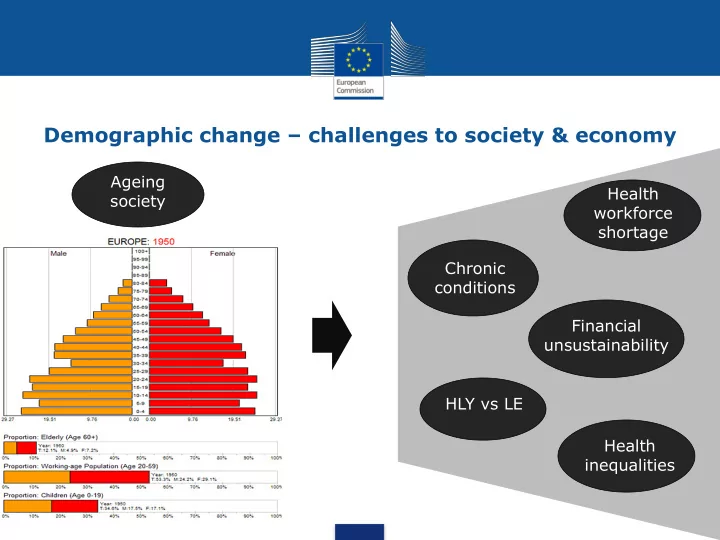
Demographic change – challenges to society & economy
Chronic conditions Health workforce shortage Financial unsustainability Health inequalities HLY vs LE Ageing society
Demographic change challenges to society & economy Ageing - - PowerPoint PPT Presentation
Demographic change challenges to society & economy Ageing Health society workforce shortage Chronic conditions Financial unsustainability HLY vs LE Health inequalities EPIDEMIOLOGIC TRANSITION DEMOGRAPHIC TRANSITION 400
Chronic conditions Health workforce shortage Financial unsustainability Health inequalities HLY vs LE Ageing society
DEMOGRAPHIC TRANSITION 50 100 150 200 250 300 350 400
1900 1920 1950
Cancer Tuberculosis Disentería Neumonía
20 40 1950 1960 1975 1995
ACVA Mortalidad no CV
EPIDEMIOLOGIC TRANSITION When the facts change, I change
my mind. What do you do, sir? John Maynard Keynes
I have been vaccinated against polio and mumps. I have been vaccinated against chicken pox, whooping cough and measles. Then I fell down the stairs. Charlie Brown - Charles M. Schulz
Life-course Determinants: Biological (including genetic) Psychological Social, Societal Environment Chronic Disease Decline in physiologic reserve Adverse outcomes
Candidate markers
REVERSIBILITY
FRAILTY
APPROPRIATE TIME
Robust Frail Functional Limitation Disability Dependency Definition Interventions to improve quality and outcomes - and prevent or delay further functional decline
What How Where
What How Where
What How Where
What How Where
What How Where
Potential reversibility of functional decline
Preventing frailty Preventing Disability Treating Frailty
CARE FOCUSED ON
Preventing Disabilty Treating Functional Decline Preventing Dependency Treating Disability Managing Dependency
B) Frailty phenotype A) Deficit accumulation
Rockwood K. J Am Geriat Soc. 2006;54:975-979 Fried et al. J Gerontol Med Sci. 2001;56A:M146-M156
Rodriguez-Mañas L & Walston JD Rev Esp Geriatr Gerontol 2017
The functional continuum ROBUSTNESS LOW FUNCTIONAL RESERVE DISABILITY-DEPENDENCY SEVERE DEPENDENCY DEATH Isolated Physiological Vulnerability MULTYSYSTEMIC IMPAIRMENT Multiple Non-reversible conditions
CURRENT TOOLS: DICHOTOMIC (FRAIL vs NON-FRAIL)
IS IT POSSIBLE TO DESIGN SUCH A FLOWCHART FOR FRAILTY
AT RISK NO YE S SCREENING PROGNOSIS TREATMENT DIAGNOSIS NO YE S NO YE S
Yes Is it necessary to modulate the prevention strategy according to the level of frailty? How should it be modulated Clinical Phenotypes By severity By comorbidity By setting With which approaches Improving diet Physical exercise Managing cardiovascular risk Others INTUITIVE NOT EVIDENCE-BASED GREAT OPPORTUNITIES FOR RESEARCH
OBSERVATIONAL STUDIES
Key Action Areas
Alignment of Health Systems Provision of LTC Age-friendly environment Improve measuring, monitori and understanding
PRIMARY COMMUNITY CARE HOSPITAL CARE SOCIAL SERVICES GERIATRICS DEPARTMENT OTHER HOSPITAL-BASED DEPARTMENTS
Patient-centred management
ACU: Acue Care Unit ; FRPAC: Functional Recovery Post-Acute Care; FOU: Falls and Orthogeriatric Unit; GDH: Geriatric Day Hospital; LT: Liaision Team; OC: Outpatien Clinic; CCU: Community Care Unit
COORDINATION COORDINATION COORDINATION INTEGRATED CARE CONTINUED CARE
Frailty is a public health problem and societal challenge in Europe that can be prevented & will benefit from a European approach Work will consider:
projects
Conclusions
report Work should be progress from:
Frailty
Building a European approach to tackle frailty at national level
The EC supports MS to work on a EU policy to prevent frailty
structures/plans
to change "Frailty prevention approach" at EU level
1. To promote important sustainable changes in the
implementation of care in the Health and Social Systems; 2. To prepare a common European framework on screening, early diagnosis, prevention, assessment and management of frailty; 3. To develop a common strategy on frailty prevention and management, including raising awareness and advocacy among stakeholders, especially policy and decision makers.
ADVANTAGE JA aims at building a common understanding on frailty to be used in all the Member States, by policy makers and other stakeholders, which should be the base for a common management both at individual and population level of older people who are frail
throughout the European Union.
A SPECIFIC MS PERSPECTIVE which will be aligned with the European one, but implemented according to the local capability and context.
Phase I (2017) - State of the Art - background information collection, analysis and rational discussion and drafting of preliminary documents. Phase II (2018) - developing and testing the draft version of the common European model to approach frailty (frailty prevention approach – FPA document). Phase III (2019) - drafting final documents, debating these with participant MSs, and drafting the final framework, the FPA document and policy recommendations.
STATE OF THE ART STATUS OF MS MS PRIORITIES ROAD-MAP DRAFTS CONSULTATION FINAL ROAD-MAPS
EAB and SC meeting Mahon, Spain, September 2017
BREAKING THE INERTIA CURE DISEASE SURVIVAL TO DO LONG-TERM REACT EPISODES CARE FUNCTION QUALITY OF LIFE RISK TO BENEFIT RATIO TIMELY INTERVENTIONS PREVENT INTEGRATED/CONTINUED
Rodriguez-Mañas et al., JAMDA 2017 Rodriguez-Mañas et al, ADVANTAGE proposal, 2016