Delivering Last Mile Solutions: A feasibility study on microhubs and - - PowerPoint PPT Presentation

delivering last mile solutions
SMART_READER_LITE
LIVE PREVIEW

Delivering Last Mile Solutions: A feasibility study on microhubs and - - PowerPoint PPT Presentation

Delivering Last Mile Solutions: A feasibility study on microhubs and cyclelogistics in the GTHA Carolyn Kim and Janelle Lee Transportation and Urban Solutions, Pembina Institute 1 July 30, 2019 The Pembina Institute The Pembina Institute is a


slide-1
SLIDE 1

Delivering Last Mile Solutions:

A feasibility study on microhubs and cyclelogistics in the GTHA

1
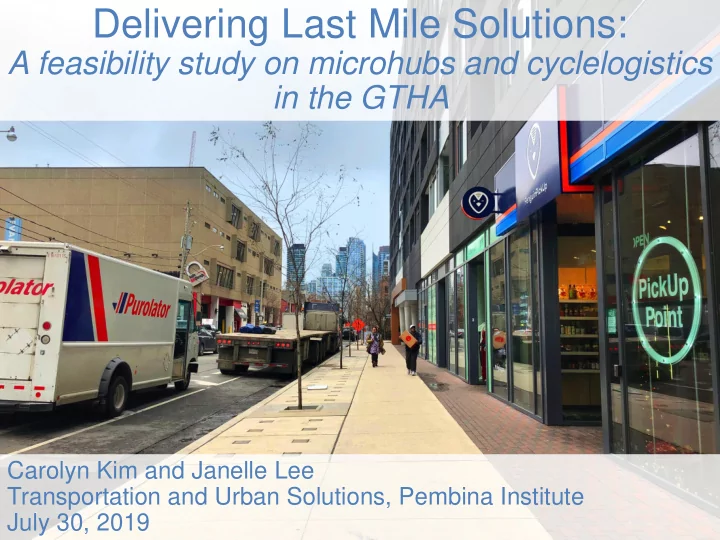
Carolyn Kim and Janelle Lee Transportation and Urban Solutions, Pembina Institute July 30, 2019

slide-2
SLIDE 2

2

The Pembina Institute

The Pembina Institute is a non-profit think-tank that advocates for strong, effective policies to support Canada's clean-energy transition.

slide-3
SLIDE 3

Our freight program

Support the freight industry and governments in achieving a deep decarbonization of freight while remaining profitable and building better communities

3

slide-4
SLIDE 4

Thanks to our generous supporters

slide-5
SLIDE 5

5

Presentation Outline

Urban freight challenges

Research objectives and approach

Key findings

Recommendations for action

slide-6
SLIDE 6

Today’s presentation

6

https://www.pembina.org/pub/delivering-last-mile-solutions

slide-7
SLIDE 7

7

  • E-commerce, changing

consumer preferences

  • Increased congestion,

curbside conflicts

  • High cost of last-mile

distribution

Urban freight challenges

slide-8
SLIDE 8

Transportation Emissions

8

GHG Emissions in Canada by Economic Sector (2017)

Source: Pembina Institute analysis of data from 2019 NIR

Change in annual passenger and freight GHG emissions in Canada

Source: Pembina Institute analysis of data from Environment and Climate Change Canada

slide-9
SLIDE 9

9

New

  • pportunities to

improve last mile deliveries and save money

  • Micro-consolidation
  • Low- and zero-emission

delivery vehicles

slide-10
SLIDE 10

10

Photo: Janelle Lee. Pembina Institute.

slide-11
SLIDE 11

11

Photo: The Drop. Photo: Steve Russell. Toronto Star. Photo: Not Far From The Tree. Photo: Janelle Lee. Pembina Institute.

slide-12
SLIDE 12

Research Objectives

Examine feasibility of microhubs and cyclelogistics

Identify conditions under which these solutions can be viable and implemented at scale

Recommend actions to support implementation of low-carbon alternative delivery systems

12

slide-13
SLIDE 13

Research Approach

Alternative

Micro-consolidation +

 electric cargo van  large e-assist cargo bike  small e-assist cargo bike

13

Business as usual

Suburban consolidation + package car

slide-14
SLIDE 14

Part 1: Determine candidate microhub locations

Locations are based on the following criteria:

  • Household and employment density
  • Zoning (permitted uses)
  • Road network (not on residential-only streets
  • r highways)

14

slide-15
SLIDE 15

Hamilton

15

slide-16
SLIDE 16

16

Toronto

slide-17
SLIDE 17

17

Business as usual (package car) Microhubs with electric van Microhubs with large cargo bike Microhubs with small cargo bike Higher volume (downtown cargo volumes) Off-peak Off-peak Off-peak Off-peak Normal congestion Normal congestion Normal congestion Normal congestion Higher congestion Higher congestion Higher congestion Higher congestion Lower volume (suburban cargo volumes) Off-peak Off-peak Off-peak Off-peak Normal congestion Normal congestion Normal congestion Normal congestion Higher congestion Higher congestion Higher congestion Higher congestion

Part 2: Compare different delivery scenarios for microhub locations

slide-18
SLIDE 18

For each delivery scenario, determine:

  • VKT
  • Travel time
  • Optimal fleet size

Use these outputs to calculate (for each delivery scenario):

  • Operational costs (labour, fuel

consumption, and fleet maintenance)

  • Emissions

18

slide-19
SLIDE 19

Microhubs and cargo bikes are viable and practical

19

  • Efficient operations
  • High asset utilization
  • Cost effective
  • Lower freight emissions
slide-20
SLIDE 20

Key Findings

20

Total operational time under high congestion, high demand conditions

Compared to business-as-usual operations, microhubs and cargo cycles have the potential to be more efficient.

slide-21
SLIDE 21

Key Findings

21

Number of trips* Optimal fleet size* Routes per vehicle* Higher delivery demand Small e-assist cargo cycle 28 6 4 to 5 Large e-assist cargo cycle 6 6 1 Small electric van 5 5 1 Package car 6 6 1

Compared to business-as-usual operations, microhubs and cargo cycles have the potential to have higher asset utilization.

* Results under high delivery demand conditions. Numbers are the same for each microhub location.

slide-22
SLIDE 22

Key Findings

22

Average scenario costs under high demand conditions

Compared to business-as-usual operations, microhubs and cargo cycles have the potential to be more cost effective.

slide-23
SLIDE 23

Key Findings

23

Compared to business-as-usual operations, microhubs and cargo cycles have the potential to be greener.

Low demand conditions

24

kg CO2/day

High demand conditions

53

kg CO2/day

Average GHG savings

using microhubs and cyclelogistics:

slide-24
SLIDE 24

Conditions for success

Relevance: high current and potential demand

Suitability: favourable service area characteristics

Feasibility: supporting institutional and economic context

From Janjevic et al. (2014)

Weather? Safety?

24

slide-25
SLIDE 25

Turning ideas into action: Industry

Set targets for incorporating low- to zero-emission vehicles in commercial delivery fleets

Pilot cargo cycles/other zero-emission vehicles and microhub operations in areas with high delivery density

Explore the potential of shared microhub space and using pooled

  • rdering to consolidate deliveries

25

slide-26
SLIDE 26

Turning ideas into action: Gov’t

Explore policies and incentives to support establishment of microhubs and uptake of zero- or low-emission delivery vehicles

Harmonize and clarify e-bike/cargo cycle legislation, regulations, and policies

Invest in cycling infrastructure

Develop or modernize land use and transportation plans and strategies

26

slide-27
SLIDE 27

Questions?

Janelle Lee Analyst, Transportation and Urban Solutions janellel@pembina.org