Decomposing road freight energy use in the UK Steve Sorrell ECEEE - - PDF document

decomposing road freight energy use in the uk
SMART_READER_LITE
LIVE PREVIEW

Decomposing road freight energy use in the UK Steve Sorrell ECEEE - - PDF document

Decomposing road freight energy use in the UK Steve Sorrell ECEEE 2009 Summer Study 1-6 June, Cte dAzur, France Sussex Energy Group SPRU - Science and Technology Policy Research Why road freight? Globally, freight transport accounts


slide-1
SLIDE 1

1

Sussex Energy Group SPRU - Science and Technology Policy Research

Decomposing road freight energy use in the UK

Steve Sorrell

ECEEE 2009 Summer Study 1-6 June, Côte d’Azur, France

Sussex Energy Group SPRU - Science and Technology Policy Research

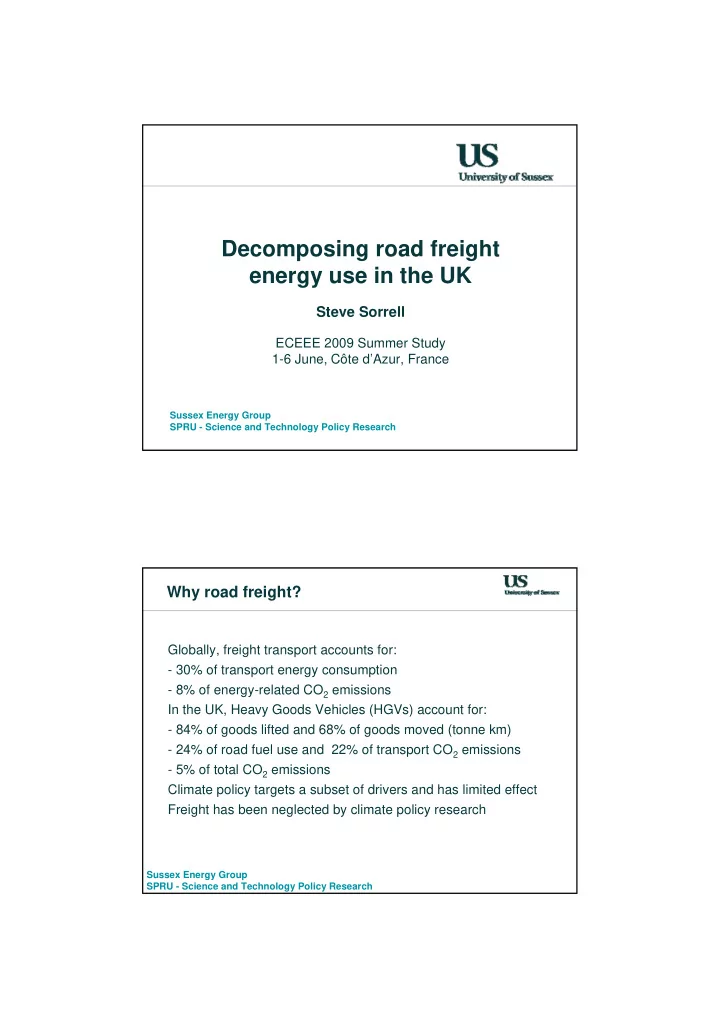
Why road freight?

Globally, freight transport accounts for:

  • 30% of transport energy consumption
  • 8% of energy-related CO2 emissions

In the UK, Heavy Goods Vehicles (HGVs) account for:

  • 84% of goods lifted and 68% of goods moved (tonne km)
  • 24% of road fuel use and 22% of transport CO2 emissions
  • 5% of total CO2 emissions

Climate policy targets a subset of drivers and has limited effect Freight has been neglected by climate policy research

slide-2
SLIDE 2

2

Sussex Energy Group SPRU - Science and Technology Policy Research

Decoupling of UK road freight energy use

60.00 70.00 80.00 90.00 100.00 110.00 120.00 130.00 140.00 150.00 1989 1990 1991 1992 1993 1994 1995 1996 1997 1998 1999 2000 2001 2002 2003 2004 Year Index GDPt FUELt

Sussex Energy Group SPRU - Science and Technology Policy Research

Decoupling of road tonnes lifted

60.00 70.00 80.00 90.00 100.00 110.00 120.00 130.00 140.00 150.00 1 9 8 9 1 9 9 1 9 9 1 1 9 9 2 1 9 9 3 1 9 9 4 1 9 9 5 1 9 9 6 1 9 9 7 1 9 9 8 1 9 9 9 2 2 1 2 2 2 3 2 4 Index GDPt TLIFTt

slide-3
SLIDE 3

3

Sussex Energy Group SPRU - Science and Technology Policy Research

Decoupling of road tonne kilometres

60.00 70.00 80.00 90.00 100.00 110.00 120.00 130.00 140.00 150.00 1 9 8 9 1 9 9 1 9 9 1 1 9 9 2 1 9 9 3 1 9 9 4 1 9 9 5 1 9 9 6 1 9 9 7 1 9 9 8 1 9 9 9 2 2 1 2 2 2 3 2 4 Index GDPt TLIFTt TKMt Sussex Energy Group SPRU - Science and Technology Policy Research

Decoupling of loaded vehicle kilometres

60.00 70.00 80.00 90.00 100.00 110.00 120.00 130.00 140.00 150.00 1 9 8 9 1 9 9 1 9 9 1 1 9 9 2 1 9 9 3 1 9 9 4 1 9 9 5 1 9 9 6 1 9 9 7 1 9 9 8 1 9 9 9 2 2 1 2 2 2 3 2 4 Index GDPt TLIFTt TKMt VKMt

slide-4
SLIDE 4

4

Sussex Energy Group SPRU - Science and Technology Policy Research

Decoupling of total vehicle kilometres

60.00 70.00 80.00 90.00 100.00 110.00 120.00 130.00 140.00 150.00 1 9 8 9 1 9 9 1 9 9 1 1 9 9 2 1 9 9 3 1 9 9 4 1 9 9 5 1 9 9 6 1 9 9 7 1 9 9 8 1 9 9 9 2 2 1 2 2 2 3 2 4 Index GDPt TLIFTt TKMt VKMt VKMTt Sussex Energy Group SPRU - Science and Technology Policy Research

Decoupling – all measures

60.00 70.00 80.00 90.00 100.00 110.00 120.00 130.00 140.00 150.00 1989 1990 1991 1992 1993 1994 1995 1996 1997 1998 1999 2000 2001 2002 2003 2004 Index GDPt TLIFTt TKMt VKMt VKMTt FUELt

slide-5
SLIDE 5

5

Sussex Energy Group SPRU - Science and Technology Policy Research

The importance of foreign-registered HGVs

100000 110000 120000 130000 140000 150000 160000 170000 180000 1 9 8 9 1 9 9 1 1 9 9 3 1 9 9 5 1 9 9 7 1 9 9 9 2 1 2 3 Million tonne km GB registered HGVs in GB All HGVs in UK

Sussex Energy Group SPRU - Science and Technology Policy Research

  • Express energy use as the product of a number of variables

that can be expressed as ratios, e.g.

  • Road share: ratio of road tonnes lifted to total tonnes lifted
  • Length of haul: ratio of road tonne kilometres to road tonnes lifted
  • Break these down by subcategory
  • e.g. commodity type and vehicle type
  • Estimate the contribution of each key ratio to the overall

change in energy consumption (ceteris paribus interpretation)

  • Can decompose both overall change and the change for each

subcategory

What is decomposition analysis?

slide-6
SLIDE 6

6

Sussex Energy Group SPRU - Science and Technology Policy Research

  • Decompose UK road freight fuel consumption over the

period 1989-2004 using ten key ratios (X) plus GDP

  • Three key ratios for the supply of goods
  • One key ratio for the freight intensity of goods (value to

weight)

  • Six key ratios for the transport of goods
  • Further broken down into:
  • 15 commodity types
  • 6 vehicle types
  • Data intensive, but allows fine-grained analysis

Decomposition analysis of UK road freight

Sussex Energy Group SPRU - Science and Technology Policy Research

Supply key ratios

  • Domestic manufacturing share: ratio of value of

UK manufacturing to GDP

  • Commodity share: ratio of value of UK

production of a commodity to total value of UK manufacturing

  • Import share: ratio of supply of a commodity to

UK production of that commodity

slide-7
SLIDE 7

7

Sussex Energy Group SPRU - Science and Technology Policy Research

  • Freight intensity: ratio of total tonnes lifted to value of UK

supply

  • Could be further decomposed into the product of:
  • Value density: ratio of value to weight
  • Handling factor: ratio of tonnes lifted to tonnes

supplied (~number of links in the supply chain)

  • Current data sources do not allow these variables to be

accurately identified

Freight intensity key ratio

Sussex Energy Group SPRU - Science and Technology Policy Research

  • Road share: ratio of road tonnes lifted to total tonnes

lifted

  • Vehicle share: ratio of tonnes lifted by each vehicle type

to road tonnes lifted

  • Length of haul: ratio of tonne kilometres to tonnes lifted
  • Payload weight: ratio of tonne kilometres to vehicle

kilometres

  • Empty running: ratio of total vehicle kilometres to loaded

vehicle kilometres

  • Energy intensity: ratio of fuel consumption to total vehicle

kilometres

Transport key ratios

slide-8
SLIDE 8

8

Sussex Energy Group SPRU - Science and Technology Policy Research

Manufacturing share

MANSHAREt 0.00 0.10 0.20 0.30 0.40 0.50 0.60 0.70 1 9 8 9 1 9 9 1 9 9 1 1 9 9 2 1 9 9 3 1 9 9 4 1 9 9 5 1 9 9 6 1 9 9 7 1 9 9 8 1 9 9 9 2 2 1 2 2 2 3 2 4 Proportion

Sussex Energy Group SPRU - Science and Technology Policy Research

Road share

ROADt

0.740 0.750 0.760 0.770 0.780 0.790 0.800 0.810 0.820 1 9 8 9 1 9 9 1 9 9 1 1 9 9 2 1 9 9 3 1 9 9 4 1 9 9 5 1 9 9 6 1 9 9 7 1 9 9 8 1 9 9 9 2 2 1 2 2 2 3 2 4 Proportion

slide-9
SLIDE 9

9

Sussex Energy Group SPRU - Science and Technology Policy Research

Vehicle share

VSIZEkt 0.0 0.1 0.2 0.3 0.4 0.5 0.6 1 9 8 9 1 9 9 1 9 9 1 1 9 9 2 1 9 9 3 1 9 9 4 1 9 9 5 1 9 9 6 1 9 9 7 1 9 9 8 1 9 9 9 2 2 1 2 2 2 3 2 4 Proportion Rigids (3.5-7.5) Rigids (7.5-17) Rigids (17-25) Rigids (>25) Artics (3.5-33) Artics (>33)

Sussex Energy Group SPRU - Science and Technology Policy Research

Length of haul

LOHt

40 50 60 70 80 90 100 1 9 8 9 1 9 9 1 9 9 1 1 9 9 2 1 9 9 3 1 9 9 4 1 9 9 5 1 9 9 6 1 9 9 7 1 9 9 8 1 9 9 9 2 2 1 2 2 2 3 2 4 Km

slide-10
SLIDE 10

10

Sussex Energy Group SPRU - Science and Technology Policy Research

Length of haul by vehicle type

0.0 100.0 200.0 300.0 400.0 500.0 600.0 1989 1990 1991 1992 1993 1994 1995 1996 1997 1998 1999 2000 2001 2002 2003 2004 km Rigids (3.5-7.5) Rigids (7.5-17) Rigids (17-25) Rigids (>25) Artics (3.5-33) Artics (>33)

Sussex Energy Group SPRU - Science and Technology Policy Research

Empty running

ERUNt 1.30 1.32 1.34 1.36 1.38 1.40 1.42 1.44 1.46 1 9 8 9 1 9 9 1 9 9 1 1 9 9 2 1 9 9 3 1 9 9 4 1 9 9 5 1 9 9 6 1 9 9 7 1 9 9 8 1 9 9 9 2 2 1 2 2 2 3 2 4 Ratio

slide-11
SLIDE 11

11

Sussex Energy Group SPRU - Science and Technology Policy Research

Energy intensity by vehicle type

EINTkt Index 60 70 80 90 100 110 120 130 1 9 8 9 1 9 9 1 9 9 1 1 9 9 2 1 9 9 3 1 9 9 4 1 9 9 5 1 9 9 6 1 9 9 7 1 9 9 8 1 9 9 9 2 2 1 2 2 2 3 2 4 Index (1989=100) Rigids (3.5-7.5) Rigids (7.5-17) Rigids (17-25) Rigids (>25) Artics (3.5-33) Artics (>33)

Sussex Energy Group SPRU - Science and Technology Policy Research

  • Supply key ratios:
  • 2.1%
  • Substantial GDP growth offset by declining importance
  • f manufacturing
  • Freight key ratios:

+18.8%

  • Increased handling factors and/or falling value

densities

  • Transport key ratios:
  • 8.6%
  • Mix of factors contributing to net reduction in energy

intensity

  • Net effect:

+6.3%

  • Overall increase in energy consumption

Aggregate results – 1999-2004

slide-12
SLIDE 12

12

Sussex Energy Group SPRU - Science and Technology Policy Research

Aggregate results – time series

  • 1500
  • 1000
  • 500

500 1000 1500 2000 1989 1990 1991 1992 1993 1994 1995 1996 1997 1998 1999 2000 2001 2002 2003 2004 Year Million litres Supply Freight intensity Transport

Sussex Energy Group SPRU - Science and Technology Policy Research

  • GDP:

+43.3%

  • Higher incomes increasing demand for goods
  • Payload weight:

+26.1%

  • Falling load factors for each category of vehicle
  • Freight intensity:

+18.8%

  • Increased handling factors and/or falling value densities
  • Import share:

+9.8%

  • More goods being imported
  • Commodity share:

+2.8%

  • shift towards producing commodities that use more energy in

transport

  • Road share:

+0.8%

  • Modal shift towards road freight

Key ratios increasing fuel consumption

slide-13
SLIDE 13

13

Sussex Energy Group SPRU - Science and Technology Policy Research

  • Domestic manufacturing share:
  • 38.1%
  • manufacturing contributing less to UK GDP
  • Energy intensity:
  • 8.6%
  • Improvements in the fuel efficiency of vehicles
  • Empty running:
  • 14.1%
  • Greater use of backhauling
  • Vehicle share:
  • 7.0%
  • shift towards larger vehicles
  • Length of haul:
  • 1.6%
  • reductions in the average length of haul for energy

intensive commodities/vehicles

Key ratios reducing fuel consumption

Sussex Energy Group SPRU - Science and Technology Policy Research

Detailed results – time series

  • 3000.0
  • 2000.0
  • 1000.0

0.0 1000.0 2000.0 3000.0 1 9 8 9 1 9 9 1 1 9 9 3 1 9 9 5 1 9 9 7 1 9 9 9 2 1 2 3 Year Million litres GDP MANFRAC CSHARE FINT ROAD VSIZE LOH ILF ERUN EINT

slide-14
SLIDE 14

14

Sussex Energy Group SPRU - Science and Technology Policy Research

  • Trends are unsustainable because:
  • Only relative decoupling and less than official statistics suggest
  • Decline of domestic manufacturing displacing emissions overseas
  • Reduced empty running and trend towards larger trucks

have significantly lowered energy intensity

  • Reasons for increase in freight intensity are unclear
  • Considerable variation between sectors (e.g. high in food and drink)
  • Decomposition analysis provides useful insights
  • For example, key ratios that have increased in the aggregate have

reduced energy consumption

  • But difficulties in accounting for endogenous variables and numerous

gaps/inaccuracies in the data sources

Concluding observations

Sussex Energy Group SPRU - Science and Technology Policy Research

  • Potential for further improvements in empty running, fuel

efficiency and (especially) vehicle load factors

  • Limited opportunities for modal shifts
  • Spatial concentration and supply chain extension may be

reaching limits within UK, but

  • continuing regional/global trend to longer supply chains
  • reversal requires restructuring of economic activity
  • Transport costs form small share of total costs for most

products, so freight activity unresponsive to price incentives

Policy issues

slide-15
SLIDE 15

15

Sussex Energy Group SPRU - Science and Technology Policy Research

Annex – Illustration of decomposition

E = Energy use A = value of goods L = goods lifted c = commodity Sct = share of commodity c in total value of goods Fct = ‘freight intensity’ of c

Ict = Energy intensity of commodity c

DX = ratio of energy consumption in year t to that in year 1 that results from the change in the ‘key ratio’ X over this period (~ceteris paribus). If DX<1.0, then X has reduced fuel consumption

∑ ∑ ∑

= = =

c c c c c c c c c c c c

I F AS L E A L A A A E E

I F S A t E

D D D D E E D = =

1