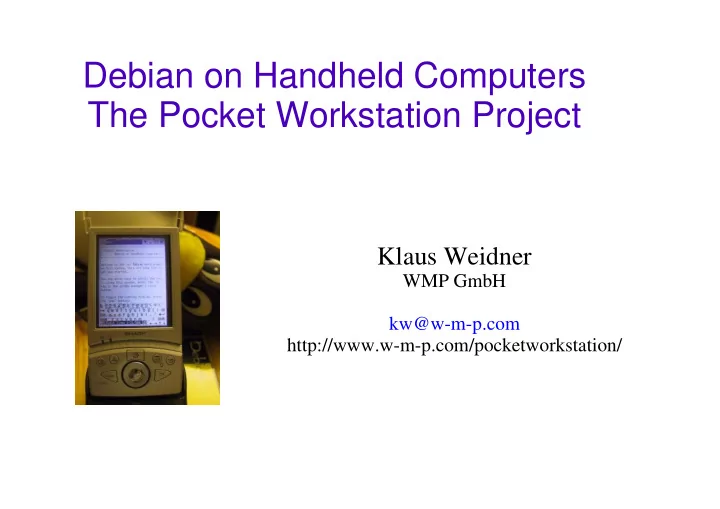
Debian on Handheld Computers The Pocket Workstation Project Klaus - - PowerPoint PPT Presentation

debian on handheld computers the pocket workstation
SMART_READER_LITE
LIVE PREVIEW

Debian on Handheld Computers The Pocket Workstation Project Klaus - - PowerPoint PPT Presentation

Debian on Handheld Computers The Pocket Workstation Project Klaus Weidner WMP GmbH kw@w-m-p.com http://www.w-m-p.com/pocketworkstation/ Contents Status of the project Why?? Limitations of the platform


slide-1
SLIDE 1

Debian on Handheld Computers The Pocket Workstation Project

Klaus Weidner

WMP GmbH kw@w-m-p.com http://www.w-m-p.com/pocketworkstation/

slide-2
SLIDE 2

Contents

  • Status of the project
  • Why??
  • Limitations of the platform
  • Bootstrapping Debian
  • Choosing the applications
  • Design Decisions
  • The next-generation handhelds
  • Where to go from here
slide-3
SLIDE 3

Introduction

  • The goal of the project: running a full Debian

environment on a handheld computer

  • Supported platforms:
  • Sharp Zaurus 5x00 and SL-C7x0
  • HP/Compaq iPAQ handhelds
  • WARNING: inflammatory subjects ahead –

this is all from a very subjective point of view, and many other solutions are possible

slide-4
SLIDE 4

Why??

  • Handheld environment should resemble desktop

OS

  • My first handheld:

The dos-based HP 200LX

  • Large selection of programs available
  • not limited to those designed for handheld
  • Why Debian?
  • Huge archive of pre-compiled software for ARM
  • Excellent package management
  • Is it something for everyone – not really...
slide-5
SLIDE 5

Current status

  • Requires SD/MMC card
  • at least 128 MB storage
  • chroot / pivot-root
  • Uses Xvnc / fbvnc client
  • native X (TinyX) optional
  • Most Debian apps work
  • Problems
  • resource limitations
  • ported apps not working
slide-6
SLIDE 6

Limitations of the platform

  • Low screen resolution
  • 240x320 not sufficient for 80-column text
  • most apps work better on landscape display
  • Keyboard missing or incomplete
  • Touch screen as primary input
  • One button mouse only
  • Hard to do drags or complex maneuvers
slide-7
SLIDE 7

Solved limitations

  • Disk space
  • SD/MMC cards available up to 512 MB (but

expensive)

  • Main memory
  • current models have 64 MB RAM (but no swap

space)

  • CPU speed
  • StrongARM CPUs fast enough for most apps

(but no FPU)

slide-8
SLIDE 8

Handheld Zoology

  • No expansion slots at all
  • All apps and data must fit in limited flash ROM

(16 – 32 MB)

  • Example: original Compaq iPAQ 3630
  • One expansion slot only
  • can't use network and storage card together
  • Two expansion slots or built-in networking
  • One slot (MMC/SD or CF) can be dedicated to

storage

  • Example: Sharp Zaurus, new HP iPAQs
slide-9
SLIDE 9

Target platform for Debian port

  • Sufficient storage capacity is available
  • at least 128 MB SD/MMC card
  • Separate networking capability
  • free CF slot for expansion cards
  • builtin WiFi / Bluetooth
  • Infrared, serial, USB networking
slide-10
SLIDE 10

Bootstrapping Debian

  • Goal: get apt-get working
  • Starting point: a working Linux system
  • can be minimal, not many tools needed
  • not usable for WinCE-only handhelds
  • Option A: use debootstrap
  • ... but I didn't know about that at the time
  • Option B: reinvent the wheel
  • shell script using sed and grep to solve

dependencies

slide-11
SLIDE 11

Bootstrapping continued

  • Use a chroot environment for the Debian FS
  • avoid conflicts with native Linux system
  • Run Debian inside chroot
  • hardware independent, uses drivers of native OS
  • can be annoying to use
  • wasted resources (two copies of C library)
  • Dual-boot using pivot_root
  • needs more configuration work to support

hardware

slide-12
SLIDE 12

Choosing applications

# apt-get install galeon Reading Package Lists... Done Building Dependency Tree... Done The following NEW packages will be installed: docbook-xml esound-common galeon galeon-common gconf gdk-imlib1 gnome-bin gnome-libs-data gnome-mime-data libart2 libaudiofile0 libcdparanoia0 libesd0 libgconf11 libglade-gnome0 libglade0 libgnome-vfs-common libgnome-vfs0 libgnome32 libgnomesupport0 libgnomeui32 libgnorba27 libgnorbagtk0 libnspr4 liboaf0 liborbit0 libscrollkeeper0 libxml1 libxml2 libxslt1 mozilla-browser oaf scrollkeeper sgml-base sgml-data 0 packages upgraded, 35 newly installed, 0 to remove and 163 not upgraded. Need to get 17.1MB of archives. After unpacking 51.3MB will be used. # apt-get install konqueror Reading Package Lists... Done Building Dependency Tree... Done The following NEW packages will be installed: gcc-3.3-base kdebase-libs kdelibs3 kdelibs3-bin konqueror lesstif1 libdb4.1 libfam0c102 libkonq3 liblcms libmng1 libpcre3 libqt2 libssl0.9.7 libstdc++5 libxml2 libxslt1 python python2.2 0 packages upgraded, 19 newly installed, 0 to remove and 163 not upgraded. Need to get 17.6MB of archives. After unpacking 56.7MB will be used.

slide-13
SLIDE 13

Web browser: links -g

  • built-in anti-aliased

fonts

  • some JavaScript

support

  • handles SSL, tables,

frames, downloads

  • bookmark

management

slide-14
SLIDE 14

Web browser: dillo

  • key features missing
  • SSL
  • file download
  • Advantage: being

able to read the text

  • n web pages
  • limit text line length

to display width when reformatting paragraphs

slide-15
SLIDE 15

Design decisions

  • What to do if the application requirements and

the platform's features don't match?

  • The Procrustes method
  • chop off bits until what's left fits the space available
  • painful for developers and users
  • The Matrix method
  • virtual platform simulates that expected by apps
  • painful for users
slide-16
SLIDE 16

Qtopia, GPE and TinyX

  • What's wrong with this picture?
slide-17
SLIDE 17

The virtual environment

  • Based on VNC client
  • simple thin client
  • virtual display
  • fbvnc client
  • Anti-aliased rescaling

and rotation

  • Virtual keyboard
  • verlay
  • 3 mouse button

emulation

  • fast
slide-18
SLIDE 18

Xvnc configuration

  • Run Xvnc with virtual

screen larger than physical display

  • rotate and resize to fit the

current app on-screen

  • surprisingly fast, but not

suitable for video and games

  • run those on framebuffer

directly

  • use shared memory ?
slide-19
SLIDE 19

More virtual things

  • Virtual Opie
  • Qt Embedded supports VNC server back-end
  • needs to be recompiled to support it
  • run: QWS_DISPLAY=VNC:2 datebook -qws
  • connect VNC client to localhost:2
  • Virtual paper
  • pipe pixmaps to fbvnc client, and display them

using built-in scaling and rotation

  • shell scripts use gs and anytopnm
slide-20
SLIDE 20

Next-generation handhelds

  • Sharp SL-C7x0
  • good keyboard
  • 640x480 landscape display
  • 64 MB RAM on C750 and C760
  • SD/MMC and CF expansion slots
  • IR, serial/USB port, stereo headphone /

microphone connector

  • Yopy, Sony Clie
  • keyboard and screen have wrong orientation
slide-21
SLIDE 21

Where to go from here?

  • PIM applications needed
  • Opie apps don't work well in X11 environment
  • GPE apps missing key features
  • sync with desktop difficult
  • Current favorite: jpilot
  • Enhancements to dpkg and apt
  • space savings (three copies of Packages data?)
  • relocate apps across filesystems (ipkg does this)
slide-22
SLIDE 22

Enhancements cont'd

  • Use standard ways of doing things
  • apm for power management
  • hwclock for real-time clock management
  • OpenZaurus handles much of this
  • should be merged in Debian distribution