SLIDE 2 2/2/2012 2
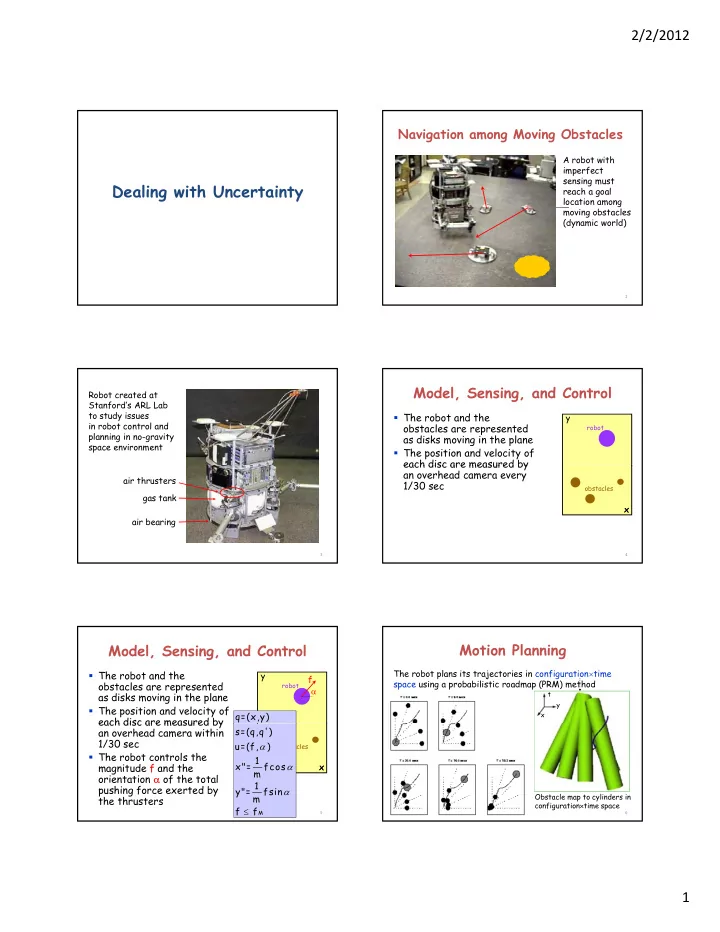
But executing this trajectory is likely to fail ...
1) The measured velocities of the obstacles are inaccurate 2) Tiny particles of dust on the table affect trajectories and contribute further to deviation Obstacles are likely to deviate from their expected trajectories
7
3) Planning takes time, and during this time, obstacles keep moving The computed robot trajectory is not properly synchronized with those of the obstacles The robot may hit an obstacle before reaching its goal [Robot control is not perfect but “good” enough for the task]
But executing this trajectory is likely to fail ...
1) The measured velocities of the obstacles are inaccurate 2) Tiny particles of dust on the table affect trajectories and contribute further to deviation Obstacles are likely to deviate from their expected trajectories
8
3) Planning takes time, and during this time, obstacles are moving The computed robot trajectory is not properly synchronized with those of the obstacles The robot may hit an obstacle before reaching its goal [Robot control is not perfect but “good” enough for the task]
Planning must take both uncertainty in world state and time constraints into account
Dealing with Uncertainty
- The robot can handle uncertainty in an obstacle
position by representing the set of all positions of the
- bstacle that the robot think possible at each time
(belief state)
- For example, this set can be a disc whose radius grows
9
linearly with time
t = 0 t = T t = 2T
Initial set of possible positions Set of possible positions at time 2T Set of possible positions at time T
Dealing with Uncertainty
- The robot can handle uncertainty in an obstacle
position by representing the set of all positions of the
- bstacle that the robot think possible at each time
(belief state)
- For example, this set can be a disc whose radius grows
10
linearly with time
t = 0 t = T t = 2T The robot must plan to be
- utside this disc at time t = T
Dealing with Uncertainty
- The robot can handle uncertainty in an obstacle
position by representing the set of all positions of the
- bstacle that the robot think possible at each time
(belief state)
- For example, this set can be a disc whose radius grows
11
linearly with time
- The forbidden regions in configurationtime space are
cones, instead of cylinders
- The trajectory planning method remains essentially
unchanged
Dealing with Planning Time
- Let t=0 the time when planning starts. A time limit is
given to the planner
- The planner computes the states that will be possible
at t and use them as the possible initial states t 0 t
planning execution
12
n u m p n
- It returns a trajectory at some t , whose execution
will start at t
- Since the PRM planner isn’t absolutely guaranteed to
find a solution within , it computes two trajectories using the same roadmap: one to the goal, the other to any position where the robot will be safe for at least an additional . Since there are usually many such positions, the second trajectory is at least one order
- f magnitude faster to compute